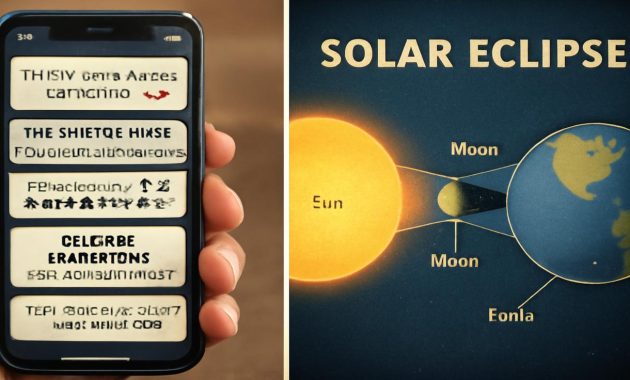
The first thing you notice is the way the light starts to feel wrong.
You’re standing in your backyard, or on a city rooftop, or in the middle of a highway turnout with a hundred strangers in lawn chairs—and something in the air quietly tilts. Shadows sharpen. Colors flatten. Birds pause mid-song. Somewhere a dog that never barks at anything lets out a low, uncertain howl.
Six minutes. That’s all the darkness will last in the path of totality. But online, it feels like we’ve already been living in this eclipse for months.
The Sky Is Falling (According to Your Feed)
Scroll long enough and the eclipse stops being a predictable dance of celestial bodies and becomes something else entirely: omen, portal, prophecy, glitch in the matrix. Everyone has a theory—and a thread, a reel, a stitch, a hot take.
On one video, a woman in a parked car whispers into her camera that “they’re not telling us the truth about what’s going to happen when the sun turns off.” On another, an earnest man in a backyard lab coat draws zigzags on a whiteboard, explaining that overlapping eclipse paths form a cosmic “X” over the continent, proof, he says, of some divine countdown.
In comment sections, people write that they’re buying weeks of food “just in case.” Someone else warns that cellphone towers will go down during totality—that the sudden darkness will mess with the power grid, the satellites, even the bees. There are frantic questions about pets, babies, airplanes, heart monitors, and whether you should stand under a doorway “like for an earthquake, but space.”
There is no shortage of fear; social media makes sure of that. The coming six minutes of darkness, a perfectly ordinary cosmic alignment, has become something far stranger in the collective imagination: a screen onto which we’re projecting our anxieties about everything else.
Why Six Minutes in the Dark Feels So Much Bigger
The truth, of course, is both simpler and weirder. The moon slides in front of the sun. Daylight dims, then vanishes. Temperatures may drop by several degrees. Animals may act like they do at dusk. Streetlights could flicker on. And then, just as slowly, it all comes back.
Six minutes. That’s less time than it takes most of us to cook frozen pizza, doom-scroll through a news feed, or sit through a single unskippable ad block. But those six minutes land in a world that already feels off balance—politically, climatologically, emotionally. So we do what we’ve learned to do: we dramatize, digitize, theorize.
It’s no accident that eclipses invite stories. For millennia they have been treated as cracks in the sky where meaning leaks in. Ancient civilizations told tales of cosmic dragons swallowing the sun, of wolves chasing daylight, of angry gods drawing a curtain over the earth. The fear was visceral. The sun disappears, and with it, the illusion that nature is predictable and tame.
We like to think we outgrew that. We have NASA animations now, precise maps, countdown timers on glossy websites. We can predict eclipses centuries in advance. Yet the emotional imprint of those old stories lingers, quietly rewired into modern superstition: not dragons this time, but government plots, alien arrivals, simulation upgrades, spiritual “resets.”
Technology gives us the coordinates; culture gives us the mood. And right now, the mood is jumpy.
How Algorithms Turn Wonder Into Worry
Fear is sticky. Online, it’s also profitable. Platforms reward what keeps us scrolling, sharing, arguing. A calm explanation of orbital mechanics will never outperform a shaky vertical video captioned “THEY DON’T WANT YOU TO KNOW THIS ABOUT THE ECLIPSE.”
Maybe you watched one clip about eclipse safety—how to protect your eyes, where to find certified viewing glasses. The algorithm takes note. Suddenly your feed is a river of eclipse content: some of it responsible and grounded, much of it not. The louder, stranger posts rise to the top. The ones loaded with all caps, ominous music, and phrases like “wake up, people.”
In that sense, the eclipse is less an apocalyptic event and more a stress test for our attention. It reveals how quickly wonder gets weaponized into worry when it flows through the machinery of social media. A once-in-a-lifetime natural spectacle becomes a canvas for the internet’s favorite feelings: dread, outrage, the thrill of knowing something others don’t.
It’s not that people are foolish for feeling uneasy. Celestial events are disorienting by design. Suddenly the reliable becomes strange. But it’s worth noticing how someone else’s unease becomes your own through repetition—and how the platforms benefiting from your extended screen time are the quiet background characters in this story of “mysterious forces.”
What People Think the Eclipse Will Bring
Every big eclipse comes with its own mythstorm, and this one has been brewing for months. Scroll across platforms and you can sort the fears and fantasies into rough categories, like shelves in a cosmic curiosity shop.
| Eclipse Belief | What Some People Expect | What Science Actually Says |
|---|---|---|
| Technology Meltdown | Cell towers, GPS, planes and the power grid will all fail in the darkness. | No evidence of systemic failures. Systems are built for night, storms, and much worse. |
| Animal Chaos | Wild animals will panic and attack; pets will lose control. | Animals often behave like it’s dusk—birds roost, insects quiet—but widespread chaos is not observed. |
| Human Health Crisis | Spikes in heart attacks, mental breakdowns, or birth defects tied to eclipse energy. | No consistent scientific link. Main real risk: eye damage from staring at the sun without proper filters. |
| Spiritual Reset | A global awakening, timeline shift, or opening of portals. | Meaning is personal. Cosmically, the sun, moon, and Earth are just aligning as they’ve done for eons. |
| Government Cover-Up | Hidden experiments or disasters being masked by eclipse hype. | Eclipses are calculable centuries ahead. No evidence they’re being used as cover for secret events. |
Spend an hour dipping into these beliefs and you’ll notice something: they say as much about our time as they do about the sky. Tech fears reveal how dependent we’ve become on infrastructure we barely understand. Animal panic theories mirror our own low-grade panic. Conspiracy ideas echo a deep distrust of institutions. Spiritual reset narratives hint at how many people quietly wish the world would change in some sudden, clarifying way.
Underneath it all, one emotion runs like a current: the sense that we’re standing on the edge of something, even if we’re not sure what.
The Fine Line Between Awe and Anxiety
Here’s the thing about an eclipse: it is legitimately overwhelming. If you’ve never seen a total one before, your body doesn’t quite know what category to put it in.
As the moon’s shadow approaches, the world doesn’t just get dimmer; it gets strange. The light turns metallic, as if someone swapped the bulb over the entire planet. Shadows go razor-sharp, then dissolve. The temperature drops, enough that you might actually feel goosebumps on your arms. Somewhere in the distance, a chorus of crickets might start up as if evening has arrived several hours early. People often describe an eerie hush falling over crowds, followed by spontaneous cheering or tears when totality hits.
Psychologists have a word for this blend of fear and wonder: awe. It’s that vertigo you feel standing on the edge of the Grand Canyon or looking up at a sky saturated with stars far from city lights. Awe reminds you there are forces, scales, and patterns much bigger than your daily worries. For a moment, your brain lets go of its constant, noisy self-story.
But if you walk into awe already saturated with fear—primed by weeks of content about disaster and doom—that same experience can tilt toward anxiety. The shiver on your arms suddenly feels like a warning. The hush seems like the prelude to something terrible. A perfectly natural event becomes a Rorschach inkblot for whatever you were already afraid of.
This is the quiet damage social media can do: not just convincing you of specific falsehoods, but changing the emotional ground you stand on before reality even arrives.
Getting Ready Without Giving In
None of this means you should ignore the eclipse, shrug it off, or refuse to prepare. Quite the opposite. There’s a real and beautiful preparation to be done—physical, practical, emotional—that has nothing to do with fear.
Start with the simple stuff: if you’re in or near the path of totality, plan your viewing spot in advance. Traffic will be intense in many places; millions of people are chasing that six minutes of shadow. Pack water, snacks, sun protection. Check the weather. Have a backup viewing spot if clouds roll in.
Most importantly: take eye safety seriously. Before and after totality, when any part of the sun’s bright disk is visible, you must use proper eclipse glasses or solar filters that meet established safety standards. Regular sunglasses, stacked sunglasses, exposed film, and improvised filters will not protect your eyes. During the brief window of totality—when the sun is completely covered and only the ghostly corona is visible—it is safe to look directly with naked eyes. As soon as the first bright bead of sunlight appears again, the glasses go back on.
If you have pets, you don’t need to panic. They generally treat the eclipse like an oddly timed dusk. Keep them close if that makes you feel better, but you don’t need special goggles for your dog. The main risk for animals, as for humans, is direct staring at the partially covered sun, which most animals simply don’t do on their own.
Choosing Awe on Purpose
Beyond logistics, there’s a subtler preparation you can make: choosing, in advance, what kind of experience you want this to be.
You might decide to turn the eclipse into an offline ritual. Leave your phone in your pocket for those six minutes, or set it to record on a tripod and forget about it. The photos from your camera won’t rival any professional shots anyway; what will matter later is what it felt like to stand there, not how your screen captured it.
You might watch with kids, narrating what’s happening in simple, concrete language: “Right now, we’re standing in the moon’s shadow. That’s why it got colder. That’s why the birds sound confused. In a few minutes, the shadow will move on.” You could even sketch the sun, moon, and Earth on paper beforehand, so the event in the sky has a map under your fingertips.
Or you might watch alone, using the darkness as a kind of reset button. Not the apocalyptic reset so many posts shout about, but a personal one: six minutes to notice your own smallness in a way that doesn’t erase you, but places you. Six minutes to remember that your life, with all its scrolling and deadlines and side arguments, is unfolding on a rock warmed by a star, momentarily blocked by a neighbor moon.
There’s a quiet courage in choosing wonder over panic when everyone around you is broadcasting fear. It doesn’t mean being naïve. It means noticing that the universe is doing something exquisite and precise overhead—and refusing to let your only experience of it come secondhand through a feed optimized for adrenaline.
After the Shadow Moves On
Here’s what will happen when it’s all over, most likely. The birds will start singing again. Cars will inch their way out of crowded fields, stadiums, parking lots, and hillside turnouts. Traffic will be bad; people will post videos complaining about it. A new wave of content will flood your feed: shaky shots of the corona, emotional reactions, debunkings of the debunkings, hot takes about how overhyped or underrated the whole thing was.
News anchors will call it historic, which is true in the literal sense; this exact eclipse will never happen again. But the sun will come back, dutiful as ever. Your notifications will keep multiplying. The same questions that haunted you the day before—about your job, your relationships, your place in a troubled world—will still be there, waiting.
And yet something will be different, if you let it. Maybe you’ll carry a memory of the way the world inhaled when the light went strange. The strange shimmering ring in the sky. The way strangers in folding chairs briefly became a community, gasping in unison. The animal part of you that tensed, then softened, when the sun returned.
Those impressions have a half-life longer than any viral post. They can alter the way you hold your days, not in a fireworks way but like a subtle shift in gravity. Once you’ve watched the sky vanish and reappear, it becomes harder to pretend that your screen is the biggest thing in your life.
Social media is already scripting one version of this eclipse: the anxious one, the conspiratorial one, the countdown-to-something-dark one. But when the moment actually arrives, it will be just you, the sky, and the shadow sweeping past—a reminder that most of what is vast and real happens whether or not we’re filming it, whether or not we understand it, and certainly whether or not we’re afraid of it.
Six minutes of darkness. That’s all. Enough time to feel a chill, to hold your breath, to reach for someone’s hand. Enough time to decide which story you want to tell yourself about what it meant.
FAQs About the Eclipse, the Darkness, and the Fears Around It
Will the eclipse really cause power outages or internet failure?
There is no evidence that a solar eclipse causes widespread failures in the power grid, internet, or cell networks. These systems are designed to work in full night, storms, and solar cycles far more dramatic than a few minutes of darkness. Local congestion may slow networks because so many people are posting and streaming, but that’s a usage issue, not a cosmic one.
Is it dangerous to be outside during the eclipse?
No. Being outside during an eclipse is not dangerous in itself. The primary risk is eye damage from looking at the bright, partially covered sun without proper protection. As long as you follow eye safety guidelines and use certified solar filters or eclipse glasses, it’s safe to be outdoors watching.
Do animals really freak out during an eclipse?
Most animals respond as if evening has arrived unexpectedly. Birds may roost, insects may quiet, nighttime species might stir. Some pets might act a bit confused or clingy because the light and temperature change suddenly. Widespread panic or aggression among animals has not been observed in a consistent way during eclipses.
Can the eclipse affect my mental or physical health?
For most people, an eclipse is emotionally intense but not harmful. Some may feel anxiety, especially if they’ve been exposed to alarming content online. There is no solid scientific evidence that eclipses cause spikes in mental illness, heart attacks, or birth defects. If you’re already feeling anxious, it might help to reduce social media exposure and ground yourself in reliable information beforehand.
Why are people talking about portals, timelines, or apocalyptic signs?
Throughout history, rare sky events have been interpreted as signs of change, divine messages, or omens. In our time, those impulses appear in the language of portals, timelines, and apocalyptic scenarios. These stories express our hopes and fears more than they describe the physics of the event. From a scientific perspective, the eclipse is simply the predictable alignment of the sun, moon, and Earth.
How can I prepare without getting caught up in fear?
Focus on practical steps and personal intention. Get safe viewing equipment, plan your location and timing, pack essentials, and decide in advance how you want to experience the moment: with family, in a crowd, or quietly alone. Consider limiting your intake of sensational content and instead learning about the science and history of eclipses from trusted educational sources.
What’s the most important thing to remember on eclipse day?
Remember that this is a rare chance to feel small in the best possible way. The eclipse is not a test of who knew the most secret information or who was most prepared for disaster. It’s an invitation—to step out from behind your screen, stand under a briefly altered sky, and let the universe rearrange your sense of scale for a few unforgettable minutes.