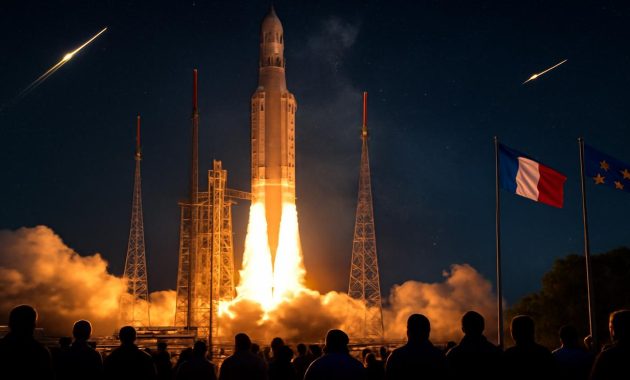
The sound that wakes you is not the trill of birds or the hum of traffic. It’s a deep, rising roar, a vibration that moves through your chest before your ears quite catch up. You’re standing on a scrubby stretch of tropical coastline in French Guiana, the air thick with salt and the smell of wet vegetation. Above the mangroves, beneath a sky turning from indigo to pale violet, a column of fire punches through a low veil of clouds. An Ariane rocket is leaving Earth, and for a breathless moment it feels like France still owns a piece of the sky.
The Quiet Anxiety Beneath the Tropical Thunder
This is Europe’s spaceport—France’s spaceport—carved from rainforest and Atlantic breeze, the launch ramp of a middle-sized country with oversized space dreams. For decades, the Centre Spatial Guyanais at Kourou has been the gateway through which Europe, led largely by French know-how and French funding, slipped its satellites into orbit.
But stand there long enough, watching the exhaust plume dwindle to a speck, and another sound creeps in: the low murmur of doubt. Because while this Ariane launch still feels momentous, the world beyond this humid coastline has changed with disorienting speed.
On the Atlantic’s far shore, SpaceX is hurling up rockets as regularly as flights leaving a busy airport, their boosters returning to land with acrobatic precision. Farther east, China is unfurling a methodical, state-powered expansion into every orbit that matters, building its own stations, its own GPS, its own lunar ambitions. In this new orbital order, the question hangs heavy in the Guianan air: can France still hold its ground in space—or is it slowly becoming a spectator on a stage it helped build?
How France Carved Out Its Own Slice of the Cosmos
To understand what’s at stake, you have to go back to a very different era—one of Gauloises smoke, de Gaulle speeches, and grainy black-and-white footage of rockets on concrete pads. In 1965, France became the third country in the world—after the Soviet Union and the United States—to put its own satellite into orbit, using its own rocket, from its own launch site.
It was an audacious move for a nation that had just staggered out of colonial conflicts and was still rebuilding from war. But de Gaulle saw space as the new dimension of sovereignty: the idea that a modern power needed independent access to orbit the way it once needed battleships and deepwater ports. Communications, reconnaissance, prestige, deterrence—space, in his eyes, was a pillar of independence from both Washington and Moscow.
From that seed grew a sprawling architecture of institutions: CNES, the French space agency. The Ariane family of rockets, developed with European partners but decisively pushed—and paid for—by France. The Kourou launch site, conveniently close to the equator, offering an extra slingshot of Earth’s rotation and spare coastline for debris to fall.
For years, this model flourished. Ariane became the reliable workhorse of commercial satellite operators. Telecom constellations, TV broadcasters, weather satellites: many trusted their multi-million-euro payloads to the quiet, methodical rhythms of European launch campaigns from French Guiana. France wasn’t just a customer of space. It was one of its landlords.
The Ground Shifts Under the Launch Pad
Then, on the shores of another ocean, a different idea of space took shape. It didn’t smell like kerosene and bureaucratic patience; it smelled like tech campuses, venture capital, and an almost reckless engineering bravado. SpaceX began as an upstart, laughed at in the backrooms of agencies and defense ministries. Rockets weren’t websites, older engineers insisted. You couldn’t just “move fast and break things” when launches exploded in the sky and rained metal.
Except SpaceX did move fast, and it did break things, and with unnerving regularity it managed to fix them. Reusability—once dismissed as impractical—became a routine spectacle: first stages flipping and landing on drone ships. Launch prices began to slide. Cadence climbed. The global commercial launch market, once relatively sedate, started to look like a tech sector: disrupted, squeezed, reassessed.
At the same time, in a very different political and cultural ecosystem, China was carrying out another kind of revolution. Backed by the full weight of a one-party state that sees space as both strategic high ground and a symbol of national destiny, China built its own space station, sent probes to the far side of the Moon, and deployed its own satellite constellations. It stitched together launch centers, rocket families, and a growing ecosystem of quasi-private space companies that blur the line between entrepreneurship and state direction.
For France, and for Europe, the ground shifted subtly, then all at once. The launch market that Ariane had dominated was no longer a steady, predictable field; it was an arena, and the new contenders were playing by very different rules.
What “Space Sovereignty” Really Means in 2026
The phrase sounds abstract—“space sovereignty”—as if it belongs in white papers and closed-door policy meetings. But in practice, it’s a very concrete anxiety: can a country still decide for itself what it does in orbit, or must it always ask for a ride, a service, a permission slip from someone else?
Space sovereignty, in France’s case, lives in three main layers:
- Launch capability: the ability to put payloads into orbit with national or allied rockets, on national or jointly controlled soil.
- Critical satellites: secure, often military or dual-use systems for communications, intelligence, navigation, and early warning.
- Industrial and technological base: the people, factories, and research networks that can design, build, and upgrade space systems without deadly dependencies on rivals.
If you lose any one of these pillars for too long, your sovereignty in space tilts. If you lose two, it crumbles. For years, France could lean on all three, plus the multiplier effect of Europe: Germany’s precision engineering, Italy’s robotics, Spanish and Scandinavian instruments, all layered atop a largely French launch spine.
But sovereignty isn’t a static trophy. It’s more like a muscle—if you don’t use and strengthen it, someone else outlifts you.
France vs. SpaceX and China: A Compressed Comparison
Look at the numbers and the asymmetry hits like a cold wave. SpaceX is now launching dozens upon dozens of rockets per year, many loaded with its own Starlink satellites. China, through its state and commercial actors, is fielding a similarly imposing cadence. Meanwhile, Europe has struggled with gaps between old and new launch vehicles, delays in Ariane 6, and a dwindling presence of Soyuz launches after geopolitical ruptures.
Yet numbers alone don’t tell the intimate story of pressure felt in control rooms from Toulouse to Paris. Engineers and policymakers know they’re caught between two giants: one driven by capitalist velocity and branding, the other by long-term state strategy and national ambition. France’s path is narrower, braided through European bureaucracy and budget constraints, but it isn’t nonexistent.
To see the landscape more clearly, it helps to put the key elements side by side:
| Factor | France / Europe (Ariane & CNES) | SpaceX (USA) | China (CNSA & State-backed) |
|---|---|---|---|
| Launch Cadence | Low to moderate; improving with Ariane 6 but far from rivals | High; dozens of launches per year, often multiple per month | High; steady government and commercial manifest |
| Reusability | Experimental; future projects, no operational reusable heavy launcher yet | Mature; routine booster recovery and reuse | Emerging; testing reusable tech, not yet routine |
| Industrial Model | Public–private, multi-national, slower decision cycles | Aggressive private-led, vertically integrated | State-led, strategic planning, growing quasi-private sector |
| Strategic Autonomy | High in principle; vulnerable during launcher transition gaps | Very high; multiple rocket families, deep industrial base | Very high; fully integrated national ecosystem |
| Cost Competitiveness | Under pressure; working to close price gap with reusables | Strong; reusability and scale reduce per-launch costs | Moderate to strong; state subsidies and controlled prices |
Can Old Strengths Power a New Orbital Era?
Numbers and tables can feel clinical, but behind them is a more textured reality. French space power isn’t just about rockets; it’s about a culture of engineering and exploration that runs from school classrooms to military strategy rooms.
Sit in a café in Toulouse—the unofficial capital of European aerospace—and you’ll hear the accents of half a continent around the table: Italian systems engineers trading notes with German software experts, French propulsion specialists explaining test results to Spanish project leads. This weaving together of skills is one of France’s quieter strengths: it anchors Europe’s space efforts in a place that already breathes aviation and orbital mechanics.
France also retains something SpaceX doesn’t need and China can’t fully imitate: the trust of partners who value independence from the gravitational pull of superpowers. Countries that shudder at the idea of relying on American commercial services or Chinese state launches still find comfort in a European-built rocket leaving a European-controlled territory, subject to European law.
Militarily, too, France has been remarkably clear-eyed. Its armed forces depend on secure satellites for communication, observation, and navigation; its nuclear deterrent, its overseas operations, its maritime awareness all lean on orbital infrastructure. That has driven sustained investment in sovereign space capabilities and in a doctrine that increasingly treats space as a contested operational domain, not a distant curiosity.
The Painful Part: Admitting What’s Broken
Yet there’s no way to sugarcoat the gaps. Ariane 5 retired with honor, but Ariane 6 arrived later than planned. The lull created uncomfortable windows in which Europe’s independent access to space looked more theoretical than real. Meanwhile, SpaceX filled not just its own manifest but those of others, including, awkwardly, European satellites that suddenly had nowhere else to go in a timely way.
There’s also the issue of culture. SpaceX behaves like a Silicon Valley creature: it tolerates visible failure in the pursuit of rapid learning. Rockets explode on livestreams; within months, upgraded versions fly again. Europe, with French engineers in the thick of it, leans toward caution: exhaustive testing, slower iteration, fewer public failures—but also slower adaptation when the world outside accelerates.
China, for its part, is insulated from public opinion in a very different way. Failures can be quietly buried in state media, successes amplified, and resources redirected from other priorities without the kind of democratic friction France must navigate. This doesn’t make China’s path better; it just makes it very different, and arguably better equipped for a ruthless, long-haul race.
In that context, “holding ground” doesn’t mean out-launching SpaceX or out-planning China. It means something more modest but still profound: remaining a player whose choices matter, whose tools are trusted, and whose orbit isn’t wholly dictated by others.
The New Playbook: How France Is Trying to Stay in the Game
Walk again through that French Guiana jungle, this time not as a spectator but as someone peeking behind the curtain. Construction crews are refitting pads. Control centers hum with new software. Engineers debate not whether reusability is necessary, but how fast they can realistically adopt it. Ariane 6 is rolling into service, and beyond it glimmer sketches of more flexible, more nimble vehicles.
At the same time, a new generation of French and European startups is trying to rewrite parts of the story. Mini-launchers designed to carry a handful of small satellites rather than giant telecom behemoths. Reusable stages tested over Atlantic waters. Propulsion systems tinkered with in anonymous industrial parks. These projects lack the raw scale of SpaceX or the command-and-control backing of Beijing, but they represent something France hasn’t always embraced in space: distributed, risk-tolerant experimentation.
The French state, for all its bureaucracy, has started nudging open doors: targeted funding for innovation, clearer defense needs for space situational awareness and satellite resilience, a willingness to speak openly of space as a domain that must be defended, not just explored. Sovereignty, in this evolving vision, isn’t about one majestic rocket family dominating the sky. It’s about a resilient ecosystem that can adapt and endure shocks.
Still, time matters. Every year that SpaceX grows its constellations and infrastructure, every mission China adds to its lunar architecture, the hill gets steeper. France can’t pause the game and patch from the sidelines. It must rebuild while still fielding enough capability to be taken seriously.
A Future Written in Exhaust Plumes and Policy Memos
So, can France still hold its ground? Under a cold, binary light, the answer might be “not like before.” It will not retake the commercial launch crown in the way Ariane once wore it; SpaceX’s head start and Starship’s looming presence change the geometry too deeply. It will not match China’s state-led cohesion, because it should not want the political trade-offs that come with it.
But sovereignty was never just about being first or biggest. It was about being able to say “no” and “yes” on your own terms: to choose partners free from coercion, to launch when you must, to observe, to communicate, to deter, without someone else’s hand on the switch.
If France, woven into the fabric of Europe, can maintain that—by restoring a reliable launcher family, by nurturing agile new companies, by protecting and renewing its military and civil satellite constellations—then it keeps a meaningful foothold on the high ground above the atmosphere.
The rainforest in French Guiana is indifferent to all this. The howler monkeys don’t care if the rocket above them is expendable or reusable; the tide doesn’t know whose flag hangs in the control room. But people do. Somewhere in a control center, a young French engineer is watching a telemetry screen flicker green and thinking not of geopolitics, but of trajectories and margins.
Space sovereignty, in the end, is built out of those quiet, precise human acts: the line of code that makes a guidance system a shade more accurate, the component designed to survive just a bit more radiation, the decision to fund a mission that won’t fly for a decade. France’s struggle is to keep those acts happening on its own soil, under its own sky, even as rockets from California and China redraw the map above our heads.
On the launch pad, another rocket waits. The air is thick again, the Atlantic restless. When its engines ignite, the question won’t be whether France can beat everyone else to orbit. It will be whether, in this crowded, contested sky, it can still claim its own, unmistakable path through the stars.
Frequently Asked Questions
Why does France care so much about independent access to space?
Independent access to space underpins national security, communications, navigation, and economic competitiveness. For France, which has nuclear forces, worldwide interests, and overseas territories, relying entirely on foreign launchers would mean strategic vulnerability and reduced political autonomy.
Isn’t space primarily a European, not just French, effort?
Yes. Most major programs—like Ariane rockets and many satellite missions—are European collaborations. However, France is often the largest funder and a key technological driver, so its national choices heavily shape Europe’s collective capabilities.
Can European launchers realistically compete with SpaceX on price?
Matching SpaceX’s prices fully is difficult in the short term because of its scale and mature reusability. Europe, led by France, is focusing on improving efficiency, exploring partially reusable systems, and offering reliability, regulatory stability, and strategic autonomy as added value.
How is China’s rise in space different from SpaceX’s influence?
SpaceX is a commercial company under U.S. jurisdiction, guided by market forces and contracts, though it serves strategic U.S. interests. China’s space push is state-directed, integrated into long-term national planning, and closely tied to its military and geopolitical ambitions.
What role do French space startups play in maintaining sovereignty?
Startups bring agility and innovation that large traditional programs struggle to match. They can test reusable technologies, small launchers, and new satellite architectures more quickly, helping diversify France’s space ecosystem and reducing dependence on a single launcher or approach.