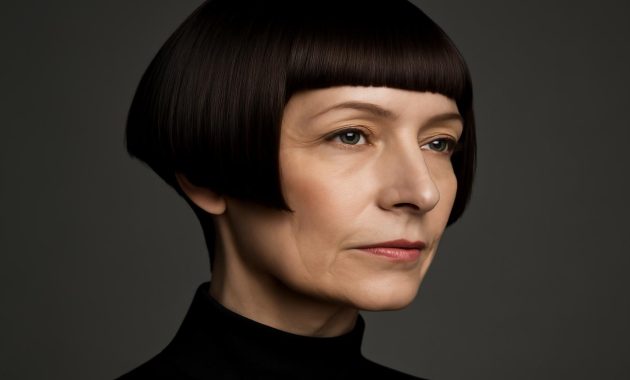
The woman in the mirror is not the same one who danced through the late 80s with a can of hairspray in hand. Her eyes carry more stories now, more late-night laughs, more quiet griefs. But this morning, as she tilts her head and watches the light catch the new shape of her hair, something unmistakable stirs: that pulse of mischief, of possibility. The cut is short, sculpted, and unapologetically modern—yet somehow familiar, like a favorite song from a forgotten summer. “I feel… like myself again,” she murmurs, surprised by the softness of her own smile.
The Return of a Rebel: When the 60s Meets 2026
If fashion moves in circles, then hair moves in spirals—always returning, but never quite the same. In 2026, one of the most powerful spirals we’re seeing is the comeback of a bold, iconic 60s haircut: the modern pixie-bob hybrid. Think of it as the lovechild of the classic 60s crop—those gamine cuts worn by Mia Farrow and Audrey Hepburn—and the relaxed, textured bobs that have dominated the last decade.
On paper, it sounds simple: shorter at the nape, slightly longer toward the front, with soft layers that skim the cheekbones. But in motion—in real life—it’s magic. The hair moves. It breathes. It reveals the neck, opens up the face, and somehow erases that heaviness that longer, tired hair can sometimes bring after 50.
This isn’t the stiff, lacquered helmet of the mid-century housewife. This is the 60s cut that belonged to the rebels and dreamers, reimagined with 2026’s love for texture, natural movement, and individuality. It’s structured enough to feel intentional, yet undone enough to look like you just walked through a gentle sea breeze rather than a salon door.
And for women over 50, it’s catching on fast—because it doesn’t whisper “I’m trying to look young.” It says something bolder: “I know who I am, and I’m lightening the load.”
Why This Cut Loves Women Over 50 (And Why the Feeling Is Mutual)
There is a quiet revolution happening in salon chairs across the world. Women over 50 are walking in with years of hair history—color experiments, perm regrets, careful lengths grown to “stay safe”—and sitting down with a new kind of intention. They aren’t asking, “What makes me look younger?” as much as, “What makes me feel more like myself?”
The modern 60s-inspired pixie-bob answers that question in a deeply practical, deeply emotional way.
First, the practical part. Hair changes with age, and you can feel it between your fingers: it’s often finer, drier, sometimes thinner around the crown or temples. Heavy, long styles that once felt dramatic can now feel flat or limp, dragging the face down instead of framing it. This shorter, sculpted cut quite literally lifts everything—visually, and sometimes emotionally.
It exposes the neck and collarbones, elongating and sharpening the silhouette. The wispy, face-framing layers sit right where you want attention to fall: the eyes, the cheekbones, that curve at the edge of a smile. It’s a cut that works with thinner strands instead of against them, using light layering and soft graduation to create the illusion of fullness without needing half a can of mousse.
Then there’s the emotional part: the almost shocking sense of relief. Over and over, women report the same feeling when the first handful of length falls away—the weight they didn’t realize they were carrying suddenly gone. Like cleaning out a closet you’ve been avoiding for years, stepping into a haircut like this can feel like reclaiming space in your own life.
In a culture that still mutters its warnings about “age-appropriate” hair, this cut quietly ignores the rules. It’s not trying to look 25. It’s trying to feel free.
The Anatomy of the 2026 60s Revival Cut
To really understand why this style is so flattering after 50, you have to get a bit closer—almost close enough to smell the faint citrus of salon shampoo, feel the crispness of freshly snipped ends between your fingertips.
Imagine the shape from the side. At the nape, the hair hugs the neck gently, not shaved or severe, but neatly tapered with soft graduation. As your eyes travel upward, the crown has a whisper of lift—not a hard bump or teased nest, but a subtle, natural volume that keeps the head’s silhouette balanced. A little air between hair and scalp. A little room to breathe.
Then there are the sides: they tilt forward, just so. Not the sharp, angular long bob of the 2010s, but a gentle forward movement. The longest points graze somewhere between the middle of the ear and the corner of the jaw, depending on face shape and preference. That length is key; it’s what makes this cut feel 60s-inspired without tipping into boyish, unless you specifically want that look.
The fringe—if you choose one—is where the personality really steps in. Some women opt for a soft, side-swept fringe that melts into the layers, gliding just above the eyebrows and drawing instant attention to the eyes. Others go for a micro-fringe, a quiet nod to 60s French cinema, letting a hint of forehead show while keeping things edgy and modern. And some skip a fringe entirely, letting the front pieces part naturally in the middle or off-center, creating that effortlessly undone feel.
This is where the 2026 twist becomes obvious: no two versions are exactly the same. In the 60s, the famous cuts were almost templates—copy-and-paste silhouettes worn by women around the world. Today, the same spirit of the cut is expressed with one key difference: personalization is everything. Your natural wave, your cowlick, your face shape, your willingness to style (or not style) each morning—all of it informs the final version.
| Feature | 60s Original | 2026 Revival (after 50) |
|---|---|---|
| Overall Shape | Uniform pixie or sharp crop | Pixie-bob hybrid with soft graduation |
| Texture | Smooth, often set or lacquered | Airy, textured, touchable |
| Styling | Rollers, setting lotions, firm sprays | Light cream, texturizing spray, fingers |
| Ideal for | Thicker, uniform hair | Fine, thinning, or mixed textures |
| Vibe | Strictly “styled” look | Effortless, modern, individual |
How This Cut Softens and Sharpens at the Same Time
Paradoxically, the modern 60s cut both softens and sharpens your features. When you sit in that chair and the length falls, what remains is clarity—your jawline defined by the curve of hair around it, your cheekbones lifted by the subtle volume at the temples. The softness comes from the feathering and texture; there are no hard, blunt ledges. Instead, pieces are lightly chipped into, with the ends softened to avoid that harsh, helmet-like silhouette that many women fear when they think “short hair.”
At the same time, the exposed neck and contour of the head bring a sculpted sharpness, almost like stepping into better lighting. The result is a gentle contrast that brings liveliness to mature features instead of trying to hide them. It’s not about erasing age. It’s about framing it beautifully.
Finding Your Version: Face Shape, Texture, and Confidence
By now you might be picturing it on yourself—tilting your head in your own bathroom mirror, sweeping your hair up as if you’re trying on a new life. But a cut this expressive can’t be pulled straight from a photo without translation. It has to be read through the lens of your face and your day-to-day reality.
Face Shape: Gentle Adjustments, Big Difference
If your face is oval, you’re in luck: most variations of this cut will fall into place almost effortlessly. You can afford to play with fringe length, crown volume, even asymmetry.
For rounder faces, your stylist might keep a little extra length in front to skim the jawline, avoiding too much fullness at the sides. Subtle height at the crown elongates the face, echoing the spirit of 60s icons without going into beehive territory.
If your face is square or rectangular, softness is your friend. Delicate, textured ends that curve inward and a side-swept fringe can gently blur sharper lines while still embracing their strength. Heart-shaped faces often shine with a slightly longer front that brushes the collarbone area, especially if you keep the nape tight and neat.
Texture: Working With What You Actually Have
One of the quiet joys of this 2026 version is that it respects reality. Fine hair gets the illusion of density through layering that’s light, not choppy, with strategic graduation at the back. Wavy hair becomes a dream in this cut; a bit of curl cream and air-drying can create that tousled, “I woke up naturally chic” vibe that stylists spend decades trying to learn how to fake.
Even curls can join the party, as long as the stylist understands how your curl pattern shrinks when cut short. The 60s inspiration shows up more in the shape than in a strict smoothness. Instead of forcing your hair into submission, the new version celebrates its soul.
Confidence: The Invisible Styling Product
You can have the best cut in the world, and if you tuck it apologetically behind your ears, it will still feel like a compromise. A bold, short style after 50 requires a specific ingredient that doesn’t come in a bottle: willingness. Willingness to be seen. Willingness to take up space with your choices, to let people notice that you did something different.
That first grocery store run after the salon can feel like a small performance: someone glances up from the fruit aisle, a friend pauses mid-sentence when she sees you on a café terrace. These are the moments when you either shrink or smile. The women who fall in love with this cut are often the ones who decide, actively, that their hair isn’t an apology. It’s a declaration.
Styling in Real Life: Five Minutes, Two Products, Done
Open your bathroom drawer in the morning. What do you see? Half-used sprays, a curling iron cord knotted around itself, maybe a round brush you haven’t truly loved in years. One of the most seductive parts of this 60s-inspired trend is how it slices through all that clutter—both physical and mental.
Your Simple Morning Ritual
Here’s what a typical routine might look like for this cut after 50:
Step into the shower. As you rinse, you feel the short strands slip cleanly through your fingers, no heavy tangles to fight with. Out of the shower, you blot—not rub—your hair with a towel. You add a pea-sized amount of lightweight styling cream or mousse at the roots and mid-lengths. Then you have a choice: let it air-dry, scrunching occasionally for movement, or give it a quick once-over with a dryer and your fingers, lifting at the crown for volume.
Finish with a touch of texturizing spray or a soft, flexible hairspray. You don’t sculpt it into submission; you coax it into place, then let it live. The whole process, from towel to “I could walk into any room right now,” can take five to eight minutes. Ten if you’re lingering over your coffee.
That kind of simplicity steals back time—not in a dramatic, cinematic way, but in dozens of quiet, daily increments. Minutes you can now spend sitting outside with your morning tea, calling a friend, or just breathing instead of wrestling with a round brush in front of a fogged-up mirror.
Color, Silver, and the Invisible Glow-Up
The 60s were the age of set colors and one-tone styles. 2026 is playing a very different game, especially for women over 50. This revived cut practically begs for dimension, whether that dimension is in the form of subtle highlights or the natural shimmer of silver and white strands.
If you’ve embraced your gray—or you’re thinking about it—this cut can be transformative. Shorter, textured hair gives silver a chance to sparkle instead of sit flat. Each layer catches the light differently: softer whites at the crown, deeper steel tones near the nape, a scattering of salt and pepper around the temples. Suddenly, what once felt like a marker of age looks more like deliberate artistry.
For those who still love color, the 60s-modern hybrid shape works beautifully with soft balayage or lowlights that create movement without harsh regrowth lines. You don’t have to chase your roots every few weeks; the cut’s structure and texture do a lot of the visual work for you. And if you’re somewhere in between—transitioning from color to natural—you’ll find this length a patient ally, blending the old and new like soft brushstrokes instead of a hard line.
Making the Leap: A Conversation With Your Future Self
So you’re thinking about it. You’ve maybe saved a photo or two. You’ve absentmindedly lifted your hair up at the dinner table, pretending to see what less would feel like. The decision to cut your hair this dramatically after 50 is rarely just about aesthetics. It’s about timing, about thresholds, about the quiet sense that some chapter is ready to close so another can open.
Before you sit in that salon chair, you might ask yourself: What do I want this cut to mark? A new decade? A new job? An emptying nest? A divorce finalized, a retirement begun, a health scare survived? Or maybe, beautifully, it marks nothing at all—just a moment where you decide that your reflection should finally match the woman who has been slowly, steadily growing on the inside.
When you talk to your stylist, bring your stories as much as your photos. Tell them what you love and hate about your hair on your busiest mornings. Be honest about how much—or how little—time you are willing to give it. A good stylist in 2026 isn’t just copying a 60s shape; they’re listening for your life between the lines.
And when the cape comes off and the cut is complete, give yourself a moment. Run your hands through it. Turn your head side to side, letting the light play on the new angles. It might feel shocking at first, like stepping out of a familiar, slightly too-heavy coat. But stay with it. Watch how you move differently. Notice how your posture shifts, how your face looks suddenly more open, more alive.
Because this is the quiet truth at the heart of this trend: it isn’t really about the 60s. It isn’t even truly about 2026. It’s about a woman standing in front of a mirror at 50, 60, 70, and choosing to meet herself again—with less weight, less fear, and a lot more room for air and light around her face.
The hair is just how the story begins.
FAQ: Hairstyles After 50 and the 60s Cut Revival
Is this short 60s-inspired cut suitable for all hair types after 50?
Yes, with the right adjustments. Fine hair benefits from soft layering and graduation for volume, wavy hair looks naturally tousled and modern, and even curls can work as long as the stylist understands shrinkage and shapes the cut carefully.
Will this haircut make me look older or younger?
It’s less about looking “younger” and more about looking fresher and more defined. The exposed neck, lifted crown, and face-framing layers often give a lighter, more energized appearance without pretending to erase age.
How often will I need to maintain this style?
To keep the shape sharp yet soft, plan on a trim every 5–8 weeks. If you’re comfortable with it growing out a bit more relaxed and lived-in, you can stretch it slightly longer.
Can I wear this cut if I’m growing out my color and going gray?
Absolutely. This length and texture are ideal for blending old color with new growth. The layers help diffuse harsh regrowth lines and make the transition to gray or silver look intentional and stylish.
What should I ask my stylist for to get this 2026 version of the 60s cut?
Describe it as a soft, textured pixie-bob hybrid: tapered at the nape, slightly longer toward the front, with light layering for movement and optional fringe tailored to your face shape. Bring a few reference photos and explain how much daily styling you’re realistically willing to do.