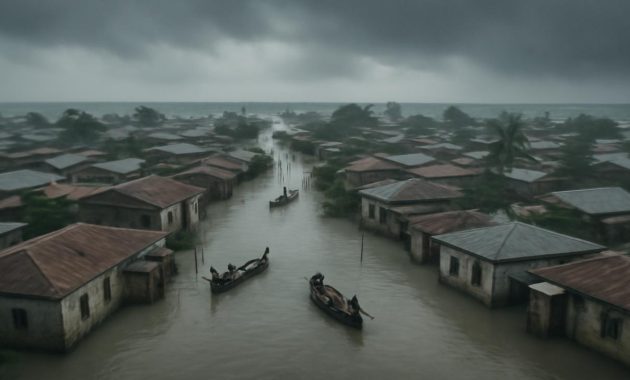
The rain begins as a soft murmur—barely more than a whisper against a tin roof. Someone in a coastal village glances up, shrugs, and keeps stirring the pot over a gas flame. In the city, office workers press their faces to the window for a moment, watching the first drops streak down the glass, before turning back to glowing screens. Rain, after all, is ordinary. Comforting, even. It greened the hills of our childhoods, filled the wells, washed dust from the air. For generations we’ve greeted it with open palms and tilted faces.
But in more and more corners of the world, rain is no longer a familiar guest. It’s an intruder. It comes wrong—too hard, too fast, too often. Streets become rivers in hours. Bridges vanish under roiling brown water. Homes tilt and slide away in the night. The comforting patter on the roof now carries a question people are scared to say out loud: How long can we stay here?
When Rain Stops Being a Blessing
On a humid midnight in a hillside town in Sierra Leone, the air is dense and breathless. People lie awake, listening. The rain is not falling—yet—but everyone knows it will. The soil on the surrounding slopes is already saturated; the trees that once anchored them have been thinned for firewood and construction. Somewhere up the hill, a stream is already swollen, gulping at its banks. When the storm arrives, it will not be a gentle curtain of water. It will be a torrent, pounding roofs, battering roads, turning paths into chutes of mud.
In 2017, after weeks of relentless rainfall, a massive slope above Freetown gave way. A red river of earth roared through homes and streets, taking more than a thousand lives in minutes. It wasn’t only the storm that killed them—it was a fragile landscape pushed to its limits by deforestation, unplanned construction, and a climate that is now supercharging the sky itself. Since then, the word “rainy season” has picked up a new edge. It carries not just inconvenience, but dread.
Rainfall extremes are increasing worldwide because a warmer atmosphere holds more moisture. For roughly every degree Celsius of warming, the air can store about 7% more water vapor. That invisible storage capacity turns into something very visible when storms form. Instead of steady, prolonged rain, we’re getting more cloudbursts—downpours that dump weeks’ worth of water in a day, or even an hour. Across the tropics and subtropics especially, this new pattern is rewriting the map of where it is safe to live.
The Countries on the Front Line of Too Much Water
We often talk about climate change in terms of heat: scorched fields, heatwaves, drought. Yet some of the countries most at risk of becoming uninhabitable by 2100 are drowning, not drying. These are places where monsoons, storm systems, and shifting oceans conspire with human-built vulnerability to create a future of near-constant disaster.
Bangladesh, for example, is a country of rivers. From the air it looks like a woven mat of water and land: glimmering braids of the Ganges, Brahmaputra, and Meghna, spreading into a vast delta that barely rises above sea level. The people here have always lived with floods. There’s a certain choreography to it—stilt houses, raised storage, seasonal migrations of people and livestock. But the rhythm is faltering. Warmer waters in the Bay of Bengal feed stronger cyclones; heavier monsoon downpours overwhelm embankments and levees. In some years, more than half the country ends up under water.
In coastal towns, residents can point to where the shoreline used to be—an absent line now far out in the waves. During intense storms, the sea and sky seem to fuse. Saltwater pushes up rivers while torrential rain falls from above. Fields are left not just flooded, but poisoned with brine. When roofs disappear under swirling floodwaters, families flee with whatever they can carry, often for the second or third time in a decade.
Thousands of kilometers to the east, in the Philippines, the threat has a different name—typhoons—but the pattern feels hauntingly similar. Villages that hug the coasts or sit in narrow mountain valleys are battered by rain that descends like a vertical river. Hillsides crumble into landslides; entire neighborhoods vanish under walls of mud and rock. After the storm, the map looks the same, but for those who have lost everything more than once, the question gnaws: at what point does “home” become a place you are too afraid to return to?
When a 100-Year Flood Happens Every Few Years
Insurance companies and city planners used to rely on the idea of the “100-year flood”—a shorthand for a very rare, severe event. But as rains intensify, the probabilities have shifted. The same magnitude of flood that was once expected once in a century can now occur every 10, 20, or 30 years, and in some places even more frequently. The language of “once in a lifetime” disaster has become meaningless to communities rebuilding for the third or fourth time.
In parts of South Asia, West and Central Africa, and Southeast Asia, this relentless pounding is compounding with population growth and urban sprawl. Cities swell along riverbanks and coasts because that’s where trade and jobs are. Informal settlements rise on marginal land—steep slopes, mangrove fringes, floodplains—because that is what is left. Without drainage infrastructure, the first heavy rain turns cramped alleyways into brown canals. The second rain erodes foundations. The third might take the whole neighborhood.
The rising chorus of flood alerts is not spread evenly across the globe. Some regions face a convergence of risk factors: monsoon or tropical storm systems, low-lying topography, rapid urbanization, and fragile governance structures. For them, 2100 is not a distant, abstract date on scientific graphs. It is a looming deadline by which entire districts may become effectively uninhabitable—not because they vanish beneath the ocean, but because it is no longer possible to live there without constant crisis.
Where the Rains Will Hit Hardest
Scientists use climate models that track how temperature, humidity, and air circulation will change over time. While exact details vary, the big picture is consistent: tropical and subtropical regions—already wet in many cases—will see more intense downpours. Below is a simplified snapshot of some regions widely recognized as facing severe risk from extreme rainfall by the end of the century if warming continues on high trajectories:
| Region / Country | Primary Hazards by 2100 | Key Vulnerabilities |
|---|---|---|
| Bangladesh & Ganges–Brahmaputra Delta | Extreme monsoon floods, river overflow, storm surge plus heavy rain | Very low elevation, dense population, limited urban drainage, saltwater intrusion |
| Philippines & Western Pacific Islands | Typhoon-driven cloudbursts, landslides, coastal inundation | Mountainous terrain, coastal settlements, deforestation, storm exposure |
| West & Central Africa (e.g., Nigeria, Sierra Leone, Cameroon) | Intense rainy seasons, urban flash floods, landslides | Rapid urban growth, informal housing, inadequate drainage, hillside settlements |
| South Asia (India, Pakistan, Nepal) | Monsoon extremes, glacial lake outburst floods, riverine flooding | River plains and mountain valleys, aging dams, vulnerable agriculture |
| Amazon & Andean Foothills | Heavier seasonal downpours, landslides, river surges | Deforestation, riverbank communities, limited infrastructure |
This list is not exhaustive. Parts of China’s Yangtze basin, Indonesia’s crowded coasts, and many small island states also face spiraling risk. “Uninhabitable” in these contexts doesn’t always mean that every human must leave, but that living there becomes a continuous negotiation with danger—rebuilding, relocating within the country, or accepting increased mortality and loss as part of life.
Life on the Edge of the Next Storm
Walk through a low-lying neighborhood in Lagos after a heavy rain, and the future feels oddly close. Water laps at doorways. Children step from block to block—broken chunks of concrete serving as makeshift bridges. Inside homes, furniture is raised on bricks in the hopeful belief that the next flood will stop a few inches lower than the last. The air smells of fuel, sewage, and wet dust. People laugh, joke, cook; life goes on. Yet almost every family can tell a story of a flood that took something that didn’t come back—a business, a field, a relative.
In these communities, rain is not just weather; it is a constant calculus. When the first dark bloom of clouds forms on the horizon, street vendors glance at the sky and mentally weigh their options: stay and sell, or pack up and run while escape routes are open. Parents wonder, should the children walk to school today, or will the streets become impassable by afternoon?
In the countryside, the arrival of erratic, heavy rainfall is also quietly eroding the foundations of food security. Rice paddies can tolerate being wet, but not being violently scoured by flash floods. Maize fields drown when storms linger, and slopes stripped for farming crumble under hammering rain, burying crops. As harvests fail or become unpredictable, rural families often send one member—usually a son—to the city. There, he may end up in another flood-prone district, trading one risk for another.
Uninhabitable Doesn’t Happen Overnight
It’s tempting to imagine 2100 as a sudden tipping point: a year when sirens blare, and whole countries are evacuated. Reality will be different, slower, more fragmented. Long before any official declarations, people will quietly decide that staying no longer makes sense.
Perhaps a family in Dhaka, who have rebuilt after three floods in ten years, finally accept an uncle’s invitation to move inland. Maybe a fisherman in the Mekong Delta finds that the combination of rising seas and violent rains has destroyed his nets, his house, and the fish he depends on; tired and broke, he takes a bus to Ho Chi Minh City and never goes back. Maybe an entire hamlet in the hills of Nepal disperses after a landslide wipes out the only footpath connecting them to the nearest town.
These are the first waves of what some call “climate migration,” though from the perspective of those moving, it’s less about climate in the abstract and more about survival. You move because the rain keeps coming, harder each time. You move because the school never reopened after the last flood, or because the well is full of mud, or because insurance payouts dried up years ago. By 2100, if current trajectories continue, tens to hundreds of millions of people could be internally displaced not only by rising seas but by the sheer violence of rainfall.
Can We Adapt to a World of Violent Rains?
There is another path between abandonment and obliviousness: adaptation. Around the world, engineers, architects, farmers, and activists are racing to find ways of living with extreme rain rather than fleeing from it. In some places, the solutions are grand—massive sea walls, river diversions, multi-billion-dollar drainage systems that store stormwater in underground caverns below cities. In others, they’re humble but ingenious: floating gardens, raised walkways, tree-planting on erosion-prone slopes.
Bangladesh has been a quiet laboratory of such ideas. Here, floating schools bob gently on swollen rivers, ensuring children can attend class when roads and paths vanish. Farmers in flood-prone areas grow vegetables on rafts woven from water hyacinth, their crops rising and falling with the floodwaters. Early-warning systems powered by simple mobile texts buy precious hours for evacuation when heavy rains upriver signal danger.
Elsewhere, “sponge city” concepts are taking root. Instead of treating rain as an enemy to be shoved as quickly as possible into drains and rivers, urban planners are weaving it into the design of streets and buildings: permeable pavements that let water soak into the ground, parks that double as flood basins, green roofs that hold back the first surge of run-off. These measures can dramatically reduce the severity of urban flooding, but they require upfront investment and careful maintenance—two things often in short supply in the very countries most at risk.
The Limits of Holding Back the Sky
Adaptation, however creative, has limits. There’s a point beyond which no levee is high enough, no storm drain wide enough, no evacuation route fast enough. For some regions, especially low-lying deltas and hyper-dense coastal megacities, that limit may be approached by the end of the century unless warming is curbed significantly.
In scenarios where global temperatures rise by 3°C or more, the combination of sea-level rise and intensified rainfall could make chronic, deep flooding a regular occurrence in many coastal and riverine cities of the tropics. When the water comes not only from the sky but also from below—seeping into basements, bubbling up through drains, saturating the very foundations of buildings—daily life becomes an exhausting series of defenses.
For national governments, the question becomes brutally practical: which areas are still worth defending, and which should be gradually let go? That conversation has barely begun in many countries, because admitting that some districts may become uninhabitable feels like political suicide. Yet avoiding the subject does not stop the rain. It only ensures that the poorest and least powerful will absorb the impacts first and worst.
Rethinking “Habitability” in a Wet Future
The phrase “uninhabitable by 2100” conjures images of empty maps, but in reality, habitability is a spectrum. A place might technically be livable yet so hazardous that only those with no alternatives remain. Another might be safe only with constant, resource-intensive protection. When extreme rainfall becomes the norm, habitability is no longer just about temperature or sea level; it’s about whether society can maintain the infrastructure, governance, and social cohesion needed to keep people safe in the face of relentless water.
Some countries, with wealth and strong institutions, may manage to adapt even to punishing rainfall regimes. Others, with fewer resources and more fragile systems, may fall into a brutal cycle: each storm erodes not just roads and homes but also public trust, savings, and the capacity to respond to the next disaster. Over decades, these small erosions accumulate into a slow unmaking of place.
Standing in the middle of a flooded street today—whether in Manila, Lagos, Mumbai, or a small settlement in the Amazon basin—it can be hard to see these slow futures. What you feel is the immediate: the chill of muddy water around your knees, the smell of fuel in the air, the weight of a child on your hip as you edge along a submerged wall. Yet stitched into those moments are the bigger questions of the century. How much rain can a home survive? How many rebuilds before people give up? What does it mean to belong to a country that the climate is trying, storm by storm, to wash away?
Somewhere tonight, the first drops are beginning to fall on another vulnerable hillside, another crowded neighborhood built on a floodplain. Someone will step outside, hand outstretched, and test the rain as our ancestors did, trying to read the sky. The water on their skin will feel the same—cool, clean, familiar. But above them, the clouds are heavier than they used to be. And inside them hangs a question that will define the lives of millions by 2100: not whether the rain will come, but whether humanity can change fast enough that people are not finally forced to leave the places they love behind.
Frequently Asked Questions
Which countries are most at risk of becoming uninhabitable from extreme rainfall by 2100?
Countries with a combination of low-lying land, monsoon or tropical storm exposure, rapid urbanization, and weak infrastructure face the greatest risk. These include Bangladesh and parts of India and Pakistan in South Asia; Nigeria, Sierra Leone, and other West and Central African nations; the Philippines and other Pacific island states; parts of Indonesia; and dense river basins like the Mekong and the Amazon.
Does “uninhabitable” mean entire countries will be abandoned?
Not usually. More often, it means specific regions—coastal belts, deltas, crowded riverbanks, or landslide-prone hillsides—may become too dangerous or costly to live in. People may relocate within their own countries, often from rural or coastal areas to inland cities, long before any whole nation is truly empty.
Why is extreme rainfall increasing with climate change?
As the planet warms, the atmosphere can hold more water vapor. When storms form, they have more moisture to work with, leading to heavier downpours. In many places, rainfall is becoming more “concentrated”: fewer rainy days overall, but more intense bursts of rain when it does fall.
Can better infrastructure solve the problem?
Improved infrastructure—drainage systems, flood defenses, early-warning systems, and resilient housing—can dramatically reduce risk and buy time. However, if warming continues unchecked and rainfall extremes intensify beyond certain thresholds, some areas may still become too expensive or technically difficult to protect in the long term.
What can be done now to reduce the risk of places becoming uninhabitable?
Two tracks are essential. First, reducing global greenhouse gas emissions to limit further warming and its impact on rainfall patterns. Second, investing in adaptation: smarter urban planning that avoids high-risk zones, restoring forests and wetlands that absorb water, upgrading drainage, protecting and relocating vulnerable communities, and supporting people who may need to move. Each step taken now makes it more likely that by 2100, more of the world’s beloved places remain livable, even under heavier skies.