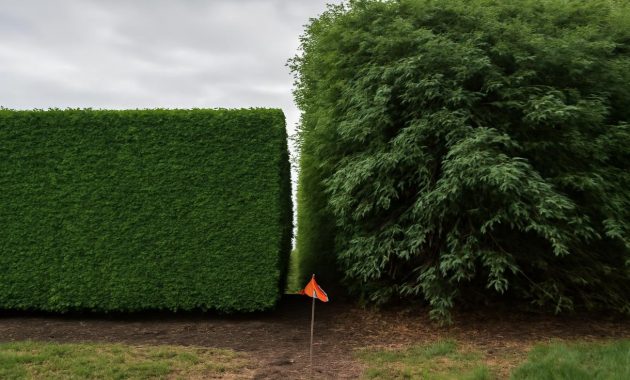
On a foggy January morning, when gardens still seem half asleep and fences glisten with frost, a quiet countdown is ticking away over the hedges. The sparrows don’t know it, the fox slinking home along the back alley doesn’t know it, but many homeowners are about to find out: from January 15, those towering green walls more than 2 meters high and standing less than 50 centimeters from the neighbor’s boundary will no longer be just a matter of taste. They’ll be a matter of law, good manners, and possibly a fine that arrives with all the chill of a winter wind.
When a Hedge Becomes a Wall
At first, it sounds almost absurd. How can something as soft and rustling as a hedge become the center of hard rules and potential penalties? But if you’ve ever watched a small garden slowly lose its light to a neighbor’s untrimmed laurel, or seen a delicate vegetable patch buried in the permanent shadow of a conifer barrier, you’ll understand how quickly greenery can turn into a grievance.
Imagine stepping out with your morning coffee. The air smells faintly of damp soil and woodsmoke. You look to the fence line… and you can’t actually see the fence anymore. The hedge, once a modest privacy screen, has pushed up and out like a leafy tide, cresting well over your head. Sun that used to spill onto your patio doesn’t quite reach anymore, and your neighbor’s garden—already small—is now trapped in a kind of evergreen cave.
This is the living, breathing backdrop to the new requirement: from January 15, hedges exceeding 2 meters in height and planted closer than 50 centimeters to the neighbor’s property must be trimmed back to compliance, or the owner risks penalties. It’s not an attack on greenery. It’s an attempt to balance the right to plant with the right to light, space, and breathable air.
The 2-Meter Rule: What It Really Means
These new rules don’t swoop down to punish every flourishing shrub. They’re surprisingly precise, and that precision matters when you’re standing in muddy boots trying to decide how much to cut.
In practice, it works like this: if your hedge is both higher than 2 meters and less than 50 centimeters from the neighbor’s boundary line, you’ll be expected to bring it back under control. The law is not worried about a single rosebush that leans a bit generously over the fence; it’s about lasting, structural shade and the loss of usable space that comes with high, dense hedging pressed tight to the dividing line.
You can almost picture a measuring tape stretched across the frosty grass. On one end, the base of the hedge, roots anchored firmly in your soil. On the other, an invisible line where your plot ends and your neighbor’s begins. If that distance is under half a meter and your hedge has grown into a towering green rampart, the law now has something to say.
To keep things clear, here’s an at-a-glance summary of how the rule plays out in different common scenarios:
| Hedge Situation | Height | Distance from Neighbor’s Property | Action Required from Jan 15 |
|---|---|---|---|
| Tall hedge forming a dense screen | Over 2 m | Less than 50 cm | Must be trimmed to comply or owner risks penalties |
| Mature hedge near the line, but not very high | 2 m or lower | Less than 50 cm | No trimming required by this rule (but keep it maintained) |
| Tall hedge planted further inside your garden | Over 2 m | More than 50 cm | Usually allowed, unless other local rules apply |
| Newly planted hedge along a narrow strip | Still low, under 2 m | Less than 50 cm | Plan for future size now; avoid letting it exceed 2 m |
The language of centimeters and meters might feel clinical, but behind it lives a very human question: how do we share space when our boundaries are both legal lines and living things?
The Neighbor’s Sky: Light, Shade, and Everyday Life
Stand in the far corner of a small urban garden late on a winter afternoon, and you understand what’s really at stake. Winter sun already travels low, smearing its light sideways through bare branches and between chimneys. Add a 3-meter hedge pressed tight to the boundary, and what remains of the sky shrinks to a pale ribbon.
Inside the neighbor’s home, lights may need to be switched on hours earlier. Plants on their windowsills stretch desperately for what little brightness slips through. On damp days, the ground beneath that hedge never fully dries, moss creeping over paving slabs, the soil heavy and cold. Children’s toys don’t get set out there. The washing line stays empty. That side of the garden becomes a zone of avoidance.
This is why the rule doesn’t just talk about fence lines, but about distance from them. Fifty centimeters may sound small on a plan, but in practice it often marks the difference between a hedge that softly frames the horizon and one that swallows it.
In dense neighborhoods, where houses sit shoulder to shoulder and gardens are slender slices between walls, the right to sunlight feels almost sacred. For someone cultivating a tiny patch of herbs, or a single cherished rose, or simply a strip of lawn where the family dog can doze in the afternoon, that lost light isn’t abstract—it’s daily life, diminished.
The Quiet Politics of Green Boundaries
Unlike a brick wall, a hedge feels alive and forgiving, and that’s precisely why it so easily crosses the boundary from pleasant to problematic. You don’t wake up one morning to a 3-meter wall that wasn’t there yesterday. Instead, it happens slowly, season by season, each flush of new shoots unnoticed until one day your neighbor is standing in their shady yard wondering when the sky disappeared.
Hedges also carry emotion in a way fences rarely do. They shield us from prying eyes, from traffic, from the unsettling feeling of being constantly on display. For many, planting a tall hedge was an act of reclaiming privacy in increasingly crowded towns and cities. To be told that this living shield must now be cut down to a legal size can feel like an intrusion.
But there’s another story under the surface: the neighbor who has spent years politely hinting, then asking, then finally escalating the issue after feeling ignored. The couple whose solar panels underperform because a green wall blocks the low winter sun. The elder who finds their only quiet bench now permanently cast in damp shade, the chill seeping into bones already stiff with age.
The new rule doesn’t attempt to untangle every knot of feeling along every property line. Instead, it draws a simple line: beyond 2 meters, within 50 centimeters, your hedge is no longer just yours—it’s a shared problem.
The Sound of Shears: Trimming as Ritual, Not Punishment
Picture the scene in mid-January. The air is sharp enough to sting your nose, and your breath hangs in white puffs as you pull on thick gloves. Frost crunches under your boots as you walk toward the hedge that has stood, quietly ruling the boundary, for years. Today, you come not just as gardener, but as negotiator—between your own desire for a sheltered nest and the open sky your neighbor longs for.
The first cuts are always the hardest. Branches that have grown wild and unchallenged for seasons suddenly fall away in ragged clumps, exposing glimpses of the world beyond: a corner of the neighbor’s patio, a bicycle leaning against their wall, a forgotten flowerpot. It feels like a minor revelation, like taking off heavy curtains after years of living in dim, familiar half-light.
Yet trimming doesn’t have to be an act of pure loss. Done with care, it can become a renewal, a kind of winter ritual in which the hedge is invited back into balance. Cutting back encourages denser, healthier growth. The shrub that once loomed like a curtain wall can evolve into a sculpted, airy screen that lets dappled light filter through instead of stamping it out entirely.
Planning the Cut
To bring an overgrown hedge in line with the new rule without butchering it, it helps to pause and plan:
- Measure honestly. It’s tempting to underestimate height, but a simple tape measure or telescopic pole can reveal whether you’re truly over that 2-meter line.
- Check the roots’ position. The rule cares where the hedge is planted, not just where it leans. If roots are closer than 50 centimeters, that’s what counts.
- Trim in stages. If your hedge is massively over height, a gradual reduction over two seasons can be kinder to the plant and less shocking visually.
- Respect the nesting season. Birds may claim your hedge as home. While the January 15 deadline is about height and distance, many wildlife guidelines also limit heavy cutting during peak nesting months. Get the big cuts done in winter, then maintain gently.
There is a surprisingly intimate pleasure in the sound of well-oiled shears closing cleanly on a branch, in the thud of cuttings piling soft and fragrant at your feet. You may find, somewhere between the first and last branch, that what began as an annoying legal chore has turned into a quiet, almost meditative afternoon in the cold air, your world narrowed to green, bark, breath, and the slow reshaping of your shared edge of land.
Conversations Over the Fence
The most powerful tool in all of this isn’t the hedge trimmer or the stepladder. It’s the awkward, essential conversation that often happens before either comes out of the shed.
Maybe you’re the one standing in the shade of your neighbor’s towering hedge, hands in pockets, rehearsing your words. Maybe you’re the one whose hedge has grown, vaguely aware but never quite ready to deal with it. Either way, the new rule turns a silent discomfort into a shared topic.
There’s a simple kind of relief in being able to say, “Look, from January 15, the law actually requires us to keep hedges under 2 meters if they’re this close to the boundary line. Could we take a look at ours together?” The conversation shifts from “your hedge is bothering me” to “we’ve both got something we need to align with.”
Turning Conflict into Collaboration
Instead of an angry letter or a cold visit from an official, it’s often far better to frame the hedge as a shared project:
- Walk the boundary together. Stand where the shade falls and where the hedge roots are. Let both sets of eyes see the same problem.
- Agree on timing. Maybe you trim in two stages, or on a weekend when both can be home.
- Share the outcome. Invite your neighbor to step into your garden once the work is done, and ask if it feels better for them too.
- Talk about the future. Discuss how often the hedge will be maintained so it doesn’t creep back over that legal line.
It might seem idealistic, but boundaries—literal and emotional—tend to grow calmer when both sides can see over them, or at least see the sun streaming above and around them.
Looking Ahead: Designing with the Rule in Mind
For those dreaming up new gardens, this rule offers a design prompt rather than a restriction. If the old instinct was to plant a hedge right along the property line and let it soar, perhaps the new instinct is to ask: what could I plant that gives me privacy without casting my neighbor into permanent twilight?
There’s a certain creative challenge in that question. Maybe the answer is a layered planting: a modest hedge at a compliant height near the boundary, with taller trees or shrubs set further inside your own garden, well past that 50-centimeter threshold. Maybe it’s a semi-open screen of ornamental grasses that sway and whisper in the breeze but never rise high enough to block the sky.
By listening to the new boundary of 2 meters and 50 centimeters, gardeners are pushed, gently but firmly, toward more thoughtful, three-dimensional design. It’s an invitation to see privacy not as a wall, but as a tapestry of heights, textures, and seasons—something that shelters you without stealing light from the person next door.
In the end, this rule is less about punishing unruly hedges and more about encouraging a landscape where everyone gets a slice of sun, a breath of wind, a view of clouds drifting by over the roofs. Somewhere between bare open fences and fortress-like thickets, there’s a middle path where gardens feel both intimate and kind.
Frequently Asked Questions
Does every tall hedge have to be trimmed from January 15?
No. The rule specifically targets hedges that are both over 2 meters in height and planted less than 50 centimeters from the neighbor’s property line. If your hedge is taller than 2 meters but stands further inside your own garden, this rule usually does not apply (though local regulations might).
How do I know where the neighbor’s property line is?
You can consult your property documents, official plans, or cadastral maps. In many cases, fences or walls mark the approximate boundary, but if there’s doubt, it’s wise to discuss it with your neighbor or seek professional clarification before doing major work based on measurements.
What happens if I don’t trim my hedge to comply?
If your hedge exceeds 2 meters and is closer than 50 centimeters to the neighbor’s land, you may face formal complaints and, ultimately, penalties or enforcement measures. These can range from fines to an official order to cut the hedge. It is usually far better—and cheaper—to act voluntarily.
Can my neighbor cut my hedge without asking me?
In most cases, the hedge owner remains responsible for trimming. Neighbors may have limited rights to cut branches that physically overhang their property, but they generally cannot reshape or reduce the hedge height on your side without permission. It’s always better to talk first and agree on what will be done.
What if trimming the hedge will harm birds or wildlife?
Many countries have additional protections for nesting birds and wildlife habitats. While the height-and-distance rule applies from January 15, heavy hedge cutting is usually best done outside the main nesting season, which commonly runs from spring into late summer. Winter is often the safest time to do major reductions, but check local wildlife guidelines before you begin.
Can I replace my tall hedge with a fence instead?
Yes, but fences are often subject to their own height and placement regulations, especially near property lines and streets. Before removing an existing hedge to install a fence, check local planning or building rules so you don’t accidentally trade one problem for another.
How can I keep my privacy if I can’t have a very tall hedge close to the boundary?
Consider combining a moderate-height hedge near the boundary with taller plants, trellises, or small trees placed further inside your own garden. This layered approach can create a sense of seclusion while keeping within the 2-meter and 50-centimeter limits, and it often results in a more beautiful, varied garden overall.