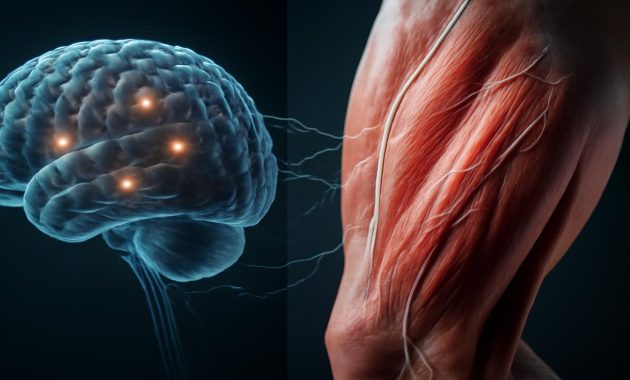
The lab smelled faintly of coffee and disinfectant the morning the mice started remembering again. On the screen, tiny gray bodies scurried confidently through a maze they had stumbled through only days before. A young neuroscientist leaned closer, squinting at the data feed from the sensors strapped to each small ribcage. Their brains hadn’t been touched. No new drugs, no gene edits, no shock of electricity. The only thing that had changed was… their muscles. Or more precisely, how those muscles were being used. Somewhere between the treadmill and the maze, a quiet revolution had begun.
The strange idea scientists couldn’t ignore
For decades, Alzheimer’s disease has been framed as a story about the brain alone—a tragedy of plaques and tangles, of misfolded proteins and dying neurons. The main characters were always locked inside the skull. We searched there relentlessly: microscopes probing brain slices, clinical trials firing drug after drug at amyloid and tau, each new failure deepening the sense that the enemy was both clever and relentless.
But beneath that spotlight, something else was happening in the shadows of the body. Epidemiologists kept noticing a baffling pattern in giant data sets: people who moved more—who walked, lifted, stretched, gardened, cleaned, danced—seemed to lose their memories more slowly. Their brains aged differently. Even when they carried genes that stacked the odds against them, their risk softened if their days were stitched together with motion.
At first, exercise was treated like a footnote. “Good for overall health,” the papers would say, in the same generic tone reserved for “eat more vegetables.” Neurologists, trained to think in synapses and neurotransmitters, nodded politely and went back to their microscopes. But then the data became too strange to ignore. Some people with heavy genetic risk and alarming brain scans—brains that looked primed for decline—were somehow functioning almost normally. They had one thing in common: strong, well-used muscles.
What if, a handful of scientists began to whisper, the real story didn’t start in the brain at all? What if the most accessible lever against Alzheimer’s was hidden in the very tissue we use to climb stairs, carry groceries, and hug our children?
The muscle–brain conversation we didn’t know existed
Once upon a time, muscles were considered simple engines—pulling, pushing, helping us move through the world. But over the last decade, a different picture has emerged, one that feels less like machinery and more like a secret messaging network. Muscles, it turns out, are also endocrine organs. When they contract, they don’t just burn calories; they speak. They send out chemical messages—tiny whispering molecules called myokines—that travel through blood, slip past barriers, and knock on the doors of distant organs, including the brain.
In one lab, a researcher squeezes a pipette and releases a clear droplet containing irisin, a myokine that muscles release during exercise. In brain cell cultures, this molecule coaxes neurons to grow longer branches, to strengthen their connections, almost like fertilizer for the mind. In mice genetically engineered to develop Alzheimer’s-like pathology, irisin and other exercise-induced signals seem to protect against memory loss, dampening inflammation and helping sweep away toxic proteins.
These myokines don’t care whether the contraction comes from a bike ride, climbing stairs, or slow, deliberate squats beside a kitchen counter. To the brain, a contracting muscle is like a hand-written letter from the body saying: “We are alive. We are moving. Adapt, repair, remember.”
Suddenly, the old idea that “exercise is good for the brain” feels almost comically incomplete. Muscles are not just support staff for your skeleton; they are active partners in your brain’s survival. And if they are partners, then losing them—through age, inactivity, or illness—may be far more dangerous than we ever realized.
The secret timeline inside your body
Stand in front of a mirror and flex your arm. You might see definition or softness, strength or a story of injury. What you don’t see is the timeline written underneath the skin. Starting in our 30s, most of us begin losing muscle mass little by little. By our 60s and 70s, that quiet decline gathers speed. The medical term is sarcopenia, but the lived experience is gentler and more insidious: the bag of groceries that suddenly feels heavier, the stairs that make you pause halfway, the jar lid that will not yield.
We often talk about this as if it were mainly about independence—about staying able to dress ourselves, cook, drive. But there’s another parallel storyline unfolding. As the muscles shrink and weaken, their chemical voice also fades. Myokines trickle instead of rushing. A once-lively endocrine conversation becomes a stuttering, half-forgotten call.
In population studies, this physical timeline and the cognitive one begin to braid together. People who lose muscle faster, especially in the legs and hips, tend to show sharper declines in memory, planning, and attention. Slower gait predicts higher dementia risk years before diagnosis. Not because walking speed itself is magical, but because it’s a crude, visible marker of the hidden health of your muscle–brain axis.
To researchers, it started to look less like a coincidence and more like choreography. As the body moves less, the brain receives fewer protective signals. As the brain struggles, the coordination and motivation to move also slip. Two great systems—muscular and neural—begin to spiral downward together. But if that’s true, then maybe the spiral is not inevitable. Maybe it’s a feedback loop that can be nudged, interrupted, even reversed.
Is the cure in a dumbbell or a pill?
In a world hungry for shortcuts, it didn’t take long for the pharmaceutical dream to emerge: What if we could bottle this? A pill that mimics exercise. A capsule of myokines that stand in for muscles we no longer have or no longer use. Some labs are already chasing it. They drip irisin onto neurons in dishes, inject muscle-derived factors into Alzheimer’s-prone mice, and watch for flickers of protection.
The results so far are tantalizing but incomplete. A molecule can nudge a pathway, but it can’t fully replace the rich symphony of signals released when a real human body moves through real space. Exercise doesn’t just release one myokine; it orchestrates dozens, maybe hundreds, whose interactions we barely understand. And it doesn’t just change blood chemistry; it alters blood flow, hormone levels, immune responses, even the microbial citizens of our gut—all of which feed back into brain health.
Yet the pharmaceutical angle matters, because not everyone can move easily. There are people already deep into frailty, those with advanced disease, those confined by injury or environment. For them, a drug that amplifies the muscle–brain signal might provide a precious second chance—a way to turn up the dimmed volume of the body’s natural protection. But for the rest of us, still capable of standing, bending, lifting, the more unsettling question is: why are we waiting for a pill to do what our legs and arms are begging to do for themselves?
What a brain-friendly day actually looks like
Imagine two mornings.
In the first, you wake up, shuffle to the kitchen, and sink into a chair. Hours pass in the gentle glow of a screen. Your muscles mostly hum at idle, doing the bare minimum required to keep you upright and breathing.
In the second, the alarm goes off and you swing your legs out of bed. You stand, stretch, maybe hold the back of a chair and do ten slow squats, feeling your thighs burn slightly. You walk around the block, even if it’s chilly, even if it’s only for ten minutes. Later, you carry a heavy bag of groceries up the stairs instead of taking two trips. In the evening, you put on music and dance in your living room, badly but joyfully.
On paper, the difference is small. No marathons, no gym selfies, no biohacking heroics. But inside your body, the second day is radically different. Muscle fibers contract and release in rhythmic waves. Myokines surge into your bloodstream. Blood flow to the brain increases. Inflammation dips. Synapses—those tiny gaps where memories are encoded—become a little more likely to strengthen instead of wither.
The magic is not intensity; it is consistency. Your brain doesn’t need you to chase pain or punishment. It needs you to tell your muscles, regularly and gently: “You are still needed. Stay.” In response, they keep sending those invisible letters north, day after day, year after year.
| Daily Choice | Muscle Effect | Possible Brain Benefit |
|---|---|---|
| Taking stairs instead of elevator | Engages large leg muscles | Boosts blood flow, myokines, alertness |
| 10–15 minutes of brisk walking | Sustained muscle contractions | Supports memory and mood regulation |
| Light strength work (squats, wall push-ups) | Builds and preserves muscle mass | May enhance resilience to cognitive decline |
| Breaking up long sitting periods | Prevents muscles from “shutting down” | Helps regulate blood sugar and inflammation |
Listening to the body before the brain cries out
If the story of Alzheimer’s begins earlier and farther from the brain than we thought, then the warning signs may, too. Before names blur and appointments are forgotten, something quieter often shifts: posture, pace, balance, confidence on uneven ground. A once-brisk walker slows. A once-steady hand hesitates on the railing. We chalk it up to “just getting older,” as if age itself were a diagnosis rather than a description.
Yet emerging studies suggest that changes in muscle strength and walking speed can precede measurable cognitive decline by years. The body, in its own language, may be nudging us long before the brain’s distress becomes obvious. “Do not ignore this,” it seems to say, in the small stumble, the rising effort of standing up, the fatigue that settles in too early in the day.
Responding doesn’t require a full reinvention of life. It may mean asking: When was the last time I felt physically challenged in a way that was safe but real? When was the last time my heart rate rose on purpose? When did I last feel my muscles wake up and complain a little the next morning?
The answers to these questions are different at 30 than at 80, but the principle is the same: muscles are like honest friends. Ignore them and they grow quiet, then distant. Pay attention—gently, regularly—and they return with stories, with energy, with that stream of biochemical care packages for your brain.
A new kind of prevention story
For many families touched by Alzheimer’s, prevention can feel like a cruel word. It arrives too late, after the forgetting has already begun, after the personality shifts and quiet grief have settled in the rooms of the house. But prevention is not only about the people who are still fully healthy. It’s also about slowing what’s already in motion, drawing out good years, stabilizing the ground beneath those whose steps are already less sure.
In memory clinics, some practitioners are starting to add a new kind of prescription to the usual list of blood tests and brain scans: walking programs, supervised strength training, balance classes. They are modest, often undersold. But families sometimes notice unexpected changes: a parent who starts chatting more on walks, a partner whose mood brightens on days when they move, a grandparent who, after a few months of gentle training, suddenly feels confident stepping off a curb again.
Is this a cure? No. Muscles alone will not erase Alzheimer’s. But they may reshape its trajectory. If you think of the disease as a long, sloping hill, movement and muscle preservation may soften that slope, stretching the plateau before the steep descent. In that extended middle ground live years of conversation, shared meals, familiar jokes, the small daily rituals that make a life still recognizably yours.
Reimagining what it means to “train your brain”
We live in an age of brain games and cognitive apps, of puzzles promising to sharpen focus and stave off decline. There’s nothing wrong with challenging your mind with crosswords or learning a new language—those, too, build resilience. But the idea of “brain training” is incomplete if it never leaves the chair.
In the story emerging from labs and clinics now, training your brain might look surprisingly physical. It might look like standing on one leg while brushing your teeth to work your balance. It might look like brisk walks where you deliberately vary your route, forcing your mind to navigate, judge distances, note landmarks. It might look like learning a simple dance sequence that asks your muscles and neurons to collaborate in new patterns.
For some, it might look like lifting weights, feeling the bar or dumbbells remind dormant fibers that they have not yet retired. Strength training, once the domain of athletes and bodybuilders, is quietly being recast as a neurological intervention. Studies suggest that resistance work can improve executive function, processing speed, even structural aspects of the brain. Not by magic, but by waking up that vast chemical conversation between muscle and mind.
And there’s another layer, quieter but powerful: the psychological shift that comes from feeling physically capable. Alzheimer’s does not only erode memory; it can erode a sense of self. Movement—especially movement that builds strength—gives a counter-narrative: My body can still learn. I can still adapt. I am not only what I am losing.
Where science meets the small, stubborn choices of daily life
In a conference hall somewhere, a slide glows on a massive screen, summarizing years of research into a few bullet points and curves. One line shows the projected explosion of dementia cases worldwide. Another, thinner but hopeful, shows how even modest improvements in physical activity across a population could bend that curve down.
Those lines can feel abstract, but they’re built from the most ordinary raw material: the decision to take a ten-minute walk after dinner instead of reaching for the remote; the willingness to practice standing from a chair without using your hands; the courage, at 75, to show up to a balance class full of strangers and wobble proudly anyway.
So what if the key to fighting Alzheimer’s isn’t exclusively in the brain? What if it’s also in your quadriceps, your calves, your glutes; in the grip strength of your hands and the endurance of your back; in every fiber that still answers when you ask it to work a little?
In the end, this perspective doesn’t diminish the importance of brain-focused research. We still need better drugs, better diagnostics, deeper understanding of the tangled biology inside the skull. But it broadens the battlefield. It says: the fight for your mind might start much earlier, every time you stand up, step out, and let your muscles speak on your brain’s behalf.
Tomorrow morning, when you wake and feel the familiar weight of your body against the mattress, you might pause for a moment. Feel your legs, your arms, your core. Consider that you are not just lying there; you are carrying around one of the most accessible, powerful tools we currently know for protecting the thing you treasure most—your ability to remember, to recognize, to be yourself.
Then, perhaps, you swing your legs over the edge of the bed. You stand. You take a few deliberate steps. Somewhere deep inside, a muscle fiber contracts, a myokine is released, and a silent message begins its journey toward your waiting brain.
FAQ
Does exercise really reduce the risk of Alzheimer’s disease?
Regular physical activity is strongly associated with a lower risk of cognitive decline and dementia. While it doesn’t guarantee prevention, people who move more—especially combining aerobic and strength activities—tend to maintain memory and thinking skills longer than those who are mostly sedentary.
Is strength training more important than cardio for brain health?
Both matter, and they work in different but complementary ways. Aerobic exercise supports blood flow and cardiovascular health, while strength training helps preserve muscle mass and the myokines muscles release. A mix of both seems to offer the best support for brain health.
How much movement do I need to support my brain?
Research often points to around 150 minutes per week of moderate activity, plus two or more sessions of strength training. But any increase from a very low baseline can help. Even short, frequent bouts—5 to 10 minutes at a time—are better than long stretches of complete inactivity.
Is it ever too late to start?
No. Studies in older adults, including those with mild cognitive impairment, show benefits from starting exercise even in later life. Improvements may appear in mood, balance, daily function, and sometimes in aspects of thinking and memory. The key is to start gently and safely, ideally with guidance from a healthcare professional.
What if I have mobility issues or a chronic condition?
Movement can almost always be adapted. Chair exercises, water-based activities, physical therapy, or supervised programs can help you engage muscles without overstraining joints or triggering symptoms. Talk with your doctor or a physical therapist to design a plan that matches your abilities and limitations.
Can exercise replace Alzheimer’s medication?
No. If you or a loved one has been prescribed medications for cognitive symptoms, don’t stop them without medical advice. Think of movement and muscle preservation as powerful companions to medical treatment, not substitutes.
What’s the single best first step I can take?
Pick something small and realistic you can repeat most days: a 10-minute walk, a set of sit-to-stands from a chair, or gentle balance drills while holding a countertop. Let it become a habit. Once your body and brain trust that you’ll keep showing up, you can build from there.