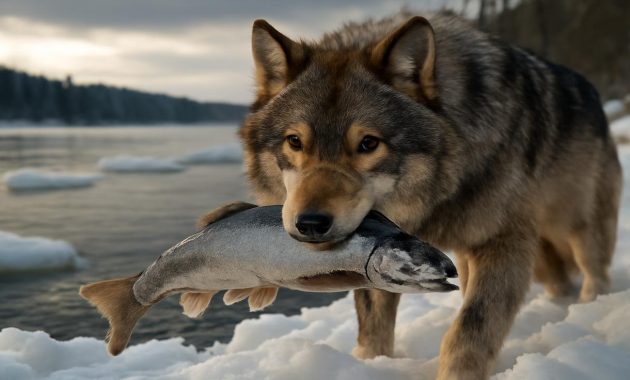
The wolf appeared just after sunrise, when the mist still clung low over the lake and the aluminum boat on shore was beaded with cold droplets of last night’s dew. At first, it was only a shadow between the leaning spruce trunks—a subtle rearranging of the forest’s gray and green. Then it stepped into the open, and the morning, for one biologist watching from a hidden blind, tilted on its axis.
The wolf moved with the easy confidence of an old local. His coat was brushed with silver along the shoulders, dark along the spine, legs dipped in pale tan, like he’d stepped too far into a painter’s wash. He paused beside the water’s edge, nose lifted, reading the air. Somewhere out across the still surface, loons called their long, wavering notes, each one ricocheting off the rock walls of the distant shore. A raven croaked from a snag overhead. The lake smelled of cold and algae and fish scales baked onto weathered wood.
From the blind, half veiled by cedar boughs, Dr. Rowan Muir watched through binoculars and tried not to breathe too loudly. He had come to this remote bay in northern Canada to study wolves and their food habits at the edge of human influence, not to witness a story that would have him questioning where the line between wild and human ingenuity truly lies.
The Lake, the Line, and the Trap
The human device the wolf had come for was hardly high-tech. No blinking lights. No motors. Just a simple mechanical trap that had been used on Canadian lakes for generations—a heavy wooden fish box, a kind of underwater pantry anchored near shore, designed to keep caught fish alive and safe from scavengers until the fisher returned.
The idea was straightforward: catch walleye and lake trout in gill nets stretched along the drop-off, then move the still-living fish into the submerged box, which floated just below the surface, chained to a stout birch post on shore. Only a human hand, gripping the rope from the dock and hauling the box up, was supposed to retrieve the meal inside.
Muir knew the system well. He’d grown up on lakes like this, where early mornings meant the slap of wet rope on cold metal, the smell of fish blood and outboard exhaust mixing as his father checked nets along the shimmering line where sky met water. Out here, several days’ travel from the nearest paved road, he was using the same style of fish box as a controlled attractant—a way to see if wolves would be curious about concentrated fish scent while he monitored them from a concealed perch.
The prevailing theory among the team had been that wolves might sniff around the box, maybe learn to patrol the shoreline in hopes of scavenging a fish or two left behind by humans. After all, wolves were opportunists, adaptable hunters with a long history of taking advantage of whatever the landscape—and people—offered.
But what no one expected was for a wolf to look at a device designed explicitly around the limits of animal access and see not a barrier, but a puzzle.
A Gray Figure in the Mist
The wolf approached the birch post with the casual intimacy of an animal that had done this before. He didn’t waste time staring at the fish box itself—the square, shadowy outline bobbing under the surface a few meters away. Instead, his attention went straight to the line.
Muir, watching through the lenses, felt his fingers tense. The rope tied to the fish box was thick, rough, and soaked; it stank of fish, algae, and human hands. The wolf pressed his nose against it, inhaling deeply. Then, surprising even in its delicacy, he opened his jaws and took the rope gently between his teeth.
At first, the biologist assumed he was just mouthing it, testing. Wolves chew things all the time—branches, bones, even old boots lost from canoes. But the angle of the wolf’s neck shifted, his shoulder muscles bunched under his coat, and suddenly the rope twitched. The fish box bobbed.
He was pulling.
The wolf leaned backward with a smooth, steady motion, paws braced in the damp moss at the lake’s edge. Each pull sent tiny ripples across the surface. The box squeaked, wood against metal staples and the soft knock of fish tails inside, a faint, watery drumming. Once, twice, three times he tugged, adjusting his grip between heaves, almost like a dock worker hauling a line into place.
The box rose slowly, slipping up the water column until its slatted lid broke the surface. A wave of fish scent rolled shoreward—bright, metallic, impossible to ignore.
Then came the part that would keep Muir awake that night, replaying in his head.
Not Just Instinct: A Wolf Solving a Problem
The wolf released the rope and moved to the water’s edge, studying the bobbing crate from a new angle. His paws sank into the mud; water lapped at his toes. He seemed to weigh options. Muir could see the wolf’s ears tilt forward and back, his eyes tracking the motion of the fish inside the box as they flashed silver between the slats.
Instead of immediately trying to chew through the wood, or claw randomly at the sides, the wolf shifted to the chain that tethered the box to the birch post. He sniffed along the length of it, then tested its tension with a careful tug. When it wouldn’t give, he circled back to the rope on shore.
Again, he took it in his teeth. This time, he didn’t just drag. He angled his head and walked up the slope a few steps, using elevation to his advantage, like someone who has learned that pulling upward is easier than hauling straight back. The box scraped against the rocks below and slid closer to shore until one corner bumped the bank.
The wolf dropped the rope and stepped onto the half-submerged crate, testing its balance with a cautious forepaw. The wood rocked but held. Slowly, he leaned his weight forward, using his chest to pin it against the bank, stabilizing it. Then, with one quick movement of his muzzle, he found the weak point: the gap at the lid’s corner, where the rope tie-down left a small opening.
His jaws disappeared inside. There was a wet thrash, the slap of fish tail against wood, and then he stepped back, a large walleye clenched sideways in his mouth.
For a heartbeat, both wolf and scientist were motionless. One at the forest’s edge with his prize, the other frozen in the shadows, barely daring to blink. Then the wolf trotted off into the trees with the fish, vanishing into the green as if he’d only plucked a berry from the shore.
He returned twice more within the hour.
When Science Expects One Thing and Sees Another
Later, when Muir and his colleagues reviewed their notes and videos, the conversation kept circling back to the same question: was this luck, or learning?
Wolves are known to scavenge from human sources. In some coastal areas, they patrol beaches for dead salmon, raid old dump sites, and occasionally test fish nets left unattended. But physically operating a human device designed specifically to keep animals out—hauling it up in precisely the same way a person would, bracing it, finding the only workable gap—crossed an invisible threshold.
This wasn’t just opportunism. It looked like problem-solving.
What made the scene more startling was that the team had evidence this wasn’t the wolf’s first attempt. Tracks around the birch post were layered, pressing one another into a story of repeated visits. Bite marks on the rope showed different depths and angles. On the underside of the lid, old scratches laced the wood: trial and error etched into the crate itself.
Somewhere in the recent past, this wolf—or perhaps several members of his pack—had encountered the fish box, smelled its promise, and failed to access its contents. That failure hadn’t taught them avoidance. It had become a lesson in mechanics.
So when he padded down to the shore that morning, that wolf wasn’t acting out a random sequence of instincts. He was executing a strategy he had already refined—one shaped not only by the shape of his teeth and hunger in his belly, but by his memory of what had worked before.
How Wolves Learn the Human Landscape
For years, wolf biologists across Canada have been documenting a slow, subtle shift: wild wolves becoming more and more adept at threading their lives through the weave of human presence. Unlike the blunt conflict narratives that tend to dominate headlines—wolves versus ranchers, wolves versus hunters—most of these adaptations are quiet, even invisible.
They are wolves timing their travel to avoid busy roads at rush hour. Wolves using plowed logging roads as winter highways, saving energy as they trot along the hard-packed corridors humans carved. Wolves shifting their diet to include road-killed deer and moose, garbage left at seasonal camps, and fish guts tossed from boats into the shallows.
Yet there is a difference between exploiting leftovers and actively working with a human-made system.
Think about what that fish box represented to the wolf on that northern lake. Here was a consistently stocked food cache, always located in the same place, always anchored to the same post. The box didn’t just offer one meal; it represented a pattern. To see that pattern, remember it, and develop a method to access it is to write the first lines of a new kind of relationship between wolf and tool—one that humans never intended to author.
From the outside, his actions might look simple: pull rope, pin box, grab fish. But each step hinged on an understanding of cause and effect, on a mental map of “if I do this, then that happens.” While we often reserve such language for primates or corvids, moments like this nudge us to examine just how tightly we’ve been drawing the borders around animal intelligence.
| Observation | What It Suggests About the Wolf |
|---|---|
| Repeated visits to the fish box area | Long-term memory of a reliable food source |
| Pulling the rope the same way humans do | Understanding of cause and effect, task learning |
| Adjusting body position to gain leverage uphill | Spatial awareness and problem-solving |
| Targeting the corner gap in the lid | Attention to weak points and fine motor precision |
| Returning multiple times in one morning | Exploiting success and optimizing effort |
What a Fishing Wolf Means for the Future of “Wild”
Stories like this one have a way of unsettling our categories. We like tidy lines: here is the human world with its boats and traps and cities; there is the wolf world with its howls and hunts and dens tucked between tangled roots. Yet in reality, those worlds have been overlapping for a very long time, and the overlap is growing wider.
When a wolf figures out how to operate a human fishing device, it hints at a not-so-distant future where more wild animals will be navigating our infrastructure as if it were simply another feature of their environment—like rivers, cliffs, or storm-fallen trees.
That future is already taking shape. Urban coyotes wait at crosswalks and look both ways before crossing busy streets. Black bears in some towns have learned not just to tip over garbage cans but to open the latches. Ravens unzip backpacks left unattended at trailheads. And now, somewhere on a northern lake, a wolf hauls up a fish box while the loons call and a scientist’s heart hammers in his chest.
For conservationists, the implications are both thrilling and sobering. On one hand, recognition of animal intelligence can help foster deeper respect. It’s harder to reduce wolves to villains or symbols when you’ve watched one think. On the other, smarter use of human resources by wild animals can lead to new conflicts: wolves raiding fish boxes could frustrate local fishing communities, just as bears in garbage do.
The challenge will be to recognize that these behaviors are not moral transgressions but logical responses to opportunity. If a landscape offers a reward and an animal is capable of learning how to claim it, it will. Our task becomes designing systems that minimize dangerous overlaps while leaving room for wild minds to exist, experiment, and surprise us.
Sitting with the Mystery
After the wolf disappeared into the forest for the final time that morning, the bay felt strangely changed. The same green shadows pooled beneath the spruce, the same dragonflies stitched the air above the shallows with their fine, glassy wings. Yet something in Muir’s understanding of what it meant to be “wild” had quietly, irrevocably shifted.
He stepped out from the blind with slow care, boots whispering through the moss. The rope lay in a damp coil where the wolf had dropped it. On the lid of the fish box, muddy paw prints smudged the wood—four-toed signatures stamped at the edges. Inside, only a couple of smaller fish remained, stunned and circling.
Muir lowered himself onto a rock and listened. In the distance, a faint howl rose, then faded, absorbed by acres of forest that had watched wolves and humans shadow one another for centuries. He thought about the early stories he’d read as a child, tales of wolves as monsters or simple creatures of hunger. He thought about how long it had taken science to catch up with the idea that a wolf’s life might include moments of curiosity, experimentation, and even quiet calculation.
He also thought, less comfortably, about all the times a wolf might have been watching from the trees as he handled nets and lines and boxes, about what might have been learned in those unrecorded hours.
The idea of being studied back by the animals we study is still unsettling for many of us. We prefer ourselves in the role of observer, the one with the notebook and the camera. But perhaps one of the quiet gifts of a wolf hauling a fish box from a Canadian lake is precisely this reversal. It reminds us that we are being woven into the mental maps of other species all the time. We are not just watching them adapt; we are part of the curriculum.
Questions in the Wake of Paw Prints
As news of the event spread through scientific circles, researchers began to trade stories—half-remembered field notes about wolves testing cabin doors, tugging at snare lines, or repeatedly checking specific campsites after learning that humans sometimes left food behind. Few incidents had been documented as cleanly as the fish box episode, with clear video and a known setup, but the patchwork of tales began to look like the outline of something larger.
Is this kind of problem-solving rare, the mark of a particularly innovative wolf? Or is it more common than we realize, happening all the time just beyond our line of sight?
Do such skills spread socially, with pack members watching and learning from one individual’s success? Will pups in that northern territory grow up seeing fish boxes not as mysterious floating objects, but as solvable challenges, no more strange than a fallen log across a creek?
Each question branches into others, like the tributaries that feed the big cold lakes of Canada’s north. Behind them all sits a quieter, deeper question: what would it mean for us to accept that “wild” animals are not just reacting to us, but actively thinking their way through the world we have made?
For now, the wolf on the lake remains a single, vivid story—a set of muddy prints on wet wood, a rope tugged taut between species, a line thrown across the gap between our expectations and reality. Tomorrow, another wolf on another shoreline may be puzzling over a new device, nose twitching, eyes bright, testing the edges of the possible.
Somewhere, a scientist might be watching. Or not. The story will unfold either way.
FAQ
Did the wolf really understand how the fishing device worked?
The wolf likely didn’t “understand” the device in a human, mechanical sense, but his actions strongly suggest he grasped the basic cause-and-effect: pulling the rope brought the box closer and up, and stabilizing it allowed access to fish inside. That level of problem-solving goes beyond simple instinct.
Is this kind of behavior common in wolves?
Wolves are known to be highly adaptable and curious, but clear, documented cases of them operating human devices like fish boxes are still relatively rare. Many biologists suspect similar events happen more often than we realize, simply without observers present.
Could other wolves in the pack learn this trick?
Yes. Wolves are social learners. If pack members observe one individual successfully accessing a food source, they may copy the behavior. Over time, this could turn a single innovation into a shared skill within a pack or territory.
Does this mean wolves are becoming “too smart” around humans?
Wolves are not becoming “too smart,” but they are adapting to opportunities and risks in landscapes altered by humans. Their intelligence is part of their natural survival toolkit. Conflict arises when our systems provide easy rewards without considering how wildlife might logically respond.
What can people do to reduce conflicts with intelligent predators like wolves?
People can secure attractants—such as fish, garbage, and livestock remains—so they’re not easily accessible; use wildlife-safe storage and deterrent systems; and plan activities with an understanding that predators learn quickly. The goal is to design human practices that don’t invite animals into risky situations in the first place.