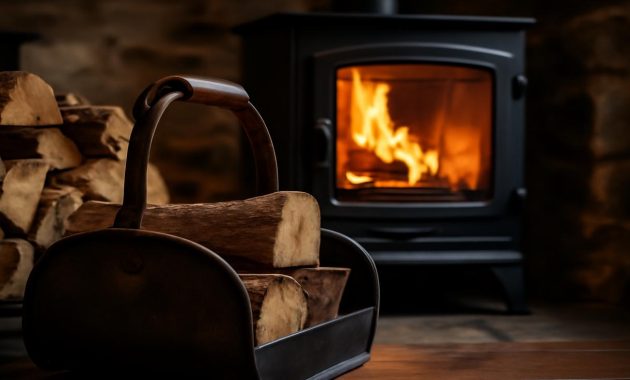
The first cold night arrived softly, without fanfare. Just a thin film of frost on the grass, a silvering of the garden, and the kind of breath that turns to ghosts in the air when you step outside. Inside the house, the rooms held that faint, late-autumn chill—the one that makes you tuck your hands into your sleeves and move a little quicker toward the corner that matters most: the wood-burning stove. It sits there like some quiet, iron-hearted animal, squat and patient, surrounded by stacked firewood, kindling, and the small rituals that turn simple heat into something more like companionship.
The Gravity of a Wood-Burning Stove
A wood-burning stove changes the way a room behaves. It has its own pull, its own orbit. Furniture drifts closer over the weeks as the temperature drops: an armchair inches inward, a basket of blankets appears, a low stool sidles up for resting tea mugs and half-read novels. Inevitably, the firewood follows, the chopped logs once banished to the far corner of the yard now coming inside, gaining status and ceremony.
If you’ve ever heated with wood, you know this dance. You don’t just “turn on” a wood stove; you build a small world around it. You place kindling within reach but not in the way. You find the perfect spot for the ash bucket, so close you can tilt the door and sweep embers into it, yet far enough that you won’t kick it in the dark. And then there’s one particular object—functional, a little magical—that belongs near your stacked firewood more than anything else: the wood-burning stove itself, standing as the warm heart around which every other object organizes.
It’s easy to think of the firewood as the star—the muscle doing the work. But the stove is the mind, the vessel, the place where raw winter fuel turns into stories, conversations, and sleepy afternoons. Place it well, and everything about living with wood heat becomes not just easier, but strangely more beautiful.
The Art of Where You Place the Heat
Before the first log ever crackles, there’s a thinking stage. You walk the room, maybe even the whole house, looking for the exact spot that will carry this iron presence. You notice wall clearances for safety, of course, and the path of heat through the space. But there are softer considerations, too: where the morning light lands, how the view shifts from the kitchen doorway, where you naturally pause to talk, read, or shrug off your day.
Many people tuck their stove slightly off-center, near an interior wall, with firewood neatly stacked just to the side—close enough that you can reach out for another log without much ceremony. Not too close, though; dry wood likes warmth, but there’s a line between warmed and scorched, and nobody wants a stack of kindling that’s already halfway to charcoal before it ever meets a flame.
Imagine it like this: your stove is the campfire, and the firewood is your gathered brush, piled not at your feet, but within an easy, almost lazy arm’s length. You want the rhythm of tending to the fire to feel natural. Open the stove door, lean to the side, hand finds wood, log meets coals, door closes. Quiet, simple, practiced. No stomping out to a cold porch in your socks at midnight because you misjudged how long the last loading would last.
There’s also the sound to consider. A wood-burning stove doesn’t roar like an open fireplace; it murmurs. It pops, clicks, sighs a little through the flue. That soundtrack is much richer when the stove isn’t exiled to an awkward corner or jammed into the narrowest wall. Center it in your daily life, and you’ll find your own habits slowly orbiting toward it: the place where you lace your boots, sip your first coffee, or stretch aching hands after coming in from the cold.
Creating a Safe and Beautiful Perimeter
For all its romance, a wood-burning stove is still a box of fire in your house. The way you place things around it matters—not to make the room look like a design magazine spread, but to keep the joy of the stove untroubled by worry.
Start with space. Every stove has manufacturer guidelines for clearances—how far it should be from walls, furniture, and anything combustible. Respect those numbers like you’d respect deep winter ice: they are non-negotiable. That includes your firewood. Yes, stacked wood looks timeless and cozy near a stove, but it needs its own bubble of safety, especially if you like to keep a generous supply nearby.
Picture a ring around the stove where only metal and stone are allowed—stove tools, hearth pad, ash bucket, maybe a kettle for humidifying the winter air. Just beyond that ring, where the radiant heat softens into a gentle warmth, that’s the domain of firewood. Not piled high like a barricade, but arranged with intention: a low stack in a metal rack, a woven basket of split logs, maybe a wooden crate repurposed and sanded smooth, positioned so the grain and bark become part of the room’s texture.
Safety lives in the quiet details: a tight-fitting stove door, a fire extinguisher discreetly tucked nearby, a metal bucket with a lid for ashes that might smolder unseen. In the day-to-day flow of tending the fire, those quiet details make the difference between an intimate, trustworthy heat source and something you’re always slightly on edge around.
The Object That Changes the Whole Room
Stand back from your stove and firewood for a moment—just a step or two, enough that you’re seeing the whole scene. It’s more than functional heat; it’s a landscape. Dark iron, pale ash, the honeyed ends of split oak or maple, a hint of red embers through the small glass window. The air near it has a smell: resin, smoke, that faint ghost of the forest, transformed.
The stove is the anchor that lets everything else feel intentional. Firewood stacked alone in a corner looks temporary, like a job half done. But firewood placed beside a stove becomes a promise: of evenings ahead, of stories, of slow meals and unhurried hours. It’s less like fuel and more like potential.
In many old houses, you can still see the imprint of this kind of placement. Floors worn smooth in a semicircle in front of where the stove once sat; walls slightly discolored from years of radiated heat; a window whose curtain is ever so slightly more faded where the afternoon light used to mingle with the glow of coals. Today’s stoves might be sleeker, more efficient, paneled with soapstone or enamel, but their role is still ancient. They turn the center of the home into a place where time slows down.
Rows of firewood catch the light differently as the day moves. In the morning, the cut ends might glow warm and pale, almost golden; at night, they darken and recede, just faint outlines in the periphery as the stove itself becomes the visual anchor, its glass eye burning amber. Nearby, your favorite chair slides a little closer. The dog discovers the warmest patch of floor. Someone in the house begins to measure their day not by the clock, but by the burn: morning kindling, afternoon reload, the gentle, final bank of coals before bed.
Designing a Little Ecosystem Around the Fire
There’s something deeply satisfying about arranging the small orbit of objects around your stove and firewood stack. It becomes an ecosystem of warmth and usefulness, each thing earning its place. Some people keep it strictly minimal: a steel log rack, a poker, tongs, maybe a single leather glove draped over the handle. Others let the space soften into lived-in comfort: baskets piled with wool blankets, a low stool or trunk, a small lamp throwing a pool of light just beyond the stove’s radius.
The placement of your firewood near the stove becomes the backbone of that ecosystem. Too sparse, and you break the spell with frequent trips outside. Too chaotic, and the room starts to feel cluttered, the line between practical and haphazard blurring uncomfortably. Somewhere in the middle is that sweet spot: a stack large enough that you can relax into the evening, small enough that it feels intentional and cared-for.
Think in layers. On the floor, you might have a hearth pad of stone or tile, extending just past the stove door, wide enough to catch the occasional runaway ember. Right behind that, your main wood rack: a low, stable frame that keeps logs dry, lifted off the floor so air can move around them. Closer to arm’s reach, perhaps a smaller basket or carrier for the next few logs—tonight’s heat, the immediate future. Nearby, but not crowding the view, a set of tools and that essential ash bucket. Each object has a job, each one in quiet relation to the others.
Here’s a simple way to think about the arrangement:
| Item | Ideal Distance From Stove | Primary Purpose |
|---|---|---|
| Main firewood stack | 60–90 cm from sides or back | Keeps several hours of fuel within easy reach |
| Small log basket | 30–60 cm from front or side | Holds the next few logs for immediate use |
| Stove tools | 20–40 cm from stove body | Safe handling of fire and coals |
| Ash bucket (with lid) | 40–80 cm away, non-combustible surface | Safe collection and cooling of ashes |
| Seating area | 1.2–2 m from front | Comfortable warmth without overheating |
These aren’t rigid rules as much as starting points. Every room is different, every stove throws heat in its own way. You’ll learn quickly by feel—by how often you find yourself swiveling in your chair to tend a log, by whether the back of your neck gets too hot when you sit in your favorite spot.
Sensory Seasons Beside the Stove
Once your stove is in place and your firewood has found its natural spot nearby, the real relationship begins. It’s not just about warmth; it’s about the loop of seasons made visible and tangible in the corner of your living room or kitchen.
On deep winter evenings, the air outside is brittle and thin, but inside, the warmth from the stove is thick and mellow. You hear the creak and soft ticking as the stove metal expands, the occasional sleepy crack from a log as it settles deeper into coals. Every trip to the wood stack becomes a minor ceremony: you feel the dry, ridged bark under your fingers, catch the sawdust-and-rain smell that clings to each piece. In those moments, the connection to the forest is right there, in your hands, feeding the small, controlled blaze.
By late winter, when the snow begins to withdraw in sullen, dirty heaps, you’ve learned your stove’s moods. You know exactly where to stand to warm your spine, how many logs will carry you until dawn, whether that last armful of birch is better saved for a leisurely Sunday morning burn. Your indoor firewood stack shrinks, then swells again when you haul in a fresh load, each rise and fall a small barometer of the season.
Even in autumn and early spring, when the stove works only in the evenings or on damp days, its presence shapes the room. You might find yourself glancing at the firewood, gauging the sky, thinking, “Tonight might be a stove night.” The first fire in fall is always a little ceremony; the last one in spring, a quiet farewell. Through all of it, the stove and the wood sit there, side by side—one the instrument, the other the score.
Living Slower, One Log at a Time
There is a pace to life with a wood-burning stove that no thermostat can replicate. You can’t just tap an arrow on the wall and wander away. You have to notice: the color of the flames, the thickness of the coals, the way the room temperature drifts over an hour. You have to plan a little, carry a little, tend a little. All of that begins with how you’ve placed the stove and firewood together.
When the logs are stored just right—close yet safe, orderly yet not precious—you remove friction from the ritual. Want to encourage conversation at night instead of screens? Build the evening around the stove. Want to remember the weather as more than a number? Let your body feel the difference between a three-log cold snap and a single-log mild night.
In a world where so much of our environment hums along automatically, unasked and unnoticed, a wood-burning stove demands your presence in the smallest, kindest ways. It asks you to step outside to fill the log carrier, to bend and reach into the rack, to listen for the moment when the fire needs a little more. It anchors you, gently, to place and season.
And in that soft, flickering corner of the room, where iron meets flame and wood balances in a neat stack within easy reach, the ordinary act of staying warm becomes something almost like a conversation—with the house, with the weather, with the landscape that grew the trees. The stove is the object you place near your firewood, yes. But over time, it becomes much more: the quiet, radiant center your days and nights naturally roam toward, again and again, whenever the air outside turns sharp and the light fades early.
FAQ
How close can I safely store firewood to my wood-burning stove?
Firewood should generally be kept at least 60–90 cm away from the stove, depending on your local codes and the stove manufacturer’s recommendations. The immediate zone around the stove is for non-combustible items only—tools, hearth pad, ash bucket—not stacked wood.
Should I keep all my winter wood inside near the stove?
No. Keep the bulk of your firewood outdoors in a dry, ventilated area. Indoors, store only what you’ll realistically burn over a day or two. This prevents clutter, reduces pests, and keeps the room feeling intentional rather than crowded.
What kind of container is best for holding firewood near the stove?
Sturdy, open containers work best: metal racks, log cradles, or strong baskets. They should allow airflow so the wood stays dry and should be stable enough not to tip when you pull out a log. Avoid lightweight plastic near the stove, as it can warp or melt.
Can the heat from the stove damage my firewood?
Excessive radiant heat can overdry or even scorch wood if it’s too close. Overdried wood can burn too fast and hot, or throw more sparks. Give your firewood its own comfortable distance so it stays dry but not baked.
What else should I keep near the stove besides firewood?
Essential items include a set of stove tools (poker, tongs, brush, shovel), a metal ash bucket with a lid, a heat-resistant hearth pad, and, ideally, a nearby fire extinguisher. Optional but useful items are a log carrier, a moisture meter for wood, and a kettle or pot for adding humidity.
How do I keep the area around the stove from looking cluttered?
Decide on a clear “zone” for each item: one place for wood, one for tools, one for ashes. Use containers that suit the style of the room, and limit how much wood you bring in at once. A small, tidy stack near the stove is more inviting—and safer—than an overflowing pile.
Is there an ideal room to place a wood-burning stove?
Most people choose a central living area where they spend the most time—often an open-plan living room or a combined kitchen-living space. The more central the stove, the better its heat can distribute, and the more naturally your daily life will flow around its gentle pull.