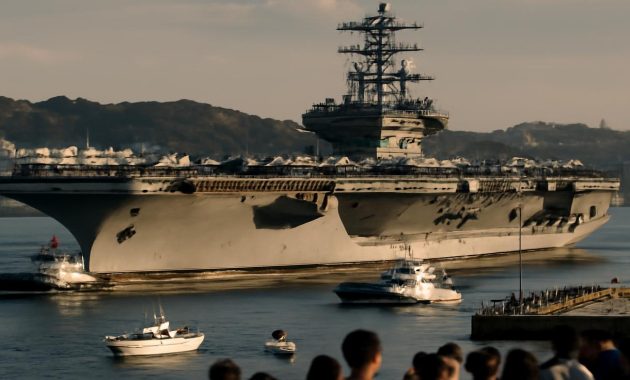
The first thing you notice is the smell. Not the harsh, oily scent you might imagine from a 97,000-ton warship, but a mingling of sea salt, distant pine from Honshu’s coastline, and the faint, metallic tang of steel that has met the open Pacific and come back with stories. As the USS George Washington moves steadily toward Yokosuka, cutting a slow, dignified wake through the late-afternoon waters, the vast carrier feels less like a machine and more like a migrating creature returning to a familiar shoreline after a long season away.
The Carrier That Moves Like an Island
If you were standing on the flight deck that morning, the ocean would feel almost too large to hold in your mind. A flat blue plain, stretching lightly rippled and indifferent in every direction, swallowing horizon and sky in a quiet line. Somewhere out there: Guam behind, the Philippines fading in memory, the open Pacific rolling out in a patient swell. Somewhere ahead: Japan, and a port that has known this ship before.
The USS George Washington is often described in numbers that strain belief—over a thousand feet of steel, a city-sized crew, nuclear reactors humming far below the waterline. But out here, under a soft wash of grey-blue sky, it’s the smaller things that define her return: the cluster of sailors leaning on the safety nets along the edge of the deck; the rhythmic clang of tools below as hands secure equipment after weeks of exercises; the quiet buzz of radios, carrying voices that slip between English and Japanese, operational code and everyday life.
For weeks, the ship and her crew had carved deliberate pathways through the Pacific and Philippine Sea, practicing the choreography of modern naval power: aircraft launching and catching back onto the deck like migrating seabirds; helicopters hovering with rotors slicing the humid air; joint drills with Japanese and allied ships tracing shifting patterns across radar screens. Out here, “exercise” doesn’t mean a quick routine and cool-down. It means long days of simulated combat, complex coordination, and the unseen weight of responsibility.
The Sea as Training Ground and Teacher
The Pacific can be glass-smooth one day and a rising wall of white and slate the next. In the Philippine Sea, where warm currents wrap themselves around deeper, cooler waters, the surface can turn from turquoise to steel in hours. During the exercises, sailors described weather like a mood swing. Morning sun sharpened the deck’s painted lines to a blinding brightness; by afternoon, low clouds overtook the sky, muting the carrier’s colors, turning the ship into a moving shadow.
Out here, every drill has a soundtrack. The hollow thump of boots on metal ladders. The distant whine of a jet’s engines building to a roar. The murmur of briefing rooms where officers trace lines on digital maps and young sailors try to imagine invisible threats coming from beyond familiar blue horizons. The ocean is both training ground and silent witness, the same sea that carries fishermen’s boats, container ships, and driftwood also holding the wake of a nuclear-powered carrier and the grim potential of what it exists to deter.
During joint exercises with regional partners, silhouettes of other ships often lingered on the horizon—sometimes close enough that you could make out superstructures and radars, sometimes no more than smudges of grey on the far edge of sight. The choreography is careful, almost balletic in its precision. Aircraft practicing interception arcs, destroyers pivoting in response to simulated threats, communications buzzing quietly between English, code words, and the frequent, grounding exchange of “roger” and “copy.”
Yet beneath the complexity, the sea itself keeps pulling everything back to something older and more elemental. The swell. The wind. The way the sun slips into the water each evening, painting the carrier’s island structure with gold and shadow, as if nothing in the world could ever be as important as the coming night and the next dawn.
Returning to Yokosuka: A Familiar Harbor
There is a particular calm that settles over a ship in the final day before reaching home port. The intensity of exercises starts to draw down. The last data is logged, the final drills cross-checked and debriefed. On board the George Washington, the Pacific slowly gives way to familiar approaches off the coast of Japan, and a different kind of tide begins to rise: anticipation.
Some sailors lean against bulkheads, scrolling through old photos on their phones, thinking of ramen shops in Yokosuka, vending machines on quiet backstreets, and the simple, grounding comfort of walking on land that doesn’t move. Others stand outside, staring at the faint outline of land as it gradually solidifies—hazy blue becoming a definite line of hills, then a coast, then a port with its own intricate history of ships, comings and goings, arrivals and farewells.
Yokosuka knows the presence of carriers. The USS George Washington has called this place home before. Its return after exercises in the Pacific and Philippine Sea is not just another entry in a logbook; it is a continuation of a story that runs deeper than steel. There is a rhythm to these movements—out to sea for training, back to port for maintenance, resupply, and a brief exhale before the next departure.
As tugs approach, small and sturdy against the looming hull, the scene takes on a strangely delicate quality. Cables swing, voices echo across water, a gull drifts overhead as if to remind everyone that nature does not pause for navy schedules. The ship turns slowly, responding to subtle pulls and pushes, until it lines up with the pier at Yokosuka. Engines throttle down. Mooring lines snake out like thick, living ropes connecting ship to shore. The ocean keeps rolling under the hull, but the great carrier is—for a time—still.
The Quiet Tension Beneath the Surface
Even in its calmest moments, the USS George Washington is defined by a quiet tension: a balance between readiness and rest, between the routine and the unthinkable. The return to Japan underscores that duality. This is a port city that lives and breathes with the rhythm of ships. Families check deployment schedules alongside grocery lists. Local businesses time their busiest days to paydays on base. Japanese and American lives intersect in the everyday details of buses, restaurants, and crowded crosswalks.
Yet stretching out beyond Tokyo Bay and the dark outline of Miura Peninsula is the same Pacific that has carried warships for generations. The exercises the carrier completed in the Pacific and Philippine Sea are not abstract. They are shaped by tensions in distant straits, unspoken rivalries, alliances tested and reaffirmed by the simple, steady reality of presence. A ship at sea, aircraft in the air, sailors awake in the dead of night watching radar screens: all of it tells a quiet story of deterrence measured not in speeches but in miles steamed and flight hours logged.
Walking along the pier as the George Washington settles in, you might notice how easily nature swallows these human intentions. The slap of small waves against the concrete. The darting silver of fish beneath the surface. The faint, resinous scent of pine trees from the hills behind the city. Sea and land go about their endless cycles while human beings add another chapter, another set of coordinates to a long-running conversation about power, security, and the spaces between nations.
People of Steel and Saltwater
Ships do not remember, but sailors do. For some crew members, this return to Japan is a homecoming of sorts—a reconnection with a place where they once learned to navigate narrow train platforms and local markets. For others, it’s their first glimpse of a country they’ve only seen on maps and in movies. Inside the ship’s labyrinth of passageways, talk turns to shore leave: which ramen shop is worth the wait; where the best sea views are from a quiet park bench; which small, tucked-away café serves coffee that almost tastes like home.
Life at sea is measured in routines and small rituals. Coffee in the same corner of the mess every morning. The steady cadence of announcements over the ship’s speakers. The habit of looking out at the water anytime you pass a porthole, just to see what mood the sea is in today. During the exercises, those routines are tightened, turned into a choreography of operations: flight ops, drills, simulated emergencies, briefings that stretch into the next watch.
But amid all of that, the natural world keeps seeping in. A flying fish suddenly skimming alongside the hull. A pod of dolphins playing in the ship’s wake, like children daring each other to get closer to this strange, humming island of steel. At night, when the sky clears and light discipline is enforced, the stars unfurl in a cold, crystalline arc, the Milky Way brushing the horizon. Some sailors step outside just for a moment, letting their pupils adjust, remembering that beyond all the politics and power, they are moving through a universe so vast it almost silences thought.
Returning to Japan doesn’t erase that. The stars grow dimmer against the glow of city lights, but the sea air still finds its way into open hatches and across the pier. The George Washington, for all its immense complexity, lives at the mercy of currents, tides, and weather patterns as old as the planet itself. The ship’s story is nested inside the much older story of the ocean.
Exercises Written in Waves and Wake
To many on shore, the phrase “naval exercises” can sound distant, almost bureaucratic. But if you could watch from above as the George Washington and her companion ships moved through the Pacific and Philippine Sea, the pattern would look almost like calligraphy written across the water.
Destroyers and cruisers swung out ahead or fell back, guardians in a constantly shifting ring. Aircraft periodically rose from the carrier’s deck, their engines momentarily drowning out even the relentless push of the ship’s bow through waves. Helicopters hovered over the sea’s rolling skin, lowering and lifting equipment or practicing rescues that, in reality, everyone hopes will never be needed.
Each turning circle, each plotted course left a temporary scar of white wake across the water, erased moments later by wind and tide. The ocean forgets quickly. It doesn’t hold onto the shape of a carrier strike group the way a map or a digital log does. What remains instead is in the minds of those aboard: the lessons learned, the friction of coordination, the muscle memory built through repetition.
| Aspect | Experience at Sea | Return to Japan |
|---|---|---|
| Environment | Endless horizon, shifting weather, isolation | Defined coastline, harbor lights, settled waters |
| Daily Rhythm | Tight operations schedule, drills, watches | Maintenance, resupply, shore leave planning |
| Sounds | Engines, wind, aircraft launches and recoveries | Harbor traffic, distant city hum, dockside activity |
| Perspective | Focus on training, readiness, distant horizons | Reflection, reconnection, preparation for next deployment |
When the ship finally pivots into Yokosuka, those invisible lines across the Pacific collapse into a single, meaningful point: here. This pier, this harbor, this moment of stillness after motion. Exercises measured in fuel burned, sorties flown, and lessons learned now yield to quieter tasks: checking hull integrity, tending to systems that ran hard at sea, allowing human bodies and minds a chance to unwind—even if only for a little while.
The Sea, the Ship, and the Stories Between
There’s an almost paradoxical intimacy that comes with a ship as large as the USS George Washington. From afar, she’s a symbol—a floating airfield, a unit of strategic calculation. Up close, she’s a place of scuffed stair treads, of hand-lettered notes taped to bulkheads, of tiny rituals that make a vast, industrial space feel momentarily human. A worn coffee mug wedged behind a pipe. A favorite view from a lesser-known spot along the deck, where you can see the sun fall directly into the sea.
The exercises in the Pacific and Philippine Sea tested not just systems, but the ability of people to live within that floating world and move in concert with it. They learned again how to read approaching weather on the horizon, how to listen for subtle changes in engine vibration, how to trust the practiced voice on a radio during a stressful drill. Modern technology might guide the ship’s course in detail, but human senses—eyes burning from salty wind, hands gripping cold rails at night, ears catching a change in tone—still anchor the experience.
Japan’s coastline, rugged in places and softened by bays in others, has seen centuries of ships coming and going, long before aircraft carriers and nuclear power. Fishing boats, trading vessels, warships from another era, all stitching their wakes into the same enduring fabric of sea and shore. When the George Washington returns to Yokosuka, it is stepping into that much older story, another chapter in a narrative written with both ink and saltwater.
On the pier, as the sun slides lower and the lights on the carrier’s island blink to life, gulls circle with an easy, unhurried grace. They have no interest in strategy or schedules. To them, the carrier is just another shape that sometimes brings food, sometimes just wind eddies and new perches. The sea continues its steady, tidal breathing along the seawall. The natural world takes in this vast, deliberate machine and simply makes space for it, as it has for so many human creations before.
Looking Ahead Across a Restless Ocean
The story of the USS George Washington’s return to Japan after exercises in the Pacific and Philippine Sea does not end at the pier. It only pauses. Even as the last lines are secured and the final adjustments made to gangways, the next phase begins: analysis, reflection, maintenance, planning. What worked during the exercises; what didn’t; what new questions emerged, like islands rising slowly from the ocean floor.
In quiet offices ashore and aboard, maps will be revisited, data poured over, procedures adjusted. The sea has a way of humbling even the most advanced technology, and every deployment is a dialogue between what planners imagined and what reality delivered on windswept decks at odd hours under unfamiliar stars.
For now, though, the ship rests. Tugboat wakes smooth out. The noises of a working pier settle into a background hum. Some of the crew glance up at the hills around Yokosuka and think of how different the air will taste once they step beyond the base gates—street food, cedar and cypress on a damp breeze, the soft echoes of a language they’re learning word by word. Others think of home oceans away, plotting time zones in their heads, ready to send messages that begin, “We’re back in port.”
The Pacific remains out there, vast and unsentimental. Its surface will be crossed by storms, fishing fleets, solitary sailors in small boats, cargo vessels the size of city blocks. And, again, by carriers like the George Washington, heading out once more into the restless blue to write new arcs of white across its moving skin. The ship’s return to Japan is a moment of stillness in a much longer motion, a breath drawn before the next step.
In the end, the USS George Washington is both symbol and story: steel and circuitry, but also salt on a sailor’s cheek, the low murmur of engines through a bunk wall at night, the glimpse of a distant coastline after weeks of nothing but sea and sky. Its journey through the Pacific and Philippine Sea, and its return to Japan, is a reminder that even the most imposing artifacts of modern power are held, ultimately, in the gentle, indifferent cradle of the natural world.
FAQ
Why was the USS George Washington operating in the Pacific and Philippine Sea?
The carrier was conducting scheduled exercises and training operations, often involving allied navies, to maintain readiness, refine coordination, and practice responses to a range of potential scenarios across a strategically important region.
Why is Yokosuka, Japan, significant for the USS George Washington?
Yokosuka is a long-standing U.S. naval hub in Japan and has served as a home port for American carriers. It provides vital infrastructure, maintenance capability, and a base of operations close to key areas of the western Pacific.
How do these exercises affect the daily life of sailors aboard the ship?
Exercises structure nearly every aspect of daily life at sea: workdays are longer, routines are tightly choreographed, and sailors move between drills, watches, and briefings, all while adapting to changing weather and sea conditions.
Does nature really play a noticeable role in life aboard a modern carrier?
Yes. Despite advanced technology, sailors are constantly aware of wind, waves, weather, and light. From rough seas affecting flight operations to star-filled skies during night watches, the natural world shapes both tasks and moods on board.
What happens after the ship returns to port in Japan?
After returning, the crew shifts focus to maintenance, resupply, and detailed review of the recent exercises. Sailors often get time ashore, while teams inspect systems, analyze performance, and prepare the ship for its next deployment or training cycle.