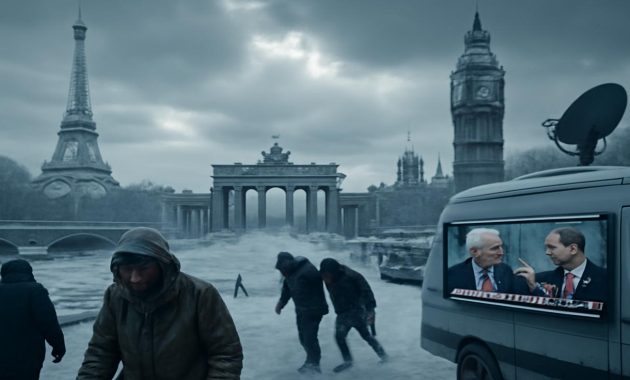
The first thing people noticed was the sound. Not the usual soft hiss of winter rain against double-glazed windows, but a harder, sharper percussion—frozen pellets raking across rooftops, needling the sidewalks, filling the night with a strange static crackle. By dawn, Europe’s February had turned into something else entirely: a continent-wide freezer humming at full power. Breath hung like ghosts in supermarket aisles. Cars became white, rounded sculptures. Trains, usually impatient and on time, stood silent and resigned under a crust of ice.
A Winter That Didn’t Feel Like Just “Weather”
In Berlin, the cold moved in like an occupying force. The air had a metallic edge, the kind that makes your teeth ache when you open your mouth too wide. Streetlights spotlighted slow-motion snowflakes, each one landing on pavements already buried ankle-deep. By mid-morning, phone screens were lighting up with headlines: “Historic Freeze Grips Europe,” “Coldest February in 70 Years,” “Record-Breaking Arctic Blast.”
In a small café near Alexanderplatz, where the windows were fogged with breath and coffee steam, people leaned closer to their screens. Old men in heavy coats muttered about winters from their childhoods, the ones they’d insisted no longer existed. Two students shared a table, their laptops open, headphones tucked around wool hats. One pointed to a satellite image of swirling blue and violet over the continent. “See?” she said. “Climate chaos. The jet stream is losing its mind.”
At the next table, a woman in a navy business suit and scuffed snow boots shook her head, not looking up from her phone. “It’s just winter,” she said under her breath. “We’ve had cold snaps forever.” Her fingers scrolled through an article quoting a politician who’d called the freeze “proof that climate change hysteria is overblown.”
The storm outside intensified, as if the sky were listening and did not appreciate being simplified.
When Science Gets Dragged Into a Blizzard
Within days, Europe’s weather had turned into a full-blown political and scientific battleground. News shows were suddenly obsessed with charts and arrows, thermal maps in bruised purples and angry reds. The phrase “polar vortex” danced across headlines like a new villain in a blockbuster franchise. Viewers watched animated jet streams wobbling and dipping, icy air spilling toward latitudes that had grown used to milder winters.
In a climate lab in Paris, Dr. Léa Fournier, a climate scientist with a stack of worn notebooks and permanent worry in her eyes, watched an interview replay on her screen. A commentator, dressed in impeccable studio lighting, was laughing about “global warming” while pointing at footage of snowdrifts swallowing cars in Warsaw.
“Weather is not climate,” she whispered at the screen, as though it might listen. “Weather is the mood. Climate is the personality.”
The cameras rarely made it into rooms like hers, where walls were pinned with maps and decades-long graphs rather than daily temperature spikes. Léa’s team spent their days reading the language of the planet written in data: ocean heat content, disrupted wind patterns, sea ice retreat in the Arctic. The signals were clear to them: a warmer Arctic can weaken the polar vortex and destabilize the jet stream, causing cold air that once stayed respectfully locked near the pole to spill southward in brutal waves.
But that explanation didn’t fit neatly into a two-minute segment between an ad for luxury watches and an update on football scores. Much easier, some said, to point at the snow in Rome or the frozen canals in Amsterdam and declare climate science overdramatic. Others, equally certain, called the freeze absolute proof of global heating—without nuance, without context.
In this tug-of-war of certainty, the complexity of what was really happening slipped quietly out the back door.
The Freeze in Numbers: A Continental Snapshot
Behind the drama, the numbers told their own quiet, stubborn story.
| Region | Lowest Recorded Temperature | Notable Impacts |
|---|---|---|
| Central Europe (Germany, Poland, Czechia) | -25°C to -30°C | Rail disruptions, energy demand spikes, widespread school closures |
| Southern Europe (Italy, Spain, Balkans) | -10°C to -18°C | Olive and citrus crop damage, frozen pipes, rare snowfall in coastal cities |
| Northern Europe (Scandinavia, Baltics) | -30°C to -40°C | Power grid strain, icy road closures, increased shelter demand |
| Western Europe (France, UK, Benelux) | -12°C to -20°C | Flight cancellations, heating fuel shortages, frozen rivers and canals |
Each number had a human shadow. The family piling into a single heated room because the gas bill had doubled in a week. The farmer walking through a silent, frost-burnt orchard, each brittle leaf a tiny financial wound. The nurse finishing a night shift, standing at a bus stop where the timetable had given up hours ago, cheeks burning with cold that sliced through three layers of wool.
Politics in a Blizzard: Green Promises, Cold Realities
In Brussels, where the cobblestones glittered under a thin sheen of packed snow, the European Parliament building glowed like a ship run aground in an ice field. Inside, the air was heated and dry, but the temperature outside seeped into the debates all the same.
On one side of the chamber, the green transition was being defended like a fragile flame in the wind. Politicians held up reports on emissions, graphs showing how delaying climate action would cost more—economically, ecologically, humanly—than acting now. They spoke of wind farms, solar grids, and insulated homes that would be warm without burning through mountains of fossil fuel. They quoted scientists warning that this freeze, counterintuitive as it might feel, was part of a world whose climate was being unsettled by accumulated greenhouse gases.
On the other side, the word of the week was “survival.” Economic survival. The businesses staggering under energy costs. The small factories wondering how they could afford cleaner technologies when they could barely pay today’s bills. A representative from an industrial region in Eastern Europe held up photos from his district: shuttered shops, queues at a fuel depot, a pensioner wrapped in three sweaters in her living room. “You talk about 2050,” he said. “My people are trying to survive February.”
The freeze had become a prop in a bigger argument: were green policies a lifeline—or a luxury? Every snow-laden roof, every frozen field, every overworked boiler became a statistic in someone’s narrative.
Heat, Money, and the Fault Lines of Inequality
Across the continent, the historic cold was exposing a quieter crisis: energy poverty. The idea that not everyone in a wealthy region like Europe can afford basic warmth still surprises some. But in this February, it became painfully visible.
In a low-rise apartment block in northern Italy, condensation beaded on the inside of single-glazed windows, freezing into delicate fractal patterns by dawn. Elena, who worked part-time at a bakery, turned the thermostat down whenever she was alone. Her hands stung as she washed dishes in lukewarm water, saving the hotter setting for when her daughter came home from school. She had memorized the price of every kilowatt-hour on the bill.
News anchors talked about “demand spikes” and “grid pressure.” Economists debated caps and subsidies. But for millions, the question was simpler and much sharper: how warm can I afford to be today?
The irony was bitter. The same fossil-fuel-based system that had helped destabilize the climate was now being defended as a shield against the very extremes it had helped unleash. Some politicians argued that Europe should pause or dilute its green agenda, at least “until this crisis passes.” Others countered that this was precisely the type of crisis that a cleaner, more resilient energy system could soften—if only it had been built in time.
Scientists Under Fire: Blamed, Needed, Ignored
In televised debates, climate experts were invited on as if they were referees for a game whose rules had been rewritten mid-match. But once seated under the hot lights, they often had only moments to compress a world of nuance into one digestible soundbite.
“Is this freeze caused by climate change, yes or no?” a host asked, eyebrows arched, voice sharpened by time pressure.
The scientist on screen inhaled, visible vapor almost forming in the uncomfortably chilly studio. “It’s not so simple,” she began. “No single weather event is caused by climate change alone. But the context is warming, and that warming is affecting the patterns that shape these extremes—”
Already the host was moving on, eager for a clearer villain, a sharper quote. The audience’s attention skittered away like snow in the wind.
In academic circles, the conversations were more sober, and far more unsettling. Studies suggested that a rapidly warming Arctic could weaken the polar vortex, allowing frigid air to lurch south more often. Other research stressed that such connections were complex and still debated. Meanwhile, records showed that despite these cold extremes, Europe’s average winters over the past decades had trended warmer, not colder.
But nuance struggled against the tide of hot takes. To some, the freeze was proof that scientists had exaggerated. To others, it was proof they hadn’t shouted loudly enough. In the middle, most experts quietly kept working, parsing wind speeds, sea surface temperatures, and atmospheric pressure as though decoding an urgent, dangerously smudged message.
Memory, Myths, and the Stories We Tell About Cold
One of the subtler battles playing out during the freeze was a war of memories. In Vienna, an elderly man named Josef stood at his window, watching the snow build up in gentle, steady layers. “This,” he said to his grandson, “is what winter used to be.”
He remembered frozen rivers strong enough to skate on, snowbanks that towered over children, the squeak of packed snow under leather boots. To him, the February freeze wasn’t a climate anomaly; it was a homecoming.
His grandson, born into milder seasons and climate headlines, felt differently. For him, winter was supposed to be manageable: chilly, damp, annoying—but not brutal. The idea that Europe could swing from heatwaves to historic cold in such a short span of years felt like living inside a weather experiment gone wrong.
Across living rooms and social media threads, conversations replayed versions of this generational disconnect. Older people spoke of “proper winters” and accused climate activists of exaggeration. Younger people pointed to floods, fires, heatwaves—and now this savage cold—and wondered how many signs were needed before action stopped being framed as optional.
The stories people tell themselves matter. They shape what kinds of policies seem reasonable, what sacrifices feel justified. A winter like this one could either reinforce nostalgia for “normal” seasons or underline how far from normal the world had drifted.
Green Dreams, Frozen Ground: Can Transition Survive a Crisis?
While politicians argued in heated rooms, the green transition itself was out in the storm, being tested by ice and wind. In coastal Denmark, wind turbines turned slow and heavy against a pale sky, their blades rimmed in frost. Some fields of solar panels lay under a thick blanket of snow, producing a fraction of their usual power. Fossil fuel plants, those aging giants many had hoped to retire, were firing harder to keep the lights on.
Critics pounced. “Look,” they said. “When the weather turns, you run back to coal and gas.”
Supporters of the transition pushed back. The problem, they argued, wasn’t that Europe had gone too green, but that it had not gone green enough—or smartly enough. Better insulation in homes could have cut demand. More investment in energy storage could have smoothed the bumps in supply. Diversified renewables, upgraded grids, cross-border sharing agreements—these were the unglamorous, technical building blocks that might have softened the blow of such a fierce winter.
In a small town in the Netherlands, one street offered a quiet example. A row of terraced houses that had been part of a pilot project—triple glazing, heat pumps, rooftop panels, and shared battery storage—glowed steadily while neighboring blocks flickered. Inside, residents noticed the cold, of course, but not as a threat. Their heating bills barely budged. Their radiators hummed on, indifferent to the chaos outside.
Just a few streets over, an elderly couple huddled in a living room where only one room was heated. Their gas boiler had failed overnight. The repair service was overloaded. Outside, the wind scraped ice crystals against the windows like fingernails.
For policymakers, those two streets could have been a blueprint, or a warning. The question was whether the political will—and the public trust—would hold through a season where fear shouted louder than planning.
What Happens After the Thaw?
Eventually, even the fiercest winter loosens its grip. The frozen February that had seized Europe began to recede, not dramatically, but in small, almost embarrassed gestures. Icicles thinned and broke, crashing into thawing gutters. Snowbanks melted from the underside, creating hollow spaces that caved in with soft sighs. People unzipped their coats halfway. The air, still cold, lost its razor edge.
In the wake of the thaw came the reckoning. Insurance claims piled up. Governments counted the costs: emergency shelters, energy subsidies, damaged infrastructure, agricultural losses. Economists added columns and shook their heads, trying to capture in numbers what it meant for a whole continent to be strangled by ice for weeks.
The political debate, however, didn’t melt so easily. Some argued that the freeze showed how vulnerable Europe remained and called for accelerated investment in resilient, low-carbon infrastructure: upgraded grids, modern rail systems, deep building renovations, diversified energy sources. Others said that the crisis proved that the green push had gone too far, too fast, making energy scarcer and more expensive for ordinary people.
In café conversations, family kitchens, and factory lunchrooms, people weighed their own experiences against the narratives flying past them. One thing was clear: no one wanted to be this exposed again—to the cold, to the bills, to the feeling that the planet’s moods could yank daily life off course without warning.
Questions That Linger in the Cold Air
In the end, Europe’s historic February freeze was less an isolated event than a stark, icy mirror. It reflected back a continent divided between immediate fears and long-term dangers, between scientific nuance and political simplicity, between the desire for comfort and the need for change.
It forced uncomfortable questions into the light: How do you ask struggling families to support climate policies that might raise short-term costs, when they’re already rationing heat? How do you convince a skeptical public that extreme cold and a warming planet can coexist in the same story? How do you adapt to a world where the old patterns—of seasons, of politics, of economics—no longer behave as expected?
In a schoolyard in Warsaw, the last of the snow still clung to the shaded corners of the yard. Children, red-cheeked and laughing, stomped through the slush, building the season’s final lopsided snowman. They were already talking about spring, about bikes and outdoor games, about the way sunlight feels on bare arms after months of layers.
For them, this winter would be a memory of extra days off school, of snow tunnels and hot chocolate. For the adults around them, it would be something heavier: a reminder that the future they’d grown up expecting was slipping out of reach, replaced by something less stable, more jagged, and far colder—and hotter—than they’d prepared for.
As night fell and the air cooled again, lights flickered on across the city, each window a small, human attempt to push back the dark. Above it all, the atmosphere flowed and buckled in patterns that scientists were still learning to read, shaped by decades of emissions and choices. The next storm, the next heatwave, the next “historic” event was already forming somewhere beyond the horizon.
The question Europe faces now is not just how to survive the next February, but how to live—and thrive—in a century where the weather is no longer background noise, but the main character.
Frequently Asked Questions
Is a historic February freeze evidence against global warming?
No. A single cold event does not disprove long-term global warming. Climate is the average of weather over decades. While Europe experienced an extreme cold spell, global temperatures over recent decades continue to trend upward, and many regions are seeing more heat records than cold records. Some research even suggests that a warming Arctic can disrupt atmospheric patterns, occasionally increasing the risk of severe cold outbreaks in mid-latitudes.
How can climate change contribute to extreme cold events?
One leading hypothesis involves the polar vortex and jet stream. As the Arctic warms faster than lower latitudes, the temperature difference that helps maintain a strong, stable polar vortex can weaken. A disrupted polar vortex may wobble or split, allowing frigid Arctic air to spill south into Europe and other regions. This process is complex and still an area of active research, but it highlights how global warming can disrupt familiar weather patterns rather than simply making everything uniformly warmer.
Why did the freeze cause such severe energy and economic problems?
Extreme cold drives up demand for heating, putting pressure on power grids and gas supplies. If infrastructure is aging, housing poorly insulated, and energy systems heavily dependent on a few key sources, sudden spikes can lead to soaring prices, shortages, and outages. Many European economies, already stressed by earlier crises, struggled to shield vulnerable households and small businesses from the combined impact of higher energy costs and weather-related disruptions.
Did green energy policies make the crisis worse?
The picture is mixed and often politicized. Renewable energy systems like wind and solar can be affected by severe weather, but they are only one piece of a larger energy puzzle. In many cases, the real vulnerabilities lay in underinvestment in grid upgrades, lack of storage capacity, slow progress on home insulation, and continued reliance on imported fossil fuels. Well-planned green transitions aim to increase resilience, not reduce it, by diversifying energy sources and reducing exposure to volatile fossil fuel markets.
What can Europe do to prepare for future extremes like this?
Experts point to a combination of measures: deep retrofitting of buildings for better insulation and efficiency, significant investment in modernized grids and energy storage, diversified renewable energy portfolios, and targeted support for low-income households to reduce energy poverty. Strengthening infrastructure, improving weather forecasting and emergency planning, and maintaining clear, science-based communication can all help. Ultimately, reducing greenhouse gas emissions globally is essential to limiting the long-term destabilization of the climate system that fuels such extremes.