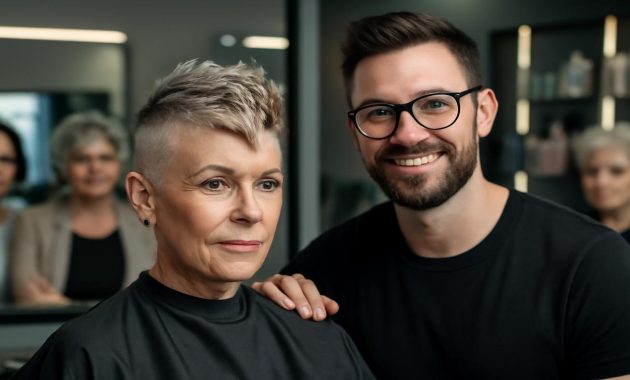
The woman in the salon chair is 68. Her hair is the color of wet sand and cigarette smoke, fine as spider silk, and she keeps apologizing for it. “It’s just thinning so much,” she murmurs, fingers worrying the frayed ends. Then, almost in a whisper: “And I know I’m too old for anything short or… edgy.” Her stylist, a silver‑haired man in black sneakers, looks at her in the mirror and smiles. “Who told you that?” he asks. “Your birth certificate, or the people who want you to disappear?” He sections her hair, the scissors begin to whisper, and somewhere between the first brave snip and the soft cloud of hair gathering on the cape, you realize: this isn’t about hair at all. It’s about who is allowed to take up visual space after sixty—especially with fine hair, especially in a culture that thinks short and bold belongs to the young.
The Pixie That Started an Argument
The door chimes on a rainy Tuesday and in walks Judith, 72, with a folder of screenshots like secret contraband. Iconic film stars, silver-haired influencers, strangers from Pinterest with daring pixie cuts. She lays them out on the station like a deck of rebellious tarot cards.
“I want this,” she says, pointing to a photo of a choppy, piece-y pixie with side-swept bangs and a nape trimmed close. “Exactly this. Only… less perfect. More me.”
Her hair is baby-fine and soft, the kind that slips out of bobby pins and sinks under the weight of hairspray. For years she’s worn it in a polite chin-length bob that behaves itself, the international default for “age appropriate.” Today, she’s restless. Her grandchildren are teenagers. Her ex-husband just remarried. She has started painting again. Something inside her is shedding its old skin.
The stylist runs her hands through Judith’s hair, feeling the density at the crown, testing how it falls. Fine hair over 60 often has its own private weather: it collapses in humidity, clings flat to the scalp, resents heavy products. A pixie on hair like this lives or dies by architecture—texture, direction, and illusion. “We’ll keep the top a bit longer for lift,” the stylist decides. “Soft bangs, not too heavy. Nape close, but not harsh.”
Accessing the clippers is like crossing a line. The buzzing hum fills the air. Hair falls like scattered feathers to the floor. The outline of Judith’s head emerges—her elegant skull, the slope of her neck, the small scar near her ear that you’d never see beneath longer layers. There’s a surprising tenderness to it, like watching someone return to their original blueprint.
When they’re done, her hair floats upward instead of down: feathery layers pushing forward at the crown, bang pieces grazing the brow, everything light, intentional, alive. She looks in the mirror and exhales a laugh edged with disbelief. “I look… younger,” she says, then corrects herself. “No. I look more awake.”
An hour later, she posts a selfie. By evening, her phone is buzzing. Her daughter sends a cautious “Wow, Mom, that’s… short!” An old friend texts, “Wish I were brave enough.” A neighbor comments on social media, “Isn’t that a bit too edgy for your age?” The post splits her world neatly in two: people who see a woman reimagining herself… and people who see a woman who’s forgotten her place.
And that’s the controversy of the post‑60 pixie, distilled. Stylists swear by it: the way it creates instant texture and volume for fine hair, the freedom of wash‑and‑go mornings, the personality it broadcasts from across a room. Critics, however, call it juvenile or severe, whispering that short hair is “unforgiving” on older faces—as though lines and lived-in softness were flaws rather than a map of everything you’ve survived.
The “Too-Short” Bob That Refuses to Behave
Ask five stylists about the most misunderstood cut for fine hair over 60 and at least three will mention the ultra-short bob. Not the safe, swinging bob that nuzzles the jawline like a well‑trained curtain, but the one that stops above the jaw, exposes the neck, and dares to flirt with pixie territory—blunt in some lights, airy and textured in others.
This is the haircut that divides waiting rooms. When a stylist pulls out the razor or starts slicing in those micro-layers around the nape, some clients visibly tense, hands gripping the arms of the chair. One wrong snip and, they fear, there’s no ponytail to hide behind, no quick pin‑up. Long hair has long been the cultural comfort blanket of femininity; taking it above the jawline can feel like standing on a stage in bright light.
But for fine hair, that short‑short bob can be magic. By removing length, you remove weight. Every extra inch on fine strands pulls them down like wet tissue. A bob that’s blunt at the ends but gently stacked at the back gives lift you can feel with your fingertips. The nape hugs close, the crown lifts, the sides skimming the cheekbones. Suddenly the face looks sculpted, the jawline a little sharper, the neck a little swanlike.
In the mirror, color seems to intensify too. Silvery strands catch the light around the temples. Soft lowlights or gentle warm tones pool and ripple as you turn your head, no longer stretched out thin and stringy over extra length. For many stylists, this bob is the sweet spot between “bold” and “manageable,” ideal for fine hair that wants structure but not daily styling acrobatics.
Still, the criticism is persistent. “Too severe.” “Too harsh on older features.” “Too exposing of the neck and jaw.” In other words: too honest. This is the cut that refuses to blur your angles or hide your profile. And yet, many women who cross that invisible jawline barrier find that the very things they were taught to hide become their strongest features. The slight hollow at the throat. The curve of a smile unobstructed by hair. The way earrings suddenly matter again.
One stylist describes it simply: “There’s always a moment when she touches the back of her head and feels how light it is. That’s the moment I know she’ll never go back to shoulder-length.”
The Most Talked-About “Rule-Breaker” Looks
Among stylists who love working with fine hair over 60, a handful of controversial cuts come up again and again—the ones that spark both compliments and side-eye. Here’s how they compare when you strip away the noise and focus on what actually works on aging, delicate strands.
| Style | Why Stylists Love It | Why Critics Call It “Age Inappropriate” | Best For |
|---|---|---|---|
| Choppy Pixie | Adds instant texture and volume to fine hair; low maintenance; shows off eyes and cheekbones. | Seen as “too young” or “rebellious”; exposes face and neck lines others expect to be hidden. | Confident personalities, glasses wearers, anyone tired of limp, flat hair. |
| Ultra-Short Bob | Removes weight so fine hair lifts; frames jawline; versatile for straight or slightly wavy hair. | Criticized as “severe” or “masculine” if not styled softly. | Women with defined jawlines or long necks; anyone wanting structure without a pixie. |
| Undercut Nape | Removes bulk at the back, gives crown extra lift; keeps fine hair from collapsing. | Seen as “edgy” and “too trendy” for older women; reveals scalp shape and neckline. | Those with hot flashes, active lifestyles, or thick patches at the nape with finer top layers. |
| Spiky Crop | Uses short layers and product for lift; turns fine hair into deliberate texture. | Labeled “trying too hard to look young”; bold silhouette draws attention. | Bold dressers, creative types, anyone who loves short styling time and strong shapes. |
| Micro Fringe + Short Cut | Micro bangs lift the face, keep hair off the forehead, great for glasses. | Critics say “too quirky” or “too fashion-forward” for over 60. | Strong personal style, fine straight hair, or those who dislike hair in their eyes. |
The Undercut You Can’t Stop Touching
The first time a 60‑plus client says yes to an undercut, there’s usually a startled laugh involved. Sometimes it starts as a practical conversation: “My hair at the back is thick, but the top is so fine, everything just collapses.” Or: “I’m always hot. The back of my neck is a furnace.” The stylist suggests shaving or scissoring the nape much shorter beneath the visible layers, taking weight out and creating a hidden scaffold for volume up top.
On paper it sounds extreme: an undercut, at sixty-five? But what actually happens is subtle. When that heavy pillow of hair at the nape disappears, the rest of the cut springs to life. A short bob suddenly floats instead of dragging. A pixie gains definition, the crown lifting just enough that even air-dried hair looks intentional. Fine strands, freed from the burden of the thick under-layer, stop clinging to the scalp and start moving.
The sensation is emotional as well as physical. Many women describe the moment they run their hand up the back of their head and feel that soft, closely cropped under-layer. It’s like discovering a secret: a little rebellious detail hidden beneath an otherwise “polite” hairstyle. You can show it or not, depending on your mood, your outfit, or the company you keep.
Of course, the idea of clippers near the scalp at an age when hair growth can be slower makes some onlookers flinch. Critics toss around words like “drastic” and “desperate to be cool.” But the women who choose it often have the opposite intention. They’re not imitating twenty-somethings; they’re solving a very real architectural problem in their hair.
An undercut nape, done thoughtfully, is less about rebellion and more about engineering: building a cut that respects how fine, aging hair behaves. It says, “I know my texture has changed. I’m not pretending otherwise. I’m working with it.” And whether you show that undercut to the world or keep it as your own secret delight, the feeling of that cooler, lighter neckline is its own quiet revolution.
The Spiky Crop and the “Too Much Personality” Problem
There is a particular sound in a salon the first time an older woman asks for a spiky crop: the rustle of magazines lowering, conversations slowing, the invisible rattle of expectations being adjusted. We’re used to seeing spiky, tousled crops on rock stars, on twenty‑something models, on fashion editors dashing between shows. Seeing it on someone who also happens to qualify for the senior discount unsettles the script.
Yet for fine hair, especially when it’s thinning at the crown, a short, deliberately textured crop can be transformative. Instead of fighting to “smooth” away every bit of lift (and accidentally revealing scalp in the process), the stylist leans into it. Hair is cut in short, jagged layers that stand and lean, more like a field of intentionally planted grasses than a flat lawn.
With the right touch of lightweight paste or texturizing spray, each strand becomes a brushstroke, drawing the eye upward. Fine hair suddenly looks purposeful, not sparse; every bit of volume is celebrated instead of flattened under mousse. The shape telegraphs energy: slightly wild, a bit mischievous, impossible to ignore.
This is precisely why some critics bristle. When an older woman wears a spiky crop, she is refusing the visual quietness that’s often expected of her. The cut says, without apology: “I have opinions. I am not blending into the wallpaper. I intend to be seen.” Too much personality, some will mutter. Too loud. Too pointed.
But “too much personality” is exactly what many women over sixty discover they’ve been starving for. After years of compromise—of work dress codes, parenting, caretaking, smoothing their own edges for harmony—there is something delicious about a haircut that refuses to flatten itself, that requires a little finger-styling, a dash of product, a moment of private performance in front of the mirror each morning.
The spiky crop doesn’t cosmetically erase age. It doesn’t pretend your hair is as dense as it was at twenty-five. It does something better: it reframes what you have as deliberate design. It takes fine, aging hair and turns it into a texture story, rather than a problem to be concealed.
Micro-Fringe, Silver Strands, and the Politics of Foreheads
Foreheads are political. In beauty culture, long sweeping bangs function like a curtain: softening lines, masking creases, hinting at the face behind them without fully revealing it. When a woman over sixty chooses a micro-fringe with a short cut—those small, bold bangs that sit high on the forehead, sometimes even mid‑forehead—it can feel like someone just snapped the curtains open in a dimly lit room.
Stylists who love this look on fine hair speak about balance. Fine bangs, kept very short, don’t separate into wispy strings the way longer bangs can. They open up the face, especially around the eyes, which so often carry the most expression. For women who wear glasses, micro-fringes can be miraculous: no more bangs stuck in frames, just a clean graphic line above, hair and glasses working together instead of fighting.
The critics see something else. Micro-fringe is “too fashion,” they argue, “too odd,” too reminiscent of punk scenes and high-fashion editorials. Attached to a short crop or pixie on a woman with silver or white hair, it reads to them like a refusal to fade gracefully—and for some, that’s unsettling.
But there’s a strange liberation in no longer hiding your forehead. You start to claim the landscape of your face in full: the expression lines etched by summers of squinting in the sun, the little horizontal ripples that appear when you raise your brows in disbelief or delight. Instead of framing your features as flaws, the cut treats them like terrain best viewed unobstructed.
In the chair, when a stylist snips those last few millimeters and the micro-fringe falls into place, there’s often a pause. The client blinks, and her whole face seems to lift. With the extra forehead exposed, the proportions shift; the eyes suddenly feel larger, brighter, framed by hair that no longer hides but highlights.
For fine hair over 60, it’s more than a style statement. A micro-fringe removes weight right at the front hairline where hair is often thinnest, preventing that heavy, piecey look. It’s air and space and clarity. Critics may mutter, but as one stylist put it, “The second she puts on her lipstick and her favorite earrings, the cut stops looking ‘controversial’ and just looks exactly like her.”
Choosing Your Own Version of “Appropriate”
Somewhere between the salon chair and the car ride home, between the first tentative selfie and the second day you wake up with your new short hair, a quiet reckoning begins. You catch your reflection in shop windows. You tilt your head in the bathroom mirror. You meet your own gaze with a question: Who decided what someone like you is supposed to look like at this age?
Fine hair over 60 comes with its realities: thinning at the temples, changes in texture, more fragility, slower growth. Short controversial cuts don’t erase those truths; they collaborate with them. They rely on clever shapes, strategic lightness, and embracing the way silver and white catch sunlight. Stylists who swear by these cuts aren’t trying to rewind your face to 35. They’re trying to place your current self—the one who has lived through heartbreak and triumphs—into a frame that matches your inner weather.
Critics talk a lot about “trying too hard” and “acting your age.” But acting your age has always been a moving target, shaped by people who are nervous about change. Forty years ago, women over fifty were scolded for wearing jeans. Now, no one blinks. Today, the battleground happens to be hair—particularly short, expressive hair on fine, aging strands.
In the end, the most controversial short hairstyles for fine hair over 60 all share a common trait: they refuse invisibility. A choppy pixie, an ultra-short bob, an undercut nape, a spiky crop, a micro-fringe… none of them are designed to help you slip anonymously through the world. They’re designed to make you recognizable to yourself when you pass a mirror, to make you feel the lightness of your own head and think, “Yes. This is my face. This is my life. This is my choice.”
If other people find that age inappropriate, maybe that says more about their fears than about your haircut.
FAQ
Is short hair really better for fine hair over 60?
Often, yes. Shorter cuts remove weight so fine hair can lift instead of collapsing. With the right layers, you get more volume, easier styling, and less strain on fragile strands. Not every short cut works for every person, but in general, fine hair benefits from being kept on the shorter side.
Will a pixie or crop make my hair look even thinner?
A badly cut pixie can, but a well-structured one usually does the opposite. Strategic layering, a bit more length at the crown, and soft texturizing can make fine hair look fuller. The key is choosing a stylist who understands how to cut for your density and growth pattern.
What if my face is too “soft” or lined for a very short cut?
No face is wrong for short hair; it’s about shape, not age. Soft features can look beautiful with gentle pixies or short bobs that frame the face. Stylists can adjust fringe length, sideburns, and nape shape to complement your bone structure and the way your features move when you talk and smile.
Do I have to use a lot of styling products with these cuts?
Not usually. Fine hair over 60 often prefers light products: a small amount of volumizing mousse, a texturizing spray, or a pea-sized dab of paste. Most short cuts discussed here are designed for low-maintenance routines—air dry or quick blow-dry, then a minute of finger-styling.
How often should I trim a short, controversial cut?
Every 4–7 weeks is common. Fine hair loses shape faster because small changes in length affect volume and structure. Regular, small trims help keep the cut looking intentional rather than grown-out and droopy.
What if I regret going that short?
Start by talking with your stylist about how it’s behaving and how you feel. Sometimes a slight adjustment to fringe, texture, or length in certain areas can change everything. Hair does grow, but while you’re in the in-between stage, a good stylist can reshape your cut gradually so it feels wearable at every length.
How do I talk to my stylist if I want a bold cut but I’m nervous?
Bring photos of what you like and what you definitely don’t. Be honest about how much daily styling you’ll realistically do. Ask your stylist to explain what they’d do step-by-step and to cut gradually—checking in as they go. A good stylist won’t pressure you; they’ll help you find a version of that “controversial” cut that feels like you, not like a costume.