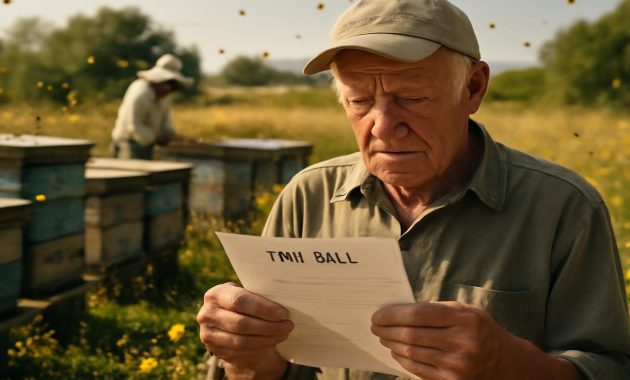
On an April morning that still smelled of frost and woodsmoke, the only sound on the hill behind Martin Keller’s bungalow used to be the wind shivering through last year’s grass. These days, if you stand there quietly, you hear something else: a living, humming curtain of sound, thousands of bees stitching the air together as they rise and fall over a row of bright wooden hives.
Martin will tell you he never meant to become a farmer. He’s 73, long retired from his job at the post office, and the acre and a half behind his house was supposed to be his peace: a little vegetable patch, a hammock between two half-grown maples, a place where time could finally slow down.
Instead, that patch of ground pulled him into a loophole he didn’t know existed — one that’s now threatening the very financial security his retirement was built on.
The day the bees arrived
It started, as so many rural stories do, on the cracked sidewalk outside the hardware store.
Martin was buying a new hose nozzle when he ran into Lucas, a younger man he recognized vaguely from town. Lucas had the restless energy of someone trying to build a life out of thin air: calloused hands, a faded ball cap with a honeybee embroidered over the brim, and the kind of hopeful politeness you get used to when you’re asking for a lot and offering very little in return.
They made small talk about the late snow, about how the lilacs were trying to bloom and getting punished for it. Then, almost shyly, Lucas mentioned that he was trying to expand his beekeeping operation.
“I’ve got more hives than land,” he said, laughing, but the laugh didn’t quite reach his eyes. “County won’t let me keep as many as I need on my parents’ place. Been looking for somewhere to set a few out, you know, away from the spray and the traffic.”
Martin, who had spent the last week thinking guiltily about his unused back field, heard himself say, “I might have a spot for you.”
They stood there in the chilly spring air, two strangers halfway between the paint aisle and the propane tank cage, sketching the outline of an agreement with nothing more formal than a handshake.
Lucas would place his hives on the far end of Martin’s land, along the fence line. He’d keep the grass trimmed, stay away from the garden, and bring over a jar or two of honey when he could. No rent, no contract. Just neighborliness, the old-fashioned kind that still survives in the corners of maps people don’t write articles about.
No one mentioned the word “agricultural.” No one mentioned “taxes.” Bees, after all, are small things. Harmless, even. Helpful. Who could imagine that a row of painted boxes could redraw the financial map of an old man’s life?
The letter that changed everything
Summer arrived in a rush of clover and clanging garden tools. The hives settled into the landscape as if they’d always been there. Martin learned to walk a wide, slow circle around them, hands in his pockets, listening. On still evenings, the air over the field shimmered with bees returning home, their legs thick with pollen like tiny saddlebags of gold.
For a time, that was the heart of the story: an old man’s idle ground transformed into something alive and purposeful. His tomatoes were better than they’d ever been. The apple tree, which had been stingy with fruit for years, suddenly dangled with small green promises.
Then, in early fall, Martin’s property tax bill arrived.
The envelope looked no different from any other year — the same off-white, the same window framing his name in rigid black letters. But inside, the numbers had shifted like sand.
He stared at the total twice, then a third time, the way you do when a simple object starts refusing to make sense. The amount due had jumped by several hundred dollars. For someone living mostly on a fixed pension and the careful unspooling of savings, it might as well have been several thousand.
He flipped the bill over, looking for an explanation that wasn’t there. Finally, he picked up the phone and called the county assessor’s office.
After a few rounds of hold music and polite transfers, a woman with a steady voice explained it to him in the language of policy and assessment codes.
His land, she said, was now classified as being used for agricultural production. The presence of commercial beehives — yes, even “just a few” — triggered a different set of levies and fees. Where once he’d simply owned a piece of residential property with some idle grass behind it, he was now, at least as far as the tax rolls were concerned, part of the local agricultural economy.
Martin listened, one hand gripping the kitchen counter. He had not sold a single jar of honey. He had not received a cent of income. He had simply said yes to a beekeeper in need of a place to park some hives.
“So because I tried to help,” he said finally, the words slow and careful, “I have to pay more?”
There was a pause on the line, the quiet of someone who has had this conversation before and hasn’t yet found a way to make it less brutal.
“Sir,” she said, “I understand this feels unfair. But the way the regulations are written, the intended use of the land is what matters, not who benefits financially. As long as there is a commercial agricultural activity happening on your property, it falls under the agricultural levy structure.”
The invisible line between hobby and business
On paper, the distinction sounded tidy. In reality, it sliced straight through the life Martin thought he was living.
Beekeeping, especially at the scale someone like Lucas operates, exists in a strange liminal space. To the casual observer, it looks like a hobby: a handful of boxes, a pickup truck with a logo hand-painted on the door, a young man selling honey at the Saturday market from a folding table next to jars of homemade jam.
To the law, it is farming. The bees pollinate crops; the honey is a product; the equipment is capital. That rare and precious thing — a small, local food producer — is also, in the eyes of tax codes and zoning laws, a business no different from a cornfield or a dairy barn.
And when that business crosses onto someone else’s land, the landowner often steps, unknowingly, over a legal tripwire.
Martin didn’t know that. Most people don’t. Regulations, even when written with good intentions, have a way of living in shadows until they fall directly across a human life.
Consider the quiet logic behind such rules. Agricultural operations can increase the demand on rural services: roads that wear faster under heavy trucks, inspectors who must travel farther, emergency responses to equipment accidents or chemical spills. Levies and assessment structures are meant to distribute the cost of that infrastructure among those who use it.
But bees and hives do not chew up asphalt the way tractors do. A small-scale beekeeper like Lucas doesn’t run semi-trucks loaded with grain down county roads. The footprint is almost ghostlike: a trailer coming and going a few times a year, a cloud of insects that can’t be fenced in or out on a map.
And yet, in the tax code, a line is a line. Once agricultural activity lands on your parcel, the clock starts ticking.
When goodwill gets a price tag
In the weeks after the bill came, neighbors began to hear pieces of the story. Someone mentioned it at the diner, between talk of weather and high school football scores. Someone else chimed in with a cousin who’d had something similar happen with a neighbor’s cattle grazing on their acreage.
Gradually, the shape of the situation came into focus — not just as Martin’s misfortune, but as a question that had been floating unasked over the community for years.
Should helping small producers cost ordinary citizens their security?
Rural and semi-rural towns often depend quietly on exactly this kind of generosity. A farmer needs to rotate pastures for a season; a friend lends half a field. A market gardener needs a corner lot with sunlight; a relative offers her unused parcel in exchange for a weekly basket of vegetables. A beekeeper needs clean, unsprayed ground; an old man with a big, empty backyard says yes.
Underneath those handshakes and nods, the bureaucracy doesn’t sleep. It doesn’t care about jars of honey pressed into a palm at Christmas, or how helping someone start a small business can stitch a community closer together. It cares only about categories: agricultural or not, commercial or not, taxable or not.
One evening, sitting at his kitchen table, Martin pulled out a notepad and did what retirees on the edge of worry have always done: he started to list his fixed costs against his fixed income.
| Monthly Item | Before Bees | After Bees |
|---|---|---|
| Property Tax (monthly equivalent) | $210 | $270 |
| Utilities & Heating | $190 | $190 |
| Groceries | $320 | $320 |
| Medication & Health | $180 | $180 |
| Total Fixed Costs | $900 | $960 |
Sixty dollars a month. For someone with a wide salary, that might be a forgotten dinner out or the difference between one streaming subscription and three. For Martin, it was the margin: the little leftover that turned the end of the month from a question mark into a period.
On another sheet of paper, he wrote down what the bees brought in. Not to him — he still refused to ask Lucas for rent, insisting that “it wasn’t the boy’s fault” — but to the world immediately around him:
- Better pollination for his garden and fruit trees.
- Stronger yields for the neighboring hayfield.
- Local honey for market customers who knew the hills it came from.
- The survival of a small business that might, with luck, someday employ another person or two from town.
Some benefits were practical, some were intangible. All of them were real. Yet none of them could be applied as a credit against the line on his tax bill.
Shared benefits, private costs
There’s a word economists like to use for the way bees help an entire landscape bloom richer: “positive externality.” It means that the benefits of an action reach far beyond the person who pays for it. When bees pollinate the clover in someone’s pasture or the squash in a neighbor’s garden, they’re creating value no one ever invoices.
What happened to Martin is almost the mirror image: a “negative externality” of regulation. A policy meant to ensure that those who profit from agriculture contribute fairly to public coffers ended up landing squarely on the shoulders of someone who wasn’t profiting at all.
He’s not alone. Quietly, across many regions, similar stories stack up. An elderly couple lets a young farmer graze sheep on their unused hillside and discovers their insurance premiums climbing because “livestock risk” has entered the equation. A suburban family allows a friend to grow organic vegetables in their spacious backyard, only to learn that zoning ordinances consider it a commercial use that triggers new compliance fees. A church turns a vacant lot into a community orchard, then spends months negotiating with the city over how to classify the fruit harvest.
In each case, the community gains — food, green space, biodiversity, resilience — while the individual host often absorbs hidden costs.
The question isn’t whether taxes or regulations are inherently bad. Local governments need revenue. Rules prevent real harms. But when the structures we build to manage large-scale industrial agriculture land with equal force on the smallest and most fragile collaborations, something is off-balance.
Lucas, for his part, was stricken when he found out. He showed up at Martin’s door with a face full of apology and a shoebox of receipts, offering to move the hives immediately or start paying “whatever share” of the taxes he could manage.
Standing in the doorway, the smell of grass and smoke drifting in from the yard, Martin shook his head.
“You move those bees,” he said, “and you lose half your clover. I’m not going to be the reason you pack it in like everyone else.”
It was a small act of stubbornness, but also one of quiet defiance: an insistence that community is worth something more than whatever number appears in the “amount due” box.
Rethinking how we reward — or punish — generosity
Stories like this tend to polarize. One camp says rules are rules: if your land hosts commercial activity, it should be taxed accordingly, end of discussion. Another argues that small producers ought to be shielded from almost all regulation — let the bees fly and the tomatoes grow, and stay out of their way.
The reality, as always, is messier. It lives in the space between Martin’s tight monthly budget and the county’s spreadsheet of expected revenue; between Lucas’s fragile margins and the roads he drives his truck on; between the public’s hunger for local food and the private risks quietly shouldered by those who make that possible.
There are alternatives, if communities care enough to look for them.
Some regions experiment with micro-agricultural exemptions: if your property hosts only a small number of hives, a limited area of vegetable production, or a small flock of animals below a certain threshold, the activity doesn’t trigger full agricultural classification. Others explore tax credits for “land stewards” who provide no-cost space to small producers, recognizing in policy what they are already offering in practice.
Local governments can work with extension services and landowner associations to create clear, simple guides: If you lend land for bees, here’s what might happen. If you host grazing animals, here’s what to expect. Clarity doesn’t erase the trade-offs, but it allows citizens like Martin to choose with open eyes, not be ambushed by fine print.
There are also community-level solutions: neighborhood funds that help offset surprise costs for elders, cooperative insurance pools for shared projects, even informal agreements where multiple beneficiaries of a local producer chip in to support the host’s additional expenses.
Underlying all of this is a deeper cultural question: how much do we value the quiet generosity that keeps small producers alive?
We celebrate the romance of the beekeeper tending hives at dusk, the farmer’s market stall piled high with heirloom vegetables, the social media photos of golden honey on homemade bread. But behind those images is a lattice of borrowed land, improvised spaces, and elders who say “Sure, you can use my field” without any idea what that “sure” might eventually cost them.
If we want more local food, more biodiversity, more small producers who can survive without being swallowed by industrial agriculture, then perhaps we have to stop treating the people who help them as invisible collateral.
FAQ
Why did the retiree’s taxes increase just because of beehives?
In many jurisdictions, any commercial agricultural activity on a property — including beekeeping for sale of honey — can trigger agricultural levies or reclassification. The law usually focuses on how the land is used, not who actually owns the business or earns the income.
Could a written agreement have protected him?
Sometimes a carefully drafted agreement and clear documentation that the landowner is not part of the business can help, but it doesn’t always override how tax codes define “use.” Local legal advice before hosting any commercial activity is critical.
Are there places that exempt small-scale projects like this?
Yes. Some regions have thresholds or “de minimis” rules — for example, allowing a limited number of hives or a small cultivation area without full agricultural classification. The specifics vary widely and change over time.
What can landowners do before lending land to small producers?
They can contact their local tax assessor, zoning office, or extension service to ask how proposed activities will be classified; consult an attorney about liability and tax exposure; and clarify in writing who is responsible for any new costs or compliance obligations.
How can communities support people who host small producers?
Communities can advocate for fair policies, create local funds or cooperatives to share unexpected costs, and recognize land hosts as partners in local food systems — offering them social, financial, and sometimes even formal incentives for their role.