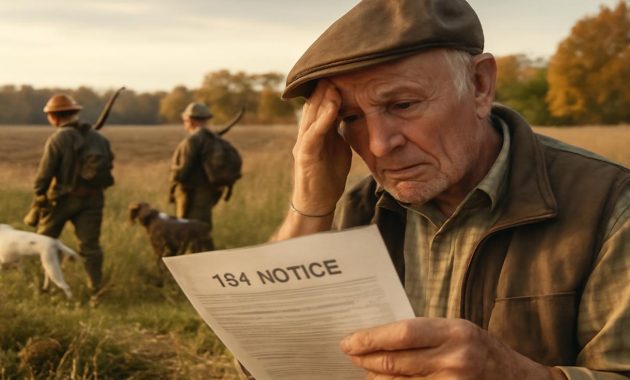
The fog came in low and silver that October morning, soft as breath over the harvested fields. From the road, the land looked peaceful—stubble glistening with dew, a few crows lifting off in slow, black strokes. But at the kitchen table of the old farmhouse overlooking those fields, peace was the one thing that had just vanished.
On the table lay a thin white envelope with the weight of a stone. Inside, a tax notice that read more like a verdict: full agricultural tax due, despite no harvest, no cattle, no bales of hay or grain in the barn. Just a few men in orange vests who, last winter, had walked those fields with guns and thermos flasks and an invitation the landowner thought was harmless.
A Favor That Turned into a Fault Line
It started, as these things often do in the countryside, with a neighborly favor.
Johan—sixty-two, shoulders rounded from years of lifting more than was good for him—had stopped farming his family land a few seasons back. The numbers stopped making sense; input costs rose, yields dipped, and cheaper imports undercut the satisfaction of bringing your own wheat to the cooperative. He leased a small portion to another farmer, let some corners go to grass and wildflowers, and kept the old buildings from collapsing through sheer stubbornness and a bit of pension money.
During hunting season, the local hunting association approached him again. They’d been asking for years.
“You’re not working those fields now, Johan,” their leader had said over coffee at the village café, fingers wrapped around a mug already gone lukewarm. “It’d be a shame to let the wildlife just explode out there. Boar, roe deer—they’ll be in people’s gardens by spring.”
Johan had hesitated. He’d grown up with hunting, with stories of strict rules and respect for the land. But he’d seen how it had changed: more weekend warriors, more trucks, more noise. Yet the men were polite, and he knew some of them from school days. And there was pressure, subtle but constant. Let us in, be part of the community, don’t be difficult.
Finally, he agreed. Not for money, just for “good relations.” They shook hands. He thought little more of it. The hunters came a few weekends that winter. They parked by the barn, shared sandwiches by the hedgerow, left behind a bit more trash than he liked. But they also brought him venison, sometimes, wrapped carefully in freezer bags. A fair trade, he told himself, for land that lay fallow anyway.
He didn’t know that he had just crossed an invisible line in the eyes of the tax authorities.
The Letter That Changed Everything
The envelope arrived in early autumn the following year. The return address carried the quiet authority of the tax office. Johan set it aside at first, assuming it was a routine notice—some small adjustment, perhaps a confirmation of the reduced agricultural tax he’d been benefiting from as a non-active, low-income landowner.
That evening, with the light already fleeing early, he slit it open with a butter knife. The words were dense, bureaucratic, and cold. When he reached the part that mattered, his breath shortened.
According to a recent review, his property no longer qualified for the reduced agricultural tax rate. The reason, in language so dry it was almost insulting, was that the land was now being used for “hunting activities” rather than “agricultural production.” The fields, in the eyes of the system, had become recreational grounds, not working farmland.
Full property tax. Backdated. Payable within months.
He read it again, and again. No farming. No income. No harvest. And now, no tax relief. The numbers scrawled in the margin by his shaking hand were brutal: the new tax bill was more than what he’d spent the year before on heating oil and food combined.
Johan walked to the window. Outside, his land lay under a sky that was turning the color of burnished tin. The tractor sheds, slowly rusting; the old silo, empty; the hedges where pheasants scuttled and sparrows argued. Nothing had changed, and yet everything had.
How a Technicality Became a Trap
As he eventually learned, the rule behind the shock wasn’t new. In many regions, reduced agricultural tax rates are meant as a lifeline—an acknowledgment that working the land brings smaller margins, unpredictable risk, and a public benefit that’s not always reflected in market prices. These breaks are tied to the land being actively used for agriculture: crops, grazing, orchards, sometimes even managed forestry.
But allow hunting, even without earning a cent, and the land can be reclassified as a different kind of property: recreational, commercial, or mixed-use. And once that happens, the shadows lengthen quickly. The taxman’s view is simple: If your land serves as a playground, it should be taxed like one.
In practice, it’s far from simple. What counts as “hunting use”? A formal lease contract with a hunting club? A handshake agreement? A neighbor occasionally shooting a fox that’s taking chickens? These questions play out in gray zones where culture, habit, and law blend uneasily.
For Johan, there was no signed contract, no rent paid. Just permission. But someone had noticed. Maybe a hunter bragged at the wrong table. Maybe a neighbor complained. Maybe a drone photo, a complaint about gunfire, or a routine cross-check flagged the property. However it happened, the result was clear: the authorities had decided that what once was a farm was now something else, and they wanted their share.
At the Crossroads of Land, Law, and Culture
Word of Johan’s tax shock moved through the village like wind in dry grass. By the end of the week, the bakery queue had split into quiet clusters: those who thought it was an outrage, and those who muttered that “rules are rules.”
In rural communities, land is never just dirt. It is identity, memory, security, and the last tangible thing in a world that increasingly seems to live on screens. The question of how it is used—who walks it, who shoots on it, who pays for it—cuts deep.
To one group, Johan’s situation sounded like an attack on rural life itself.
“If the tax office starts treating our fields like golf courses, we’re done,” one farmer told me, standing by a tractor that still bore the scars of last season’s rock-hidden furrows. “First they squeeze us on prices, and now on taxes? Some of us barely scrape by. If you can’t even let the local hunters in without being punished, what’s next? No more mushroom picking? No more kids building dens in the woods?”
To another group, the story revealed deeper tensions long ignored.
“Look, hunting has changed,” said Anna, who lives in a converted barn at the edge of the village and walks the fields daily with her dog. “It’s not just old-timers going out quietly at dawn anymore. There are big groups, organized events, people from the city driving in with expensive rifles and ATVs. It’s noise, disturbance, pressure on wildlife. And sometimes it’s a business. When landowners allow that, knowingly or not, maybe the law is right to say: you’re no longer just a farmer.”
Between these views lies a fault line that’s become all too familiar in the countryside: the clash between tradition and regulation, between survival and principle, between those who feel they are being watched and judged from faraway offices and those who argue that without rules, the land and its creatures pay the ultimate price.
Counting the Cost: More Than Just Numbers
For Johan, the fallout wasn’t abstract. It arrived in the form of bank statements and restless nights. He spread the papers across his table, pen in hand, trying to find a way through.
To understand what he was facing, you have to see the numbers in context.
| Item | Before Reclassification | After Reclassification |
|---|---|---|
| Annual property tax | Low, agricultural rate | 3–4x higher |
| Income from farming | Minimal, declining | None |
| Income from hunting | None | None (informal access) |
| Net effect on budget | Manageable | Severe deficit |
“They tax me as if I’m running some kind of hunting resort,” he said quietly one evening, hands clasped so tightly his knuckles whitened. “But I’ve never taken a cent. Not one.”
He considered fighting it, of course. There were murmurs of legal appeals, references to complicated exemptions and case law. But lawyers are expensive, and time in the countryside has its own currency. Each hour spent writing letters or sitting in a city office is an hour not repairing fences, not tending the orchard, not simply catching up on rest.
So he did what many do when the system feels too large: he turned inward, cut his budget, and tried to swallow the anger that rose whenever he saw a hunter’s truck on the road.
Neighbors Divided: Whose Land, Whose Rules?
The sharpest edges of this story aren’t in the official letters or dusty law books, but in the conversations around kitchen tables, in whispers over hedges, in the sudden coolness between people who once helped each other at harvest time.
Some villagers sided firmly with Johan. They saw in his fate a warning: the state creeping further into private life, misunderstanding the nuances of rural existence.
“First they tell us how many animals we can keep, then what we can spray and when,” a neighboring dairy farmer said. “Now they decide who walks our land and what that means for taxes? These people don’t know what a muddy field looks like in March, but they decide everything.”
Others, though, felt that something deeper needed to be acknowledged: the power that landowners hold, and the responsibility that comes with it.
“Johan’s a good man,” said a woman who lives on a small plot bordering his land. “But when he let the hunters in, that changed my life too. Suddenly we had gunshots behind the garden on Sunday mornings. My kids were scared to play near the hedgerow. Does he have the right to invite that, free of consequences, just because it’s his field?”
These questions bite at the heart of rural community life. Who gets to decide what land is for? The one whose name is on the title deed? The people who live around it? The children who roam it in summer, the birds that nest in its thick grass, the deer that cross at dusk?
Hunting, once seen as a shared, almost sacred rhythm of the countryside, has become a flashpoint. For some, it’s a tool of management and a way to stay connected to place. For others, it’s noise, danger, and a sign that the countryside is being turned into a playground for those who can afford rifles and weekend homes.
Between Guns and Grass: Rethinking “Use” of the Land
Beneath the argument about tax law lies a more fragile, complicated story about what it means for land to be “used” or “productive.”
To the tax authorities, use is something you can count: tons of grain, head of cattle, hectares in active rotation. To hunters, use is the careful watching of wind and sign, the patient waiting in early light, the notion of balance between wildlife and crops. To conservationists, use might mean letting fields grow wilder—planting hedgerows, creating ponds, giving back space to bees, butterflies, and the quiet hum of unseen life.
Johan’s fields, left mostly fallow, had begun to slip into that last category without any grand plan. Thistles rose where barley once stood. Patches of wildflowers appeared, first as a surprise, then as a quiet comfort. Skylarks returned, their spiraling songs a thin, bright thread in the wide sky.
“Maybe that’s what hurts the most,” he said, walking along a grassy margin one evening. The soil clung to his boots; a hare bolted ahead, a streak of brown lightning. “I stopped farming because I couldn’t afford it. But I liked seeing things come back. More birds, more insects. It felt like the land could breathe again. And now they punish me for that too, as if only plowed and sprayed fields count as ‘real’ agriculture.”
Here lies the quiet paradox: in many policies, the land is either “working” or “recreational.” But in reality, most honest fields are something in between—feeding people and wild things, holding memories and plans, carrying not just crops but stories. When a rule designed to protect public revenue collides with that complexity, someone like Johan gets caught in the gears.
What Could Have Been Different?
Staring at the situation from a distance, it’s easy to start rearranging the pieces. If the tax office had clearer guidelines about informal hunting access. If rural support officers actually visited and talked instead of sending letters. If the hunting association had insisted on a formal lease, including sharing costs like insurance and taxes. If farmers like Johan had better advice about the legal consequences of what seems like a simple yes.
Each “if” carries a hint of regret.
Some suggest that law and policy need to catch up with real life. Why not allow land to be a mosaic—part wild, part farmed, part hunted—without forcing it into a single tax category that ignores the nuance of use and benefit? Why not build incentives for biodiversity and shared access that don’t punish people who are already on the edge financially?
Others argue for local agreements: written rules between landowners, hunters, and neighbors that spell out not only who can shoot where, but how responsibility and cost are shared. In some regions, such frameworks exist and help. In others, tradition and pride make people wary of turning old customs into formal contracts.
Meanwhile, Johan made the only decision that felt within reach. He wrote to the hunting association and withdrew his permission.
“No more hunters,” he said simply, his voice flat. “I can’t afford the goodwill.”
Word spread as quickly as the original rumor. Some hunters were angry, accusing the tax authorities of destroying trust and access. Some neighbors were relieved, knowing their dogs and children could roam a bit freer. The deer and boar, of course, said nothing—only their tracks in the soft earth would tell the next part of the story.
A Landscape of Quiet Tension
Today, if you walk Johan’s land in late autumn, you feel a certain watchfulness in the air. The grasses whisper against your legs. Crows argue in the birch trees. The old farmhouse stands square against the wind, its windows catching the low light like tired eyes.
The fields are neither fully farmed nor fully wild. They sit in an uneasy pause, waiting for a future that could turn in many directions: a new tenant farmer, a rewilding scheme, a buyout by investors, or slow decline into scrub and bramble. Each path will bring new rules, new interpretations, new lines on assessment forms.
Johan, for his part, has grown wary of every envelope with a government crest. Yet he still walks the boundaries most evenings, boots tracing the lines his father and grandfather paced before him. He stops at the same gatepost his father leaned on when talking about weather and yields. Now the conversations are different: less about rain, more about regulations.
“They say the countryside is emptying,” he murmurs one day, watching a tractor on a distant field that no longer belongs to him. “But it’s not just people leaving. It’s trust, too. Between us and the state. Between us and each other.”
The paradox remains: a piece of land that once fed a family now costs its owner more than it brings in, taxed at full tilt because of an activity that never paid him a cent. A rule intended to prevent abuse ends up battering someone already close to the edge. A simple “yes” to local hunters turns out to carry the weight of a contract he never knew he was signing.
And the community, watching all this, is left with questions echoing down the lanes like the crack of a far-off gunshot: Who is the countryside for? Who decides? And how do you keep both the land and the people on it alive—in every sense of the word—without breaking them under the weight of good intentions gone rigid?
Frequently Asked Questions
Why did the landowner lose his reduced agricultural tax status?
He allowed organized hunting on land that was no longer actively farmed. In many regions, tax relief is tied to active agricultural production. When the land is reclassified as used for hunting or recreation rather than farming, it can lose eligibility for reduced agricultural tax rates.
Does allowing hunters always lead to higher taxes for landowners?
Not always. It depends on local law, how formal the arrangement is, and whether the land is still considered actively farmed. In some places, informal and occasional hunting has no impact; in others, even a simple agreement can trigger reclassification if authorities decide the primary use has changed.
Can a landowner be taxed more even if they earn no money from hunting?
Yes. Tax classification usually depends on how the land is used, not whether the owner receives income. If authorities consider hunting or recreation the main use, they may apply higher property tax rates regardless of whether the landowner profits financially.
What could landowners do to avoid this kind of situation?
They can seek written clarification from local tax offices before changing land use, keep any hunting access strictly limited and informal where the law allows, or ensure that formal contracts clearly define primary agricultural use and how any hunting fits within it. Consulting a local agricultural advisor or legal expert can also help.
How does this issue affect rural communities more broadly?
Cases like this deepen existing tensions in rural areas: between landowners and authorities, between hunters and non-hunting neighbors, and between those who want stricter rules and those who feel overregulated. They can erode trust and make people more reluctant to share access to land, even when such sharing is part of long-standing local culture.