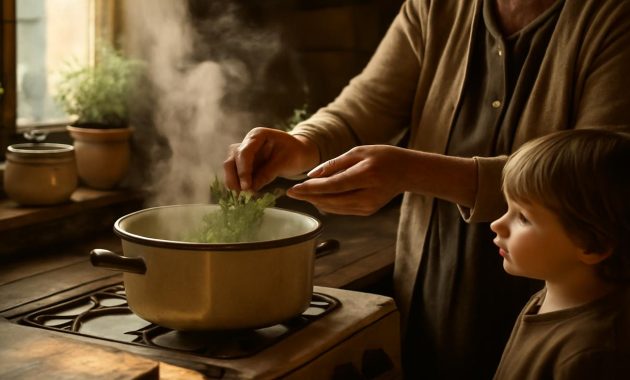
The first time I boiled rosemary on my grandmother’s stove, the kitchen smelled like the inside of a story. Not a place, exactly—more like a memory you could walk into. Steam rose from the pot in gentle clouds, threading through the afternoon light, and the whole house shifted, as if someone had opened a secret door. The air felt softer. The clatter of the outside world dulled at the edges. And there I was, standing barefoot on cool tile, watching a few humble green sprigs turn water into atmosphere.
The Day the House Changed
I didn’t grow up thinking of rosemary as anything special. It was just that woody herb my grandmother kept near the kitchen window, the one she’d pinch between her fingers and say, “Smell that. That’s how you remember where you belong.” As a kid, I’d roll my eyes, because what did a plant have to do with belonging?
One autumn afternoon, the kind where the sky hangs low and gray and the air tastes like rain, I came home feeling restless and oddly hollow. It was quiet in that heavy way that made the furniture look too still, as if the house itself was holding its breath. I opened windows, lit a candle, turned on music. Nothing felt right. The rooms were just rooms—functional, fine, but lifeless.
My grandmother, visiting for the weekend, watched me flutter about like an anxious moth. She didn’t say much at first. She just walked into the kitchen, found the small bunch of rosemary I’d half-forgotten beside the sink, and put a pot of water on the stove.
“You’re trying too hard,” she finally said, dropping the rosemary into the simmering water. The stems hissed softly as they met the heat. “Sometimes you don’t need more things. You just need to wake the air up.”
Within minutes, the sharp, piney smell began to drift through the kitchen. It was bright and clean but also somehow warm, with a tiny whisper of citrus and wood smoke. The steam curled along the ceiling, slipped down the hallway, and nudged its way into the living room. The house, which had felt like a waiting room, suddenly felt like someone had arrived.
“There,” she said, turning the heat down low. “Now your home can exhale.”
The Quiet Magic of Rosemary Steam
Rosemary has a scent you can almost hear. It doesn’t just float in the air—it draws lines through it, clears paths, carves out space. If you lean over a pot of just-boiled rosemary, the steam kisses your face, carrying that clean, resinous perfume straight to the back of your mind.
It never feels aggressive, the way some artificial fragrances do. There’s no chemical punch, no cloying sweetness. Instead, it feels like opening a window onto a hillside where the sun has been warming the plants all day. You breathe it in, and something in your shoulders lets go.
The first time I really noticed this, I was standing in that same kitchen, watching the pot tremble on a soft simmer. The bubbles rose lazily, lifting the rosemary sprigs so they bobbed and rolled like tiny green rafts. Each pop of a bubble released another breath of scent, and with it came small shifts I could feel: the air felt less stale, my thoughts less tangled.
There’s a kind of hush that falls over a room scented with rosemary steam. Not silence—more like clarity. You notice the small things: sunlight edging across the rug, the tick of the clock, your own breath moving in and out. It’s as if the house is no longer just a container for your life but an active participant in it.
My grandmother used to say plants are housekeepers of the invisible. “We sweep floors and wipe counters so we can see they’re clean,” she’d tell me, “but the air? That’s where rosemary works.” She didn’t mean it in a scientific way, though yes, steam and scent do change how we experience a space. She meant that the atmosphere of a home is as real as the furniture, and rosemary knows how to rearrange it.
How to Boil Rosemary the Way My Grandmother Taught Me
Her method is beautifully simple, the kind of ritual you can start on a sleepy Sunday morning or in the middle of a chaotic weekday when everything feels just slightly off.
Here’s the way she passed it down to me, and how I still do it:
| Step | What To Do | Little Tips from Grandma |
|---|---|---|
| 1. Fill the pot | Add about 3–4 cups of water to a medium saucepan. | She always used enough water so it could simmer for a while without drying out. |
| 2. Add rosemary | Drop in a small handful of fresh sprigs or 1–2 tablespoons of dried rosemary. | Fresh if you can, but dried works “just fine when life is busy,” she’d say. |
| 3. Bring to a boil | Turn the heat to high until the water reaches a rolling boil. | Stay nearby; she never liked leaving boiling pots unattended. |
| 4. Lower to simmer | Reduce the heat so the water settles into a gentle simmer. | This is where the magic happens—the slow release of scent. |
| 5. Let it breathe | Leave it uncovered for 20–40 minutes, adding water if it gets low. | She’d say, “Leave the lid off so your worries can climb out with the steam.” |
That’s it. No complicated recipes, no expensive devices. Just water, rosemary, and heat—the simplest alchemy in the world, turning a pot into a tiny forest for your home.
Why This Tiny Ritual Feels So Big
On paper, boiling rosemary doesn’t look like much. It won’t repaint your walls, rearrange your furniture, or solve the to-do list sitting on your fridge. Yet, somehow, it changes everything it touches—especially you.
There’s something about the act itself that steadies the day. You’re not scrolling, not multitasking, not consuming anything. You’re standing in your own kitchen, tending a small pot on the stove. The world gets smaller in a good way. The clink of the pot lid, the sound of the simmer, the gentle lift of scent—they all announce, “You’re here. This is your place.”
I’ve boiled rosemary on days when my thoughts felt like an overstuffed drawer I couldn’t close. I’ve boiled it while moving into a new apartment, boxes stacked like unfamiliar shapes in unfamiliar corners. I’ve boiled it after arguments, when the air felt heavy with words said and unsaid. Each time, the ritual gave me something very simple: a pause and a reset.
It’s not magic in the fantasy sense. It’s magic in the way a well-worn mug becomes your comfort cup, or the way one particular blanket always makes a nap better. The scent of rosemary connects moments across time. It’s the same smell from my grandmother’s kitchen, the same steam that curled past her embroidered curtains, now drifting past my own.
Our homes hold our days: the noise, the mess, the laughter, the fatigue. Little practices like this one—brief, sensory, intentional—thread softness through the structure of everyday life. They say, “This place is not just where you sleep and eat. It’s where you can feel okay again.”
How Boiling Rosemary Shapes the Atmosphere of Your Home
If you pay attention, you’ll notice that boiling rosemary doesn’t just make things smell nice. It actually shifts how the space feels, how you move through it, and how you use it.
In the kitchen, the scent wraps itself around the cupboards and countertops, turning the room into a gentle invitation. Chopping vegetables feels calmer. Washing dishes feels less like a chore and more like part of a rhythm. The steam softens the hard edges of stainless steel and tile, giving the room a warmth that has nothing to do with temperature.
In the living room, the fragrance lingers like a quiet note. Books feel more inviting. Blankets feel cozier. You might find yourself choosing softer lighting, speaking a little more slowly, or simply sitting—really sitting—without the urge to fill every silence.
Even down the hallway, where usually only dust and shadows live, that faint whisper of rosemary can make the space feel less like an in-between and more like part of the home’s story. It’s as if every corner is included, every room folded into one continuous, scented exhale.
My grandmother believed that a home’s atmosphere is built from countless small choices: the way you open the curtains each morning, which mug you reach for first, whether you stop to listen when the kettle sings. Boiling rosemary became one of those choices for me. It’s a way of saying, “Today, I choose softness. Today, I choose to be present.”
And practicality lives here too. Rosemary’s bright, herbal scent often chases away the ghosts of last night’s cooking, the lingering damp of rainy weather, or the faint mustiness of a closed-up room. You don’t have to plug anything in, buy refills, or worry about what’s in the ingredient list. It’s just a plant, water, and the same warmth you’d use to make tea.
Making It Your Own: Little Variations and Gentle Rituals
What began as my grandmother’s habit has become a flexible ritual I’ve adapted to different days and moods. The core is always the same—rosemary and water—but the details can shift, like seasoning a favorite recipe a little differently each time.
Some mornings, I add a slice of lemon to the pot. The steam turns brighter, almost sparkling, waking up the house along with me. On colder evenings, I might tuck in a couple of cloves or a piece of cinnamon stick for a deeper, cozier scent, keeping rosemary at the center while letting other notes hum quietly in the background.
Sometimes I treat it almost like moving meditation. I’ll tidy slowly while the pot simmers: folding a blanket, stacking mail, straightening the shoes by the door. As I move through the rooms, the scent moves with me, tying all the small tasks into something that feels gentler and less like drudgery. Other times, I simply sit at the kitchen table with a book or an empty notebook, letting the steam drift around me as I read or write.
On days that feel especially heavy, I wander a little closer to my grandmother’s way. I stand over the pot, close my eyes, and let the steam wash up into my face. I breathe in slowly, like I’m inhaling courage, and exhale as if I’m letting the day slip out of my shoulders. It’s a tiny ceremony, invisible from the outside, but it anchors me. It reminds me that rituals don’t have to be elaborate to be powerful—they just have to be repeated, with intention.
You might find your own version. Maybe you boil rosemary when guests are coming, not as a performance, but as a quiet welcome. Maybe it becomes the scent you use when you deep-clean once a month, carrying a sense of completion through the house. Maybe it’s the signal that work hours are over and evening has truly begun.
Over time, your mind starts to recognize the pattern. Rosemary on the stove becomes shorthand for calm, for home, for the feeling of being held by your own space. Even on difficult days, that recognition can be enough to shift something inside you, just a little.
The Legacy in the Steam
There’s one memory that returns to me every time I drop those green sprigs into the pot. My grandmother and I are standing side by side in her small, sunstruck kitchen. The counter is cluttered with the good kind of clutter—mixing bowls, mismatched spoons, a jar of wooden utensils that have seen decades of stirring. The rosemary plant sits by the window, casting narrow shadows on the sink.
“Why rosemary?” I had asked her once. “Why not lavender or something fancy?”
She smiled and pressed a sprig into my palm. “Because it grows even when you forget about it,” she said. “Because it smells like the door is always open. Because it doesn’t ask for much and gives you so much back. That’s how I think a home should be.”
Now, years later, she’s no longer here to stand beside me at the stove, but her presence shows up every time I boil that simple herb. The scent threads through my rooms and through my memories at the same time. It connects the clink of my modern kettle to the whistle of hers, my narrow city kitchen to her sunny, slightly crooked one.
We talk about “inheritance” and think of objects: dishes, books, jewelry. But there are quieter inheritances, too—the way someone folded towels, the way they greeted the morning light, the small things they did to make a space feel alive. Boiling rosemary is one of those quiet legacies. It’s a sentence my grandmother started and I keep finishing, day after day, pot after pot.
When someone walks into my home now and pauses at the doorway, inhaling with a little smile, I know exactly what they’re feeling, even if they can’t name it. The air seems both fresher and more familiar, as if they’ve arrived somewhere new and remembered at the same time. “What is that?” they often ask. “It smells incredible in here.”
I always answer the same way: “It’s just rosemary—boiled on the stove.” But inside, I know it’s more than that. It’s my grandmother’s hand on my shoulder, the echo of her quiet wisdom, the reminder that transformation doesn’t always roar. Sometimes it simmers, slowly, in a small pot on a modest stove, turning water and leaves into a home you can truly feel.
Frequently Asked Questions
How long should I boil rosemary to scent my home?
Bring the water and rosemary to a full boil, then lower the heat and let it simmer uncovered for 20–40 minutes. You’ll notice the scent start to fill the room within the first 5–10 minutes, and it will deepen as it continues to simmer.
Can I use dried rosemary instead of fresh?
Yes. Fresh rosemary has a brighter, more complex scent, but dried rosemary works very well. Use about 1–2 tablespoons of dried rosemary for a medium pot of water. You can always add a bit more if you want a stronger aroma.
Is it safe to leave the pot simmering unattended?
It’s best not to leave a simmering pot completely unattended. Keep the heat low, check the water level occasionally, and stay in or near the kitchen. If you need to leave the house, turn off the stove first.
Can I reuse the rosemary water?
You can reuse the water once or twice within the same day after it cools, but the scent will be softer each time. Always reheat gently and discard if the water looks cloudy or smells off. For the strongest aroma, start fresh each time.
Will boiling rosemary remove other odors in my home?
Boiling rosemary helps soften and mask many common household smells, like cooking odors or stuffiness from closed windows. It doesn’t erase strong odors completely, but it does create a fresher, cleaner overall atmosphere that feels far more pleasant to be in.