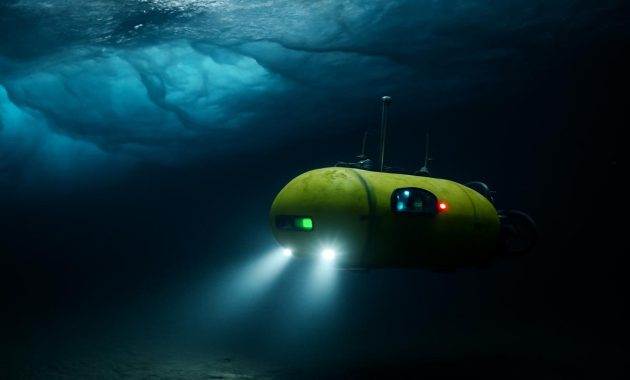
The robot slipped into the water the way a breath vanishes on a cold morning—quietly, almost shyly—then was gone. One moment it bobbed against the scalloped edge of sea ice, tethered to human hands and human hopes. The next, it disappeared beneath the frozen ceiling of Antarctica, into a world without sky, without seasons, without sound but the creak and groan of ancient ice. For eight long months it drifted in that darkness, listening, measuring, watching. And there, beneath some of the largest glaciers on Earth, it heard something no one wanted to hear.
A World Beneath the Ice
The Ross and Thwaites and Pine Island glaciers loom on satellite images like pale, frozen continents, their edges fraying into the Southern Ocean. But beneath them lies another continent entirely—a submerged world few eyes have seen. It is a place of shadow and faint blue light, where ice roofs hang like cathedral ceilings hundreds of meters overhead, and where the ocean quietly eats away at the underside of the ice sheet that locks up enough water to rewrite the world’s coastlines.
The robot—no bigger than a kayak, bristling with sensors and cameras—was built for this hidden world. Researchers called it simply an autonomous underwater vehicle, or AUV, but many on the team spoke of it the way you would a stubborn, beloved dog. They gave it a personality: patient, tough, a little reckless by design. It had to be. Its job was to slip under the floating edge of a giant glacier and stay there, alone, for as long as its batteries, instruments, and luck would allow.
The plan was as delicate as threading a needle through a shaking hand. First, the team drilled a narrow hole through hundreds of meters of ice—a vertical tunnel of warm water melting down through frozen time. The drilling rig spat steam, the air crackled at minus twenty, and the work moved in slow, methodical circles under a pale Antarctic sun. When the drill finally broke through to seawater, it was like tapping into another planet.
Lowered by cable, the AUV dropped through that shaft of light into darkness. As the hole froze slowly above it, the machine shrugged off its last physical connection to the surface. The ice re-sealed, and the robot became a ghost, wandering the invisible corridors beneath Antarctica’s giant glaciers. It carried no lights—the water there is as black as closed eyes—and it navigated by sonar and inertial sensors, its “sight” made of echoes and calculations.
But it had ears, in a way. Among its instruments was a device tuned to detect temperature, salinity, and the subtle fingerprints of different water masses. That was what the scientists cared about most. They were listening for a particular signal—one they’d discussed in meeting rooms and model simulations and nervous hallway conversations for years. A signature of warmth in a place that had no business being warm.
The Long Drift and the Silent Data
Day by day, the robot’s journey became a series of invisible lines on a digital map back at the research station. In reality, no one knew exactly where it was at any given moment beneath the grinding, shifting ice. They had programmed patterns and safety routes—a wandering circuit through under-ice canyons and cavernous spaces where the glacier lifted off the bedrock and floated, barely, on the sea.
In that submerged darkness, the ocean moved in slow, powerful tongues. Some water was ancient melt, cold and freshened by the ice it had eaten. Some was dense and salty, pushed along the seafloor by gravity. And some, the kind the scientists feared, was warmer than it should be—water that had traveled a long way, carrying with it the heat of far-off seas.
The robot recorded everything: temperature, salinity, pressure, movement. Each reading pinned to an invisible dot in three-dimensional space. Occasionally it surfaced near pre-arranged openings in the ice, whispering its backlog of data to receivers listening through the water column. Most of the time, though, it was completely on its own, filling its internal memory like a journal no one would read for months.
Above, the Antarctic plateau lay wide and indifferent. Katabatic winds scraped snow into long ripples, and the camp where the scientists lived was reduced to a few bright containers and rattling tents. The world’s worries felt far away. Yet that robot, drifting beneath their boots, was quietly collecting information about the future shape of every coastline on Earth.
By the time the AUV finally returned to the ice hole—battered, scraped, its batteries gasping—the team had already left. The recovery was another expedition entirely, and in that gap of time the robot lay in data hibernation, its silent hard drives packed with months of the glacier’s quiet secrets.
The Signal No One Wanted to See
In a small lab, thousands of miles from the ice, a scientist stared at a scrolling column of numbers. Temperature. Salinity. Depth. Latitude. Longitude. The data streamed like code from another language. The robot’s journey appeared as a tangle of colored lines, swooping under the glacier’s floating front, tracing invisible chambers and gullies in the dark.
At first it looked exactly as expected. Near-freezing water. Stable salinity. The telltale signs of cold, dense Antarctic shelf waters. But then, in a cluster of readings taken deep beneath the glacier’s belly, something shifted.
It was small. A fraction of a degree. But in the abyssal vocabulary of polar oceans, that fraction was loud. The temperature ticked upward, not once but again and again, over a region that should have been locked in the chill of traditional polar waters. The salinity fingerprint shifted too, a subtle but unmistakable trace. The numbers wrote out a clear story:
Warm, salty water was intruding far beneath the glacier.
This was the signal scientists had feared—a sign that relatively warm “Circumpolar Deep Water,” a body of ocean that circles Antarctica like a dark moat, had found a pathway under the ice. This deep water is only a few degrees above freezing, but that is more than enough to gnaw at ice that has been stable for thousands of years. A difference of 1–2°C in this world is the difference between a glacier holding its ground and a glacier stepping back.
Models had predicted this intrusion. Satellite measurements of thinning ice shelves had hinted at it. But now, for the first time, here it was, measured directly by a small drifting machine in a place no human had ever stood. A warm tongue of water, quietly eating away at the ice from below.
In the lab, the air went still. Someone muttered something soft and flat, the kind of half-swear that carries more weariness than shock. Because even though they had expected this, even though much of modern climate science had pointed right here, seeing the evidence in such sharp detail is something else entirely. The invisible fear in the models had become a plotted line glowing red on their screens.
Why a Few Degrees Under the Ice Matter
To understand the weight of that signal, you have to imagine the glacier not as a frozen cliff, but as something more like a colossal, slow-moving bridge. The part of the glacier that floats on the ocean is called an ice shelf, and it acts like a structural brace, holding back the thicker, land-grounded ice behind it. Warm water attacking the underside of that shelf is like termites gnawing at the beams of a house. You don’t see the damage right away, but the whole structure is weakening.
As the warm deep water slides up under the ice, it melts from below, carving channels, thinning the shelf, undercutting its front edge. The glacier responds by cracking, creaking, calving off enormous icebergs that drift out to sea. These dramatic events show up on the news, but they’re just the visible surface of a deeper rearrangement. Once the ice shelf is thin enough, it can’t hold back the inland ice as effectively. The anchored part of the glacier starts to speed up, like a traffic jam suddenly clearing.
The robot’s data suggested that this process is not just beginning—it’s already underway, and perhaps more vigorously than many had hoped. In certain under-ice basins, the measurements indicated melt rates far higher than estimates based only on models and satellites. It was as if the glacier’s foundation was being hollowed out, quietly and persistently, by a warm ocean that had finally found the right doorway.
Those hollow spaces matter because glaciers like this, especially in West Antarctica, rest on bedrock that deepens as you go inland—a so-called “retrograde slope.” Once the grounding line (the place where the glacier lifts off the rock and begins to float) retreats into deeper water, the ice becomes more vulnerable still. More ice is exposed to the ocean; more floating shelf appears; more area for warm water to attack. It is the architecture of a feedback loop.
The scientists knew all this in theory. They had run simulations in which the grounding line crept inland decade after decade, raising sea levels by meters over centuries. But the robot had added fresh realism to those fears. It had traced the warm water’s path like a detective following muddy footprints through a house. The evidence was clear: the suspect had made it to the basement.
What the Robot’s Journey Tells Us About Our Future
The data, once cleaned and checked and cross-checked, started to filter into global models. Oceanographers adjusted their equations about how deep water circulates around Antarctica, about where and how often it can slip onto the continental shelf and slide under the ice. Glaciologists revised their forecasts of how quickly ice shelves might thin and fracture. Climate scientists fed those new numbers into sea-level projections.
The story that emerged was not apocalyptic in the Hollywood sense. No overnight global flood, no cities swallowed in a single season. Instead, it was something more insidious: an acceleration. A steepening of curves on graphs. A tightening of timelines.
If warm water is already undercutting these glaciers more intensely than expected, then the pace at which they can contribute to sea-level rise may be faster than what many policymakers still plan for. Instead of centuries of gradual change, we are looking at decades of increasingly rapid shifts. A few centimeters more per decade, then more again, and more still—until the numbers add up not just to eroded beaches, but to reshaped coasts and redefined maps.
It helps to hold those abstractions up against real places. A rise of half a meter to a meter in global sea level transforms storm surges in cities like Mumbai, Lagos, Miami, and Jakarta. It floods low-lying deltas where hundreds of millions grow their food. It changes where the groundwater turns brackish, where salt creeps into rice paddies and mangrove roots, where levees must rise and where, ultimately, retreat becomes the only viable choice.
All that is wrapped, invisibly, in the faint signal detected by a robot drifting beneath a glacier, months and worlds away from any human street or harbor. That is the quiet power of the Antarctic: what happens there radiates outward, delayed and diffused, until it reaches doorsteps that have never seen ice.
| Aspect | Before Detection | After Robot’s Data |
|---|---|---|
| Warm Water Under Ice Shelves | Mostly inferred from models and indirect satellite signs | Directly measured pathways of warm, salty deep water |
| Melt Rate Estimates | Lower, with large uncertainty ranges | Higher and better constrained in key glacier basins |
| Glacier Stability Outlook | Potential long-term retreat, timelines unclear | Clearer signs of ongoing undercutting and faster retreat risk |
| Sea-Level Projections | Moderate contributions from Antarctica this century | Higher potential contribution and stronger urgency |
Listening to a Planet That Whispers
There is something humbling about the way the planet tells us its stories. It does not shout. It rarely offers us dramatic, unambiguous scenes. Instead, it whispers—through tiny temperature shifts, through a pattern in salinity, through a slow, almost imperceptible change in the way a glacier flows.
The Antarctic robot was, in a sense, an ear pressed gently against the underside of the ice. Its measurements were a form of listening, an act of attention paid to a part of the world that most of us will never see. That listening is not neutral; it emerges from worry and from a recognition that humanity has become a force big enough to stir even the deepest waters.
Yet there is also something beautiful in the endeavor. Picture that machine gliding through black water, its metal skin frosting over, its tiny thrusters humming against an ocean older than civilization. Picture the people who built it, who spent lonely months at the edge of the ice sheet, coaxing equipment to life in sub-zero winds, all so they could understand a line on a distant graph with a little more clarity.
We live at a moment when the boundaries between local and global have blurred almost entirely. The carbon from a single car, multiplied by millions and billions, thickens the air over cities and over the polar plateau. That thickened air warms the ocean by fractions of a degree. Those fractions slip under Antarctic ice and awaken sleeping feedbacks. Eventually, perhaps decades or centuries from now, a storm surge driven by that extra water will climb the steps of a house somewhere, and someone will say that the ocean feels closer than it used to.
In that chain of cause and effect, the robot’s eight-month drift is one of the few moments where we stop guessing and start knowing. It takes the abstract anxiety of “what if warm water is reaching the grounding line?” and turns it into a measured fact: it is there. It is happening. The future we feared is not a distant possibility; it is already under construction, in the dark.
Where We Go From Here
The story does not end with the data. That signal—those warmer, saltier readings under the ice—ripples outward into choices. Choices about how fast we cut greenhouse gas emissions. About how we design cities and protect coastlines. About how we support communities that will be on the front lines of rising seas long before anyone in a polar research station feels the spray.
It also shapes how we continue to explore. More robots will follow that first drifting scout. Some will be more agile, some will carry more advanced sensors, some will live beneath the ice for years. Together, they will help draw a more detailed map of the unseen world under Antarctica’s giant glaciers—a map not just of space, but of time, showing which regions are changing fastest and which might still be held in balance.
In the end, this is a story about attention and responsibility. A small machine, alone beneath a frozen ceiling, detected a signal scientists had long feared. That signal is not a prophecy—it does not fix the ending in place—but it is a warning, clear and urgent, written in the language of temperature and salt.
Whether we treat it as a footnote in a research paper or as a call to act like a species that understands its own power will determine what the world’s shorelines look like when today’s children are old. The robot has done its part. It has listened in the dark and brought back a message. The rest is up to us.
Frequently Asked Questions
Why were scientists so worried about warm water under Antarctic glaciers?
Because relatively warm, salty deep water can melt ice shelves from below. Ice shelves act like braces that hold back the inland ice. Once they thin and weaken, the glaciers can speed up, causing more ice to flow into the ocean and raising global sea levels.
How much warmer was the water the robot detected?
The temperature difference was on the order of a degree or two above the near-freezing waters normally expected there. In everyday life, that might sound negligible, but in polar oceans, a single degree can dramatically increase melting at the base of the ice.
Does this mean sea levels will suddenly jump?
No, sea-level rise will not spike overnight because of this single finding. However, it does indicate that some glaciers may be melting and retreating faster than previously thought, which can accelerate sea-level rise over the coming decades and centuries.
Why do scientists use robots instead of going under the ice themselves?
The spaces beneath Antarctic glaciers are incredibly dangerous and difficult for humans to access—dark, confined, shifting, and often hundreds of meters below solid ice. Robots can survive extreme pressures, low temperatures, and long periods without support, making them ideal for exploring these hidden environments.
Can this process be stopped?
We cannot directly control the ocean currents under the ice, but we can influence the larger climate system that is warming those waters. Rapid reductions in greenhouse gas emissions can limit further warming, reducing the long-term risk to Antarctic ice and slowing future sea-level rise.