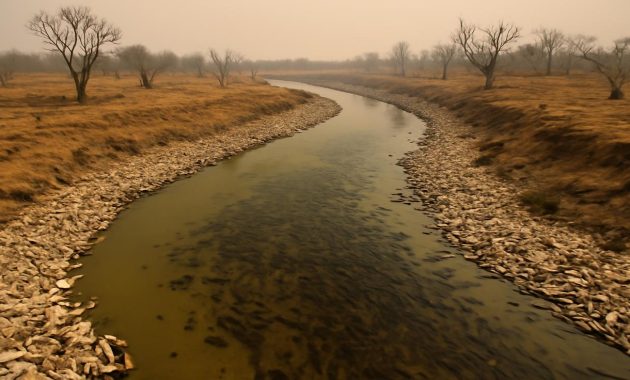
The river doesn’t roar here. It sighs. In the dusty half-light of dawn, the Murray River looks almost shy as it unwinds across the floodplain, a ribbon of steel-blue slipped between red gums that lean in like old storytellers. Pelicans rest on drowned branches. Carp roll lazily near the surface, mouths gaping like slow bells tolling beneath the mist. Somewhere, a fisherman curses softly as another empty cast comes back dripping with weed. On the bank, a scientist in mud-speckled shorts kneels with a plastic tub, peering into the murky water as if searching for a missing heartbeat.
Where a Giant River Begins to Fail
The Murray–Darling Basin, Australia’s largest river system, stretches across more than a million square kilometres, threading through four states and the ACT. It feeds towns, cities, farms, and wetlands; it carries stories from First Nations communities whose connection to these waters runs back over 65,000 years. On paper, it looks like a giant success story of hydrology and agriculture. In the field, it’s a different tale entirely.
Look closely and you can feel it: the quiet unravelling. The boats still glide and the irrigation pumps still hum, but beneath the surface the balance is tipping. Native fish are vanishing. Riverbanks are crumbling. Entire wetlands flicker like a failing light. And in the middle of it all, invasive species—plants, animals, microbes—are rewriting the rules faster than the river can respond.
“We’re watching a slow-motion collapse,” one river ecologist says, his voice flat from years of giving the same warning. “The Murray isn’t dead. But it’s not healthy enough to cope with what’s coming.”
The Carp That Turned the River to Soup
Slip your hand into the Murray’s shallows on a still afternoon and you can feel the softness of the bottom: a slurry of fine silt and rotting plant matter. Once, much of this riverbed was gravel and firm mud, anchored by reeds and aquatic plants. Now, great clouds of sediment roll up at the slightest kick. The culprit flicks its golden tail and vanishes into the murk.
European carp, introduced in the 1800s and supercharged by a strain released in the 1960s, now dominate up to 80–90% of the fish biomass in many parts of the Murray–Darling. They don’t just live in the river. They remake it. Feeding by sucking and blowing through the sediment, carp churn the bottom like living ploughs. Plants are uprooted. Water clouds. Sunlight is blocked. Oxygen levels drop. Native fish, already stressed by dams and extraction, lose the last refuges that once kept them safe.
Standing on a jetty near a popular camping spot, an old river guide gestures toward the water. “When I was a kid,” he says, “you could see the bottom right here. You’d watch the yabbies, see cod darting between logs. Now? It’s like chocolate milk. Carp soup.”
He’s not exaggerating. The turbidity from carp feeds algal blooms and shifts entire food webs. Young native fish that rely on clear shallows to hunt and hide are left exposed and starving. The river looks full of life—fish jumping, birds circling—but the diversity beneath that noisy surface is collapsing into a narrow band of hardy invaders and survivors.
The Silent Takeover Under the Bark
On the banks, another invasion whispers through the leaves. Red gums, those iconic river sentinels, are used to drama: droughts, floods, lightning strikes. But they’re not built for a world where the flood pulses that once defined their lives are throttled by dams and choked by thirsty crops. Stress cracks their defenses open, and an army of tiny saboteurs marches in.
Look closely at a struggling river red gum and you’ll find scars that weren’t always part of the story. Borer beetles, boosted by warmer winters and shifting climates, tunnel deeper and more often. Exotic pathogens—fungi and microscopic pests carried in soil, timber, or even on boots—take advantage of weakened trees. Under the bark, galleries of insects chew through the living tissue. Limbs die back. Hollows—those precious apartments for parrots, bats, and possums—crumble and fall.
What looks from a distance like a green, healthy riverside forest can be, in places, an ecosystem under siege. Stack that with invasive willows and poplars muscling into the river margins, their shallow roots changing bank stability and water flow. Shade falls in new places; leaf litter changes chemistry. The micro-world of insects and microbes shifts—and with it, the food base for fish and birds that have evolved with totally different rhythms.
It’s not just what’s here that matters. It’s what’s been lost. Goanna tracks are harder to see in the sand. Native frogs call less often on warm nights. Old timers talk about “the sound of the river” warning you of a flood days away. Today, the sound is electronic—an alert from a gauge downstream, a spreadsheet of storage levels, a policy update about water trading—and it tells a very different story.
When Menindee Went Quiet—and the Fish Floated
One of the most haunting chapters in this unfolding story played out at Menindee, on the Darling (Baaka) River—a major artery feeding into the Murray system. In the oppressive summer heat of recent years, vast reaches of water turned from life-giving to lethal almost overnight.
Locals woke to a river lined with white bellies. Hundreds of thousands, then millions of fish—native bony bream, silver perch, golden perch, Murray cod—floated to the surface in a rotting, heaving slick. The smell clawed its way through closed windows. People gagged. Some cried. Others simply stared at the water, too stunned to speak.
The immediate trigger was a perfect storm: low flows, hot weather, and a sudden collapse in oxygen as algal blooms crashed. But the stage had been set by years of over-extraction, mismanaged flows, and a river pushed to the edge. Invasive carp, already thick in the system, survived better than delicate native species. The aftermath looked like a massacre, and in many ways it was.
For First Nations communities who understand the river as a living ancestor, the trauma was spiritual as much as ecological. “It felt like watching a relative die in front of you,” one Barkandji elder said. “That river is us. Those fish are part of us.”
Experts call these events “fish kills,” but the phrase feels too neat, too small. What died was trust—trust that the river could look after itself if humans just nudged it a bit. The Menindee disaster was a warning: the system’s resilience is not infinite. Each new stress—be it invasive species, climate extremes, or extraction—lands on a structure already cracked.
A River Fragmented, a Food Web Fraying
One of the slyest things about ecological collapse is that it rarely arrives as a single dramatic moment. It creeps in through everyday details. A kid who used to catch ten yabbies an hour now pulls up two. Birdwatchers notice that a certain migratory wader just doesn’t turn up as often. Fishers complain that “you have to work twice as hard for half the catch.”
The Murray–Darling was once a highway for life. Fish like golden perch and Murray cod moved hundreds of kilometres along its length, following flood pulses, breeding in synchrony with the water’s rise and fall. Frogs laid eggs in temporary wetlands; insects swarmed; birds arrived right on cue. Now, dozens of dams, weirs, and regulators chop that highway into dead-end streets.
Introduced predators and competitors take advantage of the confusion. Redfin perch, with their sharp dorsal spines and voracious appetites, snap up the fry of native fish. Gambusia—tiny American mosquito fish introduced for pest control—nip at tadpoles and native fish larvae, shredding them to death. Even the microorganisms shift, with invasive algae and zooplankton outcompeting native forms that once buffered the system against disease and collapse.
In the soft mud of a backwater, a scientist squats with a dip net, swirling through the shallows. The tub she tips her catch into fills with wriggling shapes: carp larvae by the thousands, a few gambusia, the odd native gudgeon. “It’s like listening to a choir,” she says quietly. “Once, this river sang with so many voices. Now, every year, the harmony gets narrower, thinner. You can still hear a song, but it’s not the same one.”
What the Numbers Whispers Beneath the Surface
If you stand beside the river long enough, it feels like nothing really changes. Water still flows. Boats still pass. Dragonflies still dance above the reeds. But the data—those careful, patient measurements taken year after year—tell a grimmer tale.
| Indicator | Trend in Murray–Darling | Main Invasive Pressures |
|---|---|---|
| Native fish abundance | Estimated at <10% of pre‑European levels in many reaches | Carp, redfin perch, gambusia, altered flows |
| Water clarity | Declining in lowland reaches, frequent turbidity spikes | Carp sediment churn, bank erosion, algal blooms |
| Riparian vegetation health | Patchy; many floodplain forests stressed or declining | Invasive trees, altered flooding, pests & pathogens |
| Wetland bird diversity | Boom‑and‑bust breeding events less frequent | Reduced flooding, habitat change, food‑web shifts |
The numbers don’t arrive with the drama of a fish kill. They slip in through technical reports, conference slides, quiet admissions in committee meetings. But together, they paint a clear image: a vast river system whose ecological fabric has been stretched thin, with invasive species tugging at every loose thread.
For the experts who spend their careers in waders and boats, the worry is not abstract. “We still have incredible pockets of resilience,” one aquatic ecologist says, “but the window for turning this around is closing. Invasive species love chaos. And we’re giving them exactly that.”
Can a River This Big Be Healed?
There’s a temptation, standing on the bank of something as sprawling as the Murray, to feel small and helpless. How do you fix a million-square-kilometre catchment? How do you push back against generations of missteps and a suite of invaders perfectly adapted to chaos?
Yet, tucked between the grim statistics are hints of a different possible future.
On a cool autumn morning, a group of volunteers gathers on a muddy bend near a regional town. Kids in oversized gumboots, elders with walking sticks, farmers with weathered hats, young scientists humming with quiet purpose. They plant native reeds, install temporary fencing to keep out trampling stock, and talk about flow regimes as if discussing the mood of a friend.
Not far away, engineers and ecologists debate the pros and cons of “carp herpes”—a virus that could potentially knock down carp numbers on a continental scale. Others trial new nets and traps, smarter barriers that block invasive fish while letting natives move freely. First Nations rangers lead cultural burns and wetland restoration projects guided by intimate, place-based knowledge.
None of this is tidy. Every proposed solution carries risk and controversy. Release a virus, and you have to manage millions of rotting fish. Restore environmental flows, and someone upstream or downstream loses access to water they’ve long considered theirs. Control invasive willows, and you must also rebuild the native plants that once held the banks in place.
But the work has begun. In some restored wetlands, waterbirds return in raucous, flashing clouds. In carefully managed reaches, native fish numbers creep upward. The river remembers how to be a river when we give it half a chance.
Perhaps the most profound shift needed isn’t technological but emotional: understanding that the Murray–Darling is not a machine to be tuned solely for human use, but a living system with limits, moods, and rights of its own. A river that collapses beneath the weight of invasive species and human demand will not continue to water crops and towns as if nothing has changed. Ecological bankruptcy always comes due.
Listening for the River’s Answer
As the light fades over a quiet stretch of water, the sounds change. Day birds fall silent; frogs tentatively begin their night shift. Carp still move in the shallows, but you notice something else—a flash of a native fish under a log, the looping call of a rare waterbird sheltering in a reedbed someone fought to protect.
The Murray is not yet lost. It’s bruised, muddied, crowded with species that shouldn’t be here and starved of some that should. But rivers are patient, and they have their own kind of memory encoded in floodplain seeds, in the eggs of crustaceans buried deep in the soil, in the DNA of fish that have survived droughts far harsher than anything in recent decades.
The question is not whether the river can heal. It is whether we will choose to make space for that healing—by curbing the spread of invasive species, by giving water back to the system in forms and patterns it recognises, by trusting and resourcing the people who’ve read this landscape for tens of thousands of years.
Somewhere along the bank, a scientist closes her notebook. A child packs away a fishing rod. An elder runs his hand through the water and watches the ripples travel out, bending around snags, touching both banks. “It’s still breathing,” he says quietly. “But we have to stop pushing our luck.”
Australia’s largest river stands at a crossroads. Experts are on alert, their warnings clear. The invasion is not just of carp or weeds or microbes—it’s an invasion of short-term thinking into a system that works on centuries. The brink of collapse is not a cliff but a slope, and we are already sliding.
The choice now is stark and simple, though the work ahead is anything but: keep treating the Murray–Darling as a resource to be wrung dry, and watch invasive species write its final chapters—or step back, listen, and help the river remember how to roar again.
FAQs
Why are invasive species such a big problem in the Murray–Darling Basin?
Invasive species thrive in disturbed, stressed environments. The Murray–Darling has been heavily altered by dams, water extraction, land clearing, and climate extremes. Those changes create perfect conditions for invaders like carp, redfin, willows, and exotic pathogens to outcompete native species, reshaping food webs and degrading water quality.
Is carp the only invasive species threatening the river?
No. Carp are the most visible and abundant, but not the only problem. Other invasive fish (like redfin and gambusia), plants (such as willows and poplars), and pests and diseases affecting trees and aquatic life all contribute to the system’s decline. Their combined impact is far greater than any single species working alone.
What are experts doing to control carp in the Murray?
Scientists and managers are trialling multiple approaches: targeted netting and trapping, habitat restoration to favour native fish, engineered fishways that disadvantage carp, and ongoing research into biological controls such as carp-specific viruses. None of these is a silver bullet, so they’re being combined in adaptive, region-specific strategies.
How does water management relate to invasive species impacts?
Altered flow regimes—caused by dams, weirs, and high levels of extraction—reduce natural floods, isolate wetlands, and fragment fish migration routes. Stressed, simplified ecosystems are much easier for invasive species to dominate. Restoring more natural, variable flows makes the system more resilient and helps native species compete.
What can local communities do to help protect the river?
People living along or visiting the Murray–Darling can support riparian revegetation projects, report new or unusual pest sightings, avoid moving fish or plants between waterways, reduce pollution and runoff, and back policies that restore environmental flows. Listening to and working with First Nations groups, who hold deep cultural and ecological knowledge of the river, is also crucial.