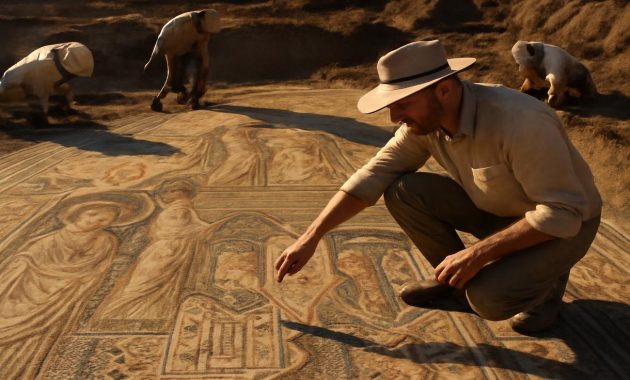
The first glint appeared just after sunrise, a trembling fleck of color in the dust. The young field assistant almost missed it, kneeling in the cool, shadowed trench with a brush no wider than a fingertip. At first, it looked like any other tessera—one of the thousands of tiny cubes that made up Roman floors across the empire. But when the bristles cleared the soil away, a sharp line of lapis blue flashed back at her, framed by a shimmer of gold. It was as if an eye had opened beneath the earth.
A Chance Discovery Beneath the Olive Trees
The site didn’t look like much at first. A low hill outside a sleepy Italian town, a stand of old olive trees, and a scatter of pottery shards that had drawn in a small archaeological team with modest expectations. They thought they were chasing the remains of a forgotten Roman villa, perhaps a few walls, a cistern, and yet another cracked floor mosaic of gods and vines and mythic beasts.
Yet as the days warmed and the trench deepened, the story shifted. What emerged from the soil was not the predictable geometry of Roman domestic art, but a pattern that felt foreign and oddly familiar at the same time. Eyes leaned closer, brushes slowed. There were stylized reeds, a sliver of what looked like a lotus flower, and there, astonishingly, a fragment of a curved shape with unmistakable contours—the edge of an Egyptian-style crown.
“You’re imagining it,” one of the senior archaeologists said at first. But his voice held more hope than doubt. He dropped to his knees in the dust, his shirt already streaked with sweat and soil, and began to brush, just as gently, just as carefully. The trench fell quiet except for the whisper of bristles on stone and the murmur of insects in the olive branches above.
Within hours, the excavators knew this was not a typical Roman floor. They had stumbled upon a mosaic that shouldn’t exist in this place, in this form—a visual conversation between Rome and ancient Egypt frozen under layers of forgotten lives.
The Mosaic That Defied Expectations
The cleaned section was no larger than a dining table at first, but even that small window felt overwhelming. Tesserae of deep cobalt and malachite green formed waves that might have been the Nile, their shimmering curves broken by bands of red and yellow stone. Instead of the usual Roman grapevines and theatrical masks, the central scene held a boat shaped like a papyrus skiff, cutting across the water. At the prow stood a figure that looked, without question, Egyptian.
He wore the short kilt recognizable from temple walls along the Nile, his bare torso defined by subtle changes in color and shadow. In his hand, he held a scepter that was more Roman than Egyptian, a fascinating hybrid of forms. Around him, birds with long legs and curved beaks stalked the mosaic marshes—ibises rendered with the careful observation of an artist who had studied them closely, or at least studied someone else’s faithful drawings.
Yet the border around this Egyptian scene was pure Rome: twisting acanthus leaves, tiny masks of Dionysus and theater, and a band of Latin text that, once deciphered, would send a new wave of surprise through the team. The mosaic, it seemed, had been laid for someone who wanted to declare, right beneath their feet, that their world stretched from the Seven Hills to the banks of the Nile.
A Name Written in Stone
The Latin inscription emerged in patient fragments, each letter a small victory against the blur of time. The line that eventually came into focus read something like a boast and a prayer combined:
“DOMUS ALEXANDRI, AMICUS ROMAE ET NILI.”
“House of Alexander, friend of Rome and of the Nile.”
Not the Alexander of schoolbook fame, the conqueror-king who died centuries before this mosaic was laid, but perhaps a merchant, a freedman, or a local notable who had taken the fashionable name. The choice of words—amicus Romae et Nili—felt less like a casual label and more like a manifesto. This was someone who wanted the world, or at least his guests, to know that his identity straddled two civilizations.
Slowly, the archaeologists began to see the room as it once was. They pictured guests reclining on couches against painted walls, wine sloshing dark ruby in cups, the scent of oil lamps and roasted meat drifting through the air. Their conversation might have leapt from local gossip to distant dramas: taxes and harvests and, somewhere far off, news from Egypt—grain shipments, temple festivals in Alexandria, the changing moods of the emperor in Rome.
Beneath it all, the mosaic gleamed: an image of a world connected by trade routes and tides, ambition and curiosity, belief and spectacle. And at its core, that strange blending of Roman and Egyptian symbols, impossible to ignore and impossible to explain away as mere decoration.
Rome and Egypt: An Uneasy Love Story
To understand why archaeologists are so astonished by this mosaic, you have to feel the tension that defined Rome’s long entanglement with Egypt. These were not simply two cultures that traded trinkets across the sea. Their story is one of fascination, conquest, and a strange, enduring romance.
By the time this mosaic was likely laid—sometime in the first or second century CE—Egypt had been a Roman province for generations. Cleopatra and Antony were already legends, their love affair and tragic end woven into the collective imagination. The grain of Egypt fed Rome’s hungry masses, its temples and strange gods stirred Roman curiosity and suspicion in equal measure.
In Rome itself, Egyptian motifs had already seeped into the urban landscape. Obelisks from the Nile stood in public squares, their hieroglyphs a mystery even to those who owned them. Temples to Isis and Serapis drew devotees from all walks of life. Egyptian-style frescoes adorned some wealthy homes, offering fantasies of exotic landscapes and mysterious rituals.
But what makes this newly uncovered mosaic remarkable is not just the presence of Egyptian imagery—it’s the intimacy of it. This isn’t a grand public monument or a cult shrine. It’s a floor in a private home somewhere far from the usual centers of imperial glamour. Someone wanted Egypt underfoot, woven into their daily life, their dinners and conversations, in vivid detail.
A Table of Clues
As the archaeologists documented each section, they began building a quiet catalog of symbols, a kind of visual ledger. Together, they start to form a story of how Rome and Egypt were braided together in the mind of the mosaic’s commissioner.
| Mosaic Element | Cultural Origin | Possible Meaning |
|---|---|---|
| Papyrus boat on a wide river | Egyptian | Reference to the Nile; trade routes and travel, perhaps a personal journey. |
| Figure in Egyptian kilt with Roman-style scepter | Hybrid | Blending of identities; a Roman citizen fascinated by or linked to Egypt. |
| Lotus flowers and acanthus leaves intertwined | Egyptian & Roman | Symbolic union of two landscapes and artistic traditions. |
| Latin inscription naming “Alexander, friend of Rome and the Nile” | Roman | Personal declaration of cosmopolitan identity and allegiance. |
| Border of theater masks and Egyptian ibises | Roman & Egyptian | Juxtaposition of entertainment and sacred symbolism; everyday life meets distant myth. |
On a mobile screen, the table compresses into narrow bands of detail, each row a small inventory of choices. Line by line, it shows how thoroughly the owner of this house had woven together two worldviews, using stone and color instead of ink and parchment.
Touching the Past, Grain by Grain
For all its grandeur, archaeology often comes down to patience and touch. There is something almost intimate about the way the team has to engage with a mosaic like this. They don’t simply reveal it; they negotiate with it, grain by grain.
The tesserae are small—some no larger than a lentil. Under a magnifier, you can see how each has been chipped by hand, the edges irregular, the surfaces not quite flat. Bits of marble, limestone, and colored glass sit side by side, held together by an ancient mortar that crumbles at an incautious fingertip. Every brushstroke risks both discovery and damage.
During a break, one of the conservators rests her hand, shaking slightly, on her knee. “You feel,” she says quietly, “as if you’re in conversation with the person who placed each stone. They meant this curve, this color. They stood right here, making choices.”
She imagines the original workshop: the sound of tools chipping stone, the clack of tesserae poured into bowls and sorted by shade, the artist—or perhaps the patron himself—gesturing over a sketch. “More blue here, the deep kind. And there, make the reeds taller. The Nile must feel wide.”
Dust settles on the present-day trench the same way it once settled on that ancient workshop floor, as if time were less a line and more a breathing thing. The team kneels where the mosaicists once stood, following their hands backwards through centuries.
When Scholars Meet Surprise
Word travels fast in the world of archaeology. Within weeks of the mosaic’s first unveiling, photographs and preliminary reports were circulating quietly among specialists. Screens lit up in offices and labs from Rome to Cairo, from Berlin to Chicago, all with the same first reaction: disbelief edging into awe.
There are Roman mosaics with Egyptian themes known from other sites, especially in Italy. But this one seemed to press further, to stage not just a decorative borrowing but a coherent narrative where Roman and Egyptian elements shared the same space on nearly equal terms. It wasn’t Rome merely exoticizing the Nile; it was Rome admitting, in stone, that Egypt had seeped into its bones.
Historians of religion wondered if the household had been devoted to Isis or Serapis, those shape-shifting gods who had already found homes in Roman hearts. Economic historians asked whether the owner might have been involved in grain or papyrus trade, his wealth built on that long, narrow river far to the south. Art historians zoomed in on the stylistic details, trying to trace the hand behind the design: Was this a local workshop with access to Egyptian prototypes? Or could Egyptian artisans have traveled here, bringing with them fragments of visual memory?
Every expert who looked saw something familiar and something new, the way you might recognize a friend’s face in a crowd and then notice a scar you’d never seen before.
What This Mosaic Whispers About Identity
The mosaic doesn’t give us dates and coordinates the way an inscription or a coin might. It offers something subtler: a window into how one household, in one corner of the Roman world, chose to see itself.
In modern terms, we might call its owner “global” or “cosmopolitan.” He lived in an empire where the Mediterranean was not a barrier but a thoroughfare. Ships carried grain, wine, ideas, and dreams from port to port. Soldiers, merchants, scribes, and enslaved people flowed along the same routes, carrying with them the gods and stories of their homelands.
For a Roman citizen with ties to Egypt, the choice to commission such a mosaic was more than a matter of taste. It was a statement of belonging to a broader story. The Nile scene underfoot said: I have seen the edge of the known world, or I am connected to those who have. My life reaches beyond this town, this hill, these olive trees.
There is something deeply human in that. Across time, people have used their homes to declare who they are and where they fit in the world. Today, we hang photographs from distant travels or stack our shelves with books in multiple languages. In antiquity, they laid it in stone and invited their guests to recline upon it.
A Dialogue Still Unfolding
As more of the mosaic comes to light, the dialogue it carries grows richer. Some sections show what appear to be small vignettes—figures carrying amphorae, perhaps loading or unloading a ship at an Egyptian port. Another fragment suggests a hybrid procession, musicians playing instruments depicted in ways that mix Mediterranean and Nile traditions.
Nothing is complete yet; each new discovery feels like overhearing one more sentence in a conversation that has been going on for two thousand years. And like any good story, it refuses to resolve neatly.
Was this mosaic meant to impress or to comfort? Was it an act of nostalgia for a homeland far away, or a display of exotic connections meant to dazzle local visitors? Did its owner stand barefoot on the Nile scene in moments of private reflection, tracing the boat’s journey with his eyes while the house lay quiet around him?
These questions hang over the trench like the heat shimmer at noon, blurring the clean lines of theory. Archaeology is rarely about firm answers. More often, it is about learning to sit with the unknown while sifting carefully through what remains.
From Buried Beauty to Shared Heritage
At the end of each workday, the team does something that feels almost ceremonial. They don’t simply walk away from the exposed mosaic. They cover it—first with a protective layer of fabric, then with a carefully measured blanket of sand. The same earth that once hid it now shelters it, layer by deliberate layer.
This act, repeated evening after evening, is a reminder that discovering the past is only half the task. Protecting it for those who will come next—future scholars, future citizens, perhaps children who will one day press their faces against a museum glass to stare at the Nile in stone—is just as important.
Conservators discuss how the mosaic might one day be displayed. Will it remain in situ, housed in a protective shelter where visitors can walk the perimeter of the original room and let their imaginations furnish its vanished walls? Or will it be carefully lifted, panel by panel, to be restored in a laboratory, its colors revived under controlled light before being placed in a museum?
Either way, its story will not belong only to the archaeologists who first brushed it free. It will belong to anyone willing to pause, to look closely, and to listen for what it has to say about connection, ambition, and the ways cultures weave themselves into one another’s stories.
And perhaps that is why the astonishment of the specialists has spread so quickly beyond academic circles. This mosaic doesn’t just change what we know about Rome and Egypt; it confirms something we suspect about ourselves. We have always lived at crossroads. We have always found ways to turn distant places into part of our interior landscapes.
Standing at the Edge of Two Worlds
Imagine, for a moment, that you could step back in time and enter that room just after the mosaic was finished. The mortar is dry, but the stones have not yet dulled under the wear of sandals and seasons. Oil lamps flicker against plastered walls. Outside, the evening wind moves through the olive trees much as it does today, carrying the click of insects and the far-off bark of a dog.
The owner—Alexander or whoever he truly was—stands in the doorway, looking down. Perhaps he feels a ripple of pride, or a quiet awe. This floor is more than decoration; it is a map of his mental world, a place where Rome and Egypt meet and shake hands. He lives in the overlap, where imperial power meets river-born myth, where Latin phrases curl around lotus petals.
Centuries later, a different dawn arrives. The house has fallen, its roof caved in, its walls reduced to shadowy lines under the soil. Above, new lives have risen and fallen: farmers, shepherds, soldiers, their footsteps never quite reaching the buried river of stone below. Then a trowel scrapes, a brush sweeps, and color returns to the light.
Archaeologists gather at the edge of the trench, their boots in the dust, their faces caught between scholarship and wonder. They are not so different from the guests who once reclined here, marveling at the skill of the artists, the shimmer of the Nile where no Nile should be. The distance between them is not as great as the years would suggest.
In the end, this mosaic does what the best stories always do. It collapses time. It brings strangers into conversation. It makes us reconsider the borders we draw between cultures and centuries. Rome and Egypt, conqueror and conquered, river and road, past and present—here they are, side by side in stone, still speaking, if we are willing to listen.
FAQ
Why is this mosaic considered so important by archaeologists?
Because it presents an unusually rich and intimate blend of Roman and Egyptian imagery in a private domestic setting. It shows not just decorative borrowing but a deep, personal identification with both cultures, offering new insight into how people in the Roman world understood their place between different civilizations.
Is it common to find Egyptian themes in Roman art?
Egyptian themes do appear in Roman art, especially after Egypt became a Roman province. Obelisks, sphinxes, and motifs related to Isis and the Nile were fashionable. However, mosaics that integrate Egyptian and Roman elements into a coherent narrative scene, like this one, are relatively rare and therefore especially revealing.
Do we know who commissioned the mosaic?
We don’t know for certain. The inscription mentioning “Alexander, friend of Rome and of the Nile” suggests a wealthy individual with strong connections—personal, commercial, or emotional—to Egypt. Whether he was a merchant, landowner, freedman, or official remains a matter of informed guesswork.
What can this mosaic tell us about daily life in the Roman Empire?
It shows that even in seemingly ordinary provincial settings, people had far-reaching horizons. Trade, travel, and imperial politics brought distant cultures into close contact. This mosaic suggests that some Romans embraced that complexity, weaving it directly into the spaces where they ate, talked, and entertained.
Will the public be able to see the mosaic in person?
That will depend on conservation decisions made by local authorities and specialists. Typically, a mosaic of this significance would either be preserved on site within a protective structure or carefully lifted and restored for display in a nearby museum. In either case, the goal is to make it accessible while ensuring its long-term preservation.