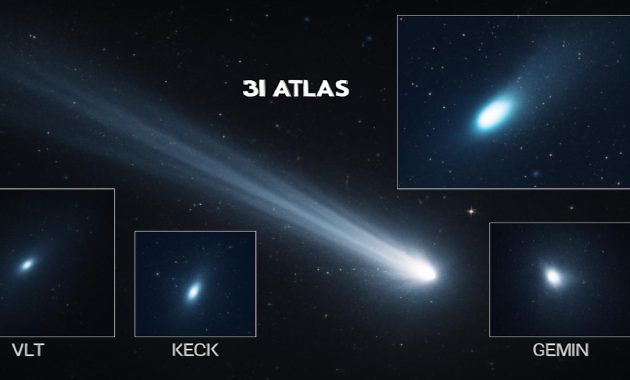
The first time you see the new images of interstellar comet 3I ATLAS, your brain hesitates, just for a breath, before it decides what it’s looking at. There’s a curl of mist, a delicate teal haze, tiny stars pricked like needlepoints in the background—and in the middle, a ghostly traveler that did not come from here. It came from the deep, dark elsewhere between the stars, carrying with it dust, ice, and questions older than our Sun. And for a few brief weeks, every major eye we could turn to the sky tried to follow it.
A Visitor With No Return Ticket
Comets are already the romantics of the Solar System. They fall inward from deep-freeze reservoirs at the outskirts, heat up, bloom into bright comas and tails, then fade again into the dark. But 3I ATLAS isn’t one of ours. It doesn’t belong to the long, slow cloud of icy remnants that orbit the Sun. It’s an interstellar comet—a piece of someone else’s planetary story that has slipped into ours for a single, unrepeatable pass.
Astronomers first tagged it with the name 3I ATLAS: “3I” because it’s only the third known interstellar object to pass through our neighborhood, and “ATLAS” for the system that discovered it, the Asteroid Terrestrial-impact Last Alert System in Hawaii. Those simple letters mask a far stranger reality: this object has spent eons drifting through the void, untethered to any star, silently coasting between galaxies of light.
Now we have new images—crystal-clear, impossibly detailed, taken with instruments scattered across Earth and in orbit. They aren’t just pretty pictures. They are our closest look yet at an interstellar comet’s true nature: its color, its dust, its volatile halo, and the quiet physics that unfold when a wanderer from another system leans too close to our Sun.
The Night the Data Started to Sing
In control rooms and mountain-top domes around the planet, the first night of coordinated observations felt almost electric. There’s a distinct sensory theater to astronomy that never really makes it into the press releases—the cold metal of the railings outside the dome, the hum of motors as shutters open, the blue glow of screens reflecting fatigue and excitement in equal measure.
On that night, optical telescopes slewed toward the faint point of light sliding through the constellation of Cetus. High up on Maunakea, at the Canada-France-Hawaii Telescope, an observer watched the first long-exposure frames appear. The comet’s coma was faint but there, a soft puff around a pinprick nucleus. Farther east, in Chile’s Atacama Desert, one of the world’s driest and clearest places, the European Southern Observatory’s Very Large Telescope started its own run: longer exposures, different filters, measuring how the comet’s light was scattered by dust and ice.
Even space joined in. The Hubble Space Telescope, orbiting high above the blur of Earth’s atmosphere, aimed its narrow gaze at 3I ATLAS, resolving structures that ground-based instruments could only smear. Soon after, the James Webb Space Telescope swung its segmented mirror toward the comet, not for a pretty visible-light portrait but to peel back its infrared secrets—heat signatures, molecular fingerprints, the faint whisper of alien chemistry.
As the first processed frames appeared on screens, the room chatter softened into the quiet that happens when humans realize they are looking at something uniquely rare. From multiple observatories, across multiple wavelengths, a single, impossibly distant story was sharpening into view.
Weaving Light From Many Eyes
One of the most striking things about the new images is not just what any single observatory captured, but how well they resonate together. Imagine taking multiple portraits of a stranger—one in soft daylight, one in infrared camera mode, one in black-and-white, one under ultraviolet lamps. Each is true. Each reveals a different layer of the face. Combine them, and you have something close to a whole person.
That’s what astronomers did with 3I ATLAS. Here’s a simplified snapshot of how the major players contributed:
| Observatory | Type of Data | What It Revealed |
|---|---|---|
| Ground-based optical telescopes (Hawaii, Chile, Canary Islands) | Visible-light images, colors, brightness changes | Overall shape of the coma and tail, rotation hints, dust production rate |
| Hubble Space Telescope | High-resolution visible and near-UV images | Fine structures in the coma, jets of material, refined orbit tracking |
| James Webb Space Telescope | Infrared imaging and spectroscopy | Composition of ices and dust, temperature, complex organic molecules |
| Radio and submillimeter arrays | Emission lines from gas molecules | Gas species like water vapor, CO, CO2, and their relative abundances |
Each image captured a slightly different face of the comet. In the visible, 3I ATLAS appears as a glowing puff of cyan-white, with a subtle, sunward-facing halo and a more defined tail stretching away like a soft brushstroke. Hubble’s high-resolution series revealed faint jets—fans of dust and gas geysering from specific patches on the nucleus as they warmed in solar light.
James Webb’s infrared eyes, though, gave the comet a different personality. In those views, 3I ATLAS looks less like a ghost and more like a coal ember, glowing softly with its own retained heat. Spectra taken by Webb’s instruments carved up that glow into a kind of bar code—sharp lines and dips that encode the presence of water ice, carbon monoxide, carbon dioxide, and more complex carbon-bearing molecules. This is where the “stunning” in “stunning new images” isn’t just about aesthetics. It’s about meaning.
The Chemistry of an Elsewhere World
Look closely at those spectral lines, and you’re peeking into another planetary system’s leftovers. The balance of ices in 3I ATLAS doesn’t match any one template we know from our local comets, but it’s eerily familiar in pieces. There is water, yes. There is carbon monoxide and carbon dioxide. There are organics—compounds with carbon and hydrogen that are the cousins, if not the direct ingredients, of life-related chemistry.
The ratios matter. How much carbon monoxide compared to water? How much dust compared to ice? This pattern is like the comet’s accent, a hint of the kind of star it formed around, the temperature of its nursery disk, the violence or gentleness of the planetary formation that eventually flung it away. The new images, paired with these detailed spectra, suggest that 3I ATLAS likely formed in the cold outer reaches of a system not wildly unlike our own, somewhere far beyond the frost line where ices can solidify and hold on for billions of years.
In other words: whatever star built this comet, it played a similar game with rocks, ice, and gravity that our Sun once played. But 3I ATLAS is the bit that escaped.
Tracing the Ghost’s Path Through Our Sky
A comet’s motion across the stars can be as hypnotic as its image. Over days and weeks, astronomers tracked 3I ATLAS as it arced through our inner Solar System on a hyperbolic path, a curve that will never close. Unlike our long-period comets, which loop back eventually, this one is on a one-way trajectory. It came from the direction of the constellation Lyra, above the plane of the planets, and after its swing around the Sun, it will depart into the southern skies, fading into the direction of the constellation Pictor.
The new images helped sharpen that orbit. Tiny details in the coma’s structure—how jets angled away, how the tail bent and widened—let scientists measure non-gravitational forces: the gentle rocket-like push as gas vents from the nucleus. Feed that into their models and the lines of possible paths tighten into a single, crisp thread. It’s not just a question of “where is it going?” but “where did it come from?”
The answer is not a precise home address; space is too vast and stellar motions too complex for that. But it does suggest broad neighborhoods. The comet likely spent millions, even billions, of years wandering the interstellar medium after being kicked free from its birth system’s outskirts. In that time, stars have shifted, orbits have danced, and any direct line back has been erased. All that remains is this moment of passage, this brief window where our detectors can chase its fading light.
The Most Human Moment in the Data
If you were inside one of those observatory control rooms when the first fully processed, color-balanced composite images came in, the most striking thing would not have been a line of numbers on a screen. It would have been the silence. People who’ve spent their lives turning cold data into warm understanding know to recognize those rare moments.
On a calibrated display, one researcher zoomed into the central region of 3I ATLAS’s coma. There, buried in layers of processing, was a tiny knot—the unresolved nucleus itself, less than a few kilometers across, surrounded by its expanding veil. Wisps of dust arced away, tracing invisible magnetic and radiation fields. The tail, when stretched and enhanced, merged into the starfield, as if the comet were pulling threads of starlight along in its wake.
“This is what another system’s leftovers look like,” someone murmured. It’s the kind of line that sticks. On the screen, the colors were false in the technical sense, tuned to reveal chemistry rather than literal human vision. Yet on some level, the image felt truer than what a naked eye could ever see.
Why This Matters More Than a Pretty Picture
When the first interstellar visitor, ’Oumuamua, passed through in 2017, it arrived as a mystery and left as a controversy. Was it a comet, an asteroid, something in between? Where was its coma? Why did its acceleration behave so strangely? The second visitor, comet 2I/Borisov, looked more comfortably familiar—a classic comet bearing a foreign passport. 3I ATLAS pushes us deeper into that story.
We now have a small handful of samples—three objects from beyond the Sun’s gravitational neighborhood. Each one is a datapoint in the grand census of how planetary systems build and discard their debris. With 3I ATLAS, the wealth of multi-observatory imaging and spectroscopy means we can make the first serious comparisons.
Is its chemistry closer to Borisov or to the average Solar System comet? Are its dust grains larger or finer? Does its activity switch on and off at different distances from the Sun, hinting at unusual ices that sublimate at colder temperatures? Early analyses from these new images suggest that, while 3I ATLAS carries its own unique signature, it sits comfortably within a broader pattern: comets, wherever they form, seem to follow similar rules when gas and ice meet gravity and time.
That has implications for everything from how water is delivered to rocky planets to how organic molecules spread through the galaxy. If interstellar comets like 3I ATLAS are common—and our growing list of detections suggests they are—then the cosmos might be constantly trading raw ingredients. Planetary systems aren’t isolated islands. They are, slowly and silently, passing each other messages in the form of icy fragments.
Seeing Ourselves in the Wanderer
One of the quiet revelations of the new imagery is how strongly it invites metaphor. Look at the soft blue-green coma swaddling a dark, unknowable core. Behind it, background stars stretch into faint streaks during long exposures, while the comet, tracked by the telescope, remains still and bright. In those frames, everything we usually think of as fixed is moving, and the visitor is the reference point.
There is a strange comfort in that reversal. Our own star, our planets, our entire familiar architecture of moons and belts and rings—these are as locally bound as any comet in someone else’s sky might be. To 3I ATLAS, the Sun is just another brief blaze it will slide past, another furnace that wakes its ices and sends them boiling off into space.
The new images give us the chance to exist, for a moment, from that perspective. To imagine our home not as the center about which everything must turn, but as a waystation on an older, longer, colder journey that began light-years away.
The Fading and the Memory
Already, astronomers know that the best images of 3I ATLAS are behind us. The comet is receding, its brightness dropping as it drifts outward. The coordinated campaigns are giving way to brief follow-ups. Schedules shift to new supernovae, new exoplanet transits, new nearby asteroids that must be tracked and cataloged.
But the data from those nights of intense focus will linger, being reanalyzed with better tools, folded into simulations of planetary systems, and revisited when the next interstellar wanderer appears. Somewhere, supercomputers will spin up models of how dust leaves the surface of a nucleus like this, how jets evolve as sunlight creeps across its frozen terrain, how granular chemistry shapes the glow that our cameras captured so delicately.
The images themselves, though, will live a parallel life: printed in textbooks, shared in classrooms, scrolling by in news feeds on phones gripped by people far from any dark sky. For some, they will be a passing impression—“pretty comet, cool colors.” For others, they might be a trigger: a sudden, sharp sense that we are not just looking out into space, but into a wider context of origins and possibilities.
Somewhere between those responses is the true power of these stunning new portraits of 3I ATLAS. They are both science and story, measurement and mirror. They show us, with exquisite clarity, an object that does not belong to us—and in doing so, they reveal how much of our own history is still written in ice and dust, waiting to be read.
Frequently Asked Questions
What is 3I ATLAS?
3I ATLAS is an interstellar comet, meaning it did not form in our Solar System. It is the third known object on a clearly interstellar trajectory to pass through our neighborhood, after ’Oumuamua and comet 2I/Borisov.
Why are the new images of 3I ATLAS important?
The new images come from multiple observatories and across many wavelengths, allowing astronomers to study the comet’s structure, composition, and behavior in unprecedented detail. This helps us understand how planetary systems form and what kind of material they eject into interstellar space.
How do we know 3I ATLAS is interstellar?
Its path through the Solar System is hyperbolic, meaning it is moving too fast to be bound by the Sun’s gravity. Even after accounting for the small push from gas jets, its orbit cannot be closed into a loop, indicating it came from—and will return to—interstellar space.
Can we see 3I ATLAS with the naked eye?
At its best, 3I ATLAS has remained a relatively faint object, primarily accessible to professional observatories and advanced amateur setups. It has not reached the brightness needed to be easily seen without optical aid from typical urban or suburban locations.
What did the James Webb Space Telescope learn about 3I ATLAS?
JWST used its infrared instruments to measure the comet’s heat and composition. Its spectra revealed the presence of common cometary ices—like water, carbon monoxide, and carbon dioxide—as well as organic molecules, offering clues about the environment where 3I ATLAS originally formed.
Will 3I ATLAS ever come back?
No. Its orbit is open-ended; after passing through our inner Solar System, it will continue out into interstellar space and not return. This is a one-time encounter.
What do interstellar comets tell us about life in the universe?
Interstellar comets like 3I ATLAS carry ices and organic molecules forged around other stars. By studying their chemistry, scientists can test whether the basic ingredients for life are common across planetary systems. The more such visitors we study, the better we can understand how widely those ingredients are scattered through the galaxy.