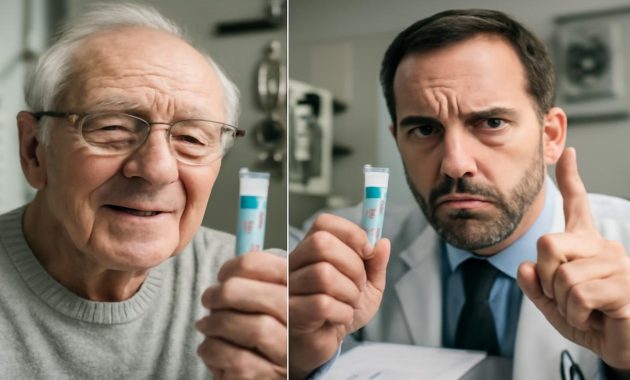
The first time I see the little glass vial, it’s sitting in a pool of late-afternoon light on the corner of a desk, no bigger than a thumb. Inside: a clear, faintly bluish gel that clings to the glass like dew clings to a blade of grass. It looks utterly ordinary. Yet the people in this room are talking about it as if it’s a doorway—a possible return from the dim edges of vision, a way back from the blur, from the milky clouding of cataracts and the fragile nerves of damaged retinas. On the label is a name that sounds almost mythical, with the kind of branding you’d expect from a sleek tech startup rather than a medical device. But in the medical world, it’s already picked up a simpler, heavier name: the “miracle eye gel.”
A Clear Promise in a Cloudy World
In a world where our eyes are both our guides and, increasingly, our overworked, screen-burned companions, the promise is irresistible. A few drops of gel, a quick in-office procedure, and—if you believe the breathless headlines—some people who might otherwise face the glare and risk of major eye surgery could see clearly again.
One of those people is Elena, a retired gardener in her late sixties. For years, her world has been softening around the edges, colors leaking into each other, details dissolving. The veins in a leaf, the shimmer of dew, the thin silver lines of spider webs across her tomato plants—all fading. Her ophthalmologist calls it “progressive lens opacity” and “early degenerative change.” She calls it losing the language of the world.
So when her son reads that a new gel can be applied under mild local anesthesia, promising to restore clarity without the whirring machinery and internal lens replacement of standard cataract surgery, he sends her the article with a hopeful note: “Maybe this, Mama?”
The idea is almost surreal: a gel that can, in some patients, reshape the way light enters the eye, repairing or compensating for damaged structures, stimulating regeneration, or supporting fragile cells with a targeted mix of bioactive compounds. No overnight hospital stay. No conscious sedation. No surgeon working inside a fragile orb only a little bigger than a large marble. Just a vial of clear gel—and trust.
The Science Behind the Shine
Like many medical miracles, the “miracle eye gel” is both complicated and, in its simplified form, seductively easy to understand. The most talked-about version is a hybrid: part drug, part device, part regenerative scaffold. In some trial protocols, it’s injected as a thin band along the edge of the cornea or into the space just in front of the lens. In others, it’s applied after a tiny incision, spreading like a liquid lens that slowly molds itself to the shape of the eye.
The formulation varies from study to study, but most share a core idea: combine a transparent, biocompatible hydrogel with molecules that support cell health, reduce inflammation, and possibly encourage nerve or tissue repair. The gel, once in place, is meant to smooth out irregularities, filter and focus light more cleanly, and create a nurturing environment for the eye’s delicate structures.
Scientists talk about it in terms of refractive indices and corneal curvature, about trans-epithelial migration and controlled release. Patients talk about it in simpler ways: being able to read a street sign again, see their grandchild’s face clearly, make out the birds on a far-off branch instead of watching a shapeless flutter of color.
In preclinical studies, the gel showed tantalizing signs of potential: healthier retinal cells in animal models, reduced scarring after minor surgical interventions, even partial recovery of light sensitivity in severely compromised eyes. Then came the early human trials—small, experimental, tightly monitored. A few participants reported astonishing results: vision scores improving dramatically, contrast returning, halos and glare easing. Word spread quickly, faster than the science could comfortably keep up with.
Desperation as an Uncomfortable Fuel
The story might have ended there—another promising therapy advancing slowly through years of cautious testing—if not for one thing: desperation. Around the world, millions live with deteriorating vision and limited access to safe surgery. Some are too old or medically fragile for major procedures. Others live in regions where surgical care is scarce, expensive, or perilous. And some, like Elena, are simply terrified of the idea of knives and lenses inside their eyes.
For those people, the notion of a minimally invasive, in-office gel procedure feels like a lifeline tossed into deep, dark water. And where there is desperation, there is always a risk that nuance will be sacrificed in favor of hope. Clinical nuance. Safety nuance. Ethical nuance.
As word of the gel spread, private clinics began to whisper about “compassionate access” and “innovative restoration.” Flyers appeared: “Non-surgical sight restoration now available,” “Avoid painful, risky surgery,” “Limited spots for early access candidates.” Fine print mentioned “ongoing research” and “not yet standard of care,” but the bold letters shouted something much simpler: miracle.
For a patient whose world has dimmed to a gauzy blur, fine print is no match for the possibility of seeing again.
| Aspect | Miracle Eye Gel | Traditional Eye Surgery |
|---|---|---|
| Procedure Type | Minimally invasive gel application or injection | Operative procedure with incision and internal repair or lens replacement |
| Anesthesia | Local drops and mild numbing | Local with sedation, or regional blocks |
| Recovery Time | Hours to days (early reports) | Days to weeks for full stabilization |
| Evidence Base | Early-stage trials, limited long-term data | Decades of large-scale clinical evidence |
| Main Appeal | Avoid major surgery; potential regeneration | Well-established outcomes and predictability |
Breakthrough or Beautiful Illusion?
Supporters of the gel speak with the quiet intensity of people who feel history shifting under their feet. They compare it to the first successful organ transplants, the earliest days of laser eye surgery, the arrival of antibiotics. They talk about the gel as a new category, not just another treatment—a platform on which future therapies can be built. A way to deliver delicate molecules directly to where they are needed without flooding the entire body with drugs.
One researcher describes watching a patient read an eye chart after treatment: “It was like watching a photograph slowly come into focus. He started with guessing shapes and ended up correctly reading lines he hadn’t seen in years. His hands were shaking.” That kind of moment is hard to ignore, especially when it is backed by early data showing improvements in visual acuity, reduced corneal irregularities, and better contrast sensitivity in some participants.
Optimists imagine a near future where ophthalmologists keep a range of gel formulations in their clinics, tailored to different eye diseases. Gels that stabilize early cataracts before they require surgery. Gels that support damaged retinal cells in people with diabetic eye disease. Gels that slow the creeping darkness of macular degeneration. These are not wild fantasies; they’re logical extrapolations of what early research hints might be possible.
Yet the word “breakthrough” can be a double-edged blade. In the glow of excitement, it’s easy for a still-experimental therapy to masquerade as a proven solution. And once hope has slipped into the room, it’s nearly impossible to ask it to take a seat and wait while the boring work of careful science continues.
The Critics: “We Are Experimenting on Fear”
In quiet meeting rooms and at crowded medical conferences, critics use blunter language. To them, the miracle eye gel is not just a promising therapy; it’s a test case in how far we are willing to stretch ethics when the currency is vision instead of years of life.
“We are experimenting on fear,” one ethicist says. “On the fear of going blind. On the fear of losing independence. This is not like a cosmetic treatment where someone is trying a new wrinkle cream. These are people terrified of darkness. That makes them vulnerable, and vulnerability is where exploitation lives.”
The central tension is not about whether the gel has scientific merit. Most critics agree it does. The problem lies in speed, in marketing, and in blurred lines between clinical trials and paid procedures. In some countries, regulatory frameworks have struggled to keep up with fast-moving regenerative technologies. Loopholes allow clinics to offer “innovative” or “experimental” treatments outside of formal trials, sometimes at staggering costs, with unclear oversight and limited follow-up.
Stories begin to emerge. A man in his fifties who traveled halfway across the world to receive the gel, paying the equivalent of several months’ salary. A woman who emptied her savings for a “vision rejuvenation package” that bundled the gel with supplements, special lamps, and follow-up visits. Some report true improvements. Others experience only a flicker of change, or none at all. A few suffer complications: inflammation that flares painfully, corneal swelling, infection. One patient, in the most troubling reports, ends up with worse vision than before.
The critics raise a hard question: at what point does hopeful innovation tip over into a dangerous experiment on desperate people? Especially when the long-term effects—how the gel behaves in the eye after five, ten, or twenty years—are still largely unknown.
The Thin Line Between Consent and Hope
On paper, it looks straightforward. Patients sign informed consent documents. They are briefed on risks, alternatives, and uncertainties. They are often told, clearly, that the gel remains experimental and that traditional surgery remains the gold standard for many conditions.
But real life is messier than paper. When you are sitting in a softly lit clinic, your pupils dilated, your world already a watery blur, the way you hear those words can change. “Experimental” may sound less like a warning and more like an invitation into a small, exclusive circle of the lucky and the brave. “Not standard of care” might echo in your mind as “ahead of its time” rather than “not yet proven safe enough.”
And when your doctor, someone you trust with the fragile windows of your world, speaks enthusiastically about early results, it can be very hard to weigh that excitement against a dry list of potential complications. Hope is not neutral; it bends our perception. It magnifies possible benefits and shrinks possible harms.
Some ethicists argue that, with treatments like the eye gel, consent documents should be even more conservative, even more brutally honest than usual. That clinics should be required to present not just best-case anecdotes but also worst-case scenarios in vivid, relatable terms. That patients should hear, out loud: “There is a chance this could make your vision worse. There is a chance it might not help at all. There is a chance we will not fully understand any damage until years from now.”
Living in the In-Between
Where does this leave people like Elena? Sitting in the kitchen on a bright morning, the window a glowing square of light she can barely see through, she is caught between two imperfect options. On one hand, a tried-and-true surgery with decades of data but very real fears of risk. On the other, a gel that whispers of gentle, almost magical restoration—but carries unknown long-term consequences.
When she finally visits a clinic offering the procedure, the waiting room feels more like a wellness spa than a medical office: soft music, pale wood, potted plants that she can’t quite make out. On the wall, a framed photograph of a forest path in perfect focus, every leaf sharp and alive. Underneath it, in tidy letters: “See life clearly again.”
The physician who examines her is careful. He explains that her cataracts are still mild, that she is not yet at the point where surgery is urgently needed. He shows her diagrams of how the gel works, how it might improve the way light enters her eyes. He also tells her, very plainly, that the procedure is not a guarantee, that improvements vary, that some patients feel only a moderate difference.
He does not push. But he does say one thing that lingers in her mind: “For many people, this feels like the gentlest intervention. It buys time. Maybe by the time you need full surgery, we’ll have even better tools.” That idea—of buying time—wraps itself around her fear like a soft cloth. The unknowns recede, not because they matter less, but because, right now, the trained voice across from her is telling her that maybe, just maybe, she doesn’t have to leap straight into major surgery.
Later, at home, she sits by the window with a cup of tea and watches the afternoon light bleed into early evening. The world is still soft and hazy, a watercolor instead of a photograph. She turns the idea of the gel over in her mind like a smooth stone: small, unassuming, holding a whole landscape of possibility.
How Do We Move Forward Responsibly?
Between the soaring promises and the harshest critiques lies a narrow, necessary path. On it, the miracle eye gel is neither a cure-all nor a villain, but a fragile, powerful tool that demands respect.
Researchers argue for more robust, transparent trials: larger numbers of patients, longer follow-up, independent monitoring, open reporting of both successes and failures. Regulators, slowly and unevenly, are tightening requirements around how such treatments are advertised and when they can be sold outside registered studies.
Some professional associations have begun drafting guidelines: how to discuss experimental gels with patients; when to offer them; when to firmly steer patients toward established surgery instead. A few clinics have voluntarily decided not to charge patients for gel procedures that are still in early stages of evaluation, absorbing the cost as part of research—an attempt to reduce the ethical tangle of paying for hope.
At the same time, patient advocates remind the medical world that risk is not something to be avoided at all costs. Every major advance in medicine was born from a willingness—by both patients and doctors—to try something new. The question is not whether we should take risks, but how we share them. Who gets to decide, and on what terms?
The Eye as a Mirror of Our Choices
There is something symbolically potent about this debate centering on the eye. Sight is our primary tether to the visible world, the way we read expressions, maps, recipes, faces. To lose it is to be forced into a different kind of listening and touching; to regain it, even partially, is to feel the world rush back in color and line.
The miracle eye gel carries all of that longing in its small, clear body. In each vial is not just a medical compound but a reflection of how we, as a society, handle people who stand on the threshold between capacity and loss. Do we rush to offer them the newest thing, hoping it will spare them pain and disability? Or do we hold them back until we are absolutely sure, at the risk of denying them a chance that might never come again?
There is no easy answer. The gel is, in many ways, a test of our collective vision—not of how well we see fine print on an eye chart, but how clearly we see the lines between innovation and exploitation, between healing and harm.
For now, the story remains unfinished. Trials continue. Regulators argue. Clinics open and close. Some patients, after the gel, step into a sharper, more luminous world and whisper that it feels like a miracle. Others blink, wait, and realize that their world remains as hazy as before, or that new problems have arisen.
And people like Elena? Some will choose the gel, accepting the uncertainty in exchange for even a small chance of seeing the veins in a leaf again. Others will wait for surgery, trusting the long, proven road over the bright, risky shortcut. Many will watch and listen, caught between fear and hope, as the story of this clear, shimmering substance unfolds.
Out beyond the clinics and conference halls, in gardens and city streets and quiet living rooms, the real measure of the miracle eye gel will not be how dramatic the headlines sound, but how gently it holds the lives that are placed in its hands.
FAQ
Is the “miracle eye gel” a proven cure for blindness?
No. The gel is not a universal cure for blindness. Early studies suggest it may help certain types of vision loss, particularly those related to the cornea or lens, but it does not restore sight in all conditions, especially where the optic nerve or brain pathways are severely damaged.
Is the gel safer than traditional eye surgery?
It is too early to say. The procedure is less invasive than many surgeries, but long-term safety data are limited. Traditional surgeries like cataract removal have decades of solid evidence behind them, while the gel is still under active investigation in most regions.
Why do some experts call it a “dangerous experiment”?
Critics worry that desperate patients may be paying for a treatment that is still experimental, with unknown long-term risks. They also question how the gel is marketed, fearing that hope and fear are being used to push people into procedures before the science is mature.
Can anyone get this eye gel treatment right now?
Availability depends on where you live. In some countries it is offered only within formal clinical trials. In others, private clinics may provide it under “innovative therapy” or similar labels. Access, cost, and oversight can vary widely.
What should I ask my doctor if I’m considering the gel?
Ask whether the treatment is part of a registered clinical trial, what evidence supports its use for your specific condition, what the known risks are, what alternatives exist (including standard surgeries), and how your progress will be monitored over time.
Could the gel delay the need for major surgery?
Possibly, for some patients. One hope is that it may improve or stabilize vision enough to postpone surgery. However, this is not guaranteed, and delaying a proven surgery when it is clearly needed can also carry risks. Decisions should be made with a specialist who understands your full medical picture.
How can patients protect themselves from being exploited?
Seek second opinions, favor treatments within regulated clinical trials, be cautious of clinics that make dramatic promises, ask for written information about risks and benefits, and be wary of anyone who pressures you to decide quickly or pay large sums upfront for unproven therapies.