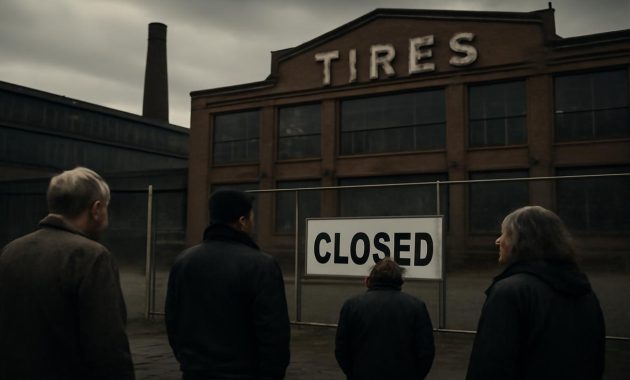
The siren didn’t sound that morning. For eighty years, the town had moved to the rhythm of that whistle—sharp, metallic, a kind of daily sunrise made of steam and steel. But on this gray Tuesday, the factory gates stayed half-open and strangely quiet. Men and women in scuffed work boots and neon safety vests clustered in small, uncertain circles, clutching thermoses they suddenly had no reason to open. A cardboard sign taped to the security window said it in language as dry as dust: “Operations Suspended Until Further Notice.” By noon, everyone knew what it really meant. The tire giant—the one that had built not just rubber and steel but mortgages and college funds and little league sponsorships—was shutting down after eighty years. Nine hundred people, including some whose grandparents had worked the same line, were out of a job. And somewhere far away, in the flat expanse of a loading dock, a container full of cheaper tires stamped “Hecho en Argentina” was rolling off a ship.
The Day the Machines Went Quiet
The last tires rolled off the line at 3:17 p.m., according to the shift supervisor, who checked the time almost without thinking. It had been an ordinary day right up until it wasn’t. Warm, chemical-scented air hung over the vulcanization room, the familiar tang of rubber and solvents wrapped around the workers like an invisible coat. Forklifts beeped in short, impatient bursts. Radio chatter, steel-on-steel clatter, the hydraulic sigh of presses—it all blended into the comforting industrial hum that had underscored generations of local lives.
Then the plant manager walked the floor with an HR representative at his side, both wearing that stiff, overprepared expression workers recognized from rumor and dread. Notices were handed out—in the break room, in the molding section, near the back loading docks where finished tires were stacked like black, circular monuments to repetitive labor. “Due to loss of industrial competitiveness,” the letter read, “primarily linked to increased tire imports from Argentina and other foreign producers, the company will cease manufacturing operations at this facility.”
On the mixing line, someone let out a laugh that sounded more like a cough. In the break room, a worker folded the letter twice, then twice again, until it disappeared into her fist. Stories about layoffs had floated through the community for months, but this felt different—final, heavier, like the last chapter of a book people had assumed would go on forever.
The Town That Rubber Built
Drive into this town, and for years the factory would announce itself before you ever saw it. The air grew denser, tinged with a burnt scent you couldn’t quite place if you didn’t grow up here. Locals joked you could tell the weather by the way the steam drifted from the stacks: long and straight for dry days, low and smeared for rain. Kids learned to navigate by the smokestacks. Teenagers marked their years by moving from summer clean-up jobs to the night shift on the finishing line. Whole families made their lives under that slow-moving industrial sky.
The factory started with one building in the 1940s, when the world was at war and the country’s hunger for tires—for trucks, planes, and jeeps—felt endless. Old black-and-white photos in the lunchroom showed men in suspenders and women in tied-up headscarves, standing shoulder to shoulder beside lathes and curing presses. Back then, the plant offered something radical: steady work with decent pay in a town that had mostly known seasonal farm jobs and odd construction gigs. It didn’t take long before a kind of unspoken covenant formed: the town would give the company its labor, its youth, its loyalty; the company would give roofs and pensions, Little League sponsorships, and funding for the high school marching band.
Over decades, that covenant shaped everything. The main street diners opened early for the first shift and stayed open late for the third. The barber kept odd hours because so many customers came straight from the line. The local bank learned to recognize overtime on a pay stub and smiled when people mentioned the plant in mortgage applications. The factory wasn’t just a place to work; it was the quiet backbone behind every new minivan in a driveway and every porch with fresh paint.
Argentina Arrives by Sea
For years, the shadows never seemed to reach the factory gates. There were downturns, yes, and a few breathless months in the early 2000s when rumors of outsourcing blew through town like winter wind. But the plant adapted: new machines, new training programs, short technical courses at the community college that promised to lift the workforce from “laborers” to “technicians.” The story of this factory was always about resilience.
Then the numbers started to shift—quietly at first, like the subtle change in a familiar smell. Shipping data showed more and more containers arriving on the docks, stacked high with imported tires from abroad. Among them, one name kept recurring in management meetings and trade reports: Argentina.
On paper, it looked clinical. Tires had become a global commodity, shuttled across oceans where wages were lower, energy sometimes cheaper, and governments eager to support exports. In Argentinian plants, operators dressed in the same safety vests, surrounded by the same hiss and roar of heavy equipment, were building tires at a cost this eighty-year-old factory struggled to match. Maybe it was cheaper electricity, or different labor rules, or a currency that made export prices hard to compete with. Maybe it was all of it at once.
For the workers here, those distant forces took shape in a simpler way. A forklift driver scrolling his phone during a break came across a news photo of a wide, clean factory floor in Córdoba or Buenos Aires, workers posing proudly in front of large pallets of brand-new tires destined for export. If you squinted, the machines in the background looked almost familiar. The comment section below the article was full of local pride on one side of the world—and anxious, bitter questions on the other.
Invisible Forces, Visible Consequences
The official explanation that circulated through investor calls and press releases boiled down to this: an eighty-year-old industrial giant had lost its competitive edge. Imports, especially from Argentina, were named as decisive. An influx of lower-priced tires undercut the factory’s pricing. Contracts that had once seemed locked-in shifted. Retailers, under their own squeezes, turned to cheaper offers.
But what does “loss of industrial competitiveness” feel like up close, without the spreadsheets?
It feels like a maintenance crew that can’t get approval for new tools. Like an engineer being asked to stretch a machine designed for 10,000 units a day to 13,000 without downtime. Like staying late to fix a conveyor that broke again because the replacement parts were delayed in shipping.
It feels like R&D teams fighting to justify new designs when the marketplace keeps screaming a single, relentless demand: make it cheaper. Cut a fraction of a cent from each tire. Squeeze the cost of labor, of raw materials, of logistics. Meanwhile, halfway across the world, someone else is being told the exact same thing, and they have just enough economic leverage to say yes.
Eventually, the numbers proved unforgiving. The company ran tables like these in private presentations long before any worker saw that layoff notice:
| Factor | Local Factory | Imports from Argentina |
|---|---|---|
| Average production cost per tire | Higher due to wages, energy, compliance | Lower via wage levels, export incentives |
| Shipping and logistics | Shorter distance, faster delivery | Longer routes but offset by low unit cost |
| Regulatory environment | Stricter safety and environmental rules | Different standards, sometimes cheaper to meet |
| Price offered to retailers | Often higher to cover fixed costs | Aggressively competitive, volume-driven |
The chart looks neat on a phone screen. In real life, those margins translated directly into which factory hummed with overtime and which one grew quiet.
Stories Behind the Numbers
On the day after the announcement, the coffee shop opposite the plant was busier than usual, though no one seemed particularly hungry. People pushed their cups around in small circles, the air filled not with the usual easy banter about shift rotations and foremen, but with sentences that started with “I was going to…”
“I was going to replace the roof this fall.”
“We were going to send Diego to trade school next year.”
“I was going to hold out three more years and then retire.”
A man in his late fifties sat near the window, his orange safety vest folded on the chair beside him. He’d started in the plant thirty-two years ago, sweeping floors on the night shift. Over the decades he’d learned every corner of the operation—from mixing compounds to supervising press lines. Somewhere along the way, he had stopped thinking of his job as temporary. The factory was the constant around which his life rotated: births, divorces, a broken leg, a new truck. Now, he was staring at his reflection in the glass, framed by a view of the silent parking lot.
Across town, a younger woman was sorting through a kitchen drawer, her layoff letter tucked under a magnet on the fridge. She’d left a retail job years before because the plant offered her something better: training, benefits, and the promise that if you learned each machine, each protocol, there was always another position to grow into. Her father had worked there. So had two uncles. Her daughter’s crayon drawings of smokestacks and forklifts went up on the refrigerator door alongside school announcements and grocery lists.
To politicians and economists, the closure quickly became a talking point. Some pointed to trade policies, others to automation, others still to the unavoidable gravity of global supply chains. But under all the rhetoric, the reality was more intimate: nearly 900 individual stories, each now forced to bend sharply in a new direction.
Echoes in Empty Corridors
You can walk the length of the factory in about eight minutes if you don’t stop, but for years nobody rushed. There was always noise—heavy footfalls, shouted instructions, forklift horns, the steady roar of ventilation fans. After closure, the quiet seeps in slowly. The clocks still tick. Safety posters still hang at perfect right angles. On some machines, half-finished tires remain like abandoned thoughts, waiting for hands that will never return.
Industrial silence has its own sound. Without the endless thrum of operation, you hear small things: the flutter of a paper sign in an air current, the drip of condensation from a pipe into a shallow puddle, the faint rattle of a loose bolt when a door closes two rooms away. The place feels like it’s holding its breath.
Outside, the town tries to keep moving. The grocery store still opens at seven. School buses still trundle past the factory entrance, their windows fogged by the breath of children who don’t yet fully understand what this closure will mean for their town. But the absence settles in subtle ways. Fewer trucks at the diner. A pause when the bank clerk sees the name of the employer line on a loan application. An extra beat of quiet before the server asks, “How’s everything going?”
Some workers talk about retraining, about learning to code or move into green energy or logistics management. Others, particularly those with kids in school or aging parents nearby, aren’t sure how far they’re willing—or able—to move in search of work. They look toward job fairs and workforce development offices and wonder if they are supposed to be grateful for the chance to start over or angry that they have to.
The Complicated Truth About Blame
In some conversations, Argentina becomes a convenient villain, a distant symbol for everything that went wrong. It’s easier, maybe, to picture a single place—a single flag—than to map out the dense web of decisions and trade agreements, corporate strategies, and macroeconomic currents that led to this moment. But reality is slipperier.
Somewhere in an Argentinian tire plant, workers stand over their own machines, their own backs sore from long shifts. They’re proud of the output, the exports, the jobs those tires represent in their cities. Their newspapers may run headlines celebrating increased production, new contracts, growing market share. Their families depend on those jobs every bit as much as this town depended on its factory.
This is the strange, often cruel geometry of global trade: one community’s industrial triumph can cast a long shadow on another’s. A line here shifts a line there. A cost cut in one hemisphere pulls the floor from under a factory in another. And hovering over it all is the customer—someone standing in a tire shop, staring at two near-identical products, one slightly cheaper than the other, making a perfectly rational choice that echoes down supply chains and into people’s lives.
There are calls now for stronger trade protections, for industrial policies that don’t leave towns like this one exposed to price wars they cannot win. Others argue that innovation, not protection, is the only sustainable path—that factories must constantly reinvent themselves or fade. But neither of those conversations feels immediate to someone who has just cleaned out a locker and handed in a badge.
What Remains After the Last Shift
The factory will not disappear overnight. Its long, low buildings will continue to catch the evening light, turning orange at sunset. Grass will keep pushing through cracks in the loading dock pavement. For a while, the parking lot will hold the slow ghost of what it used to be: the jostle of cars at shift change, the flash of taillights, the murmur of tired conversations drifting out of rolled-down windows.
There is talk at town hall of repurposing the site: a logistics hub, perhaps, or a cluster of smaller manufacturers. Some imagine a massive indoor agricultural operation; others dream of a tech campus, with glass facades and co-working spaces where old presses once stood. The building’s bones are strong. It was designed to carry weight, to shrug off vibration, to stand firm in the face of industrial fatigue.
Yet whatever comes next will arrive in the shadow of what once was. The older residents will still call it “the tire plant,” even if it becomes a warehouse for electronics or a studio space for artists. Street names—Vulcan Way, Rubber Lane, Tread Circle—will remain as fossil imprints of the industry that shaped them.
In living rooms across town, kitchen tables have become planning centers. People spread out bills and calendars, printouts of job listings, and application forms. The air smells like coffee and pencil shavings, occasionally sharpened by the metallic tang of fear. Parents assure kids that things will be okay, their voices carrying a conviction they don’t always feel in their chests.
Some of the 900 will move away, chasing opportunity across state lines, following rumors of new plants opening in other regions. Others will stay, stubborn or rooted or both, determined to carve out a life in the same streets they grew up on. Over time, the town will change shape around the absence, just as forests grow around fallen trees, using the decay as fertilizer for something new.
But for now, as the dust settles and the reality of an eighty-year chapter closing sinks in, there is a kind of shared pause. It’s the silence after the machines stop and before anyone has figured out how to speak about the future with any certainty.
Frequently Asked Questions
Why did the factory close after so many years in operation?
The company cited a loss of industrial competitiveness as the primary reason. In practice, this meant the factory could no longer produce tires at a cost that matched what large buyers could get from abroad, especially from Argentina. Higher local production costs, stricter regulations, and aging equipment all played roles in making the plant less competitive over time.
How did imports from Argentina influence the decision?
Increased imports of lower-cost tires from Argentina put sustained pressure on prices in the domestic market. Retailers and large buyers shifted purchases toward these cheaper options, shrinking the order volume for the local factory. Over several years, this erosion of demand and margin made continued operation financially unsustainable, according to company statements.
How many workers lost their jobs?
Approximately 900 workers were laid off when the plant ceased operations. This includes line workers, technicians, maintenance staff, supervisors, and administrative employees whose roles were tied directly to the factory’s production.
What will happen to the factory building and equipment?
At closure, the company began assessing options: selling or auctioning equipment, repurposing parts of the facility, or putting the property on the market for other industrial or commercial uses. Local officials have discussed possibilities such as logistics, light manufacturing, or other redevelopment, but no single path is guaranteed.
Is there any support available for the laid-off workers?
Typically, in closures of this scale, workers may have access to severance packages, unemployment benefits, and retraining or workforce development programs offered by regional or national agencies. The exact support depends on local laws, union agreements where applicable, and any special assistance programs activated in response to the closure.
Could anything have prevented the shutdown?
Some argue that earlier investment in modern equipment, stronger trade protections, or strategic diversification into higher-value products might have helped. Others believe that the broader economic forces of globalized manufacturing and cost competition made the closure hard to avoid. In reality, it was likely a convergence of many long-term decisions and external pressures rather than a single missed opportunity.
What does this mean for the future of manufacturing in similar towns?
This closure highlights the vulnerability of single-industry communities in a world of global supply chains. For similar towns, it underscores the importance of diversifying local economies, investing in skills that can transfer across sectors, and engaging early with shifts in trade patterns and technology. It also raises questions about how national policies can balance global competition with local industrial resilience.