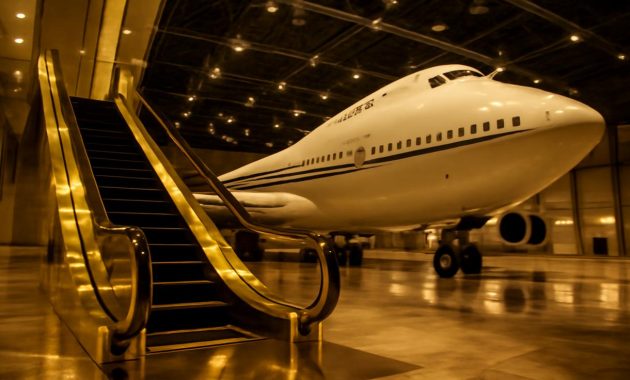
The story often begins with a flash of gold.
Not the kind of gold you tuck into a velvet box or clasp around a wrist, but a shimmering staircase that appears at the door of a private jet—an escalator, to be precise, gliding down from the belly of an aircraft like something out of a science fiction film about untouchable wealth. On a hot tarmac in Doha or a misty runway somewhere in Europe, the Qatari royal family’s gold escalator hums quietly to life, its polished steps reflecting runway lights and desert sun. Ground staff pause, even if only for a moment, to watch. Because you don’t forget the first time you see a staircase descend from a plane like a moving golden carpet.
This is where the story of “far beyond luxury” really begins. Not with a palace, not with a yacht, but with a fleet of private aircraft—up to a dozen of them—worth well north of US$400 million. Among them, a Boeing 747-8 BBJ, essentially a flying mansion, and a Gulfstream G700, a sleek arrow of technology built to erase distance. And when their doors open, that gold escalator sometimes gleams into view, like a quiet reminder that for some, the sky itself has become a private living room.
The Sound of Power on the Tarmac
Imagine standing at the edge of the apron at Doha’s airport long after commercial flights have begun to thin out. The air is still warm, even at night, wrapping around you like a dense cloak. Lights shimmer on the horizon, and then a silhouette moves into view: a hulking Boeing 747-8, the kind families once crossed oceans in, now configured to carry a small circle of people in almost unspeakable comfort.
As the engines spool down, the sound is less deafening roar and more controlled thunder, like a storm being carefully put away. The scent of jet fuel hangs sharp in the air. Then, the door opens. In most places, a set of stairs would be rolled up to the fuselage, clattering across the concrete. Here, the stairs are already part of the plane. They glide downward in a smooth, silky motion, the rails glittering. The escalator isn’t merely gold-colored; it looks like it was dipped in the concept of opulence itself.
It’s a theatrical moment, and theater is part of the point. For the Qatari royal family, the aircraft are not just transport; they are moving extensions of the palace, projectors of soft power and taste and national image. Just as important as the meetings that happen in boardrooms and embassies is the choreography of arrival: the first glimpse, the first step on the tarmac, the first handshake under the wash of aircraft floodlights.
Inside a Flying Palace
Once you step past the flash of gold and into the cabin of a Boeing 747-8 BBJ, the experience tilts from extraordinary into something else entirely. You are no longer on an airplane in the way most of us understand it. You are inside a floating world.
The air feels cooler, scented—not with the faint plastic-and-coffee smell of commercial cabins—but perhaps with something subtle and expensive; oud, sandalwood, amber. The lighting is soft and layered, like a boutique hotel or a high-end residence. The hum of the engines is still there, but muted, more like distant surf than machinery.
Where rows of narrow seats should be, there might be a lounge, with plush sofas and polished tables. A dining room could sit under a domed ceiling, with linen, crystal, and silver ready for a seven-course meal mid-Atlantic. Private suites may stretch across an entire deck, complete with king-size beds, walk-in wardrobes, and marble-clad bathrooms. The Boeing 747-8 BBJ has the range to cross continents and the volume to mimic an apartment building in the sky—and the Qatari royal configuration uses that space to full effect.
It is easy, in such surroundings, to forget that you are moving at nearly 900 km/h at high altitude. The windows become more like framed screens than portholes to the outside world. Conversations soften. Deals might be discussed over a carefully plated dessert. Children may sleep in quiet rooms that don’t feel like they’re in motion at all. And somewhere in the background, a team of staff makes the entire experience feel seamless, invisible, natural.
The Numbers Behind the Velvet
All of this glamour rests on a spine of pure, hard numbers. The Qatari royal family is understood to command a private fleet of up to 12 aircraft, a mix that may include wide-body giants and agile long-range business jets. Collectively, the value of this air armada climbs past US$400 million, and that figure can swell further when you start counting bespoke interiors, ongoing maintenance, and operating costs.
To imagine the scale, it helps to lay out some of the major players.
| Aircraft | Type | Approximate Value (USD) | Notable Feature |
|---|---|---|---|
| Boeing 747-8 BBJ | VVIP Wide-Body | US$350–400+ million (with custom interior) | Multi-deck flying palace |
| Gulfstream G700 | Ultra-Long-Range Jet | Around US$75–80 million (base) | Up to 7,500+ nautical miles range |
| Additional Fleet (up to ~10 others) | Mixed VIP/Support Aircraft | Hundreds of millions collectively | Support, logistics, and entourage transport |
The 747-8 BBJ alone can swallow a budget greater than that of some small infrastructure projects. Every square meter of the cabin can cost more to outfit than a luxury car. Gold-plated fixtures, intricate inlays, bespoke carpets hand-woven to match a specific color palette, integrated security and communications systems—nothing is off the table.
The Gulfstream G700, by contrast, is a kind of arrow in the quiver: smaller, more agile, designed for long nonstop hops where the 747 would be overkill. It is the essence of motion—sleek wings, swept-back engines, and a cabin where technology quietly recedes behind soft lighting, high ceilings, and whisper-soft seats that morph from conference setting to bedroom with a few gestures.
Why a Royal Family Needs a Private Sky
From the outside, a gold escalator and a multi-billion-dollar fleet can look like the purest expression of excess. And in some ways, it absolutely is: a visual language of wealth pushed to its outer edges. Yet for a ruling family that sits at the intersection of diplomacy, business, and cultural influence, air travel is less a luxury and more a lifeline.
In a typical year, members of the Qatari royal household might crisscross the globe for state visits, energy summits, climate conferences, art fairs, and sports events. Qatar’s power does not lie in population or landmass; it lies in relationships, timing, and presence. To be able to appear, in person, anywhere on the planet on short notice is an invisible influence multiplier.
Security concerns also loom large. Commercial flights, even in first class, cannot offer the sealed bubble of safety and control that a private aircraft can. Onboard communication systems connect directly with governments and advisors on the ground. Sensitive conversations take place behind closed doors, literally insulated by soundproofed cabin walls. The aircraft themselves may be equipped with defense systems designed to ward off threats that ordinary travelers never have to think about.
Then there’s the cultural dimension. For Gulf royal families, hospitality is not an optional add-on; it is an expectation deeply embedded in tradition. When foreign dignitaries, political allies, or business leaders step aboard a Qatari royal jet, they are entering a curated environment that expresses not just wealth, but values: generosity, privacy, comfort, and respect. The cabin becomes an airborne majlis, a place where guests are received not in an office, but in something closer to a home.
Gold Escalators and the Theater of Arrival
The gold escalator has become something of a symbol—a single, shimmering detail that captures global imagination. It has been photographed, whispered about, turned into internet legend. But what it really reveals is the precision with which every moment of a royal journey is choreographed.
Picture the arrival: engines quiet, door opening, escalator descending with a low mechanical purr. There is no awkward shuffle down steep metal steps, no tug of wind at a coat or abaya. Instead, there is a slow, almost ceremonial flow from aircraft to earth. The escalator is not merely indulgent; it’s calculated pageantry.
In many parts of the world, visual symbols communicate power long before a word is spoken. The arrival of a leader in an ordinary vehicle sends one message; stepping off a gleaming jet via a gold escalator sends another. For Qatar, a nation that has invested heavily in crafting its image—from world-class sporting events to art museums and skyline architecture—the aircraft and their golden appendages form part of a broader narrative: we are small, but we play on a very big stage.
The escalator also strips out the ordinary friction of travel: no waiting for stairs to be rolled into place, no risk of missteps in high heels or traditional robes, no compromise between formality and practicality. It is convenience elevated into spectacle.
Behind the Curtain: The Human Machinery
It’s tempting to focus solely on hardware—jets, engines, gold, leather, marble—and forget that every flight is also a performance staged by people. The Qatari royal fleet is likely supported by a carefully selected, highly trained ecosystem of pilots, engineers, flight attendants, cleaners, caterers, schedulers, and security staff.
Pilots must hold not just top-tier licenses, but also the kind of calm, precise temperament needed to fly some of the world’s most powerful individuals. Cabin staff don’t just pour coffee; they memorize preferences, honor cultural protocols, and handle last-minute changes with unruffled grace. Chefs might work with ingredients flown in from multiple continents, crafting menus that feel both familiar and extraordinary at 40,000 feet.
In the hangars, engineers work on careful schedules of inspections and overhauls. Paint is touched up, gold railings polished, interiors deep-cleaned to a standard that makes them feel perpetually new. Spare parts, logistics plans, backup aircraft—these are the hidden scaffolds that allow the illusion of effortlessness to exist.
And then there are the schedulers, who turn diplomatic diaries and family calendars into flight plans. They deal with time zones, overflight permissions, airport slots, security clearances. For every serene image of a royal jet gliding across the sky, there’s a constellation of spreadsheets and late-night calls making sure each takeoff and landing happens exactly when and where it should.
The Cost of Defying Distance
But there is another element that can’t be polished with gold: the environmental cost. Aircraft like the 747-8 BBJ are immense consumers of fuel. Even ultra-modern jets like the G700, with advanced engines and aerodynamic design, are part of an industry wrestling with its carbon footprint.
When a private jet carries a handful of passengers on a route that could, in theory, be serviced by a commercial flight, the emissions per person rise sharply. The symbolism—a gold escalator descending from a private wide-body—is hard to separate from a growing global conversation about inequality and climate responsibility.
For a country like Qatar, built on fossil fuel wealth yet eager to present itself as forward-thinking and globally engaged, this tension is particularly vivid. The royal fleet embodies both the fruits of that wealth and the questions that wealth raises. Will sustainable aviation fuels, electric aircraft concepts, or future technologies soften this impact? Perhaps. For now, the sky filled with private jets remains one of the starkest illustrations of how unevenly the ability to ignore distance is distributed.
And yet, there is also a strange, almost hypnotic appeal to this defiance of geography. In a single night, the Qatari royals can leave a desert peninsula, cross oceans and continents, and wake up in a different climate, a different language, a different architecture of streets. The aircraft are not just symbols of wealth; they are time machines, bending schedules and distances around those who control them.
Luxury, Myth, and the View from Economy Class
If you have ever sat in an economy seat, knees nudging the tray table, watching a safety video flicker on the screen, it is hard not to feel as though you live on a different planet from the people descending golden stairs from private 747s. These stories, when they reach us, feel more like parables than news—cautionary tales or fantasies, depending on where you stand.
But the existence of such extreme luxury in the sky forces a small, uncomfortable question: what does it mean that, in the same airspace, some people sleep in suites and others contort themselves into standard seats for the same journey? That beyond the curtain—or, in this case, in another entirely different aircraft—are rooms, beds, and dining tables that will never be accessible to those paying their own way?
The Qatari royal family’s fleet is an especially concentrated version of a broader phenomenon: the private skies of the ultra-wealthy. Their story, with its gold escalator and multi-billion-dollar hardware, doesn’t just speak about one family—it reveals something about a world where distance is no longer a shared obstacle, but a selective inconvenience.
And yet, there is more than envy or criticism in contemplating these flying palaces. There is also a sense of marvel. The engineering that allows a 747-8 to leave the ground, let alone house a palace inside it, is extraordinary. The ability to pour such resources into comfort and ceremony reveals human creativity as much as it does human inequality.
Sometime late at night, somewhere over a darkened ocean, the Qatari 747-8 BBJ might be tracing its arc along a familiar route, cabin lights dimmed, gold fixtures glinting softly in the quiet. In the lounge, perhaps someone is reading. In a bedroom, someone else is asleep, the faint vibration of engines the only reminder that they are thousands of meters in the air. Outside, invisible in the night, are other aircraft, carrying families, students, workers, tourists. All moving through the same cold air, toward different mornings.
Far below, the runway lights of the next destination are being prepared. Soon, the descent will begin, the flaps will extend, and the gold escalator will be readied once more. The door will open, cameras might click, and for a moment, the sky’s most private kingdom will become visible again, gleaming in the glow of airport floodlights—then disappearing into motorcades, convoys, and closed doors.
Frequently Asked Questions
Does the Qatari royal family really have a gold escalator on their jet?
Yes, reports and images from various visits and state arrivals show a gold-colored escalator integrated into one of the Qatari royal family’s aircraft. It descends directly from the aircraft door, allowing a smooth, dramatic arrival without the need for separate stairs.
How many private aircraft does the Qatari royal family have?
While exact numbers can change over time and are not always publicly confirmed, the Qatari royal family is widely understood to use a fleet of up to around 12 aircraft dedicated to royal and VIP transport, including large wide-bodies and smaller business jets.
What is special about the Boeing 747-8 BBJ in the Qatari fleet?
The Boeing 747-8 BBJ is a VIP version of one of the world’s most iconic airliners. In royal configuration, it becomes a multi-deck flying palace with lounges, dining rooms, bedrooms, offices, and high-end finishes. Its value, once fully customized, can exceed US$350–400 million.
Why does the royal family also use a Gulfstream G700?
The Gulfstream G700 is an ultra-long-range business jet that offers exceptional range, speed, and cabin comfort in a more compact package than a 747. It is well suited for smaller delegations, faster trips, or routes where a giant wide-body is unnecessary.
Is this level of air travel only about luxury, or also about function?
It is both. The interiors, gold details, and escalators are clearly about extreme luxury and image, but the fleet also serves functional needs: tight schedules, demanding diplomatic calendars, security concerns, privacy for sensitive discussions, and the ability to reach nearly any point on the globe quickly and reliably.
How much is the entire Qatari royal fleet worth?
Exact figures are difficult to verify, but considering a Boeing 747-8 BBJ, one or more Gulfstream G700s, and additional support aircraft, the combined value can easily exceed US$400 million, and potentially much more when including custom interiors and long-term operating costs.
What about the environmental impact of such a fleet?
Large private aircraft, especially wide-body jets configured for small groups, have a significant carbon footprint per passenger. This contributes to ongoing debates about climate responsibility and inequality, as the emissions per person are much higher than on commercial flights, even as the technology of newer jets aims to improve efficiency.