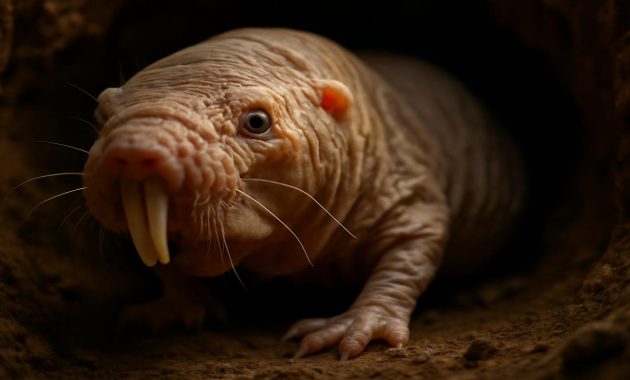
The first time you see one, you might flinch before you even realize what you’re looking at. A squashed, naked body the color of old chewing gum. Wrinkled skin pulled tight over jutting teeth. Tiny, pinprick eyes peering out of a face that seems halfway finished. Somewhere between an overcooked sausage and a pink, angry raisin. This is not the sort of creature that graces conservation calendars or plush toys. And yet, deep below the sun‑baked soils of East Africa, this so‑called “ugliest animal” is quietly rewriting the rules of survival, one astonishing adaptation at a time—most remarkably, the fact that it lives almost its entire life without ever drinking a drop of water.
Meet the Underground Misfit
Down beneath the acacia roots and cracked clay, where the air is hot and stale and the darkness is constant, the naked mole‑rat shuffles through its tunnels like a living piston. Its long, yellow teeth scrape soil away with rhythmic precision, pushing loose dirt back with its broad, paddle‑like feet. The tunnels are tight—barely wider than the animal itself—and the walls press close enough that its bare skin constantly drags along the earth.
In this world, beauty is useless. There are no eyes to impress, no feathers to flare, no dazzling colors to attract a mate. Down here, what matters is efficiency. Survival. Cooperation. Every wrinkle on that hairless body, every crooked tooth and strange behavior, has been sculpted by an unforgiving environment: blistering heat above, rock‑hard soil around, and scarce, unpredictable water.
Scientists once joked that the naked mole‑rat looked like a bratwurst with teeth. The name stuck in the public imagination. Even among biologists, it’s become a sort of mascot for the misunderstood: a living reminder that evolution doesn’t care what we find attractive. It only cares what works.
The Art of Never Having to Drink
Imagine living your entire life without ever sipping from a stream, licking dew from leaves, or tilting your head to the rain. For naked mole‑rats, this is simply normal. In the wild, they have never been seen drinking water. Not once. Not from a puddle, not from moist soil, not from anything.
So how do they manage it? Their trick is to turn their food into a water factory.
Naked mole‑rats dine almost exclusively on underground tubers and roots—starchy, swollen stores of energy that plants hide beneath the surface. Many of these tubers are rich in complex carbohydrates. As the mole‑rats gnaw and chew, their bodies begin a quiet alchemy: breaking down starches, releasing not only energy, but also metabolic water—a kind of internal condensation produced as food is processed into fuel.
They also have an almost fanatical devotion to frugality. Their kidneys are astonishingly efficient, concentrating urine to conserve every possible drop of water. Their feces are dry, tightly packed, and moisture‑sparing. Their skin leaks very little sweat. In the closed system of their underground world, every molecule of water is treated like treasure.
To help you get a sense of how extraordinary this is, here’s a quick comparison:
| Animal | Typical Water Source | Drinking Behavior | Key Adaptation |
|---|---|---|---|
| Human | Liquids, food, metabolic water | Regular drinking essential | Moderate kidney concentration |
| Camel | Oases, occasional water holes | Can go days to weeks without | Fat‑storing hump, water‑saving physiology |
| Kangaroo rat | Seeds, metabolic water | Rarely, if ever, drinks | Extreme urine concentration |
| Naked mole‑rat | Underground tubers, metabolic water | No recorded drinking in the wild | Ultra‑efficient kidneys, low water loss |
What makes this even more impressive is where they live. Naked mole‑rats inhabit semi‑arid regions of Ethiopia, Somalia, and Kenya—places where rainfall can be unpredictable and surface water ephemeral. The soil may bake in the sun, but several centimeters down, the microclimate changes. The temperature stabilizes. Humidity rises. It is still an intense world, but a buffered one. In these tunnels, the mole‑rats can afford to be specialists: animals custom‑built for a life where drinking is simply unnecessary.
A Colony That Thinks Like an Insect Hive
If you could peel back the surface of the savanna like a carpet, you’d see something astonishing etched into the earth: a sprawling network of tunnels tracing out like veins, branching and rejoining, disappearing into the distance. This is a naked mole‑rat colony—part city, part fortress, part pantry.
Unlike almost every other mammal, naked mole‑rats live in a social system that looks eerily similar to that of ants or bees. One dominant queen, a handful of chosen males, and dozens—sometimes hundreds—of workers. Most individuals in the colony will never breed. They’ll spend their lives digging tunnels, defending the nest, transporting food, and grooming one another in an endless ballet of touch and squeaks.
The queen isn’t simply a big female; she is transformed by her role. Her spine actually lengthens as she becomes the full‑time egg‑layer of the colony. She bullies subordinates into remaining non‑reproductive, maintaining her monopoly on breeding. In a twist of evolutionary irony, this “ugly” mammal has perhaps one of the most elegant examples of complex social cooperation found in nature.
In the tight confines of the tunnels, bodies press against bodies. Air is thin, carbon dioxide high, oxygen low. To us, it would feel suffocating, dizzying. We’d gasp and panic. Naked mole‑rats, on the other hand, seem perfectly at ease. They’ve evolved impressive resistance to low oxygen, shifting their metabolism in ways that allow them to survive conditions that would be lethal for most mammals. In laboratory experiments, they have survived oxygen levels that would knock out a mouse in minutes.
In such extreme conditions, cooperation becomes more than helpful; it becomes mandatory. A lone, wandering mole‑rat would quickly perish. The colony, by contrast, shares warmth, defends food stores, and constantly expands its underground labyrinth in search of new tubers. When they find a particularly large one, they don’t simply consume it and move on. They nibble at it carefully, keeping the tuber alive, allowing it to regrow like a living, renewable pantry. In an ecosystem where resources are scarce, it is a quietly brilliant strategy.
Strange Bodies, Superpowers Within
There is a moment in almost every naked mole‑rat documentary when the tone shifts—from “look at this bizarre little creature” to “wait, how on Earth is it doing that?” Because beyond the hairless skin and protruding teeth lies a catalogue of biological oddities that has stunned scientists for decades.
For one, naked mole‑rats seem to age in slow motion. In the wild, similar‑sized rodents might live two or three years at best. Naked mole‑rats have been recorded living more than thirty years in captivity—ten times longer than you’d expect for their size. And even more puzzling, they don’t seem to age in the usual way. Many animals show an increasing chance of dying as they get older. Naked mole‑rats, astonishingly, do not follow this pattern in any obvious way. A middle‑aged naked mole‑rat is, statistically speaking, no more likely to die in the coming months than a young adult. It’s as if they cheat the usual curve of mammalian life.
Then there is their near‑legendary resistance to cancer. For years, biologists tried—and largely failed—to induce tumors in them, even with techniques that reliably trigger cancers in other rodents. Their cells appear to be unusually disciplined, bound by strict mechanisms that detect overcrowding and shut down growth before it spirals out of control. One such mechanism involves a substance called high‑molecular‑mass hyaluronan in their tissues, which helps keep cells from piling up in dangerous ways.
Add to that their bizarre relationship with pain. Naked mole‑rats seem almost indifferent to certain types of pain that would make us yelp: acid on the skin, capsaicin from chili peppers. It’s not that they are invincible, but their nervous systems have been rewired to tune out sensations that, in their environment, are constant—like irritating ammonia fumes in their poorly ventilated tunnels.
All of these superpowers—longevity, cancer resistance, pain insensitivity, low‑oxygen tolerance—share a common thread: survival in a harsh, constrained, underground world. The mole‑rat’s ugliness, in a very real sense, is the visible surface of a deep, elegant engineering project by evolution.
Designed for Dirt and Darkness
Take a closer look at that face, if you can bear it. The teeth—so prominent and yellow—jut forward like excavation tools. In fact, naked mole‑rats do most of their digging with their teeth, not their paws. Those incisors are so crucial that evolution has done something clever: the lips close behind them. This means they can shovel soil into their mouths and fling it backward without actually filling their throats and lungs with dirt. Imagine chewing your way through a wall while still being able to breathe easily.
Their tiny eyes, almost vestigial, are capable of detecting light but not much detail. In the unbroken darkness of their tunnels, high‑resolution vision is a luxury they simply don’t need. Instead, their bodies are wired for touch. The scant, scattered hairs on their otherwise naked skin act like a forest of antennae, detecting the slightest change in air currents, the faintest brush of a tunnel wall, the movements of another mole‑rat passing by. It’s a tactile world, read with the skin rather than the eyes.
Their skin, though unsightly, has its advantages too. Without insulating fur, they can shed heat more easily in cramped tunnels filled with squirming bodies. When temperatures swing, they huddle together or spread out along passageways to regulate warmth. Being cold‑blooded would be fatal; being slightly less warm‑blooded, flexible in how their body temperature is maintained, is genius.
Even their social interactions are tuned to this world. They communicate in a chorus of high‑pitched chirps, twitters, and squeals—more than a dozen different vocalizations, each with a distinct meaning: alarm calls, contact calls, submission squeaks. A constant, squeaky conversation hums through the tunnels, guiding traffic and coordinating tasks, a living nervous system spread out across the colony.
Why Beauty Has Nothing to Do with Brilliance
We are quick to love the graceful antelope, the sleek cheetah, the jewel‑bright birds that flash between branches. These are the cover models of the natural world—charismatic, photogenic, instantly admired. The naked mole‑rat, with its wrinkled sausage body and buckteeth, doesn’t exactly draw gasps of delight. If anything, it sparks reflexive revulsion. But that may be precisely why it’s worth paying attention to.
In our preference for visual beauty, we risk missing the deeper stories. The naked mole‑rat has become one of the most studied mammals on the planet, not because of how it looks, but because of what it can do. Its ability to live without drinking, to shrug off low oxygen, to resist cancer, to blur the normal patterns of aging—these traits are now clues, hints that could inform human medicine and deepen our understanding of biology itself.
There’s also something humbling about it. In the hierarchy of “appealing animals,” this one ranks very low. But in the league of raw biological innovation, it sits near the top. It asks us, in its own toothy way, to reconsider how we assign value in nature. Perhaps the beauty worth noticing isn’t always in fur or feathers, but in unseen chemistry, in carefully tuned physiology, in quiet social lives carved beneath our feet.
Next time you see a photo of a naked mole‑rat and feel that flicker of discomfort, hold it there for a moment. Behind that awkward face is a story about surviving where others cannot, about making water from food, about living long in a dangerous world, about thriving in darkness with a family of hundreds. It is, in its own deeply unglamorous way, one of evolution’s finest works.
FAQs
Do naked mole‑rats really never drink water?
In the wild, naked mole‑rats have never been observed drinking free water. They obtain the moisture they need primarily from the starchy underground tubers they eat and from metabolic water produced when their bodies break down food.
Where do naked mole‑rats live?
Naked mole‑rats are native to parts of East Africa, mainly in Ethiopia, Somalia, and Kenya. They spend almost their entire lives in extensive underground tunnel systems in semi‑arid regions.
Why are naked mole‑rats considered so ugly?
They lack fur, have heavily wrinkled, pinkish skin, small eyes, and large protruding teeth used for digging. These features are highly functional underground but clash with typical human ideas of “cute” or attractive animals.
How long do naked mole‑rats live?
In captivity, naked mole‑rats can live over thirty years, which is extraordinarily long for a small rodent. This longevity, combined with their unusual aging patterns, makes them a major focus of aging research.
Are naked mole‑rats really resistant to cancer?
They show remarkable resistance compared to many other mammals. Tumors are extremely rare, and their cells have special mechanisms that help prevent runaway cell growth, making them an important model for studying cancer biology.