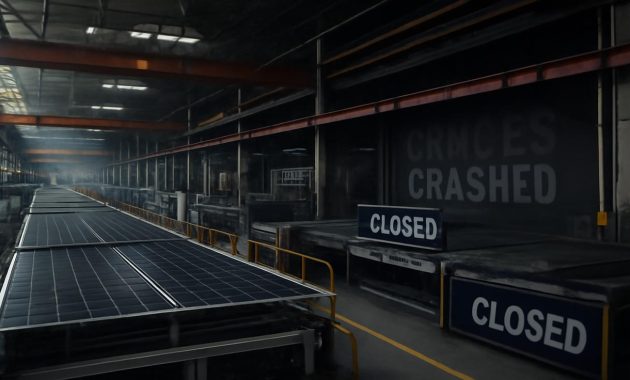
The morning light over eastern China does not rise the way it used to. It glints off square miles of bluish glass — solar panels laid out in endless, geometric fields, marching over hillsides and floating on lakes, perched on rooftops and stitched into factory roofs. From above, it looks like someone has wrapped the land in a shimmering, metallic skin. For years, this sight was China’s proud symbol of a new era: clean energy, green ambitions, and a booming industry turning silicon and sunlight into profit. But now, behind the shine, the mood feels strangely tense. In factory towns where whole communities pulse to the rhythm of solar production lines, a new worry has begun to spread: China made so many solar panels that prices crashed, and the very industry it built might need to shrink to survive.
When the Sun Meant Endless Growth
Not so long ago, the story felt almost simple. Global demand for solar power was skyrocketing as countries rushed to cut emissions, tame energy prices, and prove their climate commitments were more than political slogans. China saw an opening and charged through it.
Government planners poured incentives into the solar sector: cheap land, tax breaks, low-interest loans, streamlined permits, and explicit policy support. Local governments competed to attract factories, promising anything to be part of the next big thing. Entrepreneurs stepped in, often from other manufacturing sectors, betting on solar as the future of energy — and the future of Chinese exports.
The result was a manufacturing machine unlike anything the world had seen. In just a decade, China came to dominate every link in the photovoltaic (PV) chain: from polysilicon and wafers to cells and final panels. Conveyor belts ran day and night. New plants sprang up while older ones were still being expanded. Workers in some regions joked that if you squinted just right, you could see solar panels being born in the air itself.
It seemed like a virtuous circle. The more factories were built, the more panels they produced. The more panels they produced, the cheaper they became. And as prices fell, solar suddenly looked not just green, but irresistible. Countries installed more. Households went off-grid or slashed power bills. Solar farms turned deserts and abandoned industrial sites into engines of electricity. And back in China, investors and officials patted themselves on the back. The world wanted solar. China would supply it.
The Moment Prices Fell Too Far
Then the line that had always gone up began to bend.
There is a difference between making something cheaper and making it too cheap to sustain the people and machines that create it. By 2023 and into 2024, the solar panel market crossed that line. New factories had come online just as the world’s ability to absorb new panels started to lag. Europe’s permitting processes slowed. Grid connections took too long. Some markets were flooded. At the same time, China’s own internal expansion in manufacturing never really paused. Capacity kept expanding because the system had been built to reward growth above all else.
The result was brutal: prices for solar panels crashed. They did exactly what policymakers had once wished — they made solar adoption cheaper nearly everywhere. But they also cut straight into the profits of manufacturers, especially newer or smaller ones who had borrowed heavily to build capacity. A panel that might have sold for $0.25 per watt slid toward $0.15 and below in some contracts, and in the most aggressive cases, even less. Margins that were already thin evaporated.
Inside cavernous Chinese factories, the sensory details of this shift were easy to feel. The air still smelled faintly of machine oil and warm plastic. Robots still lifted wafers with perfect indifference. But the human mood changed. Overtime dried up. Temporary hires were quietly asked not to return. Owners who once boasted about record output began to mutter about “restructuring” and “capacity optimization” — euphemisms everyone understood.
The Paradox of Too Much Success
This is the paradox at the heart of China’s solar story: it became so good, so fast, at making panels that it undermined the business of making panels.
Solar is not like rare jewelry or luxury cars. It is a commodity product. Once efficiency standards converge and technologies mature, many panels start to look similar from a buyer’s perspective. At that point, the battle is won or lost on cost and scale. China pushed both to their extremes. Factories grew. Automation increased. Suppliers were pressed for lower and lower prices. Every improvement that made solar more affordable for the world also hollowed out the safety margin for producers.
For a while, scale itself kept the system afloat — massive orders from Europe, the United States, and emerging markets pulled product off assembly lines. But as with steel, aluminum, and other Chinese industrial giants before it, overcapacity eventually crept in. There were simply more panels than profitable buyers at prevailing prices.
Industry insiders had a phrase for it: “We raced the sun and outran our own shadow.”
Factories in the Crosshairs
When an industry is this central to a country’s economic strategy — and to its climate narrative — letting it collapse is not an option. So the story shifted again. As losses accumulated and complaints grew louder, Beijing began telegraphing a new message: not all factories deserve to survive. Some need to close to save the broader industry.
It is a harsh kind of mercy. The logic is familiar in economic policy circles. If you have too many producers chasing too little profitable demand, prices spiral downward. Weaker players drag stronger ones with them in a race to the bottom. To escape the trap, someone has to exit. But in China, where local governments depend on factories for jobs, taxes, and political prestige, closing plants is emotionally and politically fraught.
Imagine a city where half the workers’ uniforms bear the logos of just two or three solar giants. The factory gates are not just doors to a workplace; they are the beating heart of the town. Hardware shops, street food stalls, schools, and real-estate developments all orbit the solar plants. Turning off a production line is like dimming the whole local sky.
Still, signals from Beijing have grown clearer. Authorities have warned about “disorderly competition” and “blind expansion.” New rules are being discussed to push consolidation, set higher efficiency thresholds, and quietly starve outdated plants of credit and subsidies. Officials speak of “high-quality development” — code for fewer, stronger, more advanced manufacturers, and a weeding out of small, low-tech, or heavily indebted rivals.
Winners, Losers, and the Shape of Survival
Not every factory faces the same fate. The solar landscape in China is a patchwork of giants, mid-tier players, and tiny workshops. Some are vertically integrated, controlling everything from raw silicon to finished modules. Others just assemble components made by someone else. In a severe price downturn, that difference is life or death.
To understand who might endure, it helps to look at three overlapping pressures: cost, technology, and policy.
- Cost: The absolute masters of scale and efficiency can still scrape profits from razor-thin margins. Their automated lines, bulk purchasing, and logistics muscle let them sell at rock-bottom prices without instantly bleeding red.
- Technology: Firms investing in next-generation panels — higher efficiency, longer lifespans, novel materials — may step out of the pure commodity trap. If their products generate more power from the same sunlight, they can justify slightly higher prices.
- Policy: In China, survival often hinges on more than spreadsheets. Political favor, access to state banks, and alignment with industrial policy can keep a struggling factory afloat or nudge it toward consolidation.
Some companies will be encouraged to merge; others will quietly fade. A few spectacular collapses could arrive suddenly, felt most acutely through unpaid wages and shuttered dormitories in company towns. Meanwhile, those deemed “national champions” will be asked to shoulder an even bigger share of the world’s solar demand — but with more discipline this time, at least in theory.
How the Glut Looks from the Outside World
From outside China, the story sounds different, even if it is built on the same facts. For installers in Africa, homeowners in Brazil, project developers in India, and utilities in Europe, rock-bottom solar prices feel like a blessing.
Cheaper panels mean more megawatts of clean power for the same budget. Governments trying to meet climate targets can sign off on bigger projects. Rural communities gain access to electricity faster. Analysts who once wondered whether renewables could outcompete fossil fuels now see solar leading the charge on pure cost.
Yet this silver lining has its own clouds. When one country dominates production to such an extent — in some segments, over 80–90% of global capacity — others worry about dependence. What if trade tensions flare? What if tariffs or countermeasures appear, as they already have in some markets? What happens if, in the future, prices go up once weaker factories are gone and the industry consolidates into a smaller number of powerful players?
Some governments have responded with industrial policies of their own: subsidies for domestic solar manufacturing, tariffs on imported panels, or content rules favoring local production. But matching the scale and cost base of China’s established giants is not easy. Many new projects outside China are expensive and slow to ramp. Meanwhile, developers want the cheapest panels now, not theoretical supply security later.
So the world sits in a peculiar position: worried about overdependence on Chinese solar, but simultaneously addicted to the affordability created by China’s oversupply.
A Glance at the Numbers
Stripped of rhetoric, the story is visible in the numbers that drift through policy papers and market reports. They tell of a mismatch between what factories can produce and what the market can profitably absorb.
| Aspect | Indicative 2023–2024 Picture |
|---|---|
| China’s share of global solar module production | Roughly 80–90% |
| Global manufacturing capacity vs. demand | Capacity significantly exceeds actual annual installations |
| Panel price trend | Multi-year lows; sharp declines since 2022 |
| Impact on manufacturers | Margin squeeze, rising losses, factory slowdowns and closures |
| Impact on solar adopters | Historically low costs, more projects becoming financially viable |
These are not just abstract statistics. They echo in quiet factory corridors, in local government offices where budgets are being reworked, and at international summits where climate negotiators quietly admit that without China’s frenzied production, solar would not have spread this fast.
What Comes After the Boom?
If China now moves to close factories and rein in overcapacity, what does the next chapter look like?
For one, the industry is likely to become more concentrated. A smaller number of large, highly automated players may control an even greater share of output. They will try to differentiate through better efficiency, longer warranties, and advanced technologies like tandem cells or novel materials — anything that lifts them out of the most brutal commodity contest.
Domestically, China may also push harder to align production with its own clean energy buildout. That means more panels pointed inward, powering vast solar farms in deserts, on reservoirs, and on city rooftops. In theory, this could absorb some excess capacity, but only if the grid and power market rules keep up, allowing this new electricity to be used effectively.
Abroad, trade tensions may keep simmering. Countries that want both cheap solar and local jobs will continue their delicate balancing act. Some will encourage joint ventures — Chinese firms building factories on foreign soil, blending local labor with Chinese know-how and supply chains. Others will dig in behind tariffs, willing to pay more in the short term to nurture their own manufacturing base.
The most intriguing question, though, is whether the painful corrections now facing solar will ripple into other green technologies. Batteries, electric cars, and heat pumps are all seeing similar rushes of investment and capacity-building in China. Officials watching the solar glut are surely taking notes, asking how to avoid repeating the same cycle of boom, overbuild, and forced consolidation.
A Human Story Beneath the Policy
It’s easy to talk about “capacity” and “margins” and “market share” and forget that entire lives are braided into these abstractions. In coastal cities and inland industrial parks, workers who once stitched sneakers or assembled electronics now handle fragile wafers and gleaming modules. Some left farms; others left slower towns, drawn by the promise of steady wages in a sunrise industry.
As factories face closure or downsizing, their uncertainty is as real as the sunlight that bathes the panel fields each morning. A line worker wonders if she should go back home to her village or try another factory. A mid-level manager updates his résumé while still leading morning briefings. Local shop owners notice regular customers showing up less often. The anxiety is quiet, but it spreads — a subtle change in how people talk about “the future.”
In the long run, the world might look back and say: this was the price of making solar so cheap that it could compete with coal and gas on a global scale. A necessary, if brutal, correction. But for the people living through the transition, the view is closer and more personal. They are the ones feeling the tremors as China tries to rebalance an industry that outgrew its own demand.
Living with a Sky Full of Panels
Step outside, though, and the panels still gleam. On factory roofs, in distant solar farms, on village houses, they tilt toward the same sun that warmed older coal pits and oil fields. The technology is not retreating; if anything, it is still spreading. The question is how to build an industrial system around it that is both powerful and sustainable — not just environmentally, but economically and socially.
China’s solar story is, in many ways, the story of the climate era in fast forward: enormous ambition, staggering speed, and inevitable friction. It shows what happens when a country throws its full manufacturing might behind the green transition — and how quickly success can morph into instability if the numbers stop adding up.
On a clear afternoon, as light bounces off rows of panels into the sky, it’s tempting to see only the promise: energy drawn without smoke, without flame, without drilling the earth. Yet somewhere, not so far away, a factory manager is looking over spreadsheets, wondering which lines to shut down. A policymaker in Beijing is reviewing guidelines on “orderly development.” And far beyond China’s borders, someone is signing a contract for solar panels so cheap they would have been unthinkable a decade ago.
Everything is connected by the same sunlight and the same manufacturing surge that rode it. China made so many solar panels that prices crashed, and now it must decide which parts of its glittering industrial forest to prune so that the rest can keep growing. The panels will keep catching the light. The question is who will be left, on the ground beneath them, to keep turning that light into a lasting industry.
FAQ
Why did solar panel prices drop so sharply?
Prices fell because global manufacturing capacity, especially in China, grew much faster than profitable demand. As more factories competed for the same customers, they cut prices to win orders, driving margins down across the industry.
Is cheap solar a bad thing for the world?
Cheap solar is largely positive for the world’s climate and energy access, because it makes clean power more affordable. The downside is that if prices fall too low, many manufacturers struggle to survive, creating instability in the supply chain.
Why is China considering closing solar factories?
China wants to reduce overcapacity, stop destructive price wars, and protect the long-term health of its core solar manufacturers. Closing or consolidating weaker, outdated, or heavily indebted factories is one way to stabilize the industry.
Will this mean solar panels get more expensive?
In the short term, prices are likely to stay relatively low because there is still a large amount of capacity online. Over time, if many factories close and the market rebalances, prices may rise somewhat, but improved efficiency could offset part of that increase.
How does this affect countries outside China?
Other countries benefit from low-cost Chinese panels but worry about dependence on a single dominant supplier. Some are offering incentives for local solar manufacturing or imposing trade measures, trying to balance affordability with supply security.
Could the same thing happen in batteries or EVs?
It’s possible. China is investing heavily in batteries and electric vehicles, raising similar concerns about overcapacity and price pressure. Policymakers are watching the solar sector closely to avoid repeating the same boom-and-bust pattern.
What does this mean for the future of solar power overall?
The near-term turbulence in manufacturing doesn’t change the long-term trajectory: solar is likely to keep expanding as a major source of global electricity. The challenge is designing an industrial system that can support that growth without collapsing under its own success.