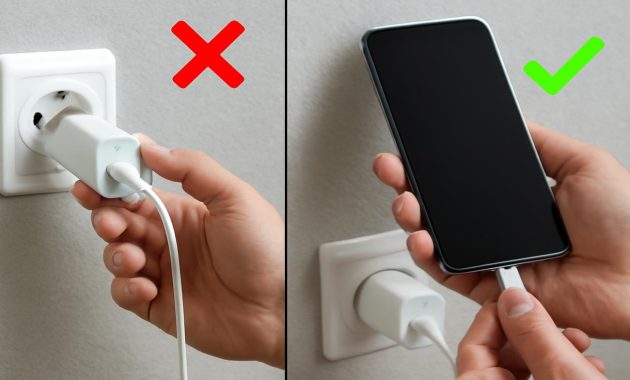
The first time someone stopped my hand as I reached for a charger, I laughed. It was late, my phone was a sliver of red battery, and all I wanted was the soft reassurance of that little lightning symbol on the screen. I did what I’d done a thousand times before: plug the cable into the wall, then into the phone. Click, buzz, done. But my friend shook his head. “Nope,” he said quietly. “Other way around. Phone first, then wall.”
I paused, cable in hand, a little insulted that he was trying to teach me how to charge a phone—as if I’d somehow missed a fundamental life skill in the last decade. Yet there was something in the way he said it, calm but firm, like a rule whispered by someone who’s seen what happens when you don’t follow it. “Trust me,” he added. “It matters more than you think.”
Why the Order of Plugging In Actually Matters
Once you start noticing it, the whole ritual of charging your phone feels strangely intimate. You reach into a bag, find the cable by touch alone, trace it to the brick, look for the nearest outlet. The move is so practiced that you rarely think about the order; muscle memory takes over. Wall first, then phone. Easy. Automatic. Invisible.
But under that quiet, ordinary action, there’s a tiny storm of electricity. A quick rush, a flicker of negotiation between phone and charger that you never see but your battery, slowly and silently aging, definitely feels. When you plug the charger into the wall before the phone, you’re energizing the cable first—giving it a pulse, a live edge—before introducing it to the delicate circuits sitting inside your palm-sized, glass-and-metal life support system.
Imagine reaching out to shake someone’s hand, only to realize their fingers are already mid-jolt with static electricity. That tiny crackle might not ruin your day, but repeat it again and again, dozens of times a week, thousands of times a year, and your nerves start to remember. Your phone is the same: resilient, clever, built to cope—but not invincible. So when you plug the cable into the phone first, then connect it to the wall, you’re flipping the script. You’re letting the phone be ready before the current arrives. You’re choosing to let the delicate device introduce itself to the power, not the other way around.
The Invisible Moment Your Phone Negotiates With Electricity
Here’s the part we rarely think about: the most dramatic moment in the life of your battery isn’t when it dies at 2%. It’s the instant you connect it to a power source. There’s a negotiation happening there—software, circuits, and tiny, precise protections all waking up at once. When you connect the cable to your phone first, the device feels the hardware presence before the surge. It can ready its internal safeguards, prime its charging logic, and stand poised like a careful gatekeeper between raw power and fragile chemistry.
Now reverse the sequence. Plug into the socket first. The charger wakes up, output primed, voltage available at the tip of the cable. That tip is now, in a small but real way, live. Even if protections exist, even if there’s no dramatic spark, you’re bringing energized metal into sudden contact with a port filled with tiny gold fingers and pathways barely thicker than a hair. It’s like stepping into a room where the music is already blaring and trying to have a calm conversation. Things still “work,” but it’s far from ideal.
Every time we do this—wall first, then phone—we trust that everything will be fine because, well, it usually is. Devices are built for clumsy humans. We bend cables, we drop phones, we plug them in half-asleep, in the dark, on airplanes, in coffee shops, at bus stops. But underneath that rugged design is fragility we forget, or never knew, existed. Little surges, tiny arcs, odd moments when dust or pocket lint or humidity turn “probably fine” into “just a little bit worse” for your phone’s charging port or battery health.
A Little Table of Everyday Choices
Think of it less as strict rules and more as habits with consequences. Here’s a simple comparison:
| Charging Habit | What You Usually Do | What’s Gentler on Your Phone |
|---|---|---|
| Plugging order | Wall outlet → charger → phone | Phone → cable → wall outlet |
| Unplugging | Pull cable from phone first | Unplug from wall, then remove from phone |
| Location | Near sinks, windows, or damp spots | Dry, stable surfaces away from water |
| Cable care | Bent, twisted, or frayed | Straight, undamaged, and replaced when worn |
None of these are dramatic on their own, but together they quietly shape how long your phone feels “new.” The simple choice—connect your phone before the wall—sits at the heart of that.
The Quiet Risks Hiding in That Tiny Spark
You’ve probably seen it at least once: a faint, barely visible flicker when you plug in a charger in the dark. Or maybe you’ve heard the soft tick of a spark at some old outlet somewhere. That spark is a story in miniature: electricity looking for a path, trying to close the distance between two bits of metal. With larger appliances and thick cables, it’s easy to dismiss. With the slender, intricate mouth of a phone’s charging port, it’s a little more personal.
When the cable is already powered, any tiny movement as you slide it into the port becomes a chance for micro-contact—brief, unstable touches between pins as they line up. You won’t see a flare of light; you won’t smell burnt plastic. But the port will remember. Maybe as a slightly roughened pin. Maybe as a bit of added wear each time the connection isn’t clean, especially if there’s dust or moisture hiding in the port. Over months, over years, this is how something that “still works” slowly becomes “a bit finicky” and then “you have to hold it just right” and finally “it doesn’t charge unless you wiggle it.”
Now imagine you reverse the habit. The cable is cold, unpowered, just a piece of metal and plastic when it meets your phone. It slides in; the phone recognizes it in a quiet, prepared way. Only then do you send power down the line. You’ve removed that awkward spark-from-nowhere moment. You let the circuitry do its job before the current shows up.
And there’s a bigger circle of safety here too. When you plug the cable into the wall first, you’re making a live tail—one that might dangle, brush metal legs of a table, slip behind a bed, or fall where a child or pet might explore. Disconnected from a phone, that energized tip has nowhere sensible to send its energy, but that doesn’t mean it’s harmless in every scenario. Choosing phone-first is choosing not to leave a live connector waving in the air.
A New Ritual: Charging as a Small Act of Care
Think about your nightly routine. The light dims. The room grows quiet. Your phone, still warm from the day’s touch and notifications, lies face-down on the nightstand. You reach for the cable. This, right here, is where a new ritual can begin.
Instead of jabbing the cable into the wall on autopilot, pause. Start with the phone. Turn it in your hand, find the port. Brush away that invisible dust with a quick glance. Slide the connector in gently, feeling the soft click of alignment. Your phone is now ready—physically and electronically—to talk to the power source. Only then do you lean toward the outlet, guiding the charger in with a feeling not unlike closing a loop.
In this new ritual, the phone isn’t an afterthought dangling at the end of a live wire. It’s the anchor. You give the device the first say in the conversation. The power comes second, as if asking permission instead of barreling in. It’s a tiny, almost poetic reversal: the delicate thing goes first, the powerful thing comes last.
There’s something surprisingly comforting about that. It turns charging from a frantic, last-minute rescue into an act of care. You start to notice other things too: whether the cable is fraying, whether the outlet feels loose, whether the brick is hot to the touch. You become, in some quiet way, the steward of this device that holds your maps, your messages, your memories, the late-night texts, the photos of people you love, the notes you write to yourself when you’re trying not to forget.
The Morning After: How Your Phone Feels the Next Day
We talk a lot about battery percentages but rarely about how charging actually feels—for the phone and for us. On mornings after a rough night of flickering power, cheap adapters, and wall-first charging, your phone may still show “100%,” but that perfection hides a more tired reality inside the battery’s chemistry.
Over its lifetime, your phone’s battery doesn’t just lose capacity at random. It responds to how it’s been treated—how often it’s been overheated, how many times it’s been pushed from near-empty to full blast, how many times the electrical handshake at the start of charging has been smooth versus abrupt. Plugging into your phone first won’t magically rewrite all of this, but it nudges the odds toward gentleness every single time.
Morning after morning, you pick up a device that’s been charged with less electrical drama. The result is subtle: a port that keeps working smoothly longer; a battery that ages a little more gracefully; fewer unexplained glitches when the cable slips or the angle changes. You won’t feel the difference in a week, maybe not in a month—but in two years, in three, when someone else’s phone is starting to feel unpredictable at the socket, yours might still respond with the easy reliability of a younger device.
Stories Hiding in Every Outlet
Every public outlet tells a story. In airports, people crouch on the floor near pillars, chargers sprawled like vines. In cafés, outlets sag with the wear of a thousand hurried plugs and unplugs. At a friend’s house, you borrow a charger from a kitchen drawer that hides a tangle of cables, some with exposed metal shining where the plastic has worn away.
In all these places, one habit quietly follows us: power first, device second. It’s what we see around us. It’s what we picked up without thinking. We learned to treat electricity as a background fact instead of a relationship. Plug in, walk away. If it breaks, buy another. If it sparks, shrug and try a different socket.
But remember that moment—the hand stopping yours, the suggestion to do it differently. Plug into the phone first. Even when the outlet isn’t yours. Even when the charger is borrowed. Even in the rush between flights or mid-conversation in a café. Especially then, perhaps. It’s a way of saying: I see this device as something worth protecting, even in small ways. I see that the quiet things—order, sequence, ritual—shape how long things last.
There’s another layer to the story too. For people who use medical devices that connect through phones, who rely on their phone for work, safety, or connection with faraway loved ones, a dead device isn’t just an inconvenience. It’s a breach in their fragile web of dependence. Every tiny habit that stretches the life of that battery and port becomes a line of quiet defense against those bad days when the phone suddenly decides to stop cooperating.
From “It Doesn’t Matter” to “This Is My New Normal”
You might still hear the skeptical voice in your head: Does the order really matter that much? Isn’t this just one more thing to think about in a world that already demands so much mental bandwidth? Here’s a gentler way to see it: it’s not about perfection. It’s about direction.
Plenty of phones live full, useful lives in the hands of people who have never once thought about which end they plug in first. But many of those same people also shrug when their phone’s port gives out early, or when the device suddenly becomes unreliable at the one thing it was supposed to do: connect. By shifting your habit, you’re not promising yourself a magic shield against failure. You’re choosing to stack little odds in your favor.
And surprisingly, it doesn’t take long before this stops being “one more thing to remember.” The body learns. The hand reaches for the phone end of the cable first without a second thought. The brain rewires the sequence. In a few weeks, plugging into the wall first actually feels wrong, like putting your shoes on before your socks. You’ve internalized a quieter, gentler order of things—phone, then power; device, then current; fragile, then force.
Making Peace With the Current
There’s a kind of humility that comes from recognizing how much of our day leans on invisible forces. Electricity hums through our walls; data ripples through the air; tiny chips negotiate everything from brightness to Bluetooth. But every so often, we get a place where our hands still matter, where the action is physical and tangible. Plugging in your phone is one of those places.
You can keep doing it the old way and probably be fine. Or you can take this small invitation: the next time your battery slips into that anxious, low-red zone, pause. Pick up the cable. Let the quiet step come first—connect it to your phone, feel that tiny, satisfying click, and only then reach for the wall. Notice how the act feels different when you do it with intention.
In the end, “To charge your phone, don’t plug the cable into the wall before connecting it to the phone” isn’t a scolding rule. It’s a gentle suggestion for a kinder relationship with the technology you lean on. It’s a way of saying: even in something as mundane as charging, you get to choose care over haste, sequence over chaos, a softer beginning over a hard, unseen spark.
And from that small choice, repeated night after night, morning after morning, your phone may just quietly thank you—with fewer glitches, a longer life, and a port that still greets the cable with that easy, confident click, long after others have started to fail.
FAQ
Does the order of plugging in really make a difference to battery health?
Indirectly, yes. Battery health depends on many factors, but consistently allowing your phone to detect the cable first can reduce tiny electrical stresses on ports and internal circuits. Over years of daily charging, those little differences can add up to gentler wear.
Is it dangerous to plug into the wall first?
In most everyday situations, it’s not dramatically dangerous, especially with modern, certified chargers. However, plugging into the wall first creates a live connector and can increase the chance of small sparks, wear on the port, and potential issues if there’s moisture, dust, or damaged cables involved.
Does this apply to laptops and tablets too?
Yes, the principle is similar for many portable devices. When possible, connect the cable to the device first, then to the power source. It gives the device’s internal systems a more controlled way to begin the charging handshake.
What about power strips and extension cords?
The same habit still helps. Plug the cable into your phone, then connect the charger to the power strip or extension. If you’re switching the strip on and off, make sure the device is already connected before flipping the switch.
Is wireless charging a better option?
Wireless charging avoids port wear entirely, but it can generate more heat, which isn’t ideal for battery health if overused. A balanced approach works well: use wired charging with the phone-first habit most of the time, and wireless charging when it’s genuinely convenient.
How can I tell if my charging port is already damaged?
Signs include needing to hold the cable at a certain angle, intermittent charging, loose fit, or visible debris or corrosion. If you notice these, clean the port gently with a non-metal tool or see a professional for inspection.
Is there a best time to charge my phone in general?
Charging when your battery is between roughly 20% and 80% is kinder over the long term. Combine that habit with connecting the cable to your phone before the wall, and you’re giving your battery and charging port a much softer life overall.