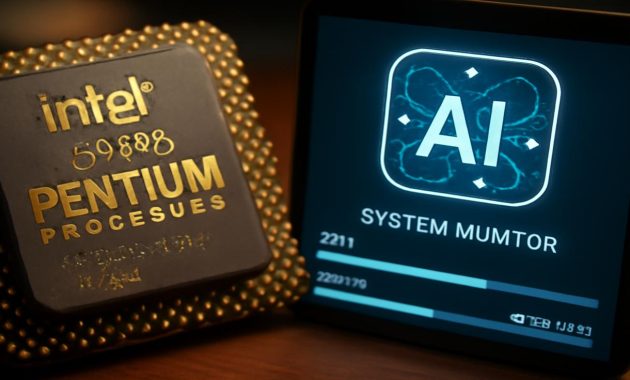
The old beige tower on my desk hums like a distant refrigerator. Its power button is scuffed, its case discolored to a kind of nostalgic nicotine-yellow, though it has never touched a cigarette. The date stamped on the motherboard reads 1998, the year I first heard a dial‑up modem sing. Twenty‑seven years later, I am standing in front of this small plastic time capsule with a ridiculous question in my head: how little does a computer really need to think with today’s artificial intelligence? The answer, as it turns out, is far more modest—and far more beautiful—than anyone scrolling past ads for liquid‑cooled GPUs might imagine: just 128 megabytes of RAM.
A Beige Time Machine in a Neon Future
The first time I turn it on, the machine coughs awake in a slow crescendo of fans. There is a smell—not of burning, thankfully—but of warm dust and aging plastic. The CRT monitor on the side table glows to life with that faint static fizz you can feel if you hover your fingertips just above the glass. Suddenly, the room is split in two: the cool blue flicker of 1998 on one side, and on the other, my modern laptop, its screen wallpapered with windows full of neural networks, Jupyter notebooks, and the endless cascade of tech headlines insisting that to do anything with AI you’ll need more, faster, bigger.
More cores. More memory. More VRAM. More watts. The narrative is relentless: intelligence, we’re told, is an arms race of silicon and electricity.
But what if it isn’t? Or at least, what if it doesn’t have to be?
That question leads to this experiment: can a machine built when Tamagotchis were still roaming school backpacks run modern AI in any meaningful way, using only 128MB of RAM? The idea feels half absurd, half mischievous—like asking a pocket calculator to write a poem. But the deeper motivation is quietly serious: strip away the hype, the glossy performance charts, and ask, at a very human level, how small can the leap to “intelligent” computation be?
The Slow Ritual of Waking Up Old Silicon
I open the case and the past stares back: a green motherboard pocked with fat capacitors and tiny chips, a single stick of SDRAM standing like a lonely skyscraper in a flat city. The CPU is a sturdy, forgotten workhorse—something in the Pentium II class, humming along at hundreds of megahertz, not gigahertz. If you listen closely, you can almost hear the rhythm of dial‑up internet buried in its design.
There’s a sort of reverence in powering up a machine this old. No lightning‑fast NVMe drives here; just a spinning hard disk that chirps and grinds and remembers, in its own way, the last millennium. I install a lightweight operating system—stripped of glossy effects, trimmed of all but the essentials. Every megabyte is a small province, and we can’t afford any wasteland.
Watching the memory usage becomes a ritual. The system boots and settles. The task manager window, stark and utilitarian, tells me I have just under 128 megabytes of usable RAM after the OS takes its share. In a world where a single browser tab can devour more than that, it feels like deciding to cross an ocean in a rowboat.
The next step is the real gamble: choosing AI models that won’t crush this old machine beneath their weight.
The Art of Teaching an Old Processor New Tricks
AI today is associated with neural networks sprawling across billions of parameters, filling entire data centers with their appetite. But beneath that spectacle lies a quieter truth: intelligence is not all or nothing. It’s a spectrum. And at the dim but fascinating end of that spectrum live models small enough to become companions for antique hardware.
I start with language. Not a hulking, chatty behemoth that writes essays and code, but a compact, distilled model trained to do simple tasks: complete short sentences, offer basic suggestions, maybe answer a factual question or two. A miniature, quiet cousin of the models that dominate headlines.
The trick is compression and quantization. Take a model that might normally need hundreds of megabytes, then squeeze and fold it—reduce its numerical precision, shave off parameters, trim redundant connections. On a modern computer these optimizations feel like tinkering; on this 1998 machine they are oxygen.
There’s also another ally: locality. Rather than expecting the relic to handle huge layers of computation in one go, I restructure the workload into small chunks that fit neatly inside the 128MB envelope. Data streams in and out in tiny sips instead of greedy gulps. It’s less a roaring fire, more a candle carefully shielded from the wind.
After hours of wrestling with build tools, compilation flags, and brittle library dependencies, the final command line appears on the CRT. A blinking cursor, a waiting prompt. I type a short phrase:
“The forest at night felt almost alive, because…”
Then I press Enter. The processor thinks.
Not quickly. There’s a noticeable pause—a beat, two beats, three—like the machine is breathing in, searching through its tiny net of parameters. Then the words start to appear, slow as rain on a windowpane:
“…because every branch seemed to listen, and even the wind carried whispers.”
There it is. A line of text that wasn’t pre‑written, wasn’t hard‑coded. This nearly three‑decade‑old computer, with less memory than many images on a smartphone, has just taken a fragment and extended it, inventing a completion with its own internal logic, texture, and mood.
It’s not brilliant. It’s not even especially original. But it’s unmistakably an act of modeled intelligence—pattern on pattern, learned from data, recombined right here in front of me in 128MB of living, breathing RAM.
The Quiet Power of Constraints
This moment draws a sharp contrast with the dominant culture of AI consumption. We’re taught that progress is a vertical climb: more data, more neurons, more parameters, more everything. Yet the old machine on the desk suggests a sideways truth: constraints themselves can be generative.
With only 128MB to work with, each design decision reverberates. You start asking questions that get lost in the luxury of excess. Do we really need this library? Can we store this weight matrix more efficiently? What happens if we prune just a bit more? Could we get away with a smaller vocabulary, a narrower focus?
In a strange way, the limited hardware brings us closer to the underlying craft of AI. We’re forced to see the model not as a magical, amorphous “intelligence,” but as a careful arrangement of numbers and processes, each one occupying a specific, costly place in memory. This makes every successful response from the model feel earned.
Listening to Old Silicon Think
Soon I give the machine more to do. A tiny vision model, barely bigger than an icon on a modern drive, is loaded into memory with the same delicate care. I hand it a downscaled image—no high‑resolution panorama, just a small, blocky snapshot of a bird on a branch.
The CPU churns. No GPU to share the burden, no vector units designed for deep learning. This is pure, brute persistence: multiply, add, activate, repeat. A neural network painted with pixels of patience instead of speed.
The result appears as text on the screen:
“bird on tree branch”
Nothing fancy. No poetic flourish. But accurate. This gray‑beige fossil in front of me has just taken a digital image and interpreted it. It has drawn a line between the shapes of reality and abstract categories learned long after its own birth. Again, all within 128MB of RAM.
There’s something almost emotional in watching this unfold. The room is quiet except for the gentle fan noise and the ticking clock on the wall. Outside, cars slip past on a wet street, their tires whispering on asphalt. Inside, this small island of computing history is thinking in tiny bursts, doing with almost nothing what the world has collectively agreed requires almost everything.
A Snapshot of Then and Now
To feel the weight of this experiment, it helps to place 1998 and the present side by side—not as nostalgia, but as contrast. Below is a simple comparison that captures how wildly the expectations around computing have changed, even as the basic act of “machine intelligence” turns out to require far less than advertised.
| Year | Typical Home PC | AI on That Hardware |
|---|---|---|
| 1998 | Pentium‑class CPU, 32–128MB RAM, spinning HDD, dial‑up internet | Mostly academic; small neural nets, expert systems, no consumer “AI assistants” |
| 2025 | Multi‑core CPU, 8–64GB RAM, SSD, broadband/mobile data, often GPU | Large language models, image generators, real‑time assistants, cloud APIs |
| 2025 on 1998 Hardware | Same old CPU, 128MB RAM, no GPU | Compressed, quantized models; slow but usable text completion and simple image recognition |
Looking at this, the central revelation is not that the old computer can match modern performance—it can’t, not even close—but that it doesn’t need anywhere near contemporary resources to cross the threshold into “AI” behavior. The word itself stops belonging only to server farms and bleeding‑edge chips, and becomes something that can live inside older, humbler machines.
Why 128MB Matters More Than It Should
It would be easy to shrug and call this a cute stunt, a kind of geek parlor trick. But the implications ripple outward into the way we think about access, sustainability, and creativity with technology.
First, there is the question of who gets to use AI. If meaningful models can run in 128MB of RAM on hardware older than some of the people reading this, then the barrier to entry is far lower than the marketing conversation suggests. A school with refurbished laptops, an off‑grid research station with low‑power gear, a community group repurposing old desktops—these places can host their own small, private intelligences without sending data into the cloud.
Then there’s the environmental angle. The appetite of industrial‑scale AI is staggering: data centers guzzling electricity, water used to cool racks of servers, rare metals dug out of the ground. A single large model training run can emit as much carbon as the lifetime of multiple cars. In that context, an AI that hums gently on a 27‑year‑old processor feels like a tiny act of resistance, a whispered suggestion: what if part of the solution is not only making models bigger and better, but making them radically smaller and “good enough”?
Finally, there’s the creative dimension. Constraints have always been fertile soil for imagination. Poets write sonnets in fourteen lines, photographers love a fixed‑lens camera, musicians thrive in limited keys. In the same way, an AI forced to exist inside 128MB invites a different style of thinking: not “how big can this be?” but “how elegant can this be?” It rewards ingenuity over brute force.
The Human in the Loop
As I watch the machine continue its slow but steady work, I start to notice my own behavior changing. I become more patient. I phrase prompts more carefully, respecting that each token will be computed with effort, not flung out instantly. I ask less trivial questions and linger longer with each answer.
This might be the strangest side effect of the experiment: the forced slowness of the old computer subtly reinstates a kind of mindfulness in interacting with AI. No rapid‑fire barrage of queries, no skimming through dozens of generated paragraphs. Each response feels like a letter arriving by post instead of a text message. It leaves room for reflection.
It also reveals how much of AI’s “magic” is actually in the dialogue between human and machine. The model completes, suggests, classifies—but I select, redirect, interpret. The constraint of 128MB doesn’t just limit the model; it draws attention to the interplay, reminding me that intelligence in practice is rarely one‑sided. It’s a conversation, and both sides are shaped by context, time, and attention.
Rewriting the Story of Progress
At some point in the evening, I power down the old computer. The fan’s hum winds down to silence, and for a moment the room feels emptier, as if some small, patient presence has gone to sleep. My modern laptop still glows, effortlessly capable, its neural engines ready to spin up models that would annihilate the 128MB limit in an instant.
Yet the machine that lingers most vividly in my mind is the one that labored.
The prevailing story of technological progress is a straight line: faster, larger, more. The 1998 processor running AI with 128MB of RAM adds a missing footnote, maybe even a quiet challenge. Progress can also be sideways, inward, subtle. It can mean doing more with less, discovering that intelligence is not exclusively the domain of the latest chips, but something that can trickle backward into the long tail of hardware already scattered across the world.
Somewhere out there, in closets and basements and school storerooms, are thousands of forgotten beige towers and thick laptops, each one considered obsolete by the forward march of software. The experiment suggests a different future for them—not as museum pieces, but as small, localized minds: running language models for offline tutoring, guiding basic diagnostics in remote clinics, helping with translation where bandwidth is scarce, or even just telling a story on a rainy afternoon when the power budget is tight.
The number—128MB—stops being a constraint and becomes a kind of emblem. It stands for the possibility that intelligence in machines does not have to be a luxury reserved for the newest, the richest, the most connected. It can be frugal, scrappy, and still astonishing.
As I stack the old case neatly beside the desk, I can’t help imagining a different style of AI conversation taking root over the next decade. One branch will continue to race ahead in scale: massive models, global infrastructures, breathtaking feats. But another branch—quieter, more grounded—might choose to look backward, to the machines we already have, the power we already generate, the memory we long ago considered negligible, and ask: what kind of intelligence can we coax from what’s already here?
In that future, a 1998 processor running a tiny, compressed model in 128MB of RAM won’t be a curiosity. It will be proof of a simple and surprisingly hopeful idea: that intelligence, artificial or otherwise, is as much about how we use what we have as it is about chasing what we don’t.
FAQ
Can a 1998 computer really run modern AI models?
Yes, but with important caveats. It can’t run massive, state‑of‑the‑art models, and it won’t be fast. With careful optimization—using small, compressed, and quantized models—a 1998‑era machine with 128MB of RAM can perform basic AI tasks like simple text completion or low‑resolution image classification.
What kind of AI models work in only 128MB of RAM?
Very compact language models and small vision models are the most practical. These are often distilled or quantized versions of larger models, designed to reduce memory usage and computational cost while still providing useful, if limited, capabilities.
Is this just a fun experiment, or is it actually useful?
It’s both. The experiment is undeniably geeky and nostalgic, but it also highlights real possibilities: running local, offline AI on low‑resource hardware, extending the life of older machines, and exploring more sustainable, energy‑efficient approaches to machine intelligence.
How does this relate to environmental concerns around AI?
Large, modern AI systems consume significant energy and resources. Demonstrating that useful AI can exist in 128MB of RAM suggests an alternative path: smaller, more efficient models that demand less infrastructure, less power, and potentially generate a smaller environmental footprint.
Could this approach help people without access to modern hardware?
Yes. Many communities and institutions rely on older computers. If they can run basic AI tools locally—without needing constant high‑speed internet or cloud services—that could open access to language assistance, education tools, translation, and simple analysis in places where cutting‑edge hardware is unrealistic.
Does this mean we don’t need big AI models anymore?
No. Large models still offer capabilities that small ones can’t match, especially in breadth of knowledge and versatility. The point is not to replace big models but to complement them: recognizing that “smaller and local” can sometimes be more appropriate than “bigger and remote.”
What’s the biggest lesson from this 128MB AI experiment?
The main lesson is that the threshold for meaningful machine intelligence is lower than we’ve been led to believe. With thoughtful design and respect for constraints, AI becomes less about chasing maximal performance and more about finding creative, sustainable ways to make technology genuinely accessible.