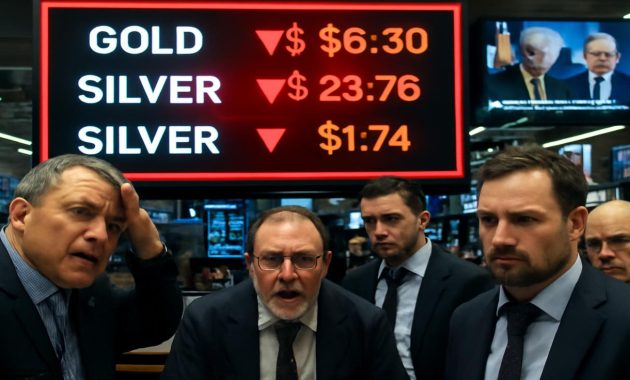
The news broke just after dawn, in that bluish hour when the world feels like it’s holding its breath. Your phone screen lit up with a familiar cascade of alerts: markets reacting, pundits speculating, numbers tilting on invisible scales. Somewhere, half a world away, a handful of people in tailored suits had spoken a few words into microphones, and now the price of ancient metals—gold and silver, old as starlight and riverbeds—was tumbling through the digital ether. You could almost hear it, like loose coins slipping from a hand into deep water.
A Day When Metals Felt Human
Imagine walking into a small-town coin shop on a gray afternoon, the kind where dust motes float lazily in the shafts of window light and the bell on the door jingles with a tired sort of optimism. The owner, a man who has watched markets longer than you’ve been alive, glances up from his ledger with a raised eyebrow. “You see the news?” he asks, not really needing an answer.
The announcement has just hit: a new Fed chief, handpicked by Donald Trump during his time in the White House, has been formally named. The headlines shorthand it as if it were a simple cause and effect—Trump picks new Fed chief, gold and silver prices tumble—but inside this shop, it feels more complicated, more personal. On a television in the corner, muted but insistent, financial tickers scroll across the screen. Little red arrows angle downward, pulling gold and silver along with them.
On the counter, a spread of coins glows softly under the fluorescent light: American Eagles, Maple Leafs, a few old silver halves with worn-down faces. Their shine doesn’t change just because a new central banker has stepped into the spotlight. But in the invisible world of futures contracts and risk models, their value is slipping, line by line, like a tide going out.
The Quiet Physics of Confidence
Markets don’t move by accident. They move on whispers, on posture, on the subtle choreography of confidence and fear. When a president names a new chair for the Federal Reserve, he isn’t just filling a job; he’s tilting the entire emotional landscape of the global economy.
In this case, the pick is seen as someone who may lean toward higher interest rates, or at least a steadier, more predictable path after years of turbulence. The markets, always hungry for a narrative, latch on quickly: a Fed chief who might tighten monetary policy over time, draining some of the easy money out of the system. That idea alone is enough to upend the delicate balance that supports gold and silver.
Gold and silver live in the tension between fear and faith. When investors distrust paper money, when they sniff inflation in the air, when the world feels unmoored, they drift toward metals that can be held in the hand, weighed, stacked, hidden away. But when a sense of order returns—when there’s talk of measured rate hikes, controlled inflation, a steady hand at the monetary wheel—those same metals can suddenly feel like dead weight. The fear premium starts to leak out.
On trading screens, the reaction is swift. Sell orders cascade through the order books like dominos, each one tipping the next. Gold gives up dollars per ounce in minutes. Silver, always the more excitable cousin, dives even faster in percentage terms. What looks from a distance like “prices tumbling” feels up close more like a mood collapsing.
| Asset | Price Before Announcement | Price After Announcement | Approx. Change |
|---|---|---|---|
| Gold (per ounce) | $1,XXX | $1,XXX – | −X.X% |
| Silver (per ounce) | $XX.XX | $XX.XX – | −X.X% |
| U.S. Dollar Index* | Low 10X | Higher 10X | +X.X% |
*Illustrative values only, reflecting the typical pattern seen when a Fed pick is perceived as “strong dollar” friendly.
The Sound of Money in an Uncertain World
Outside the coin shop, the wind moves through the bare branches with a coins-in-a-jar kind of rattle. There’s a primal comfort in holding something solid when the digital world jitters. For centuries, gold and silver were the measuring sticks of value—bright anchors for anxious human minds. Today they are more like weather vanes, spinning in the gusts of central bank policy.
When Trump’s pick was announced, you could almost chart the emotional shift in real time. Bond traders, watching from their screens, tilted forward in their chairs. Equity desks gauged whether this meant cheaper borrowing over the long term or a gradual tightening. Currency traders sniffed out the story: a perhaps more assertive Fed, a possibly stronger dollar. In that kind of narrative, gold and silver often play the role of reluctant losers.
Part of it comes down to interest rates. Gold doesn’t pay a dividend. Silver won’t send you a quarterly check. They just sit there, mute and gleaming. When interest rates are low, that silence isn’t costly. When rates rise—or are expected to rise—the opportunity cost of holding such metal grows louder. Every quarter-point hike is like another small reason to ask, “Why am I holding this, when I could be earning something somewhere else?”
And yet, step back from the screens for a moment, and the story complicates. People don’t buy gold only because of spreadsheets. They buy it because of their grandparents’ stories, because of countries that collapsed, currencies that died, regimes that vanished in the night. They buy it because it feels like owning a physical sentence in the long history of money. That pull doesn’t disappear just because a new Fed chief smiles confidently on a podium.
Trump, the Fed, and the Theater of Control
If you listened closely to the coverage when Trump’s Fed pick was introduced, the language was full of theater. Words like “stability,” “continuity,” and “credibility” were tossed around with the casual certainty of people used to being heard. The president’s tone suggested he was choosing someone who would keep the economy strong, the stock market buoyant, the American story on-brand.
But the Fed is a curious institution. It is both powerful and constrained, both central and strangely invisible. A single sentence in a press conference can trigger multi-billion-dollar moves, and yet the work itself—nudging interest rates, managing inflation expectations, steering through crises—is slow, granular, frustratingly technical. In the public imagination, however, the Fed chief often becomes the stand-in for the whole idea of control: someone at the wheel, eyes on the road, hands steady.
Markets, like people, respond to that illusion of control. The mere perception that the new chair might bring a more hawkish stance—more willing to raise rates, more comfortable letting some air out of asset bubbles—was enough to move metals. Gold and silver, often fueled by narratives of chaos, war, and dysfunction, sagged in the face of a story about order.
In a way, that tells you everything you need to know about how fragile the story really is. A single appointment changes no mines, opens no new vaults, digs up no new veins. And yet it can rearrange the global demand for the metals those mines and vaults contain. Like wind rippling through a field of tall grass, the movement is visible long before you feel it in your own pocket.
Winners, Losers, and the Long Memory of Metal
Back in the coin shop, the owner leans over the counter and taps a knuckle against a gold coin. “You see this?” he says. “This doesn’t care who runs the Fed.” He’s right in a literal sense: atoms don’t concern themselves with policy. But value is a human story, not a physical law, and stories can turn on a word, a name, a face on a podium.
Somewhere else, on the institutional side of the market, traders who’d been long gold as a hedge against political drama started hitting the sell button. A more conventional Fed chair, in their view, might mean fewer surprises, fewer inflation scares, fewer reasons to pile into safe havens. Funds with carefully balanced allocations began trimming their metal exposures by small percentages that added up to real weight when multiplied across the globe.
For a moment, it can feel as though gold and silver are losing some kind of contest. Stocks might rally on the hope of steady policy. The dollar might firm up. Bond yields adjust in a graceful or jagged arc. Metals, by contrast, often look out of step—falling precisely when they shone brightest in the anxieties of the months before.
But the story of gold and silver isn’t a single chapter long. These are assets with long memories. They remember the financial crisis, the dot-com bust, the oil shocks, the currency devaluations. They remember empires falling and new ones rising. Each time, their narrative bent but didn’t break. Prices soared and crashed and climbed again, echoing the heartbeat of human uncertainty.
Viewed from that vantage point, a tumble after a Fed appointment is a weather event, not a climate shift. It matters, especially if you’re a short-term trader. But to the person sliding a coin into a safe-deposit box or tucking a silver bar into a discreet corner of a home safe, the long arc of distrust and belief is what counts. A new Fed chief is a headline. Gold and silver are the footnotes you keep in case the main text changes again.
The Sensory Weight of Value
There’s a particular sound a stack of silver rounds makes when you lift and set them down again—a chiming clatter, bright but heavy. Gold is quieter, a soft, compact thud, like a secret being kept well. These sensations are almost stubborn in a digital age when most money exists as numbers on a screen, glowing briefly before updating in a flicker.
On the day gold and silver prices slid after Trump’s Fed pick, thousands of people around the world walked into small shops like this one, or logged into trading platforms, or checked the safe where they keep their metals. Some may have panicked, imagining further drops. Others shrugged: “It’s a buying opportunity.” A few probably smiled, remembering times when the price did the opposite and made them look prescient at dinner parties.
The markets, relentless and impersonal, don’t see these faces, don’t hear the clink and thud. But those human moments are part of what keeps metals relevant. Every decision to hold or sell is rooted in a half-remembered story: a grandfather leaving a pouch of coins, a newspaper headline from a banking crisis, a lesson learned too late in a currency that lost its value overnight.
So when a new Fed chief steps behind a podium, backed by flags and flanked by officials, and the numbers on the screen adjust accordingly, it’s worth remembering that what’s really moving isn’t the metal. It’s the stories people tell themselves about risk, trust, and time.
Reading the River, Not Just the Splash
Standing by a fast-moving river, you quickly learn the difference between a splash on the surface and the deeper current beneath. The Fed appointment during Trump’s tenure, and the subsequent swoon in gold and silver prices, is a splash—visible, sudden, loud. But the current—the reason people have clung to these metals for centuries—runs much deeper.
Interest rates will rise and fall, sometimes on well-telegraphed schedules, sometimes in panicked emergency meetings. Presidents will choose their central bankers, each selection framed as critical, historic, decisive. Each time, gold and silver will flinch or leap, tracing jagged lines on the charts. Commentators will declare the end of their run, or the start of a new golden age, with equal conviction.
Yet beneath those pronouncements lies a simpler truth: as long as humans remain a little unsure about the future—and especially about their governments’ ability to safeguard their money—there will be a place for metals that don’t depend on promises. They may not always be the star of the show. Sometimes, like on that day Trump’s pick was announced, they play the role of the stunned supporting character, momentarily out of step with the plot.
But stories shift. Confidence ebbs. A Fed perceived as steady can, in a different season, be cast as too slow, too political, too blind to some gathering risk. The very forces that once pushed gold and silver down—rising rates, a stronger dollar, faith in expertise—can reverse in a heartbeat. When they do, the same traders who hit the sell button today may be clamoring to buy tomorrow.
In that sense, the tumble in metals after the Fed appointment is less a verdict and more a snapshot. A frozen frame in a much longer film about how we assign value to the things we fear losing the most: security, autonomy, time.
Questions People Ask When Metals Fall
FAQ
Q: Why did gold and silver prices fall after Trump’s Fed pick?
A: The new Fed chief was perceived as more likely to support or continue a path toward higher interest rates and a stronger dollar. Higher rates increase the opportunity cost of holding non-yielding assets like gold and silver, and a stronger dollar typically pressures precious metals lower, since they’re priced in dollars globally.
Q: Does a drop in metal prices mean gold and silver are “over” as safe havens?
A: No. Short-term price moves often reflect changing expectations about interest rates and economic stability. The long-term role of gold and silver as hedges against inflation, currency risk, and systemic uncertainty has persisted through many policy cycles and Fed chairs.
Q: How do interest rates affect precious metals?
A: When interest rates rise or are expected to rise, investors can earn more from interest-bearing assets like bonds. That makes non-yielding assets such as gold and silver relatively less attractive, often leading to lower prices. When rates fall, the opposite tends to be true.
Q: Should long-term holders panic when metals tumble on news like a Fed appointment?
A: Long-term holders typically focus on broader themes—such as inflation trends, currency strength, and financial stability—rather than single events. Short-term drops can be unsettling, but they’re also common in markets that respond to shifting expectations and headlines.
Q: Is a price tumble after a Fed announcement a buying opportunity?
A: It can be, depending on your risk tolerance, time horizon, and belief about the future of the economy and monetary policy. Some investors use such dips to add to positions, while others wait for trends to stabilize. Careful research and, if needed, professional financial advice are essential.
Q: Does the identity of the Fed chief matter more than broader economic forces?
A: The Fed chair can strongly influence expectations and set the tone for policy, but they operate within broader economic realities and institutional frameworks. Over the long run, growth, debt levels, productivity, demographics, and political stability tend to matter as much as, or more than, a single individual at the helm.
Somewhere, as the closing bell rings and the last trades of the day flicker into the record, a coin shop owner locks his door and turns off the lights. In the dark, the gold and silver on his shelves don’t know they’ve lost value today. They just wait, quiet and patient, for the next chapter in a story that began long before any central bank, and will almost certainly outlive more than one Fed chief.