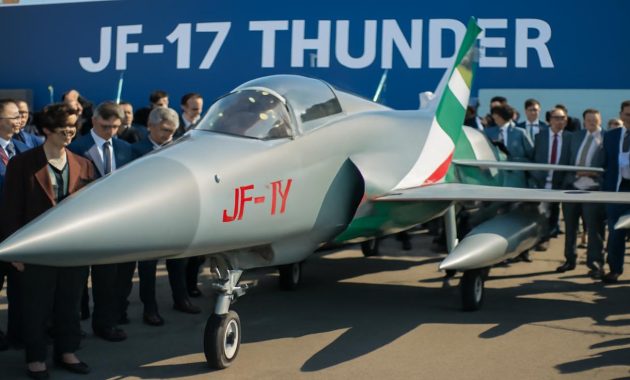
The runway heat at Dubai’s Al Maktoum Airport shimmered like a mirage, turning the horizon into a wavering ribbon of silver. Somewhere beyond the haze, a single-engine jet cut across the sky with the casual confidence of a seasoned performer. Cameras tilted up. Conversations paused. Even the distant growl of a transport aircraft seemed to hush for a heartbeat. The warplane banked, rolled, and climbed in a tight spiral, sunlight flashing off its grey skin. To most people in the crowd, it was just a thrilling airshow moment. But for the pilots, attachés, and defense officials watching from shaded chalets, this was something more intimate, more strategic. This was India’s biggest regional rival turning a recent battlefield clash into a showroom—courting more than a dozen countries with its “low-cost” fighter jet, and sending a message that echoed far beyond the desert air.
From Combat Footage to Sales Pitch
The story doesn’t begin in Dubai’s glare, though. It begins in the muted grain of combat footage, in the shadowed valleys where radar screens flare to life and pilots have seconds to decide whether they’ll be names in a report or faces in a ceremony.
When Pakistan unveiled its JF-17 Thunder to the world, it did so with the confidence of a country that knew its product had already tasted real combat. Co-developed with China and flying under Pakistan’s green and white roundel, the JF-17 wasn’t born in the sleek sterility of brochures. It was tested in the raw weather of regional tensions, especially during the 2019 aerial confrontation with India—a confrontation that still hangs in the air like a contrail whenever the jet is mentioned.
In the years since, every international airshow has become a kind of theater. Pakistan arrives not just with pilots and ground crews, but with a narrative: here is a fighter that has fired live weapons in real engagements, that has patrolled hot borders, that has been upgraded, tweaked, and sharpened in the wake of those experiences. It flies its demos with the easy swagger of an aircraft that’s already been in the arena.
For buyers—especially those who live under constant threat or chronic instability—that narrative matters. Combat experience is not just a marketing point; it is a psychological anchor. The JF-17’s story is framed carefully: a modern radar, precision-guided munitions, beyond-visual-range missiles, and the crucial refrain—“at a fraction of Western costs.” Every loop, every high-G turn at an airshow is layered with subtext: This is what you can afford. This is what we have used. This is what you can use too.
Courting 13 Countries: A Jet on a Global Roadshow
In the soft hum of air-conditioned chalets and briefing rooms, away from the roar of the displays, the real show begins. PowerPoint slides click by: radar ranges, sortie rates, maintenance hours. Outside, the JF-17 is judged for its smoke trails and turning circles; inside, it’s weighed by officials who must think in decades and billions.
Pakistan is not shy about its ambitions. It has pitched the JF-17 to a wide circle of nations—reports and briefings regularly mention a list that stretches to around 13 potential buyers. Some are African states looking to replace aging Soviet-era jets. Others are Asian or Middle Eastern nations that want a capable fighter but are hemmed in by budgets or political constraints. A few are quietly attracted by the idea of sourcing from a supplier that is neither Washington nor Moscow.
For these countries, the JF-17 is a tempting compromise. It promises multirole flexibility: air defense, ground attack, maritime strike. It can carry modern air-to-air missiles and precision bombs, and its Block III variant boasts an active electronically scanned array (AESA) radar—once a luxury reserved for top-tier fighters. Most crucially, it comes with a promise of affordability: not just in the sticker price, but in the life-cycle costs that quietly devour defense budgets over decades.
At airshows, Pakistani officials and pilots make themselves accessible. They talk about sortie rates in monsoon season, about how quickly engines can be swapped, about what it’s like to fly the jet on long patrols along tense borders. The pitch is human, textured, and tailored: “Here’s how this jet would help you patrol your coastline. Here’s how it would integrate with your existing air defense network. Here’s how quickly we could deliver the first batch.”
Around them, visitors drift through static displays, brushing fingertips along metal that will never fly for them. But in the quiet corners of these shows, memoranda are drafted, evaluation visits planned, and trial flights discussed. The JF-17 is not just an aircraft; it’s an invitation into a different orbit of alliances and dependencies—one where Pakistan and China sit closer to the center.
The Numbers Behind the Narrative
Defense deals are emotional in their own way—national pride, security fears, historical grievances—but ultimately, they land on numbers. The JF-17’s “low-cost” label isn’t just a slogan; it’s carefully curated to undercut Western and even some Russian fighters.
When defense officials pull out their notebooks, the conversation often turns to a comparison that looks something like this:
| Fighter Jet | Approx. Unit Cost (USD) | Origin | Key Selling Point |
|---|---|---|---|
| JF-17 Thunder | $25–35 million | Pakistan/China | Low acquisition & operating cost |
| Tejas (LCA) | $40–45 million (est.) | India | High indigenous content, tech transfer |
| F-16 (modern variants) | $60–80 million | United States | Proven platform, NATO ecosystem |
| Rafale | $90+ million | France | Top-tier capability, advanced avionics |
These figures, while approximate and variable, shape the mood in those tight, fluorescent-lit negotiation rooms. For a small or mid-sized country, buying four JF-17s instead of two Western jets can mean the difference between patchy coverage and a credible air defense grid. Spare parts, training, armaments—everything comes with a “budget-conscious” label that speaks directly to finance ministers.
Cost, however, is only half the story. The other half lies in the political fine print of every deal: who will approve arms sales when tensions spike, who will halt spares in a sanctions regime, who will offer upgrades 15 years down the line. On that front, Pakistan frames itself as a partner that understands vulnerability, one that has itself faced embargoes and isolation, and insists it will not impose similar strings on others.
India Watches, Competes, and Counters
Across the border, in India’s humid coastal bases and high-altitude airfields, the JF-17’s global roadshow is watched with a mix of irritation and cold calculation. For decades, India has been the region’s dominant buyer of advanced fighters—from the Soviet MiG-21s and Su-30s to the French Rafales. Its defense narrative has long revolved around scale and technology, not thrift.
But in the JF-17, New Delhi sees something different: a rival trying to reshape the market with an aircraft that combines modest capability with aggressive pricing and political flexibility. It’s not a direct competitor to India’s more advanced jets, but it aims at a segment that India itself is just beginning to enter—the export market for light combat aircraft.
Enter the Tejas, India’s own indigenous light fighter. Where the JF-17 sells combat-proven pragmatism, the Tejas sells a different dream: autonomy. It’s the story of a country breaking free from decades of foreign dependence, crafting its own avionics, its own flight control systems, its own composite airframe designs. Its development was long, sometimes painfully so, but that very struggle is part of the mythos India now wants to share with potential buyers.
In recent years, India has begun taking the Tejas on its own airshow tours, parking it on tarmacs where the JF-17 has strutted. The sales pitch leans on technology transfer, local assembly options, and the promise of a strategic relationship with a rising power that sits comfortably in multiple geopolitical camps. Where Pakistan offers “low-cost combat,” India counters with “shared growth” and the aura of a democratic, increasingly high-tech partner.
The 2019 clash hovers behind all this like a ghost. Pakistan highlights its aerial engagements to prove the JF-17’s operational credibility. India counters by pointing at its broader airpower doctrine, its multi-layered fleet, its Rafales and Su-30s, and quietly at the continuing evolution of Tejas. Each side knows that for many smaller nations, what matters is not who “won” a skirmish years ago, but who can deliver jets on time, trains pilots efficiently, and keeps those jets flying for 30 years with minimal drama.
Airshows as Modern Battlefields of Perception
If you stand at the edge of the runway during a major airshow, you can feel the competition as a physical thing. The ground vibrates under your soles as one aircraft screams upward; the smell of burnt fuel settles in your hair and clothes. Flags from dozens of nations flutter along the fences. Each fighter’s turn in the sky is part performance art, part business pitch, part strategic signaling.
When the JF-17 takes off for its demo, it often flies not just to impress, but to reassure. The maneuvers are rarely reckless. You see crisp rolls, high-alpha passes, tight turns—all meant to show that this is an agile, reliable machine, not a fragile experiment. Over the loudspeakers, commentators emphasize range, payloads, and cost. On the big screens in the chalets, carefully edited videos roll: cockpit footage, weapons tests, pilots stepping down the ladder with practiced nonchalance.
Nearby, other contenders take their turns. A Eurofighter channels raw power, a Rafale paints ballet arcs across the sky, a Russian jet leaves a thick plume as it rockets upward. In this crowded theater, the JF-17’s trick is not to out-perform the top-tier fighters, but to stay firmly in the mind of those who cannot afford them. It doesn’t need to be the star; it just needs to be the most attainable actor in the cast.
Inside the exhibition halls, scale models and glossy posters amplify the story. There are mockups of weapon loadouts, diagrams of radar cones, timelines of upgrade paths. Pakistan’s message is consistent: this is not a one-off purchase; it is an evolving platform, already marching through multiple blocks and variants. Weapons integration is showcased as a kind of buffet—Chinese missiles, guided bombs, anti-ship weapons. Choose what you can pay for; we’ll make it work.
The Soft Power in Hard Metal
Every fighter sale carries more than metal and electronics; it carries stories, loyalties, and long-term commitments. When a nation buys the JF-17, it isn’t just buying an airframe. It’s buying training ties with Pakistani pilots, technical cooperation with Chinese engineers, and a place in a wider ecosystem of spare parts and weapon upgrades that stretch between Islamabad and Beijing.
For Pakistan, this is soft power forged in hard metal. A fleet of JF-17s flying under foreign flags is a reminder that its aerospace industry, once overshadowed by its larger neighbor, is now a player in its own right. Each export becomes a diplomatic conduit; each training course in Pakistan for foreign pilots strengthens a small but steady network of influence.
India reads those signals clearly. It understands that air power is not just about deterring adversaries, but about shaping coalitions and dependencies. With the Tejas and its broader defense export push—missiles, helicopters, radars—India is trying to write its own parallel script: one where it is the partner of choice for nations that want capability without feeling locked into any single great power’s orbit.
In this sense, every airshow where the JF-17 and Tejas park within camera-shot of each other becomes a kind of quiet referendum. Which story resonates more? The battle-tested budget fighter backed by Pakistan and China, or the homegrown technological climb embodied by India’s offering? The answers don’t come quickly; they unfold in feasibility studies, loan negotiations, and long nights in foreign ministries.
Beyond the Desert Sky: What Comes Next
As the sun dips and the air cools over an airshow’s final day, the roar of afterburners gives way to the more mundane sounds of forklifts and packing crates. The fighters are wheeled back into their shelters, their fuselages streaked with a thin patina of dust and exhaust. Pilots exchange patches and handshakes. Delegations slip away to airports in black sedans.
For the JF-17, the roadshow continues. New blocks are promised, avionics tweaked, weapon options expanded. Pakistan knows it cannot afford to stand still. Rival offers from South Korea, Turkey, China itself, and eventually India are circling the same pool of potential buyers. The light fighter market is becoming crowded, and the JF-17’s early advantage as a “cheap, combat-proven option” will increasingly be challenged by newcomers with slicker electronics or more generous financing packages.
India, for its part, is racing to scale up the Tejas, refine its systems, and win its own export orders. It is watching not just Pakistan, but the whole evolving landscape of countries that no longer see Western fighters as automatic defaults. These buyers are pragmatic, sometimes deeply politicized, and acutely value-conscious. They’re wary of sanctions, hungry for technology transfer, and increasingly comfortable shopping in a multipolar marketplace.
In that marketplace, the memory of a recent clash over contested skies has been reframed. What began as a sharp, dangerous moment between two nuclear-armed neighbors has morphed—on the global stage—into a marketing theme. One side leans into its combat sorties as proof of readiness. The other leans into its grand narrative of self-reliance and industrial rise. Somewhere in between, procurement teams add up costs, parse test reports, and imagine how these machines would look silhouetted against their own skies.
Back on the runway, that single-engine jet once again lifts its nose and claws into the sky. The crowd tilts its collective chin upward, following the roar, tracking the grey dot as it carves harsh geometry into the blue. To some, it’s a spectacle. To others, it’s a symbol. To the officials quietly watching from behind tinted glass, it is a question: in a world of tight budgets and shifting alliances, is this the fighter that will guard their borders, shape their diplomacy, and define the next chapter of their air force?
The JF-17 is many things at once—Pakistan’s technical calling card, China’s export partner, a budget option for anxious governments, a direct, needling reminder to India that the contest between them now extends far beyond their shared frontier. Every roll and climb at an airshow is a line in that story, written in contrails against the afternoon sky.
Frequently Asked Questions (FAQ)
Which fighter jet is referred to as Pakistan’s “low-cost” option?
The aircraft commonly described as Pakistan’s “low-cost” fighter is the JF-17 Thunder, a single-engine, multirole combat jet co-developed by Pakistan and China. It is designed to offer modern capabilities at significantly lower acquisition and operating costs than many Western fighters.
Why is the JF-17 linked to a recent clash with India?
The JF-17 gained extra attention after Pakistan and India engaged in an aerial confrontation in 2019. Pakistan highlights the JF-17’s participation and operational use during that period as evidence that the jet is combat-proven, using the episode as part of its broader export narrative.
How many countries is Pakistan courting as potential JF-17 buyers?
Pakistani officials and open-source reports frequently mention outreach to around a dozen or more countries—often summarized as roughly 13 potential buyers. These include several nations in Africa, Asia, and the Middle East that are looking for affordable replacements for older aircraft.
How does India respond to the JF-17’s export push?
India is developing and promoting its own light combat aircraft, the Tejas, as an export product. While the Tejas targets a similar segment of budget-conscious air forces, India emphasizes indigenous technology, potential technology transfer, and long-term industrial cooperation rather than a pure low-cost pitch.
Is the JF-17 considered as capable as Western fighters like the Rafale or F-16?
In general, the JF-17 is not seen as directly equivalent to top-tier Western fighters such as the Rafale or the latest F-16 variants. It aims instead at a lower-cost, “good enough” niche, offering acceptable performance and modern avionics to nations that cannot afford or cannot access more expensive platforms.
Why are airshows so important for selling fighter jets?
Airshows provide a concentrated stage where manufacturers and countries can demonstrate aircraft performance, meet foreign delegations, and negotiate deals. Live flying displays, cockpit visits, and technical briefings all help potential buyers gauge whether a jet meets their operational needs and political constraints.
What makes the JF-17 attractive to smaller air forces?
Its appeal lies in a combination of relatively low price, manageable operating costs, multirole flexibility, and the promise of fewer political strings compared with some Western suppliers. For smaller air forces with tight budgets, the ability to field a reasonable number of modern fighters is sometimes more important than accessing the absolute highest-end technology.