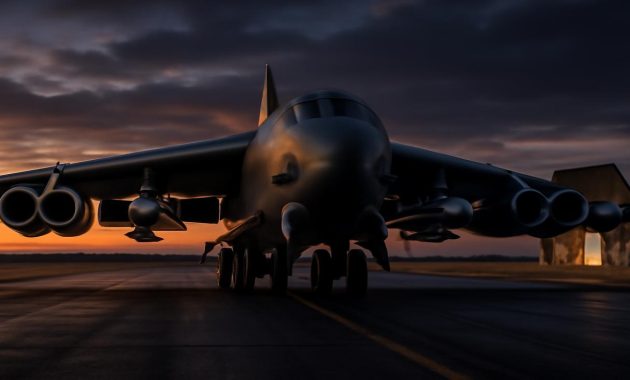
On a wind-scoured runway in Louisiana, a B-52 Stratofortress sits in the cold morning light, its wings stretching out like an iron albatross over the concrete. Ground crews move quietly beneath it, dwarfed by the eight jet engines and the bomb bay that once defined the front line of the nuclear age. For a long time, aircraft like this have mostly been symbols of another era—relics that flew in the smoky memory of the Cold War. But recently, in ways that feel both subtle and seismic, the old bomber is being invited back into the nuclear spotlight. Along with it, the buried missiles scattered across the plains of Montana, North Dakota, and Wyoming are being prepared not just to stand watch, but to “reload” for a future that suddenly feels more fragile.
The Sky Remembers: B-52s and the Return of the Dual Role
The B-52 was never really gone. It prowled the edges of wars in Vietnam, Iraq, Afghanistan. It has dropped conventional bombs, precision-guided munitions, and launched cruise missiles from the safe distance of high altitude and international borders. But in the collective imagination, its nuclear identity had faded. We learned to think of it as a bomber, not a doomsday machine.
Now, the US Air Force is deliberately nudging it back toward what it once was: a dual-capable platform, able to carry both conventional and nuclear weapons. “Dual role” sounds wonky and bureaucratic, but it boils down to this: in a world without strong nuclear guardrails—those treaties, restraints, and understandings that helped define the late twentieth century—the US wants more visible, flexible options to signal strength, deterrence, and resolve. The B-52 is, once again, being asked to embody that.
Picture an evening training sortie. The runway lights glow amber in a soft haze of exhaust. Inside the cockpit, the green instruments cast ghostly halos onto the crew’s faces. From the outside, it looks like routine flying: a big, old airplane groaning into the night. But what you cannot see from the fence line is the symbolic cargo—carefully scripted nuclear mission profiles, updated procedures, new communications systems that braid this antique-looking aircraft into the ultra-modern web of nuclear command and control.
The B-52 is becoming a kind of paradox in motion. It carries the wrinkles of history on its riveted skin, yet it’s being wired into the future: long-range stand-off missiles, upgraded avionics, digital systems that allow it to speak fluently with satellites and joint command centers. The Air Force is effectively saying: in a world more uncertain, we are dusting off the tool that never really left, and we’re reminding everyone what it was built for.
Quiet Fields, Buried Fire: “Reloading” the ICBMs
Far from the runways and the roar, the other half of this posture shift lies somewhere quieter, where the land rolls flat and open under a wide western sky. Dotting the grasslands are modest fenced enclosures, sometimes mistaken for utility sites or agricultural infrastructure by passersby. Underground, in thick concrete silos, intercontinental ballistic missiles have waited for decades—silent, inert until they are not.
When the Air Force talks about “reloading” its ICBMs, the phrase lands with an almost mechanical plainness. But what it signals is anything but ordinary. Nuclear arms control treaties that once limited how many missiles could be deployed, or how warheads could be configured, are eroding, expiring, or being openly defied. The idea of reloading isn’t just logistical; it’s philosophical. It suggests that, if needed, the United States could restore or increase the number of deployed nuclear weapons on these missiles, or adapt them in ways that match a harder, less regulated strategic environment.
Imagine the life underground: a crew in a launch control center, half-buried in concrete, spending long, quiet shifts amid muted fluorescent light and humming equipment. Outside, snow blows across a highway. Inside, the air smells faintly of coffee and electronics. Their job is to sit with the possibility of sudden catastrophe, to maintain readiness for something they spend their whole careers hoping never happens.
Against that backdrop, words like “reload” feel heavy. They mean more warheads potentially available on short notice, more launchers that can be brought up to full capability, more signals sent to potential adversaries that restraint is not a given. In the absence of robust guardrails, the basic equation of deterrence—capability plus credibility—begins to lean more heavily on visible demonstrations of strength.
The Vanishing Guardrails
For much of the post–Cold War era, nuclear strategy was bounded by treaties and unspoken norms. There was a sense—even if sometimes illusory—that the world’s most dangerous weapons were at least partially fenced in. Arms control agreements capped numbers, banned certain categories, and built inspection systems that, paradoxically, gave adversaries peace of mind. If you know generally what the other side has, and what it’s allowed to do, you’re less likely to assume the worst at every shadow.
But those frameworks have been crumbling. Key agreements have collapsed or withered. Verification mechanisms are fading. Russia’s invasion of Ukraine, China’s rapid nuclear expansion, North Korea’s relentless testing program, and the growing complexities of cyber and space warfare have all contributed to a sense of unraveling. Where there were once bright lines, now there’s fog.
In that fog, the United States is choosing to make some things clear again—not through handshakes and treaty signatures, but through hardware and posture. Bringing the B-52 back into a dual role, keeping open the option to “reload” ICBMs, and emphasizing readiness all send a message: we are still here, still capable, still willing to respond.
Deterrence, Reimagined in a Restless World
Deterrence has always been, at heart, a psychological game. It’s less about the weapons themselves than what leaders believe those weapons mean. In the twentieth century, nuclear deterrence settled into a rough pattern: each side knew the other could retaliate decisively, so no one dared start a nuclear war. It was brutal, impersonal, almost mathematical.
The twenty-first century is messier. Power is diffused across more players. Technology can obscure what’s real and what’s feint. Precision conventional weapons can threaten assets once only vulnerable to nuclear strikes. Cyberattacks can blur the origin of aggression, or even target the systems that control nuclear forces. In this landscape, the old, simple assurance of “mutual assured destruction” feels like a blunt instrument in a room full of scalpels and smoke.
So the Air Force’s shift is not happening in isolation. It’s part of a larger effort to reframe deterrence: to stitch together nuclear, conventional, cyber, and space capabilities, and present them as a layered fabric of risk to anyone who might consider crossing certain lines. The B-52’s dual role fits neatly into this, offering the ability to fly conventional missions during peacetime and crisis, while still being able to pivot—at least in signaling terms—toward its nuclear mission if the stakes rise.
Meanwhile, the ability to adjust ICBM readiness, including “reloading” warheads or launchers, becomes another dimension of flex. It’s not necessarily about deploying more weapons immediately, but about preserving the option, keeping the scaffolding in place so that any move can be made quickly and credibly. In strategy documents, this is called “hedging.” On the ground, it translates to real people maintaining real systems in real places.
| Element | Cold War Era | Emerging Posture Today |
|---|---|---|
| B-52 Role | Primarily nuclear, later mostly conventional | Re-emerging as dual-capable nuclear & conventional |
| ICBM Force | High numbers, heavily treaty-regulated | Stable core numbers, but with greater flexibility to “reload” and adapt |
| Guardrails | Robust arms control architecture | Eroding treaties, fewer binding limits, more uncertainty |
| Primary Signal | Static numbers, formal agreements | Visible readiness, flexible deployment options |
The Human Texture of Nuclear Readiness
It’s easy, talking about doctrine and posture, to forget the people. But the texture of this shift is human: pilots, missileers, maintainers, planners, analysts, all waking up, going to work, and living inside this architecture of potential catastrophe.
On the flightline, a young crew chief runs a gloved hand along the B-52’s fuselage, feeling the chill of the metal before sunrise. She wasn’t born when the Berlin Wall fell. For her, the Cold War is something out of movies and podcasts. Yet her daily checklists now plug her into a mission set that feels eerily familiar to those older than her parents.
In a launch control center buried beneath a farmer’s field, a missile officer flips through a worn binder of emergency action procedures. Above him, the world scrolls endlessly on a phone screen when he’s off duty: climate anxiety, social upheaval, economic stress. His professional life, though, is focused on a different kind of storm—a crisis that would unfold in minutes, not years, and leave scars measured not in degrees Celsius but in cities gone dark.
These people are the living interface between policy and possibility. When leaders decide to lean more heavily on nuclear options, to emphasize readiness, to bring back dual roles and talk about “reloading” missiles, it translates into new training, new inspections, different alert cycles, a subtle but relentless tightening of the psychological screws of vigilance.
Risk, Signaling, and the Edge of Miscalculation
Every move in nuclear posture has two audiences: the potential adversary and the wider world. On one hand, the US Air Force is trying to speak clearly to states like Russia and China: do not misread us as weak or distracted; we retain powerful tools and are rehearsing how to use them. On the other, there’s a global public that has grown used to thinking of nuclear weapons as background noise—dangerous, yes, but distant and static.
Bringing the B-52 back into its nuclear skin and talking openly about ICBM reloading risk reintroducing nuclear danger into everyday imagination. For some strategists, that’s the point: deterrence only works if people remember what’s at stake. For others, this kind of visibility raises the risk of miscalculation, where routine exercises or rhetorical flourishes are misinterpreted as preparation for first strike.
The tension here is natural, even necessary. Deterrence lives in this gray zone between reassurance and fear. Too little visibility, and adversaries might gamble. Too much, and everyone starts flinching at shadows. The Air Force is trying to ride that line, using the enormous bulk of the B-52 and the invisible, buried power of ICBMs as instruments in a message played not in words, but in posture.
What complicates it further is the speed and opacity of modern crises. Social media storms, cyber intrusions, false alarms, and satellite images can all distort or accelerate perception. A single misunderstood exercise or test could spiral into a confrontation if leaders are primed to assume the worst. In that context, every choice about nuclear signaling feels like stepping onto thin ice: carefully, deliberately, hoping the sound you hear is just snow and not cracking.
Living with the Old Monster in a New Forest
Modern nature storytelling often lingers on ecosystems under stress: forests shifting in a warmer climate, oceans acidifying, species pushing into new ranges. Our nuclear ecosystem—this web of silos, bombers, submarines, satellites, early-warning radars, and command centers—is also changing in response to stress. The old monster hasn’t vanished; it’s simply been standing very still, half-forgotten in the trees. Now, with treaties fraying and rivalries sharpening, we are brushing the moss off its shoulders and asking it to stand up again.
Think about how this feels at the planetary scale. On a silent night in the Great Plains, wind moves through a stand of cottonwoods above an underground missile. An owl glides from a fence post, indifferent to whatever lies beneath the soil. Thousands of miles away, in the Pacific, a B-52 arcs across an empty stretch of sky, leaving a thin white bruise of contrail that fades within minutes. To most of the world, these moments pass unnoticed. Yet layered over them, invisible but real, are the decisions that could make these systems central to human fate once more.
Nature does not care about megatonnage or throw-weight. But people do. And people are the ones building, maintaining, and reconfiguring these weapons, deciding how visible they should be, how ready they must remain, and how loudly they should speak in the language of deterrence. The Air Force’s recent signals—dual-capable bombers, talk of reloading missiles—are part of a conversation we are having with ourselves as much as with any rival: What risks are we willing to tolerate? What do we fear most—showing too much strength, or not enough?
There is an irony in how this story is unfolding. At the very moment we are grappling with climate tipping points and mass extinctions, we are also refining the machinery that could, in hours, redraw the map of human civilization. In some way, both threats share a common root: the difficulty of coordinating global restraint. Without strong guardrails—whether on carbon emissions or nuclear arsenals—we slide toward the edge, pulled there by fear, competition, and short-term thinking.
Looking Ahead: Memory, Responsibility, and the Long View
The B-52 is expected to fly into the 2050s, perhaps beyond—a single airframe spanning nearly a century of strategic thought. By then, the crews sitting in its cockpit may be the great-grandchildren of today’s airmen and airwomen. Some of the missile silos now dotting the plains may be replaced by new systems, others decommissioned, filled, and returned to pasture. But the questions we are confronting right now—about posture, signaling, and the role of nuclear weapons in our security—are not going away.
In the absence of robust nuclear guardrails, choices like restoring dual roles and preserving “reload” options feel, to many planners, like necessities. They are ways of buying time and stability in a world where trust is thin. But time bought this way is never free. It must be paid for with vigilance, diplomacy, clear communication, and the constant, unglamorous work of preventing misunderstandings.
It also demands that we remember the stories buried under the abstractions: the people sitting underground in launch centers, the pilots watching sunlight smear across the curve of the Earth, the communities living near the bases and silos, the generations that have marched against nuclear weapons or argued for their role in preventing great-power war. All of them, in different ways, are stakeholders in this moment.
When you stand near a B-52, the first thing you notice is the sound—a layered, throbbing roar that you feel in your chest—and the smell of jet fuel, sharp and oily in your nose. You can touch its landing gear and feel the vibration running up through your hand as the engines spool up. It is a machine, nothing more. Yet woven into its metal and wiring is a history of fear, strategy, and restraint. As the Air Force quietly shifts to a tougher nuclear posture, that history is being written into the present tense once again.
The challenge now is whether we can live with that reality and still push for something better: new agreements, renewed guardrails, a future where these weapons recede not because we forget them, but because we choose another way. Until then, the B-52 will keep flying, the ICBMs will keep waiting underground, and the world will keep turning under a sky that remembers more than we sometimes allow ourselves to see.
Frequently Asked Questions
Why is the US Air Force putting the B-52 back into a dual nuclear role?
The Air Force is responding to a more uncertain strategic environment, where arms control treaties are weakening and potential adversaries are modernizing their own nuclear forces. Restoring the B-52’s dual-capable role allows the US to show it has flexible, visible nuclear and conventional options, which is intended to strengthen deterrence.
What does “reloading” ICBMs actually mean?
“Reloading” refers to maintaining the capability to increase or adjust the number of nuclear warheads on existing missile systems, or to activate additional launchers if policy decisions require it. It does not necessarily mean that more warheads are being deployed right now, but that the infrastructure and expertise to do so are being preserved.
Are these changes a sign that the US expects a nuclear war?
No government publicly plans for nuclear war as an acceptable outcome. These posture shifts are about deterrence—trying to convince potential adversaries that starting a nuclear conflict would be catastrophic and futile. However, the visible emphasis on readiness does reflect greater concern about rising tensions and eroding guardrails.
How does this affect ordinary people in the US and around the world?
Most people will not see direct, daily changes. But the overall risk landscape shifts when nuclear postures become more prominent and flexible. In a crisis, miscalculation or misunderstanding could have more severe consequences. At the same time, proponents argue that a stronger posture reduces the chance of aggression in the first place.
Can nuclear guardrails be rebuilt in the future?
Yes, history shows that arms control often advances after periods of heightened tension. New treaties, verification systems, and informal understandings can emerge when states see the risks of unconstrained competition. The challenge is sustaining enough stability and communication today—through policies like those of the Air Force—so that there is a “later” in which better guardrails can be negotiated.