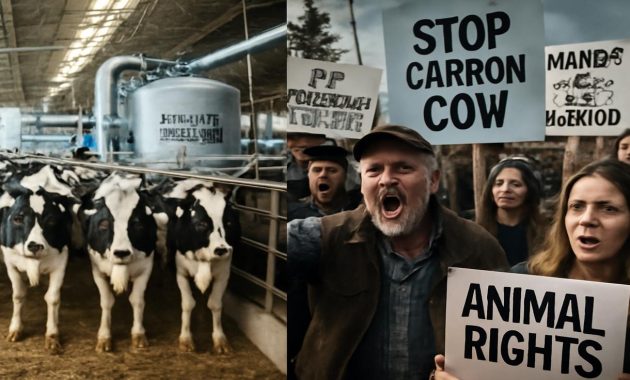
The calf has no idea it’s controversial. It blinks in the cold Alberta light, steam puffing from its nostrils, a yellow tag flickering in its ear as it leans into a scratched glove and nudges for more. Around us, the feedlot is strangely quiet—less the chaotic din of cattle and more the low mechanical hum of fans, pumps, and sensors. Somewhere behind the stainless-steel doors of a nearby barn, a computer is logging every belch this calf’s mother has produced that day. Out here, it smells like hay and manure and thawing frost. Inside, climate salvation is supposedly being born.
The Superherd Nobody Voted For
Canada’s hush-hush “carbon cow” controversy didn’t start with a press release or a protest sign. It started, like many twenty-first century revolutions, in a lab. A handful of federally funded research teams were quietly handed a mission: re-engineer the country’s cattle herds to be as close to methane-neutral as possible—without crashing an industry, enraging voters, or spooking global markets.
You can almost picture the elevator pitch: What if, instead of telling people to eat less beef, we engineered cows that barely contribute to climate change? Same burgers, same milk, a fraction of the methane. A climate superherd.
On paper, it’s compelling. Cows and other ruminants belch out methane as they digest grass and grain—a greenhouse gas far more potent than carbon dioxide in the short term. Canada’s livestock sector is responsible for a sizable chunk of national emissions, and methane is the low-hanging fruit. Cut it enough, fast enough, and you buy precious time while the world fumbles toward deeper structural changes.
But the superherd comes with a problem the scientists can’t model: feelings. Rural pride. Animal ethics. Cultural identity. Power. Once word trickled out that Ottawa was quietly bankrolling a portfolio of “carbon cow” experiments—from low-methane genetics to feed additives, gene-edited microbes, and even embryo selection programs—something broke open.
Small farmers felt betrayed. Animal-rights activists saw a biotech horror film in the making. Climate hawks split into two irreconcilable camps: engineer harder or abolish livestock altogether. And in the middle of it all, the cows kept chewing, as humans argued over whether their future was to be upgraded—or phased out.
The Science of a Quieter Belch
How Do You Build a Methane-Neutral Cow?
Walk into one of the research barns and it looks more like a space station than a farm. There are sealed chambers the size of walk-in closets, where cows stand chewing while sensors sniff every exhale. There are gas analyzers, rumen fluid samples in glass vials, and screens charting jagged green lines—each spike a burp, each valley a quiet moment in the life of a digestion system.
Methane from cattle comes mainly from microbes in the rumen—the first chamber of a cow’s stomach—breaking down fibrous plant material. You can attack this problem from several angles:
- Better genetics: Some cows naturally emit less methane per liter of milk or kilogram of beef. Breed them more, and you gradually shift the whole herd.
- Feed additives: Seaweed extracts, plant compounds, fats, and synthetic chemicals that disrupt methane-producing microbes, sometimes slashing emissions dramatically.
- Microbiome tinkering: Tweaking the microbial communities in the cow’s gut so they digest differently.
- Management changes: Grazing patterns, diet composition, and manure handling to reduce emissions across the system.
None of this is science fiction. Trials in Canada and abroad have already shown reductions of 20–80% in methane from certain approaches. The holy grail is consistency, safety, and scaling up without wrecking animal health or farm economics.
What makes Canada’s project different is the mandate behind closed doors: don’t just shave off a bit of methane. Aim, eventually, for net-zero. Combine genetics, feed, grazing, and manure management into a single system that—on paper—cancels out its climate footprint. Not a cow that merely pollutes less, but a cow that, in the carbon ledger, almost disappears.
To a policy maker staring at emissions charts, that’s irresistible. To a small farmer already barely breaking even, it’s terrifying.
Small Farms, Big Suspicion
“Whose Cow Is This, Anyway?”
If you sit long enough at a diner counter in rural Saskatchewan and mention “carbon cows,” the air thickens faster than a prairie storm. The farmer beside you might put down his coffee and ask the question you were trying to avoid: “So whose herd is this really going to be? Mine—or the government’s?”
For many small and medium-scale farmers, the controversy isn’t only about science. It’s about trust and survival. They’ve watched decades of policy “innovation” favor mega-operations: bigger barns, bigger debts, bigger contracts with multinational meatpackers. The fear is simple: the superherd will become another lever to push the little guys out.
Picture two farms. One is a mid-sized family operation rotating its cattle through diverse pastures, building soil health, selling direct to neighbors. The other is a sprawling, company-backed feedlot, already wired with monitoring tech and deep pockets for new additives. Which one will be first in line for federally subsidized low-methane feed or elite bull semen from a government breeding program?
The farmers suspect they know the answer. They worry about:
- Cost and access: Will methane-reducing feed and “climate-certified” genetics be affordable and available to independent producers?
- Data control: If emissions must be measured to qualify for subsidies or carbon credits, who owns the farm data?
- Regulatory creep: Today it’s voluntary. Tomorrow, what if low-methane cattle are a requirement to sell into major processors or export markets?
There’s a bitter irony that many of the most climate-friendly practices—well-managed pasture systems, local supply chains, mixed farms where manure nourishes crops—already exist on small farms. Yet the high-tech image of a “carbon cow” often centers on indoor, controlled, tightly managed environments where everything can be measured, branded, and scaled.
Ask some of these farmers what they want, and their answer isn’t “superherds.” It’s fair prices. Land access. Support for rotational grazing and on-farm slaughter. Recognition that sometimes the best climate tech is a fence, a shovel, and a farmer who knows when to move the herd.
Animal-Rights Activists Meet the Bioengineers
The Ethics of an Engineered Life
On the other side of the ideological spectrum, in urban community centers and campus lecture halls, a very different critique has been forming. For many animal-rights advocates, the question isn’t whether the superherd is equitable. It’s whether it should exist at all.
They see the carbon cow project as the logical end-point of a worldview that treats animals as components in a machine. If industrial livestock is the problem, how did we land on “optimize the cow” rather than “reduce or abolish industrial livestock” as the default solution?
To them, the language of “methane-neutral” animals sounds chillingly like “problem-neutral units.” With every new tweak—selecting embryos for efficiency, adjusting microbes to squeeze out more gain from less feed, optimizing barns for precise emissions measurements—the living, feeling creature inside the system seems to recede.
They raise questions that make scientists visibly uncomfortable:
- Is breeding animals for extreme efficiency compatible with their welfare, or does it inevitably push bodies to the edge?
- Could gene edits or aggressive selection have unforeseen impacts on behavior, immunity, or stress?
- Are we morally entitled to reengineer sentient beings to fit a climate target, instead of changing our own consumption habits?
To animal-rights groups, the “superherd” is a slippery slope. Today’s methane-neutral cow could be tomorrow’s “pain-dampened” pig or wing-heavy chicken that can’t fly but grows faster. Their fear is that climate urgency is being wielded as a moral shield for intensifying a system they already consider unacceptable.
They point to plant-based meats, fermentation-derived dairy, and cultured meat research and ask, “If we can access protein without animals at all, why are we pouring public money into making cows more ‘efficient’ machines?” In their view, a just climate transition doesn’t retrofit factory farming. It phases it out.
Climate Accounts and Moral Ledgers
Can a “Carbon Cow” Ever Be Truly Green?
Pull back from the barn and the protest, and you hit the cold math of climate accounting. Methane from cattle matters—a lot. Reducing it quickly can slow the rate of warming within decades. That urgency is real. For some climate policy experts, opposing low-methane livestock is like refusing to insulate a leaky house while you dream of building a perfect off-grid cabin someday.
They argue that:
- We don’t have time to wait for global dietary shifts to play out fully.
- Not everyone will give up meat, even with good alternatives.
- Millions of livelihoods, especially in rural and Indigenous communities, are tied to livestock.
In this frame, a methane-neutral herd isn’t a moral failure; it’s a pragmatic tool alongside reforestation, energy transition, and demand-side shifts. It’s not “instead of” change—it’s “as well as.”
But even among climate analysts, there’s quiet discomfort. Some worry that “carbon cows” could become a new form of greenwashing, where glossy net-zero labels hide ongoing land degradation, water overuse, and biodiversity loss. Because the atmosphere may see only molecules of methane and carbon dioxide, but ecosystems live in much richer detail.
Consider two hypothetical steaks with similar “methane footprints”:
| Attribute | Steak A | Steak B |
|---|---|---|
| Production System | Regenerative pasture, low-tech, diverse farm | High-tech feedlot with engineered low-methane feed |
| Methane Emissions | Moderate per animal, offset by soil carbon gains | Very low per animal due to additives and genetics |
| Biodiversity Impact | Habitat for birds, insects, mixed grasses | Monoculture feed crops, limited habitat |
| Animal Experience | Open air, grazing, weather exposure | Enclosed, controlled environment |
| Rural Economy | Supports local smallholder community | Concentrated ownership, fewer jobs per animal |
From a narrow carbon perspective, Steak B might win. But many people would still feel ethically and ecologically drawn to Steak A. The climate crisis is pressing us to ask a brutal question: are we willing to sacrifice certain values—animal autonomy, landscape diversity, rural independence—to hit emissions targets? Or can we design food systems that honor both?
Into that tension steps the carbon cow, carrying a digital tag and a moral burden far larger than its 600 kilograms would suggest.
Engineer or Abolish? The Fork in the Field
Imagining Two Futures
Stand on a fence line in 2040 and imagine two versions of Canada’s countryside.
In the first, the superherd succeeded. A patchwork of large, tech-heavy farms supplies the bulk of the nation’s beef and dairy. Cows are tracked from birth to slaughter, their methane output monitored in real time. Feed trucks carry tailor-made rations laced with low-methane additives. The industry proudly brandishes its near-zero climate footprint. Meat eaters keep eating with a little less guilt. Small farms have either adapted by plugging into the system—or disappeared.
In the second future, livestock herds are smaller overall. Meat and dairy consumption have dropped sharply as plant-based and fermentation-derived proteins went mainstream. The remaining cattle herds exist mostly on mixed farms and Indigenous-managed lands, integrated into regenerative landscapes where they graze, fertilize, and move on. Methane-neutral tech exists but plays a supporting role; the heavy lifting came from people changing how and what they eat.
Which future feels more just? Which feels more realistic?
Many scientists working on carbon cow technologies quietly imagine something in between: a transition period where emissions from existing herds are slashed while society gradually reduces reliance on livestock protein. They don’t see themselves as choosing “engineer over abolish,” but as buying time and smoothing the landing for rural communities that cannot pivot overnight.
Yet public discourse often demands a side. To endorse the superherd is, in some circles, to be accused of entrenching factory farming. To push for livestock abolition is, in others, to be accused of abandoning farmers and ignoring cultural histories of herding that stretch back millennia.
The uncomfortable truth is that both futures—engineered livestock and fewer livestock—are already unfolding at once. Plant-based foods surge in supermarkets even as biotech firms file patents for methane-blocking compounds. Some farms install emissions sensors while their neighbors tear out feedlot pens and return fields to prairie. The controversy isn’t only about what Canada will do. It’s about which version of the countryside we choose to nurture.
Listening for the Quiet Answers
What the Cows Can’t Tell Us
Back in the Alberta research barn, the calf from the opening scene has lost interest in philosophical debates and trotted off toward a pile of hay. A researcher stands by the gate, thumb idling on a tablet, watching a graph of emissions tick across the screen. When you ask whether this work feels like saving the planet or selling out, she exhales slowly and says, “Honestly? It depends on the day.”
On some days, she thinks about Arctic permafrost thawing, about floods and fires and people whose lives will be torn apart in the near future if we don’t cut every possible ton of greenhouse gases, immediately. On those days, a lower-methane cow feels like a small but vital kindness to a heating world.
On other days, she drives past an enormous feedlot and wonders whether the tools she’s building will mostly help systems that should never have grown so big in the first place. Whether, as she puts it, “we’re putting a very sophisticated Band-Aid on a wound that still hasn’t been properly cleaned.”
The cows, meanwhile, continue with their quiet routines. They don’t know they’ve become symbols—or scapegoats. They don’t know that entire conferences and protest marches hinge on whether their future grand-calves will be gene-edited, or allowed to vanish from most human diets. They know the sound of a grain bin auger spinning up, the smell of fresh bedding, the feel of a hand on their flank. They chew, swallow, belch, and breathe clouds into cold Canadian air that we are desperately trying to keep from warming.
The question facing Canada is not whether we can build a methane-neutral superherd. The science says we probably can, at least approximately. The question is whether that herd will be a bridge to a more humble, less livestock-heavy food system—or a fortress protecting business as usual. Whether public funds will flow only to proprietary technologies, or also to land stewardship, indigenous grazing knowledge, and small farms that already tread lightly.
We tend to want clean heroes and villains: carbon cows as either climate saviors or biotech monsters. But like most real animals, they are messy, complicated, and entangled in our own contradictions. If there’s any wisdom to be borrowed from the herd, it might be this: everything is connected. You can’t tug on methane without pulling on land, ethics, culture, and livelihoods.
Somewhere between abolition and acceleration lies the harder task: learning to eat, farm, and innovate within limits that honor both the atmosphere and the animals we’ve brought into our orbit. That might mean fewer cattle, raised differently, with some carefully chosen tools to soften their footprint. It will almost certainly mean fewer illusions that any one “superherd” can save us.
For now, the calf licks frost from a metal gate, the sun climbs, and the hum of machines measuring invisible gases continues. Out beyond the test barns, the debate rages—over who gets to decide what a good cow is, what a good farm looks like, and how far we’re willing to go to cool a fevered planet that all of us, human and bovine, call home.
Frequently Asked Questions
What exactly is a “carbon cow” or methane-neutral superherd?
The term refers to cattle selectively bred, fed, and managed to produce dramatically lower methane emissions, ideally close to net-zero when combined with land and manure management practices. It’s not a single technology, but a bundle of approaches—genetics, feed additives, microbiome tweaks, and farming methods—aimed at slashing the climate impact of livestock.
Why is Canada investing in low-methane cattle research?
Livestock, especially cattle, are a major source of methane emissions in Canada. Methane is a potent greenhouse gas in the short term, so reducing it quickly can significantly slow warming. The government sees low-methane livestock as one of several tools to meet climate targets without abruptly dismantling the agricultural sector.
How do small farmers see this project?
Many small and mid-size farmers are skeptical. They worry that high-tech, federally supported solutions will mainly benefit large industrial operations that can afford new genetics, feed additives, and monitoring equipment. Concerns include cost, data ownership, and the risk that low-methane standards could become barriers to market access.
Why are animal-rights activists opposed to the idea?
Animal-rights advocates often argue that the focus should be on reducing or ending animal agriculture, not making it more “efficient.” They see engineering animals to fit climate goals as deepening a system that already treats animals as production units, and they question the ethics of further manipulating sentient beings rather than changing human diets.
Is a methane-neutral cow inherently better for the environment?
Lower methane is beneficial for the climate, but it doesn’t automatically guarantee better outcomes for biodiversity, water, soil health, or animal welfare. A low-methane cow raised in an intensive system can still be linked to monoculture feed crops and poor living conditions, while a higher-methane cow in a regenerative grazing system might support richer ecosystems but have a larger short-term climate footprint.
Does this mean we don’t need to change what we eat?
No. Most climate roadmaps suggest that both technological solutions and dietary shifts are needed. Even with methane-reducing technologies, large-scale livestock production uses significant land and resources. Many experts argue for a combination of reduced overall meat consumption, more plant-based foods, and improved livestock practices.
Could this technology help, even if we ultimately eat less meat?
Yes. Supporters of the research often frame it as a transitional tool—reducing the climate impact of existing herds while society gradually shifts diets and farming systems. The key questions are who benefits, how it’s regulated, and whether it becomes a bridge toward more sustainable systems or an excuse to prolong unsustainable ones.