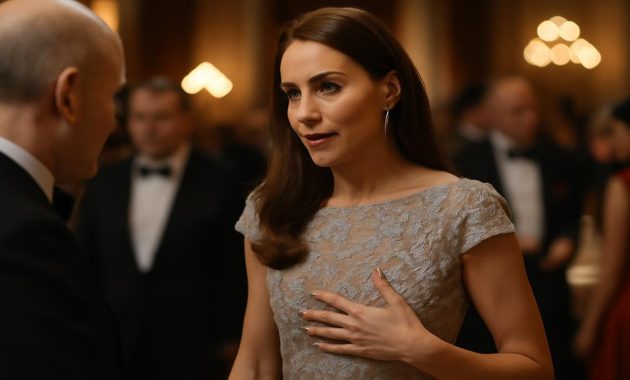
The car door opens to a soft roar of cameras, a flutter of shutters like distant rain. Out steps the Princess of Wales, and for a split second, the crowded courtyard seems to exhale. The lights catch first on the embroidery—thousands of tiny stitches that glimmer like frost on winter hedgerows—before faces, flags, and polished marble fade into the background. It’s another diplomatic evening, another high-profile state dinner. But in that instant, as Kate Middleton lifts the hem of her gown and moves forward with an easy, practiced grace, it’s also something else: a quiet love letter to British craftsmanship stitched in thread and tradition.
Stitching Diplomacy Into a Dress
Most state dinners are technically similar: long tables, tall candles, crystal glinting under chandeliers, a delicate choreography of protocol and politeness. But the details—the colors, the fabrics, the tiny choices almost lost behind the sparkle—are where the language of soft power is written. On this night, Kate’s choice of an embroidered evening gown is deliberate, nuanced, and richly layered with meaning.
The gown, tailored to trace her silhouette without ever shouting for attention, seems to belong as much to the room as it does to her. It doesn’t fight the setting; it converses with it. The fabric flows like poured light as she walks, and the shimmer of embroidery—subtle metallic threads twined with silk—mirrors the gilt edges of picture frames and the warm glow of candelabras lining the vast hall.
From a distance, the dress reads as simple elegance. Up close, it becomes an entire storyscape in miniature. Each stitch is a decision; each motif, a reference. English wildflowers curve around the bodice. Ferns and trailing leaves trace the skirt, like hedgerows seen from a train window at dusk. There are whispers of heritage textiles too: the kind of old-world needlework that once lived in quiet drawing rooms and small-town ateliers, now revived and reimagined by skilled artisans for a global stage.
In that hall, surrounded by foreign dignitaries and political power, this gown is a reminder that not all diplomacy is written in policy. Some of it is sewn in thread, in the steady work of hands that may never see the glow of such a room but whose craft is carried, quite literally, into the heart of international conversation.
Behind the Seams: The Makers and Their Magic
If you trace the gown backward, from glittering reception back to the quiet places where it was dreamed up, the story becomes even more tactile. There is the rustle of paper patterns laid across a cutting table in a London studio; the soft snip of shears slicing through fabric; the quiet concentration of embroiders bent over frames, fingers nimble and sure.
While the royal wardrobe is often shrouded in a tactful veil of discretion, it is no secret that Kate frequently turns to British designers and heritage houses. The gown’s embroidery, though executed with red-carpet finesse, carries the unmistakable voice of traditional British needlework: dense yet airy, intricate without tipping into excess, layering modern design on top of centuries-old practice.
In workshops scattered from London to the Midlands to the coasts, highly trained artisans still ply their trade, often by lamplight, often in rooms that smell faintly of steam and pressed cloth. They work with magnifying lamps, pin cushions blooming with needles, and spools of thread in shades that sound like poetry—antique gold, winter white, dusk rose, deep moss.
Picture a frame stretched taut with fine silk, and over it, the slow bloom of pattern: seed stitches like distant constellations, satin stitches forming petals so smooth they look painted, delicate couching anchoring metallic threads that catch even the faintest flicker of light. Every section of the gown’s embroidery likely passed through several sets of hands, each person adding their touch, unseen but essential.
By the time the gown arrives at a fitting, it is already a small masterpiece of domestic industry: British fabrics, British design, British labor. When Kate chooses such a piece for a diplomatic event, she isn’t just putting on a dress; she’s wearing an ecosystem of talent that stretches far beyond the palace walls.
Elegance as a Quiet Kind of Advocacy
To the casual viewer, it might seem like just another beautiful gown on a glamorous princess. But repeat the scene year after year, dinner after dinner, and a pattern emerges: Kate’s wardrobe favors homegrown talent, particularly on the nights that matter most in the diplomatic diary. Her clothing speaks before she does, and the message is clear—Britain has stories to tell in silk and satin, in embroidery and tailoring, in design and detail.
There’s a particular kind of restraint at play here. Unlike costumes created for impact alone, her evening wear rarely veers into spectacle. The dress doesn’t upstage the event; it supports it. It’s as if she understands that true luxury doesn’t scream; it whispers. And in that whisper, she makes room for emphasis on the people behind the seams.
British craftsmanship has weathered decades of manufacturing shifts, the rise of fast fashion, and the global race to the bottom in cost and speed. And yet, small ateliers, royal warrant holders, and independent artisans remain, some in family-run workshops that have survived multiple generations. By wearing their work when the world is watching—at state banquets, receptions with foreign heads of state, or diplomatic dinners hosted at historic residences—Kate quietly lifts them into the spotlight.
That matters. Fashion houses cited in royal wardrobes see a surge in interest. Traditional crafts that might have been dismissed as “old-fashioned” suddenly feel current, even aspirational. Young designers look again at embroidery, tailoring, hand-finishing, and see not a relic of the past, but a viable, vibrant future. A gown at a dinner table becomes, in its own way, an ambassador.
The Language of Detail
Look carefully at the gown from that evening, and the symbolism is almost lyrical. The color—often a neutral or softly luminous tone—allows the embroidery to be seen as texture rather than contrast, the kind of detail you notice not in the first instant, but in the second or third. It rewards attention the way a good book rewards a second reading.
Motifs from British nature—flowers, vines, maybe even suggestions of oak leaves or meadow grasses—are not accidental choices. The United Kingdom’s identity is, in many ways, inextricable from its landscapes: the rolling patchwork of fields, the clipped gardens, the wilder moors and coasts. Encasing that natural heritage into a diplomatic gown is like bringing a piece of the countryside into the room without ever saying a word.
In a world where digital speed throttles our attention spans, where clothing is often designed to be clicked, bought, and forgotten, such slow detail feels almost radical. And yet, that’s what makes it powerful. British craftsmanship, especially in embroidery and couture-level finishing, thrives on patience. It is, by definition, anti-disposable.
A Gown That Carries More Than Fabric
When Kate takes her seat at the long dinner table, the gown settles around her in soft folds. The camera lenses shift to other guests, to toasts, to speeches. But the garment keeps doing its work quietly. It’s there in the glances traded between guests, in the murmurs of stylists and editors watching from afar, in the sharp intake of breath when the first high-resolution photographs land in newsrooms and on social feeds.
It might be tempting to dismiss this as simply “good PR,” but there’s something more intimate and enduring about it. Clothing, after all, is one of the most personal forms of storytelling we have. Across cultures, we dress to signal respect, identity, belief, belonging. A diplomatic dinner gown that deliberately centers British artisans is as much an offering as a speech carefully drafted for the occasion.
For those who spend their lives honing these skills—cutters, seamstresses, pattern makers, embroiderers—the sight of their work on the global stage can be profoundly affirming. It sends a message not just to the world, but to them: what you do still matters. Your craft is still worthy of time, of investment, of reverence.
That respect for craft also resonates with the guests sitting across the table. Many come from nations with their own deep traditions of textiles and design, from handwoven silks to ceremonial dress. In Kate’s gown, they see something familiar: the idea that culture can be worn, that identity can be threaded into a hem or a sleeve. It’s a subtle but potent bridge.
The Ripple Effect Beyond the Ballroom
Outside the grand hall, the ripple continues. The images that circulate online do more than showcase glamour. They invite questions: Who made that gown? Where was it embroidered? Is it sustainable? How old is that technique? These are not idle curiosities; they’re points of entry into a wider conversation about craftsmanship and value.
You can see it in how people talk about these gowns: not just “beautiful” or “stunning,” but “bespoke,” “hand-finished,” “intricately embroidered.” Language itself shifts to acknowledge the human endeavor behind the appearance. For young people scrolling through their feeds, perhaps dreaming of creative careers, this can be revelatory. Suddenly, the idea of learning to sew, design, or embroider is not old-fashioned; it’s aspirational, tied to prestige and purpose.
In that sense, the gown becomes a mentor of sorts, whispering: beauty is built, not just bought. There is a lineage of skill behind every shimmering panel, a patience that can’t be rushed. In championing British makers, Kate is also championing a way of approaching fashion that is slower, more respectful, more deeply connected to place.
Narratives Woven in Silk and Tradition
There’s also a narrative continuity at play. Over the years, Kate has steadily cultivated a wardrobe that nods to British design—from Alexander McQueen to Jenny Packham to smaller labels that focus on local production and traditional techniques. Each formal event becomes another chapter in a story about what modern British elegance looks like.
It isn’t stiff or overly ceremonial. Instead, it’s fluid, approachable, and subtly rooted in heritage. The embroidered evening gown at this particular diplomatic dinner captures that spirit. It glows under the chandeliers but doesn’t blind. It references the past without feeling trapped by it. It’s formal enough for the occasion, yet soft enough in line and movement to feel almost storybook—if storybooks were lit by camera flashes instead of candlelight.
In many ways, the gown seems to echo Kate’s own public persona: composed, warm, guided by a clear sense of duty but grounded in relatable humanity. She laughs with guests, leans in to listen, lifts her glass to toast. The embroidery moves as she does, catching the light with every gesture, a constellation of stitched detail bound to the arc of her evening.
And when the night winds down—the final dessert served, the final handshake given—the gown leaves with her, back through corridors lined with portraits of monarchs and long-ago statesmen. Tomorrow it may be zipped away in a garment bag, labeled and stored. But its work is not done. The photographs and memories remain, and with them, a strengthened sense of what British craftsmanship can mean in the 21st century.
A Look at Royal Evenings and British Craft
Across multiple high-profile events, Kate’s consistent reliance on British makers is striking. While specifics of private wardrobe decisions are often kept discreet, years of public appearances paint a clear pattern of support:
| Occasion | Type of Gown | Craftsmanship Highlight |
|---|---|---|
| State Banquet at a Royal Residence | Embroidered full-length evening dress | Hand embroidery, bespoke pattern cutting |
| Diplomatic Corps Reception | Softly structured gown with train | British silk, couture-level tailoring |
| Charity Gala with Foreign Dignitaries | Beaded evening dress | Hand-applied beading from UK atelier |
| Cultural Exchange Dinner | Floral-embroidered gown | Motifs inspired by British wild flora |
While each gown is unique, the thread that binds them is clear: local artisans, precision work, and an emphasis on details that reward a closer look. The embroidered gown from this diplomatic dinner is simply one of the most luminous examples of that ethos.
Why These Choices Matter Now
In a century defined by speed and scale, moments of slowness become surprisingly powerful. Fashion that is made to last—emotionally, visually, structurally—is quietly rebellious. And in the realm of royalty, where clothing is both personal and political, the choice to foreground homegrown craftsmanship carries real weight.
It’s not just about nostalgia for “how things used to be.” It’s about insisting that there is still room in our modern economies for workshops where people know the names of their tools, where apprenticeships pass skills from one generation to the next, where the making of an evening gown can still be an act of art, not just production.
By wearing that embroidered evening gown to a high-profile diplomatic dinner, Kate Middleton is doing more than adhering to dress code. She is aligning herself with a vision of Britain that is not only powerful in politics but rich in makers, in craftspeople, in the quiet dignity of skilled work. The gown becomes a shimmering manifesto against disposability, against forgettability.
For the viewer—whether seated under the same chandelier or watching from a phone screen miles away—the impact is both visual and emotional. The dress invites you to look closer, to think about the time it took, the hands involved, the tradition it represents. And perhaps, to wonder what it would mean if more of the clothes we wore carried that depth of story.
In the end, the evening recedes into the flow of history: another dinner, another speech, another set of headlines. But the image of that embroidered gown lingers—a quiet, gleaming reminder that diplomacy is not only written in documents and declarations. Sometimes, it’s sewn into a seam, rendered in thread and light, and carried with poise into a room where the world has gathered to watch.
Frequently Asked Questions
Why is Kate Middleton’s choice of an embroidered gown significant?
Because it showcases British craftsmanship on a major international stage. By wearing a meticulously embroidered, British-made gown to a diplomatic dinner, she draws attention to local artisans, traditional techniques, and the value of slow, skilled work.
How does her fashion support British designers and makers?
Her outfits often come from British labels and ateliers known for their tailoring, embroidery, and couture finishing. When these pieces are photographed and discussed worldwide, the designers and craftspeople behind them gain recognition, new clients, and renewed prestige.
Is there symbolism in the embroidery and design motifs?
Yes. Motifs like wildflowers, leaves, and nature-inspired patterns often echo British landscapes and heritage. Subtle color choices and classical silhouettes further link the gown to tradition, culture, and the setting of historic royal venues.
Why is craftsmanship important in a modern royal wardrobe?
It signals values: sustainability, respect for heritage, and support for local industry. In a fast-fashion era, choosing hand-finished, high-quality garments suggests a commitment to longevity, care, and meaning in what is worn.
What message does this send in a diplomatic context?
It communicates that Britain’s identity includes not just political and economic power, but also a rich cultural and artisanal legacy. The gown serves as a visual ambassador, fostering connection and respect through shared appreciation of craft and tradition.