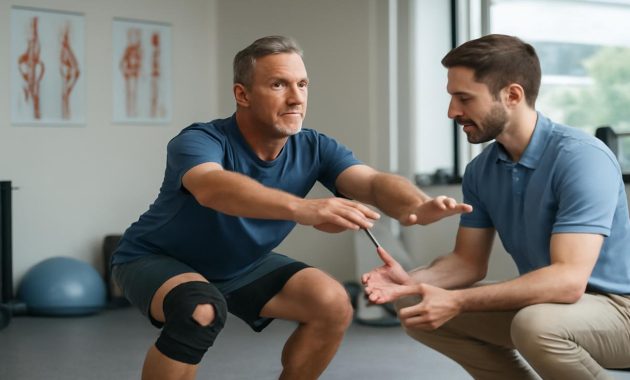
The first time I watched someone squat with knee pain, it looked exactly like what every pamphlet at every clinic tells you never to do. Her heels were firmly planted on the gym mat, her hips sinking low, her knees gliding forward past her toes—almost defiantly. Instinctively, I winced. This, I thought, is the moment the grinding, aching, arthritic knees finally give up. But then something unexpected happened: nothing. No flinch, no sharp inhale, no hand shooting down to cradle the joint. Instead, she stood back up, slowly, breathing out with a small, surprised smile. “That… actually felt good,” she said.
When the “Do Not Bend Your Knees” Rule Starts to Crack
If you’ve ever dealt with knee pain, you probably know the drill by heart. Avoid stairs. Don’t kneel. Don’t run. Definitely don’t squat. Somewhere along the line, squats were tossed into the same forbidden category as sprinting marathons on concrete or leaping off garage roofs. Doctors, relatives, and well-meaning internet commenters all seemed to agree: “Protect your knees by not using them too much.”
And for years, the safest recommendations sounded comfortingly gentle: take up swimming, try Pilates, stick to low-impact movements. Glide, don’t stomp. Stretch, don’t strain. Yet beneath the soothing advice, frustration simmered. People were still in pain. Many found that months—or years—of “rest” left them weaker, stiffer, and more fearful of movement than before.
Then a new wave of experts began quietly saying something that sounded almost heretical: for many people, the very movement we’ve been avoiding—the squat—might be part of the solution, not the problem.
This idea has launched a small revolution in rehab clinics, strength studios, and on social media feeds, where videos of people doing deep, almost uncomfortable-looking squats with sore knees are drawing millions of views—and equally heated debate. Some physiotherapists and sports physicians are now praising carefully programmed squats as a powerful way to reduce knee pain. Others are alarmed, arguing that this trend oversimplifies a complex joint problem and risks doing harm.
The Squat That Broke the Internet
Spend a few minutes scrolling under hashtags like “kneepain” or “knee rehab,” and you’ll find them: people standing on slanted boards, knees drifting far over their toes as they sink into slow, deliberate squats. They pause at the bottom, quads shaking, then rise up, sometimes with a look of stunned relief. Some call it “knees-over-toes” training. Others label it “deep tolerance” or “loaded range rehab.” The visuals alone are enough to make traditional orthopedic advice twitch.
For decades, the rule in gyms and rehab centers was simple: don’t let your knees travel past your toes. The idea was that this position would overload the joint, wearing down the cartilage and increasing pain. But newer research has complicated that story. Our knees, it turns out, are not glass hinges. They evolved to flex, bend, and bear load—sometimes in very deep angles—when they’ve been prepared and strengthened to do so.
What this newer, controversial approach suggests is not that anyone with knee pain should start dropping into deep squats with a barbell on their back. Instead, it proposes something more nuanced and more unsettling: that, with careful progression, controlled squatting—even into ranges we’ve long been told to avoid—can actually build resilience in the very structures that hurt.
Why Experts Are Divided
On one side are clinicians and trainers who see these squats as a missing piece in the rehab puzzle. They argue that most knee pain protocols have focused heavily on calming things down—ice, rest, anti-inflammatories, gentle stretching—while neglecting the reality that knees live in the real world, where we squat to sit, stand, climb, and lift. At some point, “protecting” the joint by underusing it may leave it too fragile for everyday life.
On the other side are cautious medical professionals who worry that the pendulum has swung too far. They point out that not all knee pain is the same. A twenty-eight-year-old ex-basketball player with patellofemoral pain has a very different knee from a seventy-year-old with severe bone-on-bone osteoarthritis. To them, watching strangers on the internet dive into deep squats based on a viral video is like watching someone self-prescribe antibiotics because it worked for their neighbor.
The controversy, in other words, isn’t about whether movement is good for painful knees—almost everyone agrees that it is. The real argument is over how much, how soon, and in what position.
Inside the Joint: What Your Knees Feel When You Squat
To understand why squats are both feared and celebrated, it helps to imagine what’s happening under the skin when you bend your knees. Cartilage, shaped like smooth padding on the ends of your bones, helps them glide against one another. Ligaments support the joint, tendons transmit force from muscle to bone, and the quadriceps—the big muscles on the front of your thighs—act like powerful shock absorbers.
When you squat, forces travel through this whole system. Yes, pressure on the knee joint increases as you bend more deeply. But so does muscle activation. Those big quad muscles and the smaller stabilizers around your hips start working harder, sharing and distributing the load. Over time, with gradual practice, they tend to get stronger. It’s this strengthening—plus the way tissues adapt to stress—that many proponents believe can reduce pain.
The key word here is gradual. A knee that’s been babied for years, or one recovering from injury, won’t react kindly to sudden heroic squats. It’s like asking a reclusive homebody to run a mountain marathon with no training. That, in many ways, is where some of the backlash comes from: people see the end stage of the process online (deep, confident squats) but not the months of careful preparation it often takes to get there.
From Fear to Load: A Different Story About Pain
There’s another twist in this story that makes it both fascinating and confusing. Pain does not always equal damage. You can have significant arthritis on an X-ray and very little pain—or minimal structural changes and severe pain. Our nervous system interprets signals from joints, muscles, and our emotional state to create the experience we call pain.
For some people, especially those who have been told for years that their knees are “bad” or “worn out,” the brain has learned to associate bending, loading, and squatting with danger. The result: even gentle movements can feel sharply painful. In these cases, controlled, progressive squats become not just strength training but education. They teach the nervous system that the knee can bend, bear load, and return safely to standing.
This is thrilling for practitioners who specialize in movement-based rehab. But it also makes some physicians uneasy. The worry is not that this concept is entirely wrong—but that it might be misused to dismiss real structural problems, or to push people into pain with the promise that if it hurts, it must be healing.
What These “Controversial Squats” Actually Look Like
In practice, the new wave of knee-friendly squats doesn’t usually start with dramatic, Instagram-ready movements. It often begins with something far less glamorous: a small bend. Maybe just enough to feel a mild, tolerable sense of effort or discomfort—often described as a two or three out of ten on a personal pain scale.
People might start with a support, like holding onto a railing or countertop, shifting weight gradually onto the more painful side. From there, they might add a slight incline under the heels, or use a slant board, allowing the knees to drift cautiously forward while keeping the movement slow and controlled. They might do only a few repetitions at first, then give the joint time to recover.
Over days and weeks, the goal is not to chase pain, but to expand what feels safe. That might mean bending a little deeper, holding the position an extra second, or adding a small weight. To an outsider, it may look like a deep squat appeared overnight. To the person doing the work, it feels like a long conversation with their own knees—sometimes tense, sometimes hopeful, often surprisingly emotional.
A Quick Look at Variables That Matter
For all the complexity, some of the key differences between helpful and harmful squats can be boiled down to a few tunable elements: depth, load, frequency, and support. Here’s a simplified comparison:
| Variable | Gentle Rehab-Focused Squat | High-Risk Squat Scenario |
|---|---|---|
| Depth | Shallow to moderate, gradually increased | Sudden deep squats with no buildup |
| Load (weight) | Bodyweight or light resistance at first | Heavy weights, maximal effort early on |
| Support | Using rail, chair, or wall if needed | No support, poor balance or control |
| Pain Response | Mild, short-lived discomfort that settles within 24 hours | Sharp, worsening pain that lingers or swells the joint |
| Progression | Week-to-week increases, guided by symptoms | Jumping ahead quickly, ignoring warning signs |
It’s in the gap between these two approaches that much of the current conflict lives. The principle—use movement to build capacity—is widely supported. The execution—how to apply that to a specific, individual knee—is where things become murky.
Why Swimming and Pilates Aren’t the Whole Story
None of this means that swimming, cycling, or Pilates are suddenly “bad” for knee pain. They’re still often excellent choices. The buoyancy of water or the low-impact, controlled movement of a reformer can offer much-needed relief, especially during a painful flare. They allow people to move without fear of jolts or landings, to gently restore circulation and flexibility.
The emerging criticism isn’t about these activities themselves, but about the idea that they’re enough, on their own, to prepare knees for life outside the controlled environment. You don’t usually live your whole day lying on a reformer carriage or floating in six feet of water. You live it on stairs, in chairs, crouching to tie shoes or pick up a dropped phone or chase a child across the lawn. Those real-world tasks are, essentially, squats in disguise.
To some experts, never training those squatting movements under load is like practicing singing but never raising your voice above a whisper. You may be technically “using” your vocal cords, but you’re not preparing them for the demands of a full song. In this view, the knee needs not just gentle movement, but also progressive strength work in the exact patterns it’s most scared to perform.
The Emotional Weight of Bending Again
What’s easy to overlook in all the biomechanics and arguments is how personal this is. Many people with chronic knee pain have spent years inside small, cautious movements. Every step is calculated. Every slight bend is measured. The idea of squatting—truly squatting, with intent and weight and depth—feels less like exercise and more like crossing a fault line.
That first supported squat, that first moment of bending a little lower than feels comfortable, can bring a wave of feelings: fear, hope, anger at all the lost time, astonishment that the joint didn’t explode as promised. Clinicians who use these controversial squats talk about tears in the gym, not just from pain, but from the relief of discovering that the body may be more capable than the story someone has been told about it.
And yet, this is precisely why some in the medical community call for restraint. Hope is powerful, but it can also be exploited. A charismatic coach or influencer promising “bulletproof knees” in a few weeks with the right type of squat can easily pull people into programs that aren’t appropriate for their age, history, or current capacity.
Listening Between the Cracks of the Debate
So where does this leave someone standing at the crossroads of knee pain, caught between doctors who caution against squatting and experts who insist it’s the missing piece?
Some truths cut through the noise:
- Completely avoiding knee bending and loading rarely leads to long-term improvement. Most knees do better with some movement and strength work.
- Not all squats are equal. A shallow, supported bodyweight squat is a different creature from a heavy, deep barbell squat—even if they share a name.
- The right progression is deeply individual. Age, body weight, injury history, arthritis severity, and overall fitness matter.
- Pain is a guide, not a dictator. A bit of discomfort may be acceptable; sharp, escalating pain or swelling is a red flag.
- Expert guidance beats guesswork. Whether it’s a physical therapist, sports physician, or an experienced coach with medical collaboration, having someone tailor the process to your body can be invaluable.
The split in the medical community may not be a sign that one side is entirely right and the other is completely wrong, but rather that the old, rigid rules are finally being questioned. Instead of blanket bans (“never squat”) or blanket prescriptions (“everyone should squat deep”), the conversation is shifting toward nuance: how can we use the power of loaded movement without ignoring the realities of injury, degeneration, and individual variation?
If you’re reading this with a familiar ache behind your kneecap, the answer may not lie at either extreme. It may sit in the middle: in small, respectful experiments with bending; in seeking a professional who doesn’t flinch at the word “squat” but also doesn’t rush you onto a slant board on day one; in learning the difference between protective pain and progressive overload.
Somewhere between the swimming pool and the Pilates studio, there’s that quietly radical motion: a deliberate lowering of your center of gravity, a controlled bend in a joint you were once told to shield at all costs. You might hold onto the back of a chair, feel your thighs tremble, and wonder if this is bravery or foolishness. The truth is, right now, even the experts are still figuring that out.
But in those seconds—breath held, heels grounded, knees gently forward—you’re participating in a new, unsettled chapter of medical thinking. You’re not just testing your knees. You’re testing the story you’ve been told about them.
FAQ
Are squats safe if I have knee osteoarthritis?
They can be, but it depends on severity, pain levels, and how they’re performed. Many people with mild to moderate osteoarthritis benefit from carefully progressed, supported squats that build strength in the quadriceps and hips. However, if you have severe arthritis, significant deformity, or frequent swelling, you should work closely with a healthcare professional before adding squats.
Should my knees go past my toes when I squat?
For many people, allowing the knees to travel slightly past the toes is natural and not inherently dangerous, especially in controlled, pain-tolerable ranges. What matters more is gradual progression, good balance, and how your knees feel during and after the movement. If the position sharply increases your pain, it may be too much too soon.
How much pain is “okay” during rehab squats?
A commonly used guideline is that mild discomfort (around two or three out of ten) that settles within 24 hours may be acceptable. Sharp, sudden pain, or pain that lingers, worsens, or causes swelling is a sign to back off and reassess your technique, depth, or load with a professional.
Can I rely on swimming and Pilates alone for my knee pain?
Swimming and Pilates can be very helpful for reducing pain and improving mobility, especially during flare-ups. However, they may not fully prepare your knees for everyday tasks like sitting, standing, and climbing stairs, which require loaded bending. Many people do best with a combination: gentle low-impact exercise plus progressive strength work, sometimes including squats.
Do I need a professional to start squatting with knee pain?
It’s strongly recommended, especially if your pain is persistent, you have a history of knee injuries, or you’re unsure what type of squat is appropriate for you. A physical therapist, sports medicine doctor, or qualified strength coach can help tailor the movement to your specific condition and reduce the risk of doing too much, too fast.