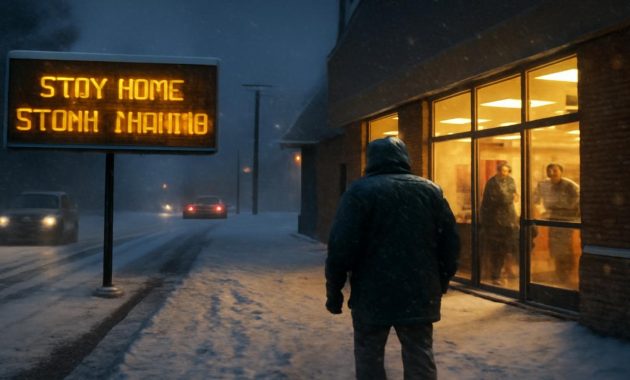
The first snowflake lands on the back of your ungloved hand, a tiny six-armed star that melts almost the instant you notice it. Another follows. Then another. By the time you look up, the sky has turned into that familiar gray weight, the kind that swallows distance and softens edges, and you understand: tonight will not be a gentle dusting. Tonight is going to be one of those storms people tell stories about in diners and barbershops for years afterward.
The Forecast That Changed the Evening
The weather alert arrives as a low buzz on kitchen counters, office desks, passenger seats. Phones light up with the same blunt message: Heavy snow expected to begin tonight. Travel could be very difficult to impossible. There is no poetry in the wording—just the cold, clipped grammar of urgency.
Out past the last strip mall, the horizon is already disappearing. The snow isn’t heavy yet, but it’s gaining confidence, drifting sideways in hesitant gusts. In the time it takes to pull into a gas station, the windshield is salted with tiny ice pellets, a promise of thicker things to come.
Inside homes, people move through the familiar pre-storm rituals: pulling boots from closets, gathering flashlights, double-checking the pantry. Somewhere a child presses their forehead to the window, thrilled by the possibility of a snow day. Somewhere else, a nurse scrolls through their messages, wondering if the roads will be passable for the night shift. A delivery driver counts the remaining packages and calculates how much daylight is left. The storm is coming for all of them, but in different ways.
The Voice of Caution
By late afternoon, the local authorities have had enough of polite suggestion. Their tone hardens.
The sheriff’s department posts a notice: Please stay off the roads after 8 p.m. unless absolutely necessary. The emergency management office echoes the warning. Radio stations break from songs to repeat the same phrase over and over, the words weaving themselves into the fabric of the evening: Stay home. Stay off the roads. Let the plows work.
It’s not that the people in charge don’t trust drivers. They’ve just seen what happens when heavy snow turns highways into slow-moving dioramas of hazard—trucks jackknifed across lanes, tail lights glowing hopelessly through whiteout, ordinary sedans angled like stranded fish against guardrails. They remember last year’s storm, and the one before that.
In the quiet, windowless operations room beneath the county building, planners study radar images that shift like inkblots across the state. The bright bands of color thicken, crawling toward town. Someone leans in, squints, and mutters the latest snowfall prediction: eight to twelve inches, possibly more in higher elevations. They know what that means for ambulance response times, for stranded motorists, for the firefighters who will dig through drifts to reach heart attack victims and house fires.
“Stay home,” they repeat to the cameras, to the microphones, to the social feeds that never sleep.
The Push to Keep the Lights On
But while the official message says stay, another voice—quieter but insistent—says go.
In strip malls and downtown storefronts, managers stand beneath humming fluorescent lights and frown at the weather app. They have their own set of numbers to consider. A restaurant already short-staffed on a good day can’t afford to close on a Friday night. A big-box retailer has quarterly targets. A warehouse operates on promised delivery windows that don’t make exceptions for snowflakes.
“We’ll keep normal hours,” a supervisor posts to the staff message board. “Use your best judgment for safety. But we do plan to be open.”
“We still expect coverage for morning shifts,” another email reads, carefully worded but unmistakably clear. The pressure is subtle, familiar: the sense that business as usual must be maintained, no matter what’s happening outside the plate glass windows.
As the afternoon grays into evening, you can feel the tension building, like a barometer dropping. On one side: emergency alerts and televised briefings urging people to stay home, to clear the roads, to let the storm do its work without human entanglement. On the other: schedules, payrolls, promises to customers, the ironclad faith that commerce must not pause.
This tug-of-war plays out in break rooms, group chats, and parking lots. A barista wonders whether they’ll be penalized for calling out. A grocery clerk zips their coat a little higher and shrugs: “They’re saying it’s going to be bad, but I need the hours.” A rideshare driver refreshes the app, sees the surge pricing creep upward even as road conditions worsen. Risk begins to translate directly into money.
The Faint Glow of Headlights
By the time darkness falls, the snow has gained both volume and authority. It no longer drifts politely; it drives itself into every crack and corner, hissing along the pavement, swirling in alleyways. Streetlights hang in the storm like soft yellow moons, their halos shrinking as the flakes thicken.
Those who heed the warnings are already home. Inside, the world takes on an indoor quiet threaded with the gentle percussion of sleet on windows, the rumble of plows in the distance. People pull on thick socks and wrap fingers around warm mugs, the house scented with something simmering—chili, stew, a pot of tea.
But out on the roads, a smaller, more defiant world persists. A line cook noses their aging sedan through deepening tire tracks, squinting at the faint reflectors along the shoulder. A nurse leaves their children with a neighbor, scraping the windshield clear for the second time in an hour, knowing that a hospital cannot close. A warehouse crew member angles through blowing snow toward a building glowing fluorescent at the edge of an industrial park.
From inside a car, the storm is not beautiful. The windshield wipers jerk and squeal, each swipe revealing less than before. Headlights are swallowed a few yards ahead, and the lines on the road vanish under a slippery, shifting white. Every brake tap feels like a conversation with gravity. Every curve is an act of faith.
Outside, the snow keeps falling, steady as breathing.
Inside the Storm’s Quiet Center
For those who stay home, the storm becomes an event to witness. You stand at the window, curtains pushed back, and watch as the world is erased and redrawn in slow motion. The ordinary shapes of the neighborhood transform—the parked car becomes a swelling mound, the trash cans soften into gentle, rounded humps. Trees grow thick white stockings along every branch. Street signs gain beards of ice.
The snow changes sound before it changes sight. The neighborhood’s usual soundtrack—leaf blowers, distant traffic, barking dogs—falls away. Soft snow absorbs noise, and the world is muffled to a hush so complete that even the buzzing of the refrigerator feels louder. Each passing plow rumbles with an importance that borders on regal, a brief mechanical thunder through an otherwise cotton-wrapped night.
Time behaves differently in this kind of weather. Minutes stretch out as you stand there, watching the flakes tumble in columns, sometimes swirling sideways, sometimes falling straight and fast. The outside light grows spectral—no clear source, just a general glow reflecting off millions of tiny surfaces.
Yet even in this quiet, you know that somewhere not far away, the storm is not a spectacle but an obstacle. An older neighbor worries about a power outage and a failing furnace. A single parent wonders if school will be canceled and how that will affect tomorrow’s shift. A tow truck driver waits by the radio, anticipating the inevitable calls.
A Night of Uneasy Balance
The diverging messages—stay home, keep working—converge in the bodies of people who occupy both worlds at once. A grocery store cashier, normally anonymous, becomes a kind of lifeline for last-minute shoppers who suddenly realize they’re nearly out of milk and bread. A gas station attendant, dwarfed by towering piles of plowed snow, keeps the pumps running for drivers who decided to risk one more errand.
As the night deepens, the snowfall crosses from heavy to punishing. The radar loops glow with dense, angry swaths of color over your town. Snowplow operators trade quick updates over radios, battling not only the accumulation but drifting winds that undo their progress within minutes.
Inside the cab of a plow, the world is reduced to a tunnel of light and swirling white. Each pass takes patience and nerve. The driver feels the blade catch and bounce on hidden curbs, sees the pile of snow grow in a rolling wave before the truck. Every so often, a set of headlights appears behind them, far too close, and they know there’s a driver who either didn’t see the warnings or had no choice but to ignore them.
Somewhere else, in a dim living room, a small business owner is pacing, calculating lost revenue for every hour they might close tomorrow. They think of their staff, the ones who count on each paycheck. They think of the bills stacked on the desk. The storm outside feels less like a weather event and more like an accounting problem written in white.
Where Safety and Survival Collide
This is where the storm reveals a truth that clear skies sometimes hide: safety is not evenly distributed.
When authorities say “stay home,” they are speaking most clearly to the people who can. People who can log in from a laptop instead of driving across town; people with jobs that come with paid time off; people whose absence doesn’t cause the machinery of daily life to grind and spark.
But the storm does not fall more lightly on those without that privilege. The grocery stocker, the nurse, the bus driver, the overnight warehouse team—the ones who keep the city’s skeleton moving—often don’t get the luxury of staying home just because the world has turned white and dangerous. The storm is their commute, their shift, their exhausted drive back at dawn.
On nights like this, you see the invisible framework of normal life. You see who is expected to bend, who is expected to show up, who must pit paycheck against icy road and make an impossible calculation in under ten seconds.
Outside, the snow continues accumulating on every unmoving surface. On the roof of the hospital. On the darkened school playground. On the supermarket loading bay where, even tonight, a truck might be backing in, tires spinning slightly as the driver angles just right.
Under the Streetlights, After Midnight
After midnight, the streets shift from sparse to nearly empty. Most have heeded the call by now; the others are hunkered down wherever they ended up—at work, at home, at a friend’s house less risky to reach than their own.
In the eerie glow of the streetlights, the world looks both newborn and ancient. Footprints appear briefly and then fill in again. Tire tracks etch fleeting paths that vanish within minutes. It’s as if the storm is gently but firmly asserting its rule: everything changes, and nothing you leave on the surface is permanent.
Yet even in this altered, suspended world, the stubborn rhythms of human life keep ticking. A bakery begins prep for morning bread, ovens warming the chilly air. A radio DJ, alone in a small booth, cues another track and tells the few listening drivers to be careful out there. Somewhere, a snowbound diner stays open for truckers and tow drivers, steam clouding the windows while the storm presses its cold hands against the glass.
The authorities look at the latest forecast models and consider additional measures: more plows, temporary road closures, perhaps even declaring a state of emergency. They re-read their prepared lines about safety and common sense, hoping the message penetrates through the glow of store closing times and delivery schedules.
Morning After, and What We Remember
When morning finally wrestles its way through the thick cloud cover, the world is unrecognizable. The storm’s work is complete: sidewalks erased, cars half-swallowed, tree limbs bowed and glittering beneath their new burdens.
You step outside into air that tastes clean and almost metallic, sharply cold yet strangely invigorating. Each breath smokes out in front of you. The first step into untouched snow breaks with a muffled crunch, the sound swallowed quickly by the surrounding quiet.
For a few minutes, it’s possible to forget last night’s tension and soak in the stark beauty of it all. The way the morning light reflects off billions of snow crystals, casting an almost blue-white glow. The way sound still feels smothered, giving everything a dreamlike quality. Your own footprints trail behind you, the only evidence of disturbance in this temporarily softened world.
Then reality reasserts itself. You see the car that didn’t quite make the turn, nosed gently into a drift, hazard lights still faintly blinking. You watch a neighbor shovel out a driveway with a stiffness that suggests more years than strength. You hear, faintly but unmistakably, the siren of an ambulance trying to navigate a still-clogged side street.
At the same time, your phone buzzes again: messages from workplaces, schools, and services negotiating the aftermath.
| Organization | Status | Impact on People |
|---|---|---|
| Public Schools | Closed | Parents juggle childcare and work obligations. |
| Hospitals | Fully Operational | Staff faces long shifts and treacherous commutes. |
| Grocery Stores | Reduced Hours | Employees work under pressure; shelves may be low. |
| Small Retail Shops | Varies by Owner | Owners balance revenue needs with safety concerns. |
| Road Crews & Plows | Extended Operations | Workers endure long, stressful, physically demanding shifts. |
The numbers on the screen tell their own version of the story: closures and delays, modified business hours, the delicate balance between caution and continuity.
You scroll through photos shared online: kids tunneling through backyard drifts, dogs bounding joyfully through powder, commuters stuck in snow halfway up their bumpers, empty downtown streets turned into temporary postcard scenes. The storm has made everyone a witness, each from their own perspective.
What lingers after a night like this is not just the memory of the snow’s beauty or the frustration of canceled plans. It’s the uncomfortable recognition of our competing priorities. Safety versus livelihood. Individual risk versus collective responsibility. The call to stay home versus the push to keep things running, to pretend that weather can be negotiated with like any other business arrangement.
Choosing the Next Footstep
Heavy snowstorms have always been part of life in many places—a seasonal punctuation mark, a reminder that nature still reserves the right to disrupt. But in a world built on the expectation of constant availability, 24-hour shipping, and round-the-clock service, these storms reveal a fault line.
They show us how quickly we ask some people to become the buffer between danger and convenience. They show us the weight of decisions made in offices far from the slippery parking lots and unplowed side streets. They invite us, perhaps, to reconsider what we mean by “essential.”
Next time a notification scrolls across your screen—Heavy snow expected, travel could be very difficult—you might pause a little longer. You might ask not only, “Will I be safe?” but also, “Who has to be out there so that my version of normal can continue? And what do I owe them?”
Outside, for now, the snow lies still and quiet, a white ledger across the landscape. The plows will come again. The sun will rise higher, the melt will begin, and the branching streams of runoff will carry this particular storm toward the edges of memory.
But the choices we make—whether to stay home, to ask others to come in, to slow down, to protect one another—those can last longer than the drifts piled at the end of the driveway. In the end, the story of any great snowstorm is not written only in inches and wind speeds. It’s written in the lives that moved through it, the ones who stayed put, the ones who ventured out, and the fragile space in between where safety and survival meet.
FAQ
Why do authorities urge people to stay off the roads during heavy snow?
Authorities know that heavy snow reduces visibility, hides ice, and makes stopping distances much longer. Staying off the roads helps prevent crashes, allows emergency vehicles to move more freely, and gives plows space to clear snow efficiently.
If conditions are so dangerous, why do some businesses stay open?
Many businesses face financial pressure to remain open, especially those that rely on daily sales or strict delivery schedules. Some also provide essential goods and services like food, fuel, and medication, which creates a strong incentive to operate despite the risks.
What jobs are typically considered “essential” in a major snowstorm?
Essential roles often include healthcare workers, emergency responders, utility crews, road maintenance and plow operators, public transit staff, and some grocery and pharmacy workers who support basic needs for the community.
How can drivers decide whether it’s really safe to go out?
Check official weather alerts, road condition updates, and local authority guidance. Consider your vehicle, driving experience in snow, the necessity of your trip, and whether your route includes hills, bridges, or rural roads that may be slower to clear. When in doubt, postponing travel is usually the safest choice.
What can employers do to better protect workers during heavy snow?
Employers can offer flexible schedules, remote work where possible, provide safe transportation options, avoid penalizing staff for weather-related absences, and clearly communicate that safety comes before business as usual. Thoughtful policies can reduce risk without completely halting operations.