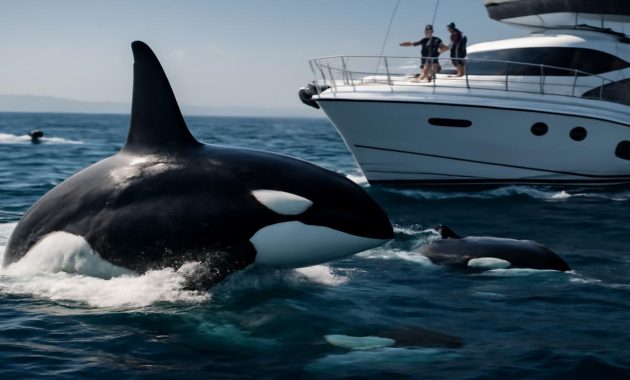
The first time the yacht shuddered, everyone thought they’d hit a submerged log. Crystal flutes chimed on the teak table, a bottle of champagne sloshed, and a woman in a linen dress grabbed the rail, laughing in that nervous way people do when they don’t yet know whether to be afraid. Then the second impact came—harder, angrier, like something alive slamming itself against sixty feet of polished fiberglass. Someone shouted from the helm. Out on the stern, the sea boiled black and white.
The orcas had arrived.
A Perfect Day, Right Up Until It Wasn’t
It was one of those afternoons that look almost staged: a flat, silver-blue sea off the coast, the sun hanging soft behind a veil of cloud, and a luxury yacht slicing a clean, glossy line through the water. On board, music thumped out of hidden speakers. A chef in deck shoes passed around plates of sea bass tartare. The owner leaned back, satisfied, watching the shoreline drift by like a high-definition screensaver.
Then came the sound. A hollow, resonant thud that rose up through the hull like a struck drum. The kind of sound that has weight and intention. The captain swore under his breath and threw the engines into neutral. Beneath the stern platform, a dark shape rolled, and a tall dorsal fin knifed the surface. The guests surged to the rail with phones out, already angling for video. Someone said, “Wow, we’re so lucky,” just before the orca rammed the rudder.
This scene, or one uncannily like it, has been playing out again and again along certain coasts in recent years. Once-in-a-lifetime wildlife encounter? Maybe. For many luxury yacht owners, it’s starting to feel more like a deliberate siege. Social media feeds fill with shaky footage of orcas targeting rudders, circling boats, returning again and again. Insurance companies rewrite policies. Repair yards add extra shifts. And in the middle of it all, the people who know the water best—the fishers, the skippers, the coastal families—find themselves pulled into an argument that is as much about class and culture as it is about whales.
The Sea Has a Long Memory
Biologists, for their part, are cautious about using big, dramatic words like “revenge.” They prefer terms like “learned behavior,” “social transmission,” and “cultural pattern.” But the story that circulates in harbor bars is simpler: one traumatized orca, struck by a boat or tangled in a line, began targeting rudders—and taught others to do the same. Whether that’s the whole truth or only part of it, one thing is clear: some orca groups have started paying a lot of attention to certain kinds of boats, especially sleek sailing yachts and motor vessels with swim platforms that look, from below, a lot like something to push, bump, and test.
On the pier, an old fisherman in a sun-bleached cap shrugs when you ask him about it. “They’re smart,” he says, stringing hooks with the practiced flick of someone who’s done the same motion since childhood. “Smarter than most of us, if you ask me. You treat the sea like a toy, don’t be surprised when it pushes back.”
Not everyone sees it that way. A few slips down, a younger man in deck shoes and mirrored sunglasses stares at the fresh scar along his yacht’s hull. “It’s insane,” he says. “I pay top money for a vessel that’s safe, certified, legal. I respect the regulations. And I’m supposed to what—sit there and let a two-ton predator smash my boat while authorities tell me to ‘stay calm and live with it’?”
Between these two men stretches the new frontline of a conflict that doesn’t quite have a name yet. It’s part animal rights debate, part climate anxiety, part class tension—and all of it is playing out on the slippery, shifting surface of the sea.
“Live With It”: When Authorities Step Back
Marine authorities, caught in the middle, have adopted a stance that infuriates some and reassures others: don’t retaliate, don’t provoke, slow down, reroute if you can—and accept that orcas are now a factor in coastal navigation. In simpler language: live with it.
At first, that phrase was meant as a kind of pragmatic calm. Don’t panic. Don’t grab a flare gun and start shooting into the water. Don’t floor the throttle and try to outrun a creature that treats thirty knots like a playful jog. Just power down, keep hands and feet out of the water, call it in, and wait.
But “live with it” hits differently if you’re the one staring at a set of cracked rudder bearings and a repair quote that runs higher than the price of a small apartment. It chafes when a season’s sailing plan collapses under the threat of another encounter. And it burns, deeply, for those who feel that the rhetoric of conservation is being wielded mainly against people who can afford to be visible—in immaculate marinas, in gleaming white hulls—while bigger, less photogenic threats to orcas, like industrial pollution and collapsing fish stocks, roll on with less fanfare.
On the other hand, coastal conservationists hear that outrage and taste an old, bitter flavor: the expectation that the ocean should be predictable, controllable, and ultimately subordinate to human leisure. One local marine ranger puts it bluntly. “The sea is not an amusement park,” she says. “These are apex predators in their own home, interacting with us because we are there, in numbers and in noise they’ve never experienced before. Living with it doesn’t mean we’re abandoning boaters. It means we’re finally admitting we’re not in charge.”
A New Kind of Risk, A New Kind of Resentment
The conversation gets especially sharp in the taverns and quaysides of small coastal towns. For many working fishers, risk is just part of the vocabulary of life. Weather can turn in minutes. Nets can tangle. Engines can die at the worst possible moment. The idea that an orca might slam a hull is serious—but not, in their eyes, apocalyptic.
“We’ve always lived with the sea doing what it wants,” says a woman mending nets beside a rust-streaked trawler. “Now some weekend captain gets a scare and suddenly it’s a crisis of national importance.” She waves a hand toward the sleek yachts bobbing beyond. “They arrive three months a year, act like they own the horizon, and when the ocean disagrees, they call the authorities.”
This is where the conflict sharpens into something more brittle than simple fear of wildlife. Orcas become symbols. For some, they’re ambassadors of a wildness that still survives at the edge of an increasingly industrialized ocean. For others, they’re dangerously protected animals that inflict very real economic damage—and seem to enjoy a level of official sympathy not always extended to human workers in coastal industries.
Insurance adjusters, dragged reluctantly into this theater, start producing spreadsheets and updated clauses. One surveyor swipes through photos on his tablet: bent rudders, torn swim platforms, splintered steering quadrants. “They go for the same place, again and again,” he says. “It’s targeted, but from a behavior standpoint, not a moral one. To them, a rudder is just a responsive toy. It moves when they push it. It’s tactile, it’s interesting. To us, it’s thousands of euros.”
Listening to the Science, Hearing Something Else
Marine biologists stand with their charts and their careful data and repeat, with patient emphasis, that there is no evidence of coordinated “orca warfare.” The animals involved are usually part of a particular subpopulation. They exhibit what researchers dryly call a “fad behavior”—something picked up by a few individuals and socially taught to others. In other orca pods around the world, the “fads” might be carrying dead salmon on their heads or playing with kelp. Here, unfortunately, it is ramming boat rudders.
To people whose boats are being rammed, the academic subtlety can feel like an insult. “Call it whatever you want,” one yacht owner fumes. “My reality is that I had to be towed back to port, my kids were terrified, and the repair yard is booked for months.”
Still, the data they bristle at tells an important story. Most orca encounters don’t lead to catastrophic sinking. The majority result in damage that, while expensive, is survivable. No humans have been killed. In many cases, the animals disengage after a handful of impacts, as if their curiosity is satisfied or their threshold for interest met.
Authorities lean hard on these numbers to justify their “live with it” approach. They issue guidelines: avoid known hotspots during peak times; slow down when orcas are sighted; cut engines if an interaction begins; don’t scream or throw objects into the water. Some jurisdictions experiment with acoustic deterrents, which in turn trigger heated debate about underwater noise pollution and unintended stress to other species.
That’s the maddening thing about the ocean: every solution echoes. Every action propagates beyond its target.
At the Edge of Luxury and Wildness
Aboard the high-end yachts, this all lands in a specific, awkward way. The modern luxury boating experience is already sold as a kind of curated wildness—Panoramic windows so you can “feel at one with the sea,” silent engines to “glide in harmony with nature,” eco-packaging for caviar and hand towels. Anchored in an empty cove, owners talk about getting away from it all, about reconnecting with something elemental.
Then the element hits back.
And in that instant, the marketing gloss burns away, leaving behind a set of raw, unadorned questions. What does it really mean to enjoy wild places without controlling them? How much risk are we prepared to accept in exchange for proximity to creatures we say we revere? Do we truly mean it when we talk about respecting wildlife—or only until the wildlife dents the hull?
One skipper, who’s ferried wealthy clients for two decades, describes the shift he’s seen. “Used to be, seeing an orca was the highlight of the whole charter. People would cry, they’d talk about it for years. Now, I watch half of them go from awe to anger the moment they feel the boat judder. It reveals something. For some, the sea is beautiful so long as it behaves like a backdrop.”
| Group | Main Concern | Typical Response to Orca Encounters |
|---|---|---|
| Luxury yacht owners | Damage costs, safety, loss of control | Demand stronger deterrence, criticize “live with it” stance |
| Local fishers | Livelihood, long-term ecosystem health | Accept risk as part of the sea, resent elite panic |
| Marine authorities | Human safety, species protection, legal liability | Promote non-lethal measures, monitoring, navigation rules |
| Conservationists | Orca welfare, cumulative human impact | Support “live with it,” push for broader ocean protections |
Coastal Communities Caught in the Middle
For the villages and small cities that line these coasts, the orcas themselves are only one part of the story. The other part is money. Luxury boating brings jobs—dockhands, mechanics, cleaners, chefs, guides. It feeds restaurants and boutiques. When word spreads that a region is an “orca hotspot,” some tourists come hoping for a glimpse; others quietly cross it off their itinerary, unwilling to chance an encounter that might mean days in a repair yard.
Harbor masters juggle calls from worried skippers and underfunded regulators. Boatyards become unofficial rumor exchanges, where speculation outpaces fact. “My cousin says they’ve learned to recognize certain hull shapes.” “I heard they go after boats that played loud music.” “There was this one yacht—they followed it for hours.” Each story adds a layer of myth, and with myth comes fear.
In café corners, neighbors argue about who should bend. Should routes be shifted away from known orca feeding and breeding grounds, even if that makes day trips longer and fuel bills higher? Should there be seasonal limits on recreational boating in sensitive areas? Should there be subsidies to help retrofit rudders and hulls, spreading costs across all users of the sea, not just those unlucky enough to be rammed?
The debate doesn’t align neatly along political lines. It cuts instead along lived experience. People who grew up watching the ocean’s moods cycle through violence and gentleness are often more willing to frame the orcas’ new behavior as another chapter in a long, complicated relationship. Those who came to the coast later, drawn by the promise of pristine views and safe, controllable adventures, tend to feel more betrayed.
What It Means to Share a Changing Sea
Beneath the arguments lies a harder truth: the ocean these orcas navigate is not the same ocean their grandparents knew. Ship traffic has multiplied. Noise levels have climbed. Plastic threads itself through food chains. Fish stocks that orcas rely on have dwindled along some stretches, nudging them closer to human activity in search of meals.
Seen from that angle, the orcas aren’t invaders. They’re citizens of a damaged world, adapting in real time to pressures they did not choose. Whether ramming rudders is a stress reaction, a learned game, or some uneasy mix of the two, it emerges from a context we created.
“We’ve filled their acoustic space with engines,” a researcher says quietly, standing on a windswept headland, hydrophone cable snaking into the water below. “We’ve rerouted their migration paths with shipping lanes. We’ve changed the availability of their prey. And then we’re surprised when they start interacting with us in ways we didn’t script.”
The phrase “live with it” begins to bend under that weight. Not as a flippant dismissal of human fear, but as a stark description of the only option that remains when coexistence is no longer a choice, but a condition. The orcas will not simply stop. We cannot simply abandon the sea. The question, then, is not whether we will live with them, but how.
Between Fear and Wonder
There are, even now, encounters that don’t end in bent metal and insurance forms. A small sailboat bobbing on an evening swell, engine off, canvas furled. A pod of orcas rising and falling around it like slow breaths. The only sounds are the slap of water on the hull and the occasional ring of a distant buoy. No ramming. No nudging. Just parallel presence—two species occupying a patch of ocean for an hour, then parting ways.
On shore, later, the sailors talk about it with a kind of shaken joy. “I felt tiny,” one says. “But not in a bad way. Just… honest.” Moments like these still seed stories of reverence, of humility, of that fragile, giddy feeling of being allowed, briefly, into the orbit of something powerful and other.
Yet for every quiet dusk encounter, there’s a video clip of a yacht’s stern rising under impact, of children crying, of adults cursing, of black-and-white backs rolling unbothered beneath the surface. Fear is a potent editor. It cuts out nuance, zooms in on threat. And fear, left unexamined, can quickly ripen into hatred.
Here, perhaps, is where coastal communities have their most delicate work to do. To make room for fear—because it is not irrational to be afraid when the hull under your feet shudders—but to stretch the story wider than fear alone. To remember that the same animals denting hulls are also complex, social beings with cultures, dialects, and lineages that stretch back long before propellers ever churned these waters.
In the end, the sea conflict that now divides marinas and fishing piers, conservation offices and yacht clubs, is less about choosing sides—orca or owner—and more about choosing a stance toward uncertainty. The old bargain in many coastal places was unspoken: behave well enough and the ocean will let you pass. The new reality is more jagged. You can do everything “right” and still find yourself adrift, rudderless, watching a tall dorsal fin slice casually away into the distance.
What we do with that helplessness—whether we turn it into rage, into policy, into new design, into art, into slower travel, into deeper listening—will shape not just the future of luxury boating, but the character of our coasts themselves.
For now, the yachts keep leaving the harbors, their white hulls bright against the blue, their wakes fanning out over dark water. Beneath them, in the layered, echoing world of sound and pressure, the orcas move along ancient routes, weaving their own stories through the lanes we’ve drawn on charts. Sometimes they pass each other without incident. Sometimes metal trembles. Sometimes champagne glasses ring like bells.
Somewhere between those notes of terror and wonder, a new understanding of what it means to share the sea is slowly, painfully being written.
Frequently Asked Questions
Why are orcas ramming yacht hulls and rudders?
Current research suggests this is a learned behavior within certain orca groups, possibly originating from one or a few individuals and spreading socially. The leading theories are that it is a form of play, a tactile exploration of moving parts like rudders, or a stress-related behavior linked to previous negative encounters with boats. There is no scientific consensus that it is “revenge” in a human sense, even if it feels that way to those on board.
Is it dangerous for people when orcas hit boats?
It can certainly feel terrifying, and the risk is real, but so far incidents have mostly led to property damage rather than serious human injury. In some cases, boats lose steering or are disabled and must be towed back to port. Authorities advise wearing life jackets, staying calm, keeping limbs out of the water, and following official guidance during an encounter.
What do marine authorities recommend during an orca encounter?
Typical recommendations include slowing or cutting engines, avoiding sudden course changes, not attempting to touch or feed the animals, and not throwing objects or using weapons. Skippers are usually advised to report the location and details of the interaction to help with monitoring and research. The goal is to minimize escalation and avoid reinforcing the behavior as a “game.”
Why don’t authorities just drive the orcas away or cull them?
Orcas are highly protected in many countries, often classified as vulnerable or endangered populations. Lethal control or aggressive deterrents would raise serious ethical, legal, and ecological concerns. Non-lethal measures, such as routing changes, speed limits, and experimental acoustic deterrents, are being explored, but all have trade-offs and potential side effects on other marine life.
How are coastal communities affected by this conflict?
Local economies often depend on both tourism and working fisheries. Increased yacht damage can mean lost income, higher insurance premiums, and nervous visitors, but orcas themselves also attract tourist interest. Tensions arise when different groups—yacht owners, fishers, conservationists, and authorities—disagree on who should bear the cost of adapting to these new interactions and how much risk is acceptable on the water.
Are there ways yacht owners can reduce the risk of orca damage?
Some strategies include avoiding known hotspot areas during peak seasons, reducing speed, staying informed about recent sightings, and considering design modifications such as more robust rudders. None of these offer a guarantee, but together they can lower the chance and potential severity of encounters. Ultimately, sharing the sea with large, intelligent predators involves accepting some level of unpredictability.