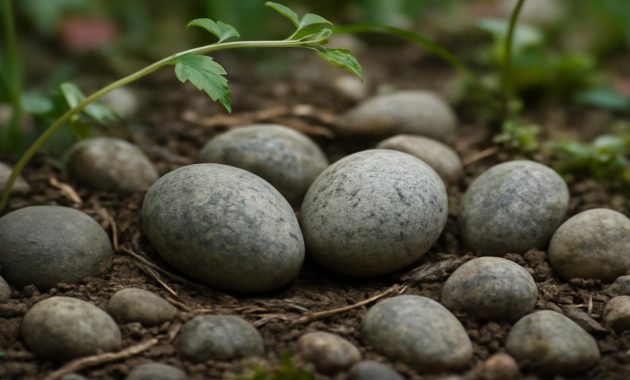
The first time you see them, you probably won’t even stop to wonder. They don’t flash or shine or scream for attention. They just sit there, half-buried in the loose soil by the lavender, like a handful of tiny, weathered pebbles. You bend down, squinting. They’re oddly round, mottled, a little chalky. Maybe some neighbor’s kid was playing with marbles? Maybe they’re just stones turned up by last night’s rain. And then a thought crosses your mind—eggs? No, they’re far too small, too rough, too… well, stony. Your fingers hover for a second, itching to pick one up, to see what it really is.
That tiny moment—your hand stretching toward what looks like a few insignificant pebbles—might be the most expensive impulse of your gardening life.
The “Pebbles” That Aren’t Pebbles At All
Let’s slow time down and bring the garden into focus. It’s early morning, the kind when the air still smells of damp soil and last night’s cool breeze lingers in the shrubs. Somewhere a blackbird is testing out a new melody. The grass glitters with dew. You’re out with your coffee, doing that silent inspection so many gardeners love: leaves, buds, suspicious nibbles on lettuce, the usual suspects.
Near a low, sunny patch of bare ground—just where your herbs give way to a small rock border—you spot them. Five or six little ovals, pale and speckled, blending seamlessly with the gravel. They look like they’ve been dropped by accident, forgotten. No nest, no obvious owner. Just pebbles that don’t quite match the rest.
But they do belong to someone. And not just to any someone, but to a species the law cares about very, very deeply.
Across many parts of Europe, those “pebbles” may in fact be the carefully hidden eggs of a protected reptile species—most often lizards or certain snakes that choose sunny, sandy or gravelly corners of gardens, allotments, and paths to lay their eggs. These animals are protected because their habitats are shrinking faster than they can adapt. Urban expansion, pesticides, tidier gardens, fewer wild corners—each subtle change squeezes them a little further out of the map.
So when a female reptile finally finds a spot that’s warm and safe enough to tuck her eggs into, she’s placing a kind of desperate bet on the future. Those eggs are not just potential hatchlings; they are statistically fragile miracles. Every clutch matters. Which is why the law steps in where our curiosity might overstep.
The Law Has Eyes on the Ground (Even in Your Backyard)
In much of the European Union, disturbing, collecting, moving, or harming the eggs of protected species is illegal—full stop. These rules don’t only apply in national parks, reserves, or wild forests. They follow the animals wherever they go, including the place you weed and water and proudly call your own.
That’s where the numbers come in, and they’re not small. Fines for intentionally disturbing or destroying the eggs of protected species can reach up to €150,000, depending on the country, the seriousness of the offense, and whether it’s considered deliberate. Even if you didn’t mean any harm, the law can still take a dim view of “I just wanted to see what they were.”
Environmental officers, wildlife agencies, and even local councils are increasingly alert to the presence of rare and protected species in private gardens. Sometimes they learn of it through citizen science projects, sometimes through reports from neighbors or local nature groups. And when someone is caught digging up, removing, or destroying eggs, the penalties are designed to sting hard enough that word spreads: these small, fragile lives are not to be treated as curiosities or disposable inconveniences.
It may feel extreme—€150,000 for a handful of eggs?—but from a conservation point of view, this is the price of finally taking biodiversity seriously. Laws with no teeth don’t protect much of anything. By setting high potential fines, authorities send a blunt, unmistakable message: wild animals are not ornaments in our gardens; they are legal beings with rights to live, breed, and continue their species.
What Those Eggs Are Really Doing in Your Garden
To understand why you should never touch those “pebbles,” you need to imagine the garden from the reptile’s point of view. A female lizard, for example, doesn’t see your flower beds as “decorative.” She reads them as a patchwork of microclimates, escape routes, hunting grounds, and nesting sites.
That sunny, slightly elevated ridge beside your path? To her, it’s a perfect incubator. The stones around it store daytime heat and release it slowly during the night, keeping the soil at a steady, warm temperature. The ground is loose enough for her to dig, but not so exposed that predators can easily sniff out her clutch. The nearby plants offer cover from birds of prey. It’s a carefully chosen compromise between safety and warmth, secrecy and survival.
Reptile eggs are nothing like the hard, porcelain-smooth chicken eggs we know from kitchens. They’re softer, more leathery, and often carry camouflaging speckles and patches of grey, beige, or off-white. Up close, they can look like worn river stones or the kind of chalky pebbles you kick along a dried creek bed. Nature has spent millions of years fine-tuning this disguise, and you’ve just stumbled into the middle of it with a gardening fork and a cup of coffee.
Inside each of those eggs, a silent story is unfolding. A soft, transparent embryo is slowly turning into a scaled, alert little being: spine curling into form, limbs budding out, pigments speckling skin and eyes, senses tuning in to the faint vibrations of the outside world. It’s a process that depends on stability: temperature, humidity, and the undisturbed darkness of the soil.
When you pick up, roll, or even slightly shift one of these eggs, you might not see any damage. The shell won’t crack like a chicken egg. But on the inside, the developing embryo can detach from the inner shell or be turned in a way that interferes with blood flow and organ development. What looks like harmless curiosity can be a quiet, fatal injury.
How to Recognize Eggs You Should Leave Alone
Of course, not every odd pebble in your garden is a reptile egg, and not every wildlife mystery is covered by strict protection laws. But there are a few simple rules that help you err on the side of respect—and legality.
Here are some common visual and contextual clues that those “stones” are actually eggs that must not be disturbed:
- Shape: Ovoid or slightly elongated, but not perfectly spherical like glass marbles.
- Texture: Matt, chalky, or faintly leathery when looked at closely, unlike the shiny surface of typical pebbles.
- Color: Off-white, grey, beige, or speckled—often subtly camouflaged to match soil and gravel.
- Location: Shallowly buried in warm, loose soil, under flat stones, near sunny borders, or in compost heaps.
- Grouping: Usually found in a small cluster or clutch, not scattered randomly.
If you discover something that fits this description, the safest and most responsible decision is simple: do nothing. Do not poke them. Do not pick them up. Do not relocate them to a “safer spot.” The animal that laid them chose that place for reasons you may not see, and the law backs her decision.
Still curious? Here’s a quick comparative overview to help you get a feel for what you might be looking at:
| What you see | Likely to be | Should you touch? |
|---|---|---|
| Small, matte, off‑white ovals in a cluster, half‑buried in warm soil | Possibly reptile eggs (lizard or snake, potentially protected) | No. Leave them undisturbed; contact local wildlife authorities if unsure. |
| Perfectly round, glossy, bright-colored balls | Glass marbles, beads, or decorative stones | Generally safe to move; check for context (children’s toys, decorations). |
| Single hard-shelled egg in a nest of leaves or twigs | Bird egg (many species are protected) | No. Do not handle or disturb the nest. |
| Soft, jelly-like clusters in water or very damp soil | Amphibian spawn (frogs, toads, newts) | Best left alone; some species are strictly protected. |
| Small, scattered, irregular shapes inside compost or under logs | Insect cocoons, pupae, or harmless soil invertebrates | Avoid unnecessary disturbance; they are valuable for the ecosystem. |
The Hidden Cost of “Just Cleaning Up the Garden”
Modern gardens are often victims of our love of neatness. We rake every leaf, edge every border, mow every blade of grass to a uniform height. The wildness that once threaded through every yard—piles of stones, rotting logs, scruffy corners—has been systematically removed, often with the best of intentions.
For small reptiles, amphibians, and countless invertebrates, those messy bits aren’t neglect; they’re infrastructure. They’re the difference between a hostile desert of trimmed lawn and a thriving micro-habitat full of hiding places and nesting sites. When we flatten and sanitize everything, wildlife quietly retreats, and what remains struggles to reproduce.
This is why the law can feel surprisingly strict about eggs. Each clutch may represent a significant proportion of the remaining local population. When a protected lizard species vanishes from a neighborhood, it’s rarely because someone bulldozed a forest—more often, it’s death by a thousand tiny “tidy-ups”: a stone wall repointed, a hedgerow removed, a sunlit patch paved over, a clutch of eggs “cleaned up” or thrown away before anyone realizes what they were.
The €150,000 fine is not aimed at the absent-minded gardener who accidentally nicked an egg with a spade while turning soil. It targets deliberate destruction—people who knowingly remove, collect, or crush eggs despite warnings and regulations. Still, the line between accident and negligence can blur, and ignorance of the law is rarely a free pass.
There’s a deeper question here: what kind of space is a garden meant to be? A perfectly curated stage, or a shared piece of earth where other lives are allowed to quietly play out? The presence of reptile eggs in your flower bed isn’t a problem; it’s a compliment. It means your patch of land is still alive enough, wild enough, to be chosen as a nursery.
What to Do If You Find Eggs in Your Garden
So, you’ve spotted something suspicious—stone-like eggs in the soil, tucked under a slab, or revealed while moving a pile of gravel. What now?
- Stop immediately. Put down the spade, the fork, the trowel. Don’t move or handle the eggs any further.
- Gently cover them back. If you’ve already exposed them, lightly push soil or the original material back over them, as close as possible to how it was. Avoid pressing or compacting.
- Mark the spot. Use a discreet stick, small stake, or stone nearby so you remember where they are, without drawing obvious attention.
- Keep the area calm. Avoid walking over it, letting pets dig there, or carrying out heavy gardening work too close.
- Contact local wildlife authorities. Call or email your regional conservation office or environment agency, describe what you’ve found, and ask for guidance. They can often identify species from a description or photo and advise whether the eggs belong to a strictly protected species.
- Follow official advice. In many cases, the best option is simply to wait and let nature take its course. If there is a genuine risk—like scheduled construction or major landscaping—authorities may decide on a controlled intervention conducted by trained professionals.
By taking these steps, you’re not just avoiding a legal problem. You’re taking an active role in conservation—right there, in your own backyard.
Sharing Your Garden with the Wild Neighbors
There’s a quiet shift happening in how people think about their outdoor spaces. Instead of seeing wildlife as an intrusion, more and more gardeners are starting to think of themselves as hosts. The goal is changing from “How do I keep nature under control?” to “How can I make room for more life here?”
Letting a protected species lay eggs in your garden is a radical kind of hospitality. It doesn’t require grand gestures—no need to rewild the entire lawn overnight. It starts with small acts of tolerance:
- Leaving a sunny, undisturbed corner of bare soil or gravel.
- Keeping a modest pile of rocks or old bricks where lizards can bask and hide.
- Reducing pesticide use so their insect prey remains abundant.
- Letting some parts of the garden stay just a bit messy and wild.
In return, your scaly guests do their part in the ecosystem: they eat slugs, snails, and insects; they feed owls, hedgehogs, and other predators higher up the chain; they keep the web of life woven together. Their presence is a sign that your garden isn’t just decorative—it’s functioning.
And there’s something deeply grounding about stepping into a space where you know that just beneath your feet, in a carefully chosen pocket of soil, a handful of eggs is quietly transforming. Life is germinating there, not because of anything under human control, but because for once, we stepped back and didn’t interfere.
A Fine You’ll Never Pay—If You Learn to Pause
So, back to that early morning scene. Your hand hovers over the strange little ovals in the earth, curiosity tugging hard. This is the precise moment when stories split.
In one version, you pick one up, roll it between your fingers, maybe crack it open by accident. Later, a neighbor mentions that protected reptiles are known in the area. You search the internet, feel the slow twist of doubt in your stomach, and end up making a nervous phone call you can’t unmake.
In the better version, you pause. You notice the way the eggs are clustered, the way the soil around them feels warm, the way they’re tucked just-so into their little hollow. Something in you recognizes that you’ve walked into the middle of someone else’s plan. You quietly cover them back, mark the spot with a small stone, and spend the rest of your coffee watching the sun slide a little higher, knowing that there’s a secret under your feet now, and it isn’t yours.
You don’t touch them. You don’t move them. You don’t pay a fine. Instead, you pay attention.
And that small, invisible choice ripples outward—through the clutch that hatches quietly one day when you’re not looking, through the lizards that slip into your rockery, through the ecosystem they help stitch together, and through a culture that is slowly, finally learning that not everything we find is ours to handle.
FAQ
Are all reptile eggs in my garden protected by law?
Not every reptile species is strictly protected, but many are, and it can be very hard for a non-expert to tell them apart. Because of this, the safest approach—legally and ethically—is to treat any suspected reptile eggs as protected and avoid disturbing them. If in doubt, contact your local wildlife authority for advice.
What if I accidentally dug into a clutch of eggs without realizing?
Accidents happen, especially during routine gardening. Stop immediately, gently replace any disturbed soil without pressing the eggs, and try not to handle them further. Then, contact your regional conservation or environmental agency, explain what happened, and ask what to do next. Being honest and proactive is far better than ignoring the situation.
Can I move the eggs to a “safer” place in my garden?
No. Moving protected eggs without authorization is usually illegal and can kill the embryos inside by disrupting their orientation, temperature, or humidity. Even if your intention is good, relocation is a decision that should only be made—and carried out—by trained professionals under official permission.
How long do reptile eggs take to hatch?
Incubation time varies by species and temperature, but many reptile eggs take anywhere from 6 to 12 weeks to hatch. Warmer, stable conditions generally speed up development. During this period, it’s important to keep the nesting area as undisturbed as possible.
Who should I contact if I find what I think are protected eggs?
Reach out to your local or regional wildlife authority, environment department, or conservation agency. Many areas also have herpetological societies or nature groups that can provide preliminary identification. Share clear photos and a description of the location, but do not move the eggs while you wait for guidance.
Could I really be fined up to €150,000 for disturbing eggs?
In some European countries, maximum fines for intentionally destroying or disturbing the eggs of protected species can reach around €150,000. The exact amount depends on the laws of your country, the species involved, and whether the act is considered intentional or negligent. The key is simple: don’t touch, don’t move, and seek official advice if you’re unsure.
How can I make my garden more friendly for protected species?
Leave some sunny, undisturbed patches of bare soil or gravel, keep a few rock or log piles, reduce chemical use, plant native species, and accept a bit of wildness in corners of the garden. These small changes create shelter, hunting grounds, and potential nesting sites for reptiles and other wildlife, turning your garden into a genuine refuge instead of just a backdrop.