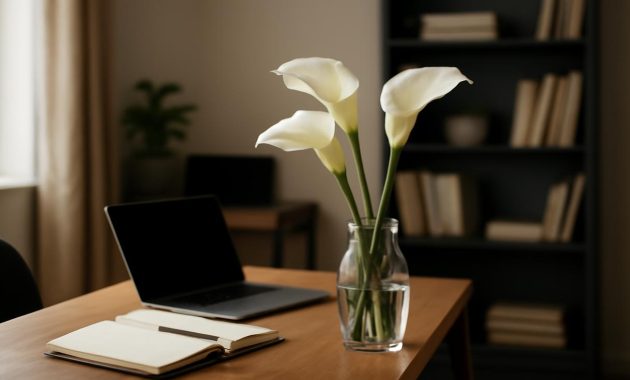
The first time I brought a pot of calla lilies home, I put them right in the kitchen window. It felt practical and poetic at once: soft white trumpets caught in a stream of light, looking clean and elegant beside the sink. Two days later, my aunt came to visit, set down her bag, and froze in the doorway.
“Ay, no,” she murmured, her eyes moving from the stove to the lilies. “Not here. Calla lilies are too refined for grease and garlic.” She laughed as she said it, but there was something else in her voice—an old echo of rules and rituals that had traveled far, carried quietly, from southern China to our cramped city apartment.
That night, after we’d eaten and the dishes were drying in a precarious tower by the sink, she took my calla lilies in both hands and walked them through the apartment as if looking for the right line in a poem. Hallway—no. Bathroom—absolutely not. Bedroom—she shook her head. And then she stopped in the living room, where the afternoon light usually slowed to a warm, golden drift.
“Here,” she said. “They’ll breathe better. And you will, too.”
Calla lilies and a quiet kind of power
In Chinese culture, flowers are rarely “just decoration.” They carry stories, wishes, warnings. And calla lilies—those long, sculpted stems topped with a single curled bloom—carry a particular kind of quiet power.
Their Chinese name, jian xin yu (剑心玉) or sometimes ma die hua, varies by region, but the feeling they convey is almost universal: elegance, purity, and a certain poised strength. They look like something a careful hand folded from porcelain, then breathed life into. The gently spiraled petal cradles a golden spadix like a candle that never quite burns down.
In traditional symbolism, calla lilies evoke:
- Purity and clarity – not innocence in the naïve sense, but a clear, composed kind of presence.
- Respect and dignity – the straight stem and minimal form give them a formal, almost ceremonial air.
- Longevity of beauty – their blooms last unusually long, suggesting lasting grace.
You’ll find them in wedding arrangements, elegant banquets, and sometimes at funerals, too—a flower that can bridge joy and sorrow without losing its composure. That dual role makes them special, and also a little delicate, symbolically speaking. In many Chinese homes, where feng shui principles quietly guide furniture, doors, mirrors, and yes, even plants, calla lilies are treated with a particular kind of care.
So when someone from an older generation says, “Don’t put them in the kitchen or the bathroom,” it isn’t superstition for superstition’s sake. It’s a way of protecting that quiet power—and the atmosphere of the home itself.
Why the kitchen and bathroom feel “wrong” for calla lilies
Walk through a home and pay attention—not to the furniture or the color of the walls, but to how each room feels against your skin. The warmth, the smells, the sounds. In a Chinese household, that felt sense has names: qi (energy), yin, yang, the balance between movement and rest, growth and retreat. Plants are part of that balance, and some plants “belong” to certain spaces more than others.
The kitchen: too sharp, too busy
The kitchen, in feng shui and tradition, is the heart of fire and sustenance. Oil popping in a hot pan, steam from a pot, knives flashing, metal, flame, salt, and strong smells. It’s a space of transformation—raw to cooked, cold to hot, hunger to satiety.
From a symbolic perspective, this presents a problem for calla lilies:
- They embody calm refinement, while the kitchen is all bustle and heat.
- They prefer stable, gentle light, but kitchen light is often intense, directional, and interrupted.
- Grease and smoke cling to their smooth petals and leaves, dulling the very clarity they’re meant to represent.
In Chinese tradition, placing such a dignified, almost ceremonial flower in a space of splatter and sharp metal can feel like asking a guest in silk to stand in the doorway of a busy workshop. They’re out of place, and their symbolism is disturbed. A fire-heavy room like the kitchen pairs better with sturdy, “earthier” plants or herbs: green onions in a jar, a pot of mint, chives in a small planter—plants that match the kitchen’s working rhythm.
The bathroom: the wrong kind of water
Bathrooms are a different story. If the kitchen is fire and metal, bathrooms are the densest concentration of water energy in the home—and not the pure, flowing kind we usually celebrate in feng shui. Here, water is mostly about waste and cleansing. Drains, flushes, moisture that collects on mirrors and seeps into grout. The symbolism leans strongly toward letting go, washing away, and sometimes, unfortunately, loss.
Now imagine setting calla lilies—a symbol of refined purity and lasting grace—right in the middle of that nervous, draining atmosphere. The clash is subtle but sharp:
- Purity versus disposal: the noble bloom sits inches from sinks and toilets whose purpose is to carry things out of the home.
- Moisture overload: calla lilies like humidity, but a constantly damp bathroom can invite rot, mold, and leaf damage.
- Energetic “leakage”: feng shui-minded elders sometimes say that putting auspicious plants in a bathroom “flushes away” good luck.
In some modern interiors, a single monstera leaf in a tall vase or a hardy snake plant might be used in a bathroom for sculptural effect. But calla lilies, with their funereal associations and elevated symbolism, are more sensitive. In Chinese tradition they’re not meant for utilitarian, high-drain spaces. They’re meant to stand where life gathers, and where beauty lingers without being hurried out the door.
The living room: where calla lilies actually belong
Let’s go back to my aunt, standing in my living room with the pot of lilies poised against her hip. The room was quiet except for traffic far below the window and a neighbor’s TV leaking through the wall. Light pooled on the floorboards in a soft rectangle, the kind of light that makes you speak more quietly without knowing why.
“Here,” she repeated, setting the pot on the low cabinet near the window. “Living room is good. Calla lilies like to watch people.”
It sounded like a joke. But the more I looked, the more it felt true.
In traditional Chinese thinking, the living room (or main sitting room) is the ming tang—the bright hall. It’s where energy collects as people come and go, sit, talk, share tea, argue, reconcile, celebrate. It is, in many ways, the visible face of the home’s spirit. This makes it the perfect stage for a flower that stands for dignity, hospitality, and steady grace.
Calla lilies in the living room bring:
- A sense of ceremony: even on ordinary days, they make the room feel slightly more intentional, as if something meaningful could happen at any moment.
- A gentle vertical line: their tall stems draw the eye upward, softening low furniture and anchoring scattered décor.
- A shared blessing: instead of hiding in a bedroom where only one person sees them, they offer their elegance to everyone who enters.
From a feng shui perspective, this works beautifully. The living room is a social, “yang” space, full of movement and conversation. Calla lilies bring a cool, composed “yin” counterbalance—softening without draining, calming without deadening. They stand near, but not too close to, the main entry: close enough to greet, far enough not to be buffeted by every gust of outdoor air.
Where exactly to place them in the living room
You don’t need a big house or a sweeping bay window. What calla lilies want is something simple and surprisingly specific:
- Bright, indirect light – near a window but not pressed against the glass where midday sun can scorch their leaves.
- A stable spot – not on a table that’s constantly bumped, not directly under an air conditioner or heater vent.
- Clean, uncluttered surroundings – calla lilies look best with room to breathe; crowd them between stacks of papers and remote controls and they lose their quiet magic.
In feng shui, certain corners of the living room have special meaning. If you stand at the main entrance facing into the room, the far left corner is often called the “wealth corner,” and the far right, the “relationship corner.” A pot of white or pale calla lilies in either can be read as a wish for graceful abundance or elegant, lasting connections.
But even if you never think in corners, just placing them where you naturally pause—beside the sofa where you read, near the low table where you drink tea—honors both the plant and the tradition. Calla lilies do their best work where people slow down enough to notice them.
Bedroom or study? Choosing the second-best spots
Not every home has a generous living room. Some apartments blur the line between work, sleep, eating, and rest in a single compact space. In those homes, calla lilies can still bring their composure and beauty—if you choose carefully.
Calla lilies in the bedroom
The bedroom is a deeply Yin space: private, soft, slow. It’s where the body drops its daytime armor. Chinese tradition often favors softer, rounded-leaf plants in bedrooms—peace lilies, jade plants, small orchids—because they echo rest and intimacy. Calla lilies can fit here, but with nuance.
Symbolically, they bring:
- Clarity in relationships – their clean lines suggest honesty and respect between partners.
- Refinement in rest – a hint that sleep itself is something to be honored, not just collapsed into.
But they can also feel a bit too formal, especially in single-person bedrooms that double as offices. Too many strong, upright stems pointed at the bed can be interpreted by feng shui practitioners as “excessive yang,” potentially agitating rest.
If you do place calla lilies in a bedroom:
- Keep them on a side table or dresser, not directly facing the bed from the footboard.
- Aim for one modest pot, not a whole row, to keep the energy gentle rather than ceremonial.
- Make sure the room gets enough light; a dark bedroom will leave them struggling and drooping.
Calla lilies in a study or home office
In a study, their presence makes almost immediate sense. Chinese tradition loves linking plants with scholarship and the arts: bamboo for resilience, plum blossom for perseverance, orchids for refined character. Calla lilies, with their poised curves and clarity of form, sit comfortably in that lineage.
In a workspace they can symbolize:
- Focused thinking – the single, clear bloom wrapping around its center evokes a mind that has gathered itself.
- Elegant expression – good for writers, musicians, designers, anyone who shapes ideas into form.
Place them where your eye lifts between tasks—beside the monitor, near a bookshelf, close to a window you glance through when your thoughts need stretching. Just keep them out of the way of paper piles and devices that blast hot air. Energetically, they’ll temper the hard lines of screens and shelves with a living curve, reminding you to breathe.
Reading the plant: a small guide to care and meaning
Even the most beautiful symbolism withers if the plant itself is unhappy. One of the quiet pleasures of keeping calla lilies is learning to read their bodies—each leaf and stem a small message about how the home is treating them.
| Plant Sign | What It Usually Means | What to Adjust |
| Leaves pale or yellowing | Too little light or poor drainage | Move closer to bright window; check soil isn’t soggy |
| Leaf tips turning brown | Air too dry or fertilizer too strong | Mist lightly, use gentler plant food, avoid heater vents |
| No blooms, just leaves | Not enough light, or plant is resting | Increase indirect light; allow a rest period with less water |
| Stems flopping or bending | Low light or inconsistent watering | Rotate pot weekly; water when top soil begins to dry |
In the language of tradition, a thriving calla lily says the room’s energy is supportive: not too harsh, not too neglected. A struggling one asks for adjustments not just in care, but sometimes in placement. If your lilies sulk by the TV but perk up when moved closer to the window, you’ve just learned something subtle about both plant and home.
In many Chinese households, even small changes—rotating the pot so a new side faces the light, shifting it half a meter away from a draft—are done with a brief, almost wordless intention: Here, you’ll feel better. And so will we.
Bringing an old tradition into a modern home
It can be tempting to treat cultural planting rules as rigid instructions: never do this, always do that. But underlying those rules is something much more flexible and alive: attention. Attention to how a plant looks in a certain light, how a room feels with or without it, where your own shoulders finally lower as you move through your home.
The Chinese tradition that nudges calla lilies out of the kitchen and bathroom and into the living room isn’t about policing décor. It’s about aligning the plant with what it naturally suggests—grace, respect, a hint of ceremony—and placing that suggestion where it can breathe.
In a tiny studio, that “living room” might be a corner near a window with a single armchair and a lamp. In a shared apartment, it might be the clearest, calmest patch of common space you can claim. Even in a chaotic home with kids, pets, and shoes in the hallway, a pot of calla lilies on a sturdy sideboard can carve out a small island of composure—an invitation to move just a little more slowly when you pass.
When I think back to my aunt’s visit, I remember less the exact spot she chose than the way she moved through the rooms: listening not with her ears, but with her eyes and the back of her hand against the air. She was doing, in her way, what feng shui has always tried to teach—matching living things to living spaces so neither has to fight to be itself.
And now, whenever I see calla lilies in someone’s home, I notice where they’ve been placed. On a dining table flooded with gentle light. On a sideboard watching over evening conversations. In a quiet corner by a window where dust motes drift like slow, private fireworks. Always, when they look most at home, they’re far from the clatter of pots and the echo of tile and drains.
Not in the kitchen. Not in the bathroom. Instead, right where the house takes a breath—and invites you to do the same.
FAQ
Can I ever put calla lilies in the kitchen, even just temporarily?
For a short time—say, during a dinner party as a centerpiece away from the stove—it’s fine. Tradition mainly advises against keeping them there permanently, where heat, grease, and noise can dull both their health and their symbolic elegance.
Are calla lilies considered lucky in Chinese culture?
Yes, they’re generally seen as auspicious, associated with refined beauty, respect, and sometimes harmonious relationships. Their long-lasting blooms are considered a good omen for enduring grace and stability.
Is it bad feng shui to keep calla lilies in the bathroom if that’s my only bright spot?
It’s not “bad” in a catastrophic sense, but tradition suggests choosing a hardier, less symbolically elevated plant for bathrooms. If the bathroom truly has the best light, consider a different species there and keep calla lilies in any reasonably bright, drier part of your main living space.
What color calla lilies are most appropriate for the living room?
White is classic and most aligned with purity and clarity. Soft pastels—cream, blush, pale yellow—also work beautifully. Deep purples or dark reds carry heavier, more dramatic symbolism and are often chosen more carefully, sometimes for specific occasions.
Can I keep calla lilies in a pot, or do they have to be cut flowers?
Both are acceptable, but potted calla lilies are especially valued in Chinese homes because they symbolize ongoing, living elegance rather than beauty that fades quickly. A healthy potted plant that blooms year after year is considered particularly auspicious.