The morning I first heard that somewhere in southern France there was a magnet strong enough to hoist an aircraft carrier out of the sea, I pictured a kind of science-fiction lasso, a glimmering ring tugging steel behemoths into the sky. It sounded absurd, like pub talk or the opening scene of a blockbuster movie. But the magnet is real, its power measurable and terrifying, and it is not designed to lift ships or warp compasses. It exists for something quieter, more ambitious, and infinitely more hopeful: to help humanity bottle the power of the stars and secure the future of our energy supply.
Stepping Inside the Realm of Extreme Magnetism
You arrive long before you see it. First, there is the sense of entering a new kind of landscape—one where vineyards thin out into research campuses, where road signs share space with acronyms, and where security gates look oddly out of place against the blue Mediterranean sky. Then a vast hall comes into view, a cathedral of metal and concrete, humming softly with air systems, lined with cranes, cables, and consoles.
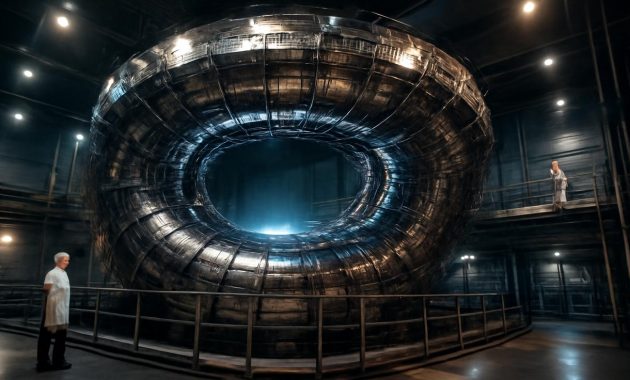
At the center of this hall sits the giant: a coil of metal and insulation the height of a building, fat and dense as if gravity itself is pooling inside it. This is not a magnet as you know it from fridge doors or school experiments. This is a superconducting magnet, a machine that bends the very fabric of space around it with invisible lines of force.
The numbers feel unreal. At full power, its magnetic field is hundreds of thousands of times stronger than Earth’s. Engineers like to translate that into something your mind can grab: if you could somehow strap this magnet beneath an aircraft carrier, it could lift the steel leviathan clear out of the water. Not in some tidy, cinematic arc, of course—real physics is messier than that—but in raw force, the comparison stands.
Yet here in this quiet hall, nobody is planning to move battleships. People walk around with tablets and notepads, wearing hard hats, not capes. The power of this magnet is being tamed for a more subtle purpose: it is meant to hold, confine, and sculpt a living star made of hydrogen, shrunk down to fit in a metal vessel on Earth.
The Star in a Bottle
To understand why France is home to this magnetic giant, you have to imagine something that is, by design, invisible. Deep inside the planned fusion reactors of tomorrow, there will be no flickering flame, no spinning turbine face you can see. There will be plasma—a strange, luminous, superheated gas where atoms are pulled apart into a roiling soup of charged particles. This is the state of matter you find at the heart of stars.
Fusion, in simple terms, is what happens when light atoms—like hydrogen—are forced so close together that they fuse into heavier atoms, releasing colossal amounts of energy. It’s what powers the sun and every star you have ever seen. On Earth, if we can master it, fusion could provide steady energy without the long-lived radioactive waste of fission, without vast open-pit mines, without belching carbon dioxide into the sky.
There is, however, a catch: to make hydrogen atoms fuse, you have to heat them to temperatures hotter than the core of the sun—hundreds of millions of degrees Celsius. No solid material can withstand that. You can’t put that kind of fire in a box and hope the box survives.
So, instead of a box, you use a magnetic field. Charged particles are steered by magnetic forces, and if you sculpt the field just right—if you wrap it around and around into a kind of invisible doughnut—you can cage the plasma in mid-air, never letting it touch the walls. To do this, you need magnets so strong they push the limits of human engineering.
France’s super-magnet exists precisely for this task: to create and test the monstrous magnetic fields that will one day confine star-hot plasma inside fusion reactors. Its strength is not a stunt; it is a rehearsal for the magnets that will stand guard around our future power plants.
The Quiet Drama of Superconductors
There is a strange paradox at the heart of this immense machine: it is both ultra-powerful and eerily quiet. The key is superconductivity. Inside the coils, rivers of electrical current flow through special materials cooled to unimaginably low temperatures—colder than deep space. When they reach those temperatures, these materials become superconductors, losing all electrical resistance. Current flows without friction, like a river without rocks, generating titanic magnetic fields without melting the metal or wasting energy as heat.
To get there, the magnet is bathed in liquid helium and other cryogenic fluids, locked inside nested shells of insulation, shining like metal Russian dolls. Technicians hover nearby, monitoring pressure, temperature, and vibrations. Any tiny deviation can lead to a “quench”—a sudden loss of superconductivity that would send the stored energy roaring out as heat. In the worst case, that could damage the coil or even rip parts of it apart.
This is why so much of the drama here is hidden in numbers and graphs, not in visible spectacle. When the magnet is powered up, you don’t see swirling arcs or hear thunder. You watch lines on screens, creeping, bending, stabilizing. You feel the tension in the room as engineers hold their breath. The real theater is happening in the invisible magnetic cage that blossoms around the coil, extending far beyond what your eyes can sense.
Even basic objects become suspect in such a field. Smartphones, keys, and tools must be carefully managed; a loose wrench can turn into a steel missile if it strays too close while the magnet is energized. This invisible strength, this capacity to seize and fling metal, is the same power that, at full scale, could tug an aircraft carrier. But here it is held back, trained like a working animal, harnessed to the patient goals of measurement and calibration.
From Laboratory Marvel to Power Plant Workhorse
It’s tempting to see this magnet as an exotic, one-off wonder—something built to break records and impress committees. But the people who spend their days around it talk in a different language: reliability, scalability, reproducibility. For them, this is not a museum piece; it is a prototype for the mundane miracle of future infrastructure.
If fusion is ever going to power cities, magnets like this must eventually become less extraordinary. They need to move from experimental halls into the quiet, anonymous spaces that now host transformers and turbines. That’s a huge leap. Today, every percentage point of performance is fought for, every quench is dissected like the black box of a failed flight. But with each test, the knowledge base grows. Materials are improved, insulation techniques refined, power supplies tamed.
In that sense, the French magnet is a bridge between eras. On one side: a world where our energy comes mostly from tearing things apart—splitting uranium atoms, burning coal and oil, breaking chemical bonds formed over millions of years. On the other side: a world where energy flows from bringing things together—fusing light atoms to release clean, dense power.
The people tending this magnet are architects of that bridge. They are working so that, one day, our children might glance at a fusion power plant on the horizon the way we glance at a wind farm or a nuclear station now: with mild curiosity, perhaps, but mostly with the benign boredom that comes from something being reliable, just there, endlessly doing its job.
How Strong Is “World’s Most Powerful”?
Numbers have a way of numbing us, especially when they turn into superlatives. “World’s most powerful” can sound like marketing more than science. But here, the phrase has teeth. To anchor the idea, it helps to compare.
| Magnetic Field Source | Approx. Field Strength | What It Can Do |
|---|---|---|
| Earth’s magnetic field | ~0.00005 Tesla | Guides compasses, shapes auroras. |
| Fridge magnet | ~0.01 Tesla | Pins paper notes to metal surfaces. |
| Hospital MRI scanner | 1.5–3 Tesla | Images soft tissues deep inside the body. |
| Advanced research magnet | 20–45 Tesla | Probes quantum materials, extreme physics. |
| World’s most powerful fusion magnet in France | Tens of Tesla, with immense stored energy | Could, in principle, lift an aircraft carrier’s mass; designed to confine fusion plasmas. |
The difference is not just in the field strength, but in how much energy is stored in that field. Think of it like tightening a spring. A tiny spring in a pen stores almost no energy; a garage door torsion spring stores enough to injure you badly if it snaps. Now imagine a spring big enough to run under a shipyard, wound to the breaking point. That’s the scale of energy hidden in the magnet’s invisible embrace.
Engineers must treat that stored energy with the same respect given to rockets stacked with fuel. That’s why every ramp-up is gradual, why countless simulations are run before each test, why the magnet’s behavior must be mapped with exquisite care. The goal is not just strength, but control.
Why France, and Why Now?
There is something fitting about this happening in France, a country already deeply woven into the story of nuclear energy. Decades ago, it made a national bet on fission reactors and now enjoys one of the lowest per-capita carbon footprints in the industrialized world from electricity generation. The presence of the world’s most powerful magnet here is a sign that the next gamble—on fusion—is not a distant fantasy, but a live project with steel and concrete and coolant pipes in place.
Yet the magnet is also emblematic of something broader: an era in which energy research is increasingly global. The design expertise might come from one place, the superconducting cables from another, the cryogenic systems from yet another continent. Teams speak in accents from around the world. The “France” in this story is as much a host and collaborator as it is a proprietor.
Why now? Because the clock on climate change is ticking audibly. Because billions of people still aspire to higher living standards that will require more electricity, not less. Because wind and solar, while essential, have limitations of intermittency and storage. And because the physics of fusion, once a wild dream, has matured into something more like an engineering problem—a brutal, complicated one, but no longer a fantasy.
The magnet is a physical answer to a metaphysical question: are we willing to commit to the equipment and infrastructure that might not pay off for decades—but, if it does, could change the human story? Standing beside it, dwarfed by its bulk, you get a clue as to our current answer. Humanity, at least in this hall, is betting big.
From Cosmic Phenomena to Everyday Light Switches
It’s easy to feel that fusion belongs in an entirely different category from your daily life. Cosmic, remote, too grand to matter when you flip a light switch or charge a phone. But this magnet is one of the places where those worlds meet.
If future fusion plants come online, their outputs won’t look exotic. They will feed electrons into the same grids, powering the same homes, factories, bakeries, and server farms. The warmth in your living room, the glow of your reading lamp, the battery in your electric car—none of these will feel “futuristic.” They will feel normal, quietly supported by distant reactors where magnets like this one hold small artificial suns in their invisible grip.
Meanwhile, every test run of the French magnet adds another thread to that possible future. A better understanding of how superconductors behave. A tweak in how coils are braced to handle magnetic forces that try to tear them apart. A new method for cooling, for sensing, for shutting down safely. And with each step, fusion moves from the realm of “if” closer to the realm of “when and how.”
The magnet doesn’t guarantee success. No single machine can. But it is a declaration that we are no longer content to only watch stars from a distance; we are determined to learn, with humbled seriousness, how to borrow their fire without burning our own planet.
The Human Imprint on an Invisible Force
By the time you leave the hall, the magnet seems to have grown larger, not physically but in your mind. You think of all the hands and eyes that have shaped it—the machinists who milled its components to tolerances thinner than a sheet of paper, the physicists who scribbled equations late into the night, the technicians who will one day crawl through it, checking bolts and seals under maintenance lights.
For all its power, the magnet is ultimately a human artifact, layered with our intentions and anxieties. It holds our fear of scarcity, our dread of climate disruption. It holds our hope that the age of digging and burning might one day give way to an age of fusing and flourishing.
Outside, the light over southern France is sharp and generous. The world beyond the fence hums with cars, planes, and power lines still fed mostly by fossils or aging reactors. But inside that hall, wrapped in cryogenic piping and steel, the world’s most powerful magnet waits to help us do something we have never done before at scale: make our own small stars and keep them caged long enough to turn their light into a future.
Frequently Asked Questions
Is this magnet really strong enough to lift an aircraft carrier?
In terms of raw magnetic force and stored energy, yes, its field is powerful enough that, if applied in the right way, it could lift an object with the mass of an aircraft carrier. In practice, it is not used this way—its design and shape are optimized to confine plasma for fusion research, not to physically hoist ships.
Why do fusion experiments need such powerful magnets?
Fusion plasmas must be heated to hundreds of millions of degrees, which no solid material can touch. Powerful magnetic fields act as an invisible cage, keeping the charged particles suspended away from the reactor walls. The stronger and more precisely shaped the field, the better the plasma can be confined and controlled, which is essential for sustained fusion reactions.
Are these magnets dangerous?
They can be, if not managed carefully. The stored energy in the magnetic field is enormous, and any sudden loss of superconductivity can cause intense heating and mechanical stress. That’s why these systems are surrounded by strict safety procedures, extensive monitoring, and carefully designed shutdown mechanisms.
Will fusion powered by magnets like this really solve the energy crisis?
Fusion is not a magic bullet, but it could become a major part of a long-term, low-carbon energy mix. If successfully commercialized, fusion reactors could provide steady power with abundant fuel and limited long-lived waste. However, significant engineering challenges remain before fusion can contribute at scale to global energy needs.
When might fusion power plants become common?
Timelines are uncertain, but many experts talk about demonstration plants in the coming decades rather than centuries. Progress depends on the success of current experiments, including those testing magnets like the one in France. Even after technical hurdles are cleared, building and deploying full-scale plants worldwide will take time and investment.