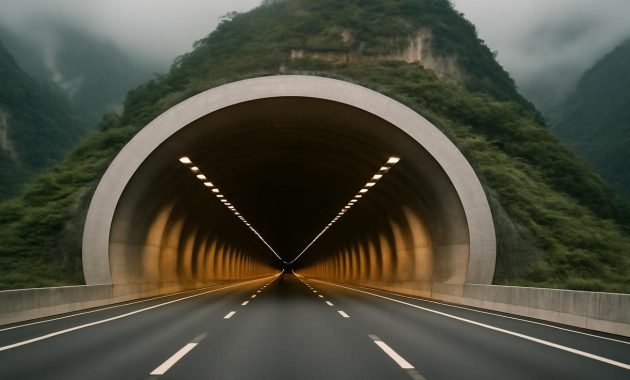
The air in the mountains tastes like metal and pine. It is early morning in Yunnan, and the mist hangs low over the ravines, coiling through cedar branches and the thin steel lines of power pylons. A few decades ago, this place might have felt like the edge of the world—a landscape ruled by gravity and weather and slow, winding roads. Today, it hums faintly with generators and distant machinery. Somewhere beneath the mountain under your feet, an idea has been carved into rock: a 22-kilometer tunnel that slices straight through one of China’s most rugged regions. It is an engineering miracle, people say. It is also, quietly, a monument—a reminder of what a state can do when it decides that geography is no longer allowed to say “no.”
Carving a Straight Line Through Mountains
The tunnel begins almost modestly. From the outside, it looks like a wide arch cut into stone, lined with concrete, flanked by road signs and cameras. Trucks rumble in, headlights glowing, swallowed by the mountain. The real drama lies beneath the surface—literally—where decades of engineering knowledge, political will, and raw human labor have been compressed into a dimly lit tube of ordered chaos.
Building a 22-kilometer tunnel through fractured rock is less like drilling a hole and more like negotiating with the earth. Engineers faced a geology that seemed almost designed to resist them: unstable fault lines, water-bearing strata, and rock that behaved one day like solid granite and the next like wet sand. Tunnel boring machines—those massive, rotating steel teeth that look like something out of a science fiction film—chewed, scraped, and pulverized their way forward. Each meter gained was a victory held together by bolts, rebar, shotcrete, and relentless calculation.
Imagine the sound down there: the grinding roar of metal on stone, the clank of rebar cages, the echo of shouted instructions in Mandarin, Yunnan dialects, and the wordless language of hand signals. Dust hangs in the air. The walls glisten with seepage. Sensors blink like tiny stars along the unfinished lining, tracking pressure, vibration, gas levels, temperature. Every so often, the work stops, and the mountain speaks—sometimes through a hairline crack, sometimes through a shudder that rattles tools off hooks.
For the workers who spent years underground, the tunnel is not an abstract achievement. It is measured in missed birthdays, in the ghostly pallor of faces that rarely saw sunlight, in the ritual of stepping into and out of the earth each day. For the planners, it is a line on a map finally made real: shaving hours off a journey, unlocking trade routes, tying remote regions tighter into the bloodstream of the national economy.
The Numbers Behind the Miracle
Big infrastructure projects in China often arrive wrapped in superlatives, and this tunnel is no exception. It is long, deep, expensive, and spectacular, part of a network designed to turn the country’s twisting topography into something more predictable and manageable. The raw figures tell one story; the context, another.
| Key Feature | Details |
|---|---|
| Tunnel Length | 22 km (approximately 13.7 miles) |
| Maximum Overburden (Depth of Rock Above) | Over 1,000 meters in sections |
| Construction Duration | Roughly a decade from planning to completion |
| Primary Purpose | High-speed transit corridor linking interior regions to coastal markets |
| Key Technologies Used | Tunnel boring machines, real-time rock monitoring, advanced ventilation and safety systems |
On paper, it is a case study in optimization. There is the fuel saved from detours around mountain ranges, the reduced travel times, the lowered logistics costs, the elegant geometry of an almost-straight line through a once-impassable barrier. Computer models translate rock strata into color-coded diagrams. Financial reports convert years of human labor into capital expenditure and expected returns.
But try to stand near the tunnel portal at dusk and not feel something more visceral. When a freight train or convoy of trucks emerges from the deep glow of the interior, it carries with it an invisible cargo of human intention. This is what it looks like when a country decides that distance and difficulty are themselves enemies to be defeated.
Rewriting the Map of the Interior
The tunnel does not exist in isolation; it is a single, gleaming link in a vast and fast-growing chain. Think of China’s interior not as a static mass of hills and valleys, but as a living network—mountains braided with cables, rivers crossed by viaducts, plains stitched together by rail lines and expressways. Where an older map might show winding roads and provincial boundaries, the new one shows vectors, hubs, corridors.
For the villages scattered along the old mountain roads, this new geography lands with both promise and uncertainty. A journey that once demanded a full day along switchbacks and landslide-prone curves now shrinks to an hour. Fresh food can move faster. People can commute further. Families can scatter more widely, and also stay, tethered by better connectivity. This is development in the most literal sense: unfolding, opening up, flattening the constraints of terrain.
Yet beneath the vocabulary of “connectivity” and “efficiency” lies a quieter realization. Infrastructure does not simply respond to needs; it shapes them. Once the tunnel exists, it invites traffic, investment, and attention. It draws in capital, logistics firms, factories, and all the scaffolding of a more industrialized, more centralized modern life. Over time, the presence of a tunnel this significant can tilt the gravity of an entire region, pulling the future in a particular direction.
Power in Concrete and Steel
Stand on a high ridge above the tunnel and look out, and you can see more than just the physics of rock and road. Looming behind the roar of engines and the glow of LED safety lights is a more intangible force: the will of the state. You can feel it in the scale of the undertaking, in the sheer audacity of slicing through 22 kilometers of complex geology, in the speed with which such projects now appear on the landscape.
In many countries, an idea of this magnitude would crawl through layers of public debate and political compromise. Environmental impact reports would be pored over for years. Lawsuits might stall construction. Funding would rise and fall with elections and budget negotiations. The mountain would wait, holding its silence.
In China, the process flows differently. Once a project has been folded into a national strategy—whether labeled as regional integration, poverty alleviation, or a step in some wider economic corridor—the question is no longer “if,” but “how fast.” Provincial governments compete to host and complete ambitious works. State-owned enterprises bring experience from thousands of kilometers of rail and road already carved into the terrain. The tunnel becomes a physical expression of centralized priority: visible, unambiguous, undeniable.
It is tempting to call this simply “efficiency,” but the word feels too sterile for something that reshapes mountains. What we are really seeing is a particular configuration of power—the ability to mobilize resources, align institutions, and press them into the service of a single trajectory. Power here is measured not just in laws passed or policies announced, but in the cold, smooth curve of a freshly poured tunnel wall.
Whose Mountain, Whose Future?
Walk down, away from the polished portal, and the questions begin to multiply. On the slopes above the construction camps, farmers recall the years when the valley echoed less with engines and more with birds. Some have been compensated for land. Others have seen their fields cut by access roads, their streams clouded with runoff. Young workers might be grateful for construction jobs. Elders are more likely to glance at the new road and ask, quietly: “For whom?”
Critics inside and outside China see in such mega-projects an unsettling pattern. They acknowledge the brilliance of the engineering and the tangible gains—jobs, speed, safety—while worrying about what gets lost in the process. Environmental assessments are carried out, but rarely in a context where public challenge can significantly slow or alter a project of national importance. Local consultation happens, yet the final decision rests elsewhere, in offices far from these valleys.
The tunnel thus becomes a crossroads of stories. There is the official narrative of modernization and unity, a vision of a nation knitting itself together with high-speed threads. There is the engineering narrative of problem-solving, risk management, and the quiet pride of professionals who have pushed their craft to new limits. And then there is the local narrative, more intimate, more ambivalent: a sense of being both connected to and overruled by forces that loom as large as the mountain itself.
The Earth Remembers
From a distance, infrastructure can look final—concrete, steel, equations solved and sealed. Up close, it is always a negotiation with ongoing, restless forces. Inside the tunnel, monitors will spend decades watching for tiny shifts in the rock. Ventilation systems will fight the slow invasion of exhaust and dust. Maintenance crews will patrol the dim light, listening for any hint that the mountain is reconsidering its agreement with those who drove a line through its core.
Nature, in this story, is not just a backdrop but a character with a long memory. The same tectonic energies that built these ranges over millions of years have not gone quiet simply because a human project cuts through them. Water will keep seeking paths of least resistance. Heat and pressure will continue to reshape rock. What looks like permanence—this neat, artificially lit tube—rests on constant vigilance, endless budgets, and the hope that climate and geology will not deliver too many surprises in the decades to come.
There is humility in recognizing this, but also a certain companionship. The workers who bored through these mountains have left behind a kind of scar, one that future generations will use without ever touching the tools that made it. Yet the land retains its own logic. Fog still rolls down the slopes at dawn. Snow still falls on high passes. Wild grasses still recolonize forgotten access roads. Some birds will learn to treat the new rail line as a boundary; others will adapt, flying higher or nesting elsewhere.
Seen from above—from the window of a plane, perhaps—the tunnel is almost invisible. The mountains still dominate the view. No matter how deep or long the hole we dig, the larger shape of the land insists on its own scale. This, too, is a kind of balance: a reminder that human ambition, for all its power, still moves within a wider, older frame.
Between Wonder and Unease
It is hard not to be moved by the tunnel. If you are an engineer, it is a masterpiece. If you are a traveler, it feels like a small miracle: the way darkness briefly wraps your journey only to deliver you, minutes later, into a new valley or a different province. If you are a policymaker, it is proof that ambitious goals can be turned into solid reality with breathtaking speed.
Yet for many observers, the emotions the tunnel stirs sit somewhere between admiration and unease. On one hand, there is the undeniable rightness of safer roads, faster connections, fewer lives lost on treacherous mountain passes. On the other, there is the question of lessons learned: What does it mean when a state proves, again and again, that it can remake landscapes at will?
In an age when climate change demands rethinking how much we build, pave, and consume, a project of this magnitude feels both aligned with and at odds with global priorities. Efficient transit can reduce emissions, but construction itself is carbon-heavy. Linking regions can spread opportunity, but also extend the reach of extractive industries into fragile ecosystems. The tunnel, gleaming with technological sophistication, reflects back our own contradictions as a species: our desire to master the world, and our growing awareness that this mastery comes at a cost.
A Monument You Can Drive Through
One evening, not long after the tunnel officially opens, a bus full of passengers winds its way up the access road. Some people are dozing, their heads bumping gently against the windows. Others stare out at the last remnants of sunset catching the snow on distant peaks. As the bus enters the tunnel, the world narrows to a steady rhythm: the thrum of the engine, the repetition of lights on the smooth, curved ceiling, the sense of being held inside something enormous yet precisely measured.
No one on that bus may be thinking about national strategies or hydraulic jacks pushing pre-cast lining segments into place. To the passengers, this is simply the new normal: a faster road, a safer route, an artery of daily life. They do not see the years of excavation, the political bargaining, the hidden calculations of risk and reward. They experience only the result—a miracle so thoroughly built into the landscape that it already feels inevitable.
But for anyone willing to look closely, the tunnel speaks. It says: this is what can be done when a state marshals its will, its engineers, its budgets, and its narrative of progress. It says: mountains are now a problem, not a boundary. It says: the future, as imagined by planners and party committees, can be driven into the very bones of the earth.
For some, this is exhilarating. For others, it is unsettling. Most will simply live with it, the way we live with highways, dams, and skyscrapers—half aware of what they represent, more aware of the ways they shape our days. The tunnel is, in the end, a monument you can pass through at 100 kilometers an hour, without ever stopping to read a plaque.
Yet if you step back into the thin morning air of the mountains, you can still feel the older world pressing close. The ridgelines remain jagged. The birds still launch themselves into the mist. Somewhere above the tunnel roof, a shepherd leads goats along a path worn into the hillside long before surveyors arrived. Below, engines roar toward the interior darkness. Above, the sky stretches indifferent and enormous.
Between those two realms—stone and sky, ambition and constraint—this 22-kilometer line of concrete and light will hum for decades, perhaps centuries. An engineering miracle, yes. And a quiet, continuous reminder of the power that decided it should exist at all.
Frequently Asked Questions
Why is this 22 km tunnel considered an engineering miracle?
It is regarded as an engineering miracle because of its exceptional length, the complex geology it passes through, and the advanced technology required to build it safely. Excavating 22 kilometers under mountains with unstable rock, water seepage, and fault lines demands cutting-edge tunnel boring machines, precise monitoring systems, and highly coordinated construction teams. The successful completion showcases world-class expertise in large-scale underground engineering.
What is the main purpose of the tunnel?
The tunnel is designed to serve as a high-capacity transit corridor, significantly reducing travel time through a mountainous region. It links interior provinces more directly with major economic centers, improving logistics, trade, and passenger travel. By replacing older, winding mountain roads, it also aims to enhance safety and reliability in all seasons.
How does the tunnel benefit local communities?
Local communities gain faster access to markets, services, and jobs. Travel that once took many hours can now be completed in a fraction of the time, making it easier to move goods and commute. In the construction phase, the tunnel generates employment and related business activity. Over the long term, improved connectivity can attract investment and tourism, potentially raising local incomes.
Why is the tunnel also seen as a symbol of state power?
Beyond its technical achievements, the tunnel represents the capacity of the Chinese state to plan and execute massive projects with remarkable speed and coordination. It embodies centralized decision‑making, large‑scale mobilization of resources, and a political priority on infrastructure-driven development. To supporters, this demonstrates effective governance; to critics, it highlights how much power is concentrated in the hands of the state, sometimes at the expense of public debate and local autonomy.
Are there environmental or social concerns about the project?
Yes. Large tunneling projects can disrupt ecosystems, alter groundwater flows, and increase human pressure on previously remote areas. Some local residents worry about land loss, pollution, and cultural change. While environmental assessments are carried out, observers question whether they are rigorous or independent enough to meaningfully influence such high-priority national projects. The tunnel thus raises broader questions about how to balance rapid development with ecological and social resilience.