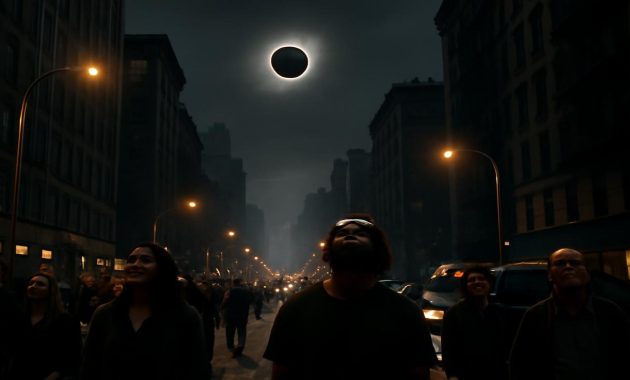
The news broke the way all big news travels now—through a blurry video, a startled caption, and a thunderclap of shares. Somewhere between a coffee sip and an unread email, you may have glanced at the headline: Day will briefly turn to night as the longest total solar eclipse of the century is confirmed by astronomers. You probably scrolled past, thumb already trained to chase the next thing. But then the words snagged on something deeper—a childhood memory of pinhole projectors, a relative warning you never to look at the sun, that eerie photo of black disc and halo you saw in a textbook once. The thought settled in: the sky itself is going to shut off, and we already have the date stamped on the calendar.
The Day the Sun Blinks
The astronomers say it like this: the Moon, in its quiet, predictable orbit, will slide between Earth and Sun in such perfect alignment that the Sun will be completely covered for several breathtaking minutes. This isn’t just any eclipse; according to teams studying orbital mechanics and long-term celestial cycles, this will be the longest total solar eclipse of the century. A slow, cinematic blackout stretched across continents, timed down to the second.
Imagine you’re standing in a city square, or a farm field, or on a windswept rooftop. It’s mid-day, bright enough to squint. Shadows fall the way they always have. And then, almost too slowly to notice at first, the light begins to change. Not dim, exactly—sharper. Colors flatten. The world looks as if someone is turning down the warmth slider on a photo. Birds shuffle uneasily. Wind shifts. There’s a hush that doesn’t belong to weather.
Above you, the Sun becomes a bitten coin. A crescent. Then a sliver. Then, with a last thin slice of light that flares like a diamond, it clicks into darkness. The day gives up its hold, and for a few long minutes, you stand under a version of night that should not exist at that hour. The horizon glows like a 360-degree sunset, planets wink into view, stars reclaim their ancient authority. The Sun is no longer a blinding disc but a black hole surrounded by a white, ghostly ring—the solar corona, usually invisible, now thrown wide open like a secret suddenly too big to hide.
People who have seen totality use words that border on religious: transcendent, humbling, overwhelming. Astronomers, usually so careful with superlatives, are already calling this one a “once-in-a-lifetime wonder” for much of the globe. It joins a short list of great eclipses that get their own names in history books. This one, they say, will rewrite sky-memories for millions.
Chasing Shadows: The Science and the Spectacle
A total solar eclipse is, in some ways, an exquisite accident. The Sun is about 400 times wider than the Moon—and also about 400 times farther away. That cosmic coincidence means that from Earth, they appear almost exactly the same size in our sky. So when orbits line up just so, the Moon can hide the Sun almost perfectly, like a coin erasing a searchlight.
This coming eclipse will follow a path that astronomers already refer to as the “path of totality”—a narrow band, only about 100 to 200 kilometers wide, that sweeps across the Earth’s surface. If you’re inside that band, you get the full show: totality. Outside it, you get a partial eclipse: interesting, but not the same. Totality is its own category, like the difference between hearing about the ocean and standing waist-deep in surf.
In a way, the whole thing is a triumph of predictability. We know the date, the hour, even how long the light will vanish over a specific field or rooftop you might stand on. Eclipses are one of the cosmos’s most precisely predictable spectacles. We can sketch their patterns centuries into the future and trace them centuries into the past, using cycles known to ancient Babylonians and refined by modern computers humming through gravitational equations.
And still, when it actually happens, predictability doesn’t shield us from feeling astonished. There’s a reason people become “eclipse chasers,” crisscrossing the globe to stand for just a few minutes under a stolen daylight. Some say once you’ve seen totality, partial eclipses feel like watching a movie trailer instead of the film.
The Longest Eclipse of the Century: What That Really Means
Not all total eclipses are created equal. Some last only seconds at a given location; others stretch past seven minutes. This one, astronomers say, will push up against that upper boundary, making it the longest of the 21st century. The length depends on a delicate dance: how close the Moon is to Earth that day, how close Earth is to the Sun, and exactly where the shadow sweeps across the globe.
When the Moon is near its closest point to Earth (perigee), it appears a bit larger in our sky. A larger Moon covers the Sun’s disc more fully and its shadow lingers. Add in the geometry of Earth’s curvature and rotation, and the result is a black Sun hanging in the sky for what feels, in human emotional time, like forever.
For those standing in the center of the path, totality will last long enough for your brain to move through stages: disbelief, awe, a strange calm, and then, just as you start to relax into this new reality, the first bead of sunlight breaks the spell. The world rushes back.
Preparing for a Cosmic Event in a Distracted World
We live in a time when our attention is a contested resource. Every notification, every headline, every algorithm tugs at the edges of our awareness. Against that backdrop, this eclipse is an odd proposition: a fixed, inevitable, slow-building event you can’t swipe away. It is, in fact, an interruption so large that you can only ever be the one interrupted, not the one doing the interrupting.
In the months leading up to it, weather forecasters will experiment with eclipse-specific models. Cities within the path of totality will prepare for a surge of visitors. Rural towns may see their quiet roads suddenly thick with rental cars, campers, and tripods. Hotels will sell out long in advance. Airlines will study flight paths that briefly dip through the Moon’s shadow.
Scientists will ready telescopes, spectrometers, and cameras tuned to capture the corona, those delicate tendrils of hot plasma that shape space weather and occasionally fling charged particles toward us in storms that can scramble satellites and power grids. Because the bright face of the Sun will be blocked, instruments can collect data that is normally impossible to gather from the ground.
Meanwhile, everyday people will make plans: where to go, what to bring, whether to pull kids out of school for a once-in-a-lifetime sky lesson. Safety campaigns will ramp up—eye protection, warnings about counterfeit eclipse glasses, instructions for pinhole viewers made from cereal boxes. Public health officials will worry about crowds and heat. Traffic engineers will imagine thousands of people moving at once after the event, all trying to beat the rush back home.
Is it a Wonder—or a Distraction?
Not everyone greets the news with unqualified delight. Alongside the awe, a sharper question emerges: in a century thick with urgent crises—climate change, inequality, conflict, collapsing ecosystems—is devoting so much attention, money, and media bandwidth to an eclipse a kind of collective escapism? Is this “once-in-a-lifetime wonder” actually a dangerous distraction from real problems?
It’s a fair question. Hotels will price-gouge. Some regions could see more investment in eclipse viewing platforms than in long-term public infrastructure. Companies will turn the sky’s brief blackout into marketing opportunities. Social feeds will fill with eclipse selfies while floods, fires, and political turmoil keep burning at the corners of the frame.
It’s also possible to go too far the other way, to treat joy, curiosity, and shared awe as guilty pleasures we can’t afford. But humans have always watched the sky, even in the hardest times. Eclipses once set off panic—people saw them as omens, signs that gods were angry or that empires would fall. Today, we know the physics. But the deeper question isn’t whether we should look up; it’s what we bring back down with us when the light returns.
What Happens to Us When the Sky Goes Dark?
There’s something physical that happens to your body under an eclipse. The air cools, often by several degrees, in a matter of minutes. The wind changes direction as temperature gradients shift. Animals behave as if someone has hit a fast-forward button on dusk: crickets begin their songs, birds roost, cattle drift toward barns. Even the leaves on trees become strange devices, projecting countless tiny crescent suns on the ground.
But there’s also the mental and emotional weather. Ask those who have stood in totality and you’ll hear a chorus of similar phrases: “I felt very small”; “I understood my place in the universe differently”; “I cried, and I didn’t really know why.” In a hyper-individual era, an eclipse temporarily resets the scale. For once, we are not the main characters; the orbits are.
This can be unsettling in a culture that praises control—control of time, of schedules, of narratives. The eclipse doesn’t care what’s trending. It offers no likes, no comments section. It asks, without words: Can you stand still for this?
Some psychologists argue that moments of awe—standing under a star-lashed sky, hearing a glacier crack, watching the ocean heave during a storm—can make people more generous, more willing to cooperate, more attuned to the needs of others. Awe shrinks the ego, gently, and nudges us toward a sense of belonging that goes beyond our small personal dramas. If that’s true, the eclipse might be less a distraction and more a deep reset: a global, synchronized dose of perspective.
The Problems That Won’t Vanish in the Shadow
Of course, nothing magically improves because the Sun disappears for a few minutes. When the light returns, wars resume, heatwaves intensify, bills still need paying. The hard truths of our century will be waiting at the edge of the shadow.
But consider this: many of those challenges—climate change, biodiversity loss, fragile democracies—stem at least partly from a failure of imagination and a shortage of shared stories. We struggle to act collectively when we no longer feel collectively anything bigger than the day’s outrage or the latest rumor.
An eclipse gives us, briefly, a shared frame: the same sky event, the same countdown, the same moment when daytime wrongfully turns to night. We will talk about it beforehand, plan around it, and remember it after. That shared experience won’t fix what’s broken, but it may, if we let it, reinforce something we badly need: a sense that we live under one atmosphere, bounded to one fragile planet, orbiting one star that can, for a few minutes, blink out and remind us how much we depend on its steady burn.
How to Experience the Eclipse Without Hurting Your Eyes or Your Patience
There’s a very practical side to all of this. You absolutely cannot stare at the uneclipsed or partially eclipsed Sun without proper protection; retinal damage is silent and permanent. That old myth about sunglasses being enough? Wrong. Stacking multiple pairs? Also wrong. The only safe direct viewing during the partial phases is through properly certified solar filters—eclipse glasses or handheld viewers meeting recognized safety standards—or via indirect methods.
During the brief moments of totality—when the Sun is completely covered, not even a sliver of bright photosphere showing—it’s safe to look with the naked eye. But the instant that diamond ring of light reappears, protection must go back on. If you’re the kind who gets lost in beauty, set an alarm or follow a practiced observer’s lead.
For those without specialized gear, a simple pinhole projector is both safe and oddly delightful. Poke a tiny hole in a card, hold it up with your back to the Sun, and let the light fall on a surface a meter or two away. The image that appears isn’t just a bright dot—it’s the changing shape of the Sun, bitten more deeply by the Moon as minutes pass.
Here’s a compact way to think through your viewing options:
| Method | What You See | Safety Notes |
|---|---|---|
| Eclipse glasses / solar viewer | Sun as a sharp, slowly shrinking crescent | Use only certified filters; never use with binoculars/telescopes |
| Pinhole projector | Projection of the Sun’s changing shape on a surface | Indirect viewing, safe for all ages |
| Tree leaf “projector” | Dozens of tiny crescent suns in patchy shade | Look at the ground, not the Sun |
| Naked eye during totality only | Black Sun, glowing corona, stars and planets | Safe only when Sun is 100% covered |
Beyond eye safety, there’s emotional preparedness. Expect traffic. Expect weather to be fickle. Some will travel hundreds of kilometers only to find their chosen spot smothered by clouds at the crucial moment. That’s part of the deal: you can calculate orbits to the second, but weather remains stubbornly wild. For some, the gamble is part of the thrill; for others, it’s a reminder that even with our best instruments, we are still at the mercy of a chaotic atmosphere wrapped around a hot rock.
Finding Meaning Between the Shadows
Perhaps the more serious preparation is this: decide, beforehand, what you want to carry out of those few minutes of eerily stolen daylight. Maybe you simply want the memory, sharp and crystalline, of that ring of fire in the sky. Maybe you want to give a child the kind of story they’ll tell their own grandchildren. Maybe, as the world cools and darkens briefly, you want to make a quiet promise to yourself about what you will do when the light returns.
Because it will return. The Moon’s shadow will slide away. Streetlights will blink off, again confused. Birds will resume their ordinary arguments. Someone will check their phone, scroll, and notice that news is still breaking, crises are still unfolding. The world will feel startlingly normal, as if nothing cosmic had just brushed past.
But you will know differently. You will have seen the Sun—our Sun, the steady backdrop of every human story—briefly vanish. And you will have felt that strangeness in your bones, in the hair on your arms, in the tightening of your throat when the sky went wrong at midday. Whether you call it a wonder or a distraction might depend on what you do next, under a sky that, for all its predictability, is still capable of surprising us.
Questions People Are Asking About the Eclipse
Will I be able to see the total eclipse from where I live?
Only those within the narrow path of totality will see the Sun completely covered; everyone else will see a partial eclipse. Maps from national observatories and space agencies will show the exact route of the shadow and the times for different locations.
Is it really dangerous to look at the eclipse without protection?
Yes. Looking at the uneclipsed or partially eclipsed Sun can cause permanent eye damage, even if it doesn’t hurt at the time. Only during the brief window of totality—when the Sun is entirely covered—is it safe to look with the naked eye.
Why is this eclipse called the longest of the century?
Because the combination of Earth–Moon–Sun distances and the eclipse path will give this event the longest duration of totality anywhere on Earth for the entire 21st century. Other eclipses this century will be shorter at their maximum point.
Could the money spent on eclipse tourism be better used on real-world problems?
Resources devoted to any large event could theoretically be redirected. But scientific observations, educational outreach, and shared experiences of awe can also support long-term public engagement with science, environmental awareness, and a sense of global connection—intangible but valuable ingredients in solving “real-world” problems.
What should I do to make the most of this once-in-a-lifetime event?
Plan early: identify where you need to be to see totality, secure safe viewing equipment, and think about who you want to share the moment with. On the day itself, give yourself time to simply be present—watch the changing light, feel the temperature drop, notice the animals—and then, afterward, talk about what it meant to you. The eclipse lasts minutes; the story you tell about it can last a lifetime.