The first thing anyone noticed was the smell.
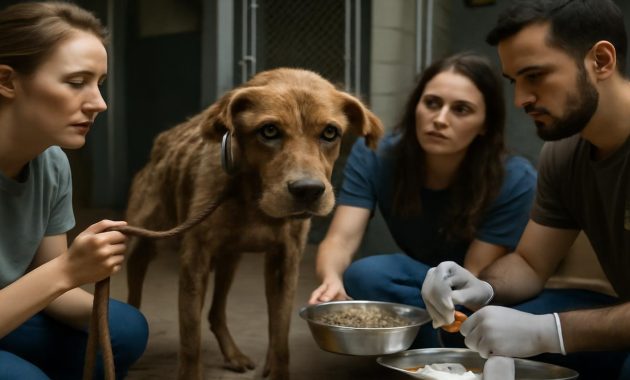
It drifted down the shelter hallway before anyone saw him—a sour mix of infection and fear that made volunteers pause mid-step, mid-sentence, like the air itself had thickened. The van doors opened, and there he was, standing as if he were made of splinters: ribs showing, fur sloughed off in patchy islands, eyes too big in a face too thin. His name, according to the old intake file, was Benny.
Someone whispered, “He’s back.”
A clipboard confirmed it. Same microchip number. Same date of birth. Same dog who had walked out of this shelter a year and a half earlier wearing a bright blue adoption bandana and the sort of hopeful grin that could power a small town.
This was not the dog who had left.
The Dog Who Came Back
Benny stepped out of the transport crate and onto the concrete as if it might collapse under him. His paws splayed, shaking. He flinched at the echo of voices in the corridor, at the distant bark from the kennels. His tail hung like a forgotten thing, dragging close to the ground. The driver handed over paperwork and a crumpled apology—his owners had “no time,” “too many issues,” “couldn’t handle him.”
His fur, once thick and cinnamon-colored, had thinned to a brittle fuzz along his spine. The rest was a grim mosaic of scabs, open sores, and bare, angry skin. Every knob of his spine and hip pushed against the surface like the architecture of neglect. His ears were crusted and raw; his nails, curled into painful hooks. But it was his eyes that stalled the room.
They were not wild or aggressive. They were…gone. Not empty, exactly, but shut-in. As if he had taken every ounce of himself and hidden it somewhere deep, far from the reach of hands that might hurt him again.
“Benny,” murmured Mara, a volunteer who recognized him first. “Hey, buddy. It’s us.” She crouched low, sideways, nothing direct or demanding. Her voice combed the air gently, like a hand that knew where not to touch.
Benny flicked his gaze toward her and then away. His body gave the smallest tremor, as if debating whether it was worth the risk to remember.
When the Shelter Holds Its Breath
In any animal shelter, there are days that blur—intakes, adoptions, cleaning shifts, feeding charts, health checks. But there are also days that carve themselves into the walls, into air and memory. Benny’s return became one of those days.
The staff moved in slow, practiced choreography: one person holding the leash, another gently lifting Benny’s back end when he hesitated on the step, someone else laying a towel over the metal exam table to stop the cold from biting into his bones. The vet, Dr. Kline, ran a hand down Benny’s side and exhaled through her teeth.
“Malnutrition. Severe dermatitis. Mange, likely. Secondary infections. And he’s terrified.” She didn’t add what everyone knew—that fear could be the hardest wound to heal.
Still, paperwork was signed. A treatment plan sketched. Pills counted, ointments arranged. The shelter’s whiteboard filled quickly:
| Area | Issue | Plan |
|---|---|---|
| Physical Health | Malnutrition, skin infections, overgrown nails | Special diet, antibiotics, medicated baths, nail trim |
| Mental State | Extreme fear, shutdown behavior | Quiet kennel, slow exposure, soft voices, consistent routine |
| Training & Confidence | Lack of trust, possible trauma triggers | Force-free training, confidence games, gentle leash work |
| Socialization | Fear of touch, tension around people | One-on-one volunteer team, careful introductions |
At the bottom, Mara added one more line in a different color: “Goal: Give Benny the best rehabilitation we’ve ever done.” Under it, she drew a small, wobbly heart.
It wasn’t an official part of the plan, but no one erased it.
Small Rituals of Repair
Benny’s rehab didn’t begin with grand gestures. It began with the tiny, almost invisible decisions made in quiet corners of the day. Where his kennel would be placed. Who was allowed in his space. How fast someone reached for his leash (answer: not fast at all).
They gave him a corner kennel near the staff room, where the noise dropped to a softer hum. They covered the back half of it with a blanket to make a small, dark den where he could retreat. They added a worn-out armchair just outside, a kind of unofficial office for whoever was “on Benny duty” that day.
“We move at his speed,” Mara reminded everyone. “If his speed is standing still for twenty minutes, then that’s what we do.”
The first night, he ate only a few mouthfuls of food. The second night, a little more. On the third day, a volunteer walked past and heard the delicate sound of kibble crunching steadily in the dim of his kennel. She stopped, smiled at the closed door, and walked on without peeking in. No pressure. Let the victories be private if that’s what he needed.
The medicated baths were the worst part for him. The smell of antiseptic, the sensation of water on raw patches of skin—his whole body turned into a question mark of tension. So the volunteers layered the experience with everything soft they could think of: slow humming, warm towels, hands moving in steady, predictable patterns.
One afternoon, as the water rinsed over his back, Benny’s head lowered, then gently leaned against Mara’s leg. It lasted three seconds. Maybe four. But it was the first voluntary contact he had offered.
Mara didn’t move. Her leg went numb from holding still, but she waited until he stepped away on his own. Later, in the break room, she told the others, and they all felt the same flicker of something bright and dangerous: hope.
The Quiet Science of Earning Trust
The volunteers began to study Benny the way someone might study the weather, noticing patterns in small things: the direction his ears tipped when a new person walked by, the exact second his tail twitched at a sudden noise, the difference between “frozen in fear” and “frozen in thought.”
They built his world around predictability. Same people, same routine, same phrases spoken in the same tones.
- “Good morning, Benny,” when the lights flicked on.
- “I’m just passing by,” when someone needed to walk past his kennel without stopping.
- “All done now,” when a bath or a nail trim or a medication session ended.
Words became signposts, reassuring him that nothing terrible was hiding in the pauses.
They watched his body language with a kind of reverence. When he took a step toward the front of his kennel instead of shrinking back, no one rushed in with treats or praise. They let the moment grow on its own. When his nose inched forward to sniff a hand, they held still, letting him choose the next move.
Fearful dogs, one trainer explained, are like tight knots. You don’t pull harder. You loosen them one thread at a time. Maybe today the thread is letting him sniff the air beside your hand. Maybe tomorrow it’s letting him touch your fingers with his nose. Maybe, weeks later, it’s the first time he leans his shoulder against your leg and exhales.
Every interaction was a question answered slowly: Are you safe? Are you sure? Are you sure today too?
Building a Village Around One Dog
Word spread among the volunteers about Benny’s condition and his history—how he’d once been the shelter favorite, how everyone had cheered when he’d gone home, how no one had imagined they’d see him like this again. Anger flickered through the conversations, that hot, bitter kind that comes with stories of neglect.
But anger didn’t feed dogs or pay vet bills or heal skin. Action did.
They formed a “Benny Team,” a core group of volunteers who would handle most of his care. Too many faces would mean too many variables; he needed consistency above all. Each member signed up for specific tasks:
- Morning feeds and gentle check-ins.
- Midday quiet time—just sitting near his kennel with a book, letting him get used to the presence of a person who wanted nothing from him.
- Evening walks, as he was ready, in the quieter back lot instead of the busy street side.
- Bath days, with extra towels and an unspoken agreement to remain calm, no matter how long it took.
They tracked his progress like a tiny, beating stock market of hope. On a whiteboard in the break room, they kept a “Benny Log.”
“Day 5: Took a treat from my hand (through the kennel bars!).”
“Day 9: Walked 10 steps outside before freezing, then turned back on his own. No panic, just thought it through.”
“Day 14: Tail moved! It was more of a twitch than a wag, but I swear it happened.”
On bad days—because there were bad days—someone would write, “Tough day. Extra scared today. We try again tomorrow.” It was a promise as much as a report.
When a Dog Teaches You to Slow Down
As weeks slipped by, Benny’s transformation was not the cinematic, overnight kind people love to share in thirty-second clips online. It was slower, quieter, made of tiny edits rather than sweeping rewrites.
His fur began to return first, fuzzing over bald patches like hesitant spring grass. The sores scabbed, then healed, leaving pink memories on his skin. The sharp corners of his hips softened as muscle and weight came back. But it was his posture that told the real story.
He stopped hugging the far corner of his kennel all the time. Sometimes, when a familiar voice approached, he’d stand closer to the door. He began to sniff the air with something like curiosity instead of alarm. His ears, once glued back against his skull, started to swivel again, cataloging sounds without flinching at every one.
Benny taught the volunteers a new kind of patience. It wasn’t just about waiting for progress; it was about re-learning what counted as progress.
A dog who can’t bring himself to step outside one week might sniff the threshold the next. A dog who once panicked at a leash might, after dozens of quiet trials, finally allow it to be clipped on without shutting down. These were miracles, just dressed in everyday clothes.
One evening, Mara sat in the armchair outside his kennel, reading out loud. The shelter buzz had dimmed to the low murmur of closing time. Benny lay in his bed, eyes half open, listening.
At some point, he stood, stretched—slow, careful, cat-like—and walked to the front of his kennel. He lay down against the bars, his shoulder pressed where her hand rested on the other side.
Mara didn’t speak. She simply lowered her fingers until they brushed the fur along his shoulder through the gap. He stayed. His eyes slid closed. The moment settled between them, tender and fragile as a moth’s wing.
That night, she added to the log: “Day 27: He chose to rest near me. I think, for a few minutes, he believed the world might be gentle.”
The First Real Walk
The first time Benny walked all the way to the back lot without freezing, the late afternoon light was stretched thin and gold. The ground smelled of dust and cut grass. There was no grand plan for this to be The Walk; it just happened to be the day when the string of small yesses finally tied itself into a larger one.
They had been practicing the routine for days: leash clipped on, kennel door open, one step into the hallway, treat, retreat if needed. Some days they made it three steps. Some days they made it none.
But that afternoon, Benny hesitated only twice. His paws moved like they were discovering new language—hesitant, testing, but forward. Past the office door. Past the row of kennels where other dogs barked, the sound now a backdrop instead of a siren. Through the side exit, into air that smelled of sun-warmed gravel and wind.
He stopped at the threshold, nose high, drinking in the outside. The leash stayed loose. No tugging, no urging. Just an open question: Want to try?
He stepped out.
The lot was empty except for a few training cones and the ghosts of earlier play sessions. Benny’s shadow stretched long beside him. He walked the perimeter once, then twice, each circuit a little less rigid. On the third round, his tail—thin, newly furred, cautious—lifted just above the line of his back.
Not a wag. Not yet. But no longer the anchor it had been.
When he finally turned back toward the door on his own, Mara followed. No fuss. No cheering. Just a quiet, “Good job, Benny,” as if this had been the most ordinary thing in the world, not the carefully built miracle it truly was.
A Different Kind of Happy Ending
People ask shelters about happy endings a lot. They want the bow-wrapped stories: dog rescued, dog healed, dog adopted into a perfect home with a yard and a fireplace and someone who works from home and never travels.
Benny’s story didn’t fall into a neat timeline. Rehabilitation, especially from neglect, rarely does.
Months in, he was still wary of new people. He still started at sudden sounds. He preferred the company of the volunteers he knew best, and his world stayed relatively small—kennel, hallway, back lot, exam room. But within that smallness, there was a richness of progress.
He could now:
- Walk on a leash without freezing or shutting down.
- Take treats gently from hands he trusted.
- Relax enough to flop onto his side for belly rubs—carefully, and only with a few chosen people, but still.
- Make soft, grumbly contentment noises as he fell asleep, the kind dogs make when they feel safely tired.
His body was stronger. His fur had grown back in a patchwork of russet and cream, with a few thin scars tracing past hardships. His eyes, once hollow, now held a guarded curiosity. Not innocence—he’d lost that somewhere along the way—but something sturdier: resilience.
The shelter began the slow, careful search for the right adopter—not just anyone with a free afternoon and a good application, but someone who understood what it meant to live with a dog who carried old shadows. Someone patient. Someone willing to see progress not as a straight line, but as a tide that sometimes rolled back before it came in stronger.
In the meantime, Benny had something he hadn’t truly had even in his first adoption: a village. A team of people who knew his every flinch and every triumph. A network of hands that had only ever been gentle.
On quiet afternoons, you could find him lying in his kennel, chin on his paws, watching as volunteers moved through the hallway: cleaning, feeding, laughing softly as they swapped stories about the animals in their care. Sometimes, when a familiar figure walked by, his tail would give a small, humble wag.
Not the helicopter blur of a carefree puppy, but a deliberate, considered gesture. A decision: You. I’m glad you’re here.
What Benny Gave Back
It’s easy, from the outside, to see shelter work as one-directional—humans rescue animals. Humans fix what others broke. Humans are the heroes. But anyone who has sat on a concrete floor beside a frightened dog for an hour, waiting for them to take a treat or one tentative step forward, knows that rescue is more of a loop.
Benny, in his hesitations and half-steps, gave the volunteers something they hadn’t quite known they needed: permission to slow down. To celebrate the kind of progress that doesn’t make headlines. To measure their days not in how much they had done, but in how deeply they had listened.
He taught them to notice the micro-expressions of trust: the looseness of his jaw when he finally unclenched, the way his breathing deepened when he realized the bath was almost over and no one had hurt him, the soft huff he’d make when he settled onto his bed with the practiced sigh of someone who had learned, against all odds, to rest.
He reminded them that rehabilitation is not about erasing the past. It’s about building enough good moments that the bad ones don’t get to tell the whole story anymore.
One evening, long after visiting hours ended, the shelter hummed with the muted chores of closing time. Lights dimmed. Kennels tidied. Bowls rinsed. A storm rolled somewhere far off, thunder a low growl on the horizon.
In his corner kennel, Benny lifted his head as the sky flickered. A year ago, a sound like that might have sent him deep into himself, curled tight against fear. Now, he listened. Somewhere down the hall, a familiar voice called, “It’s okay, guys. Just thunder.”
Benny’s ears twitched. He yawned, slow and cavernous, then laid his head back down, his body stretched a little longer, a little looser. Outside, the storm kept talking. Inside, the shelter breathed with him.
He wasn’t healed in the fairy-tale sense. But he was healing, which is quieter and messier and somehow, in its honest incompleteness, even more beautiful.
And around him, a small community of tired, hopeful humans carried on with what they did best: showing up, again and again, with leashes and treats and open hands, determined that this time—no matter how long it took—Benny’s story would be written with more kindness than the chapters before.
Frequently Asked Questions
Why do some adopted dogs get returned to shelters?
Dogs are often returned because their humans were unprepared for behavioral challenges, medical needs, or simply the time and commitment a dog requires. Sometimes life circumstances change—a move, job loss, illness—and the dog pays the price. In Benny’s case, neglect over time led to serious health and emotional issues that his former owners did not address.
Can severely neglected dogs really recover?
Many can, though “recovery” looks different for each dog. Some regain full confidence and live typical, happy lives. Others, like Benny, may always be a bit cautious or sensitive. With consistent, gentle care, most neglected dogs can experience comfort, safety, and joy again, even if they remain a little different from carefree, well-socialized dogs.
What are the key elements of good rehabilitation for a fearful dog?
Patience, predictability, and kindness are crucial. That means a stable routine, a limited number of trusted handlers, force-free training methods, and careful observation of the dog’s body language. Pushing too quickly can set progress back; moving at the dog’s pace creates real, lasting change.
How can volunteers help a dog like Benny without being professionals?
Volunteers can offer time, calm presence, and consistency. Sitting quietly near a kennel, reading aloud, offering treats slowly and respectfully, walking the same route each day, and following staff guidelines for handling all make a huge difference. You don’t need to be a behaviorist to help; you just need to be teachable and gentle.
What can someone do if they can’t adopt but want to support dogs like Benny?
You can volunteer at a shelter, foster a dog short-term, donate funds or supplies, share adoptable animals on social media, or simply listen and respond when shelters ask for specific help. Even small acts—buying a bag of special food, sponsoring a medical treatment, or spending an hour a week sitting with a nervous dog—can become part of a larger story of rehabilitation and hope.