The first warning arrives not as a blaring headline, but as a rumor on the wind. Someone in the café murmurs, “They say the sun will vanish in the middle of the day.” Another replies, half-joking, “Like the end of the world?” Laptops snap shut. Someone scrolls to a news alert. The words feel too big, too dramatic to be true: Astronomers confirm the century’s longest eclipse will briefly turn day into night.
Outside, the ordinary sky goes on being ordinary: scattering traffic fumes into pale blue, laying sunlight across rooftops and satellite dishes, glinting off car windshields. But suddenly, that light feels temporary. You look up with new eyes, aware that sometime soon, in a span that could fit between lunch and the next meeting, the universe will pull off one of its oldest magic tricks—and stretch it longer than anyone alive has ever seen.
The Day the Clock Will Stutter
The date slides across your screen in clean, clinical digits—a calendar entry labeled something like “Eclipse: Day turns to night.” It reads like a typo. Days don’t just turn into night, not where you live, not in the middle of a Tuesday. Yet astronomers, the quiet timekeepers of the cosmos, seem remarkably calm about it. They’ve been waiting years for this one.
In observatories scattered across deserts and mountains, telescopes and computers have been whispering about this event for a long time. The path of the moon is known with obsessively precise mathematics. Calculations that jog back through ancient Babylonian eclipse records and forward through supercomputers all converge on the same conclusion: this will be the longest total solar eclipse of the century, a drawn-out blackout that will linger in totality for several breathless minutes—long enough to feel the planet exhale.
Most total eclipses are fast drama. The moon’s shadow screams across the planet at thousands of kilometers per hour, delivering totality like a sudden blackout: two minutes here, three minutes there, rarely much more. Blink and you miss it. But this one is different. This one is a slow, deep bow of the sun behind the moon, designed by celestial geometry to test your sense of time. Astronomers speak of it in numbers: duration, path width, shadow velocity. But the words that keep appearing in their interviews are softer. Rare. Precious. Unforgettable.
They show you charts, diagrams, simulations. You nod politely. Only later, in a quiet corner of the evening, does the reality sink in: there will be a moment, in your own lifetime, when the sky will decide—just briefly—that the rules you’ve trusted since childhood no longer apply.
The Long Shadow’s Path
On a spinning marble hurtling around a star, a total eclipse is a kind of cosmic coincidence. The sun is 400 times larger than the moon, and roughly 400 times farther away, making them appear almost exactly the same size from here. It’s an alignment so improbably perfect that some ancient cultures assumed it must mean something profound about humans. How could such geometry be an accident?
For this particular eclipse, the alignment is almost overachieving. Astronomers explain that the moon will be near its closest point to Earth, appearing just a bit larger in the sky. The Earth, at this time of year, will be slightly farther from the sun, making the sun appear just a bit smaller. A fraction of a fraction here, a tiny adjustment there—and suddenly the moon isn’t just covering the sun, it’s over-covering it, carving out a swath of shadow that lingers. The upshot: a uniquely long stretch of totality.
It will begin over the ocean, as many eclipses do, unnoticed by most of the world—just a dark bruise sliding over water, startling a few seabirds and confusing the internal clocks of fish. Then that shadow will run toward land, a fast-moving stain of darkness racing across countries. The exact path—who gets the full blackout, who gets only a partial bite out of the sun—has become a matter of global fascination.
Maps bloom online showing a ribbon, sometimes only a hundred or so kilometers wide, threading through continents and over cities. People study those maps like treasure hunters. Somewhere, a child looks at that dark path crossing their hometown and realizes: the universe will be doing something spectacular right above our house. Somewhere else, someone sees they’re just outside the path and starts quietly checking train times and budget airlines.
Where You Stand in the Shadow
Location will define your story of this eclipse. Stand in the path of totality, and day truly collapses into star-dusted twilight. Stand outside it, and you’ll witness something impressive but incomplete—a sun that becomes a crescent, the world dimmed but not transformed. When astronomers share the numbers, they’re trying to help you understand what to expect in your patch of world.
| Viewing Zone | What You See | Approx. Max Duration of Darkness |
|---|---|---|
| Deep Path of Totality | Complete sun coverage, stars visible, temperature drops sharply | Over 6 minutes of total night-like darkness |
| Edge of Totality | Very thin solar crescent, brief corona appearance | 1–3 minutes of deep twilight |
| Near Total, Partial Eclipse | Most of the sun covered; strange, dim daylight | No true darkness, but 2–3 hours of evolving partial phase |
| Distant Partial | Noticeable “bite” from the sun; subtle sky changes | Up to 1–2 hours of mild dimming |
Those numbers are the scaffolding, but the experience itself resists math. People who have stood in the path of totality talk as if they’re describing a fever dream. “You think you understand what it will look like,” one eclipse chaser says, “and then it happens, and your body just doesn’t believe it.”
How the World Will Feel When Day Falls Apart
Imagine the morning of the eclipse. The world, stubbornly indifferent to cosmic schedules, carries on. Children are bundled to school, coffee machines hiss, buses wheeze into motion. Somewhere above all this, the moon begins its slow approach across the face of the sun, unseen at first. Birds keep singing. Dogs lie in sunbeams that are not yet threatened.
Then someone notices the light. Not darker, exactly. Stranger. Shadows sharpen, as if drawn with a finer pencil. The colors of the world shift almost imperceptibly—grass reddens slightly, skin tones go ashy, white walls seem to glow with a faint, unnatural clarity. It’s as if someone has replaced the world’s lightbulb with a colder, alien filament. Cameras adjust exposure automatically; your eyes do the same thing, but your spine registers the change before your brain does.
Half an hour passes. The moon continues its crawl. The sun has become a fat crescent in the safety of a filtered lens or eclipse glasses, but to the naked eye, the world still looks like very late afternoon. Then come the animals. Birds quiet. Bees seem confused. Some flowers, triggered by the diminishing light, begin to fold as if night has arrived early. Farm animals shuffle toward barns. If you listen, really listen, you can hear the planet’s diurnal rhythm stumble.
As totality approaches, the temperature drops—sometimes by 5 or 10 degrees. A cool breeze slides across the watching crowd. People put on jackets they hadn’t thought they’d need until evening. The horizon, 360 degrees around, begins to blush with a deep, impossible orange, like a sunset circling the entire planet. But overhead, the sky is fading toward bruised purple.
Then the last sliver of sun vanishes.
For those in the path of totality, this is the pivot. One moment, there is a blinding point of daylight. The next, that point is gone, and you are standing, however briefly, in night.
Standing Under a Midnight Sun
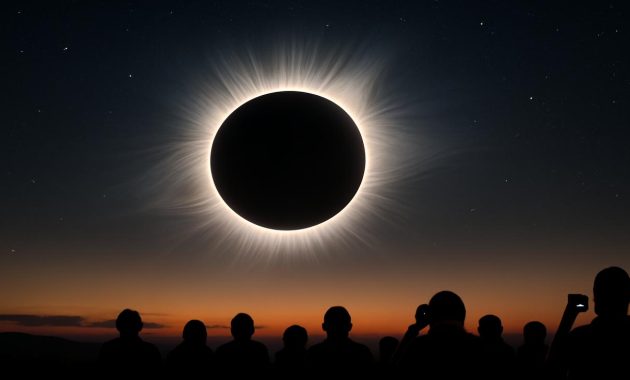
It is not like any night you’ve known. Above you, where the sun should be, is a black hole burned into the sky—a perfect dark disc, rimmed with a wild, white crown of plasma. The sun’s corona, usually lost in its own brilliance, spills out in streamers and wisps, twisting like ghostly winds. Around that impossible wreath, faint stars and planets pop into view, winking through an indigo that should not belong to mid-day.
People react in ways they didn’t expect. Some cheer, the sound thin and startled. Others fall silent, eyes wide, mouths open. A few cry without knowing why. Cameras, tripods, phones all forgotten for a beat, as if the body needs a single moment of unmediated awe before it can remember the script: document, capture, share. Children clutch at hands. Elderly faces tilt skyward, reading this darkness with memories older than most of the crowd.
In that elongated, historic totality, time goes weird. Six minutes can feel like thirty seconds and an eternity, both at once. Your brain knows you are outdoors, sometime after lunch. Your senses insist this is midnight in some alternate universe where the sun has been replaced by a haloed void. Every molecule of existence hums with contradiction.
Wind shifts. Somewhere, an owl calls. Streetlights, tricked by the sudden fall of light, flicker on. In some cities, traffic is hushed by simple human agreement; in others, car headlights sweep through the false night like curious comets. The world is still itself, yet flooded with a sense of being briefly dislodged from the familiar machinery of day and night.
And then, as abruptly as it began, it starts to end.
When the Sun Comes Back
The first sign of the sun’s return arrives as a diamond of blinding brilliance at the edge of the moon. Astronomers call the effect “Baily’s beads” and the “diamond ring”—sunlight pouring through lunar valleys. Most people, though, just call it impossible to describe. The black disc with its soft, mystical halo suddenly sprouts a single, fierce point of white fire. The crowd reacts with something like a gasp, half delight, half alarm. Darkness has been beautiful, but the return of light strikes some ancient chord of relief.
Within seconds, the world flips again. Sky brightens from purple to deep blue to something closer to normal. Birds resume their songs, a little late and somewhat jumbled, as if trying to reboot the day. Temperature creeps back up. That uncanny 360-degree sunset recedes toward one horizon, where the real evening will eventually belong. Shadows soften. The planet remembers what time it is supposed to be.
Yet for a while, even as the partial eclipse phases away and the sun regains its full disk, everything feels slightly different. People linger, squinting upward through filters, watching the bite shrink until the sun is whole once more. There is chatter again, practical concern about traffic and dinner and the price of those ridiculous cardboard eclipse glasses. But beneath it all is a long, shared exhale.
Later that night, social media will flood with the same images from a thousand different angles: black sun, white corona, the ghostly ring, the crowd’s silhouettes. News anchors will use words like “historic” and “record-breaking.” Astronomers will publish papers, refining measurements of the sun’s outer atmosphere, testing theories about solar winds and magnetic fields. But that’s for later.
A Rare Chance to Feel the Universe
For now, the eclipse settles into stories. Someone will describe to a friend far away how the light felt “like being underwater.” Someone else will swear that the air pressure changed, that they could feel the shadow arrive on their skin. Children will draw black circles with chalk coronas. A few months from now, a novelist will sneak an eclipse scene into a manuscript, knowing most readers will picture this one.
There will be arguments, too. Was it worth the travel, the cost, the packed trains and highway standstills? Those who were under clouds may bristle at the gushing of those who had clear skies. Some will shrug: “It was interesting, sure, but not life-changing.” Others—often the quietest ones—will look away for a moment, as if replaying a memory only they can see, and simply say, “You had to be there.”
Astronomers love data, but they also understand this part. They know that once in a generation—or in this case, once in a century—an eclipse like this one offers something that no telescope time or satellite feed can fully reproduce: a direct, bodily encounter with cosmic scale. In the middle of your ordinary day, the machinery of the solar system becomes impossible to ignore. You feel, in your blood and bones, that you live on a rock in space, and that space is not empty but alive with motion and chance.
Preparing for the Longest Shadow
In the months before the eclipse, the world will practice. Schools will run lessons explaining why the sun can disappear without danger to Earth. Science museums will set up model orreries with lamps and foam balls, making tiny moons cast tiny shadows on tiny Earths. Amateur astronomers will meet in community halls, passing around solar filters like precious artifacts, demonstrating with stern kindness that regular sunglasses are not enough.
There is a practical choreography to these preparations. Hospitals check backup power systems, anticipating minor surges when everyone turns lights on at once during the false night. Power grid operators study historical data from past eclipses and sketch out contingency plans. Wildlife researchers design experiments to see how animals respond to an extended, abrupt darkness carved into the middle of a bright day.
For individuals, preparation is quieter. You might buy a pair of ISO-certified eclipse glasses and tuck them into a drawer near your keys, a small paper promise to your future self. You might mark the date on your calendar, set a reminder a week before. Maybe you think about travel: is the path of totality close enough to reach? Do you have friends or family under that dark band of future sky?
Behind all the logistics lies a more intimate kind of planning: deciding how you want to meet this moment. Will you stand among thousands in a stadium, listening to the roar of a synchronized gasp when totality hits? Will you climb a local hill alone, your only company the insects and the shifting wind? Will you bring your children, knowing they may grow up describing this day as a mythical memory that other kids did not get to have?
It’s worth thinking, too, about what you will notice. Not just the obvious—the shrinking crescent of the sun, the sudden black disc—but the subtleties. The way your own shadow looks a few minutes before totality. The temperature of the air on your arms. The sounds of your neighborhood when the birds fall silent. The way your heart responds when the rules of the sky bend, just a little, just long enough to remind you how provisional “normal” really is.
After the Century’s Eclipse
Once the last sliver of shadow leaves the Earth and the moon continues on its way, the event will undergo a transformation of its own. It will move from prediction to memory. Astronomers will file it under a new label: observed. The “longest eclipse of the century” will become a line in textbooks, a neat figure in a chart of record-holders, a reference point for future generations of sky-watchers who will never quite understand what it felt like to stand in that particular darkness.
Human lives, by comparison, are shorter and softer things. A child who watches this eclipse may live to see several more. An elder might know this was almost certainly their last—and that knowledge may have sharpened every second. Somewhere, a scientist whose career has orbited around solar physics will look up during totality and taste the bittersweet beauty of seeing their life’s work painted in fire around a blackened sun.
Not everyone will remember it in detail. Some will recall only the inconvenience: traffic jams, rescheduled appointments, the coworker who wouldn’t stop talking about “totality.” Some will remember the way the office fluorescent lights flickered on by themselves. Others will carry a single, sensory snapshot: the sound of a crowd going wordless together; the cold wind on a summer day; a dog pacing anxiously when the bright afternoon dropped into twilight.
But taken together, all those scattered memories amount to something unmistakable: a species looking up, at the same time, for the same reason. For a few minutes, billions of people share a single focal point. In a world fractured by borders and algorithms, that kind of collective attention is almost as rare as the cosmic coincidence that causes it.
The century will move on. Other headlines will crowd out the eclipse. New crises, new celebrations, new discoveries. The sun will rise and set, rise and set, its punctuality once again so dependable we stop really seeing it. Yet somewhere in the back of your mind, the memory of that stolen night will sit quietly, an anchor to something bigger than the churn of daily life.
One day, years from now, you may find yourself telling the story to someone who was too young to remember, or not yet born. You’ll try to explain how the light changed, how the air cooled, how the sun itself seemed to be replaced by a dark, haloed hole in the sky. You’ll use your hands to trace circles and crowns in the air. You’ll struggle for words, and in that struggle, you’ll discover what all eclipse chasers eventually admit: no photograph, no description, no list of numbers can fully contain what it feels like when day becomes night and the universe lets you watch the gears turn.
And maybe that is the most extraordinary part of this long eclipse: not the record it breaks in minutes of darkness, but the brief, fierce clarity it offers about our place in the grand machinery. For a handful of heartbeats, under a blackened sun, you will know—viscerally, unmistakably—that you are a small, fragile being standing on a moving world, lit by a star, accompanied by a moon, in a universe that is infinitely larger than your worries and infinitely more beautiful than your plans.
Frequently Asked Questions
Is it safe to look at the eclipse with the naked eye?
It is only safe to look at the eclipse with the naked eye during the brief period of totality, when the sun is completely covered. At all other times, including partial phases before and after totality, you must use proper eclipse glasses or certified solar filters. Regular sunglasses, smoked glass, or camera filters are not safe.
How long will the total phase of this eclipse last?
At the point of greatest eclipse along the path of totality, the sun will be fully covered for more than six minutes, making it the longest total solar eclipse of the century. Locations nearer the edge of the path will experience a shorter total phase, ranging from about one to three minutes.
Will everyone on Earth see day turn into night?
No. Only people located within the narrow path of totality will see the sky darken to a night-like level. Those outside the path, but still within the wider region of partial eclipse, will see the sun partially covered and notice dimmer, stranger light, but not full darkness.
Do animals really react to an eclipse?
Yes. Many animals rely on light cues to guide their behavior. During a total solar eclipse, birds often stop singing or fly to roost, nocturnal animals may stir, and some insects become active or fall silent. The extended darkness of this particular eclipse is expected to make those responses even more noticeable.
How can I prepare to experience the eclipse fully?
Plan your location early, aiming for a spot along the path of totality with historically favorable weather. Obtain certified eclipse glasses well in advance. On the day itself, arrive early, bring layers for the temperature drop, and take a few moments to put cameras aside so you can experience at least part of totality with your own eyes and senses.