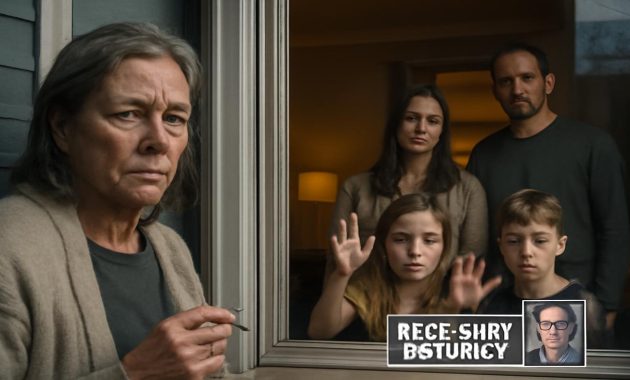
On the first warm Saturday of spring, the park smells of cut grass and sunscreen and the faint sweetness of bubble soap. Children streak across the playground like brightly colored birds, shrieking, laughing, climbing. On a bench a little way back, a woman in her late sixties watches them, fingers curled tight around a folded cardigan. Every so often, her hand moves unconsciously to her pocket where a pack of cigarettes used to live. She doesn’t light one. She doesn’t dare. Her daughter is here, and her daughter has made the rule very clear: no smoking, no smell of smoke, no trace of smoke—ever—around the kids.
Two toddlers tumble toward the swings, but they don’t run to the woman on the bench. They run past her, small legs wobbling, and launch themselves instead at their mother. “Nana’s sitting,” the mother says gently, steering the children toward the play structure. “Go show me how high you can climb.” The grandmother smiles, but the smile doesn’t reach her eyes. She has retired early, she has time to spare, and all she wants, more than anything, is to help raise these children. But because she refuses—cannot, will not, does not want to—quit smoking, her daughter will not let her be alone with them.
To some, that boundary sounds harsh, even cruel. To others, it feels obvious, necessary, overdue. Somewhere between the smell of cut grass and old habits, a very modern family battle is unfolding, and it is leaving parents and grandparents divided in ways that feel as personal as breath itself.
The Day the Offer Was Refused
When Helen retired from her job as a school administrator at 67, she had a plan. She imagined mornings with her granddaughter, making toast soldiers and reading picture books. She imagined picking up her grandson from nursery, waiting inside the small cloakroom that always smelled of glue sticks and damp mittens. She pictured being indispensable in that quiet, everyday way that grandparents sometimes are: the ones who show up when the nursery calls because someone is sick; the ones who know which stuffed animal must be in the crib for any hope of sleep.
Her daughter, Leah, had other ideas—or rather, one condition.
“Mum, I love that you want to help,” Leah said one evening over a kitchen table scattered with Duplo bricks and uncapped markers. “But we need to talk about the smoking.”
Outside, dusk pressed against the window. The smell of stir-fry hung in the air. Helen shifted in her chair, reaching for her mug of tea as if it were some kind of shield. She’d been through this conversation before, in pieces, over years: during Leah’s teenage lectures, at Christmas when she sneaked out between courses, the time she smoked too close to the pram and Leah’s jaw tightened almost imperceptibly.
“I don’t smoke around them,” Helen said, fighting to keep her voice even. “I step outside. I wash my hands. I’m not stupid.”
Leah’s gaze moved to the high chair, the sticky tray where her daughter had mashed peas into a green constellation. “It’s not just the smoke, Mum. It’s the residue. Third-hand smoke. It sticks to clothes, to furniture, to your breath. I’ve read about it. We’re not having it around the kids.”
“So what are you saying?” The silence between them stretched. A blackbird sang once outside, as if to punctuate the question.
Leah pressed her palms flat on the table. “If you want regular time with them, if you want to babysit, if you want to do school runs when they’re older—then you need to stop. Properly. No cutting down. No ‘only outside.’ Quit.”
In Helen’s memory, the moment stands still: the grain of the wood under her fingers, the faint buzz of the refrigerator, her daughter’s face set with a resolve that looked disturbingly like her own when she was younger. For a second, she saw not her grown child but the toddler who used to tug on her sleeve and say, “Come on, Mum, we’re going now.”
But now, it was Leah who was drawing the line and walking away if it wasn’t respected.
The Invisible Smoke After the Smoke
To understand why this particular line has become so charged, you have to step for a moment into the invisible. Everyone knows about second-hand smoke—the cloud that hangs between a cigarette and a nearby nose. What fewer people grew up hearing about is what lingers long after the cigarette is stubbed out: third-hand smoke.
Experts describe third-hand smoke as the film of chemicals that clings to surfaces, hair, skin, clothing, carpets, car seats. It seeps into the fabric of things, into the very fibers of a sofa or the steering wheel of a car. For adults, it’s unpleasant. For young children, who crawl on floors, press their faces into sleeves, lick fingers, and chew on everything in reach, it’s a highway into their bodies.
Nicotine, heavy metals, carcinogens—these are not abstract words when you picture a baby gnawing on the collar of a grandparent’s jacket or a toddler cuddling into the chest of someone whose clothes always smell faintly of smoke and mint gum. New research is making this once-theoretical problem feel painfully tactile for parents already juggling worries about pollution, processed food, microplastics, and endless environmental hazards.
Many young parents, like Leah, say they feel they are raising children in a world that is physically riskier than the one they grew up in, or at least more transparently so. They have access to data, studies, and expert commentary at all hours of the day. Health guidelines no longer stop at “don’t smoke in the house” but extend to “don’t smoke in the car,” and now, increasingly in some families, to “don’t smoke, full stop, if you want closeness with the kids.”
On the surface, it sounds simple: choose children over cigarettes. But beneath that simplicity lies a tangled web of identity, addiction, autonomy, and generational hurt that does not vanish with a single ultimatum.
When Love Feels Conditional
In online forums and family support groups, stories like Helen and Leah’s unfurl with a mix of anger and sorrow. One retired grandfather writes that his son and daughter-in-law won’t let him take his grandson to the park alone because they “don’t trust” him not to smoke. Another grandmother confesses she didn’t tell her daughter about a relapse after trying to quit; she now drives to a neighboring town to smoke behind a supermarket, then scrubs her hands until they’re raw before picking up the children.
For many older adults, smoking is not simply a bad habit. It’s stitched into their life stories. It was there in the break rooms of their first jobs, in the pubs where they met their partners, in the quiet of evenings when the children were finally asleep and they stepped into the garden to breathe and think. It was there during losses and celebrations, threaded through decades of muscle memory.
To be told, in later life, that they must let go of that history or risk losing access to their grandchildren can feel like love turning into a transaction. Quit, and you may see them. Don’t, and you won’t. Some describe it as blackmail. Others call it a boundary. The words people choose reveal which side they’re on.
“My granddaughter is my whole world,” one woman in her seventies writes, “but I’ve already given up so much. They told me what I could feed my kids, how to dress them, and now they’re telling me how to live my own life in my own home. I’m tired of being told I’m wrong.”
From the other side of the divide, a young father counters, “I watched my dad die of lung cancer. I’m not doing that again with my daughter. If setting a hard boundary makes me the bad guy, fine. I’d rather have a living child who resents me briefly than a sick one who never had a chance.”
Somewhere between those two voices lies the ache that rarely makes it into neat advice columns. Parents want their children safe. Grandparents want to be trusted, to be needed, to be more than the sum of their worst habit. No one wants to be told that the way they have comforted themselves for forty years is now a threat.
The Tightrope of Boundaries
Family therapists often liken modern parenting boundaries to walking a tightrope. On one side is the drop into control and rigid rules; on the other is the slide into chaos and resentment. With smoking, the rope feels even thinner because the stakes—health, access to grandchildren, lifetime habits—are so stark.
Experts who support firm no-smoking policies around children argue that this is not about moral judgment but about harm reduction. They point out that addiction, while deserving of compassion, does not erase risk. They remind families that boundaries are not punishments, but conditions under which relationships can remain safe and sustainable.
Yet even calm, rational explanations can sound cold to a grandmother who feels she is being kept at arm’s length, watching her grandchildren from the park bench rather than pushing the swing. She hears, instead, “You are dangerous,” even if the words spoken were “Your smoke is dangerous.”
Language matters. So does timing. Some parents quietly put rules in place from the start: no smoking relatives will hold the baby unless they have showered and changed clothes; no cigarettes on visits at all. Others, like Leah, move gradually from discomfort to confrontation as their awareness of third-hand smoke grows. In many families, the real fracture comes not from the boundary itself, but from how abruptly and emotionally it is dropped into the middle of an otherwise fragile peace.
At the Kitchen Table: The Unspoken Numbers
If Helen and Leah’s conversation were replayed with a clinical backdrop, there would be numbers to lay on the table alongside the half-eaten peas and the cooling cups of tea. Smoking remains one of the leading preventable causes of death worldwide. Children exposed to tobacco smoke are at higher risk of respiratory infections, asthma, ear infections, and sudden infant death. Studies suggest that nicotine residues on surfaces can re-emit into the air and form new toxic compounds over time.
But parents and grandparents don’t usually trade statistics. They trade stories, memories, unspoken fears. To make those tensions visible, you could imagine their conflict sketched out in a simple table—less as a checklist of rights and wrongs, more as a map of how differently the same situation can feel from each side of the family table:
| Perspective | What They Say | What They Often Feel |
|---|---|---|
| Parent | “I need to protect my children from smoke, even if that upsets my parents.” | Fear of illness, guilt about hurting their own parents, pressure to do “the right thing.” |
| Grandparent | “I raised you while I smoked. Now you’re saying I’m not good enough for my grandchildren?” | Shame, defensiveness, grief, a sense of being judged or replaced. |
| Health Expert | “Third-hand smoke poses real risks. Children need smoke-free caregivers and spaces.” | Frustration that clear science can still feel negotiable in family settings. |
| Family Therapist | “Boundaries are about safety, but they must be communicated with empathy.” | Awareness that this is about more than smoke—identity, autonomy, history are all in play. |
At that kitchen table, though, nobody is drawing charts. Leah is thinking about tiny lungs. Helen is thinking about the long nights she spent rocking Leah through croup when the doctor told her “no smoking in the bedroom” and she thought she’d complied as best she could by leaning out of a window. Each feels the other is rewriting the past, or ignoring what was survived.
Can There Be a Middle Ground?
In families where smoking and childcare collide, conversations often circle back to the same question: Is there a compromise that feels safe enough to parents and respectful enough to grandparents? Some try elaborate workarounds—smoking jackets that get taken off at the door, outdoor-only rules with strict handwashing, no smoking for several hours before seeing the children. A few families find a delicate truce here.
But even elaborate systems lean heavily on trust. Can the parents trust that their requests will be followed when they’re not in the room? Can the grandparents trust that they’re not being subjected to a never-ending series of tests they are bound to fail?
For some, the only sustainable answer is all or nothing: quit, or accept that your role will be smaller, more supervised, more occasional. That starkness hurts. It also sometimes works. There are grandparents who, given this boundary, do quit. They talk about their grandchildren as their “reason,” their “last chance,” the line that finally got them over the hump after years of half-hearted attempts.
Others try and fail, again and again, dragged back not by defiance but by dependence. Addiction does not loosen its grip just because a new baby is born. The danger in these families is that love gets misread as willpower. “If you really loved them, you’d stop” is a sentence loaded with misunderstanding. You can love someone more than your life and still be trapped by something that started decades before they were born.
So where does that leave families? Somewhere unsatisfying: in the gray area where hard boundaries may still be necessary, where children’s health justifiably comes first, but where compassion for those who cannot yet meet those standards is not a betrayal, but a relief.
The Quiet Mourning No One Talks About
On a rainy weekday, months after that first park visit, Helen stands in the doorway of her own living room, looking at the unused crate of toys in the corner. She bought them when she retired: soft blocks, a wooden train set, a puzzle with farm animals whose pieces still smell faintly of varnish. She imagined this room filling with the clatter and chaos of small people. Instead, it’s mostly quiet.
She still sees her grandchildren, of course. There are Sunday lunches, birthday parties, impromptu visits where Leah stays close, watchful but trying not to show it. The kids know their grandmother. They reach for her, sit in her lap, demand another biscuit. But she is not their emergency contact. Her phone does not ring at 3 p.m. with a nursery asking if she can come right away. She is not the one they expect at the school gate.
There is a particular kind of mourning that sets in when imagined futures fall away. Helen mourns the version of herself she wanted to be: the “hands-on Nana,” the one whose fridge was plastered with hand-drawn rainbows and wobbly handwriting. Instead, she has photographs on the mantelpiece and an ache in her chest she sometimes mistakes for the start of a cough.
Leah, too, is grieving something, though she rarely admits it. She had pictured her mother as a central pillar in her children’s lives, the person she could lean on when work overwhelmed her, when she and her partner fought, when flu ripped through the house. She had not expected that pillar to come with conditions she could not, in good conscience, accept.
“It’s like choosing between my child’s health and my mother’s feelings,” she tells a friend. “And I hate that those two things are even in the same sentence.”
They both, in their separate houses, wonder if they are being too rigid, too proud, too stubborn. They both rehearse conversations in their heads where the other finally understands. Mostly, they carry on as they are: loving the same children, walking parallel paths that rarely fully meet.
Looking Forward: A Different Inheritance
One day, those children will grow into teenagers, then adults. They may one day stand in kitchens of their own, with their own children, and talk about boundaries and history and health. If the patterns of families hold, they will find new things to argue about—screen time, social media, sugar—and some old battles will soften with time.
Perhaps, by then, smoking will be rare enough that this particular conflict fades. Already, in many countries, far fewer young people are taking up cigarettes. Vapes, with their own debates and dangers, have complicated the landscape, but the cultural glamour once attached to smoking has dimmed. The children watching their grandmother now are also watching how their parents respond: both the firmness of the boundary and the way it is enforced.
They will inherit more than DNA. They’ll inherit scripts about health, autonomy, forgiveness, and the right to change the rules when new information emerges. They’ll see whether love in their family could stretch to hold both safety and sorrow, or whether one always had to win at the expense of the other.
On another spring day years from now, they may sit on a bench in a park with their own aging parents and their own restless toddlers, inhaling the smell of cut grass and sunscreen and whatever new fears define their time. They may remember how their mother insisted on a smoke-free world for them, how their grandmother both bristled and reached for them, how complicated and human it all was.
For now, though, somewhere, a retired mother flicks ash into a small tin she keeps in her coat pocket, far from the swings and slides. She watches her grandchildren run in the distance, their laughter carried on the breeze. She tells herself, as she has told herself for years, that she will quit tomorrow. In another part of the park, her daughter tightens a sunhat under a small chin and looks up, catching her mother’s eye. There is love there, undeniable and fierce, and also a space between them that smells faintly, stubbornly, of smoke.
Frequently Asked Questions
Is it really dangerous if grandparents only smoke outside?
Smoking outside is safer than smoking indoors, but it does not fully remove the risk. Third-hand smoke residues can cling to clothes, hair, skin, and objects, and young children are especially likely to ingest or inhale those residues through touch and close contact.
What is third-hand smoke?
Third-hand smoke is the contamination left behind after a cigarette is extinguished. Chemicals from tobacco smoke settle on surfaces, fabrics, and dust. These residues can persist for long periods and may be inhaled, absorbed through the skin, or ingested, particularly by children.
Are parents being unreasonable by banning smoking grandparents from childcare?
Parents have a responsibility to protect their children’s health, and many experts support strict smoke-free boundaries. Whether it feels “reasonable” often depends on how the boundary is communicated and whether there is empathy for the grandparent’s addiction and history alongside the firm rule.
Can families find a compromise that still protects children?
Some families use measures like smoking only away from the home, changing clothes, and washing hands before contact. However, many health professionals still recommend a completely smoke-free environment and smoke-free primary caregivers, especially for babies and very young children.
How can grandparents who smoke stay close to their grandchildren?
Even without unsupervised childcare, grandparents can nurture strong bonds through regular visits, shared activities, and honest, calm conversations about the smoking issue. If they wish to quit, involving their adult children in a supportive way—rather than out of fear or shame—can sometimes help strengthen, not weaken, the relationship.