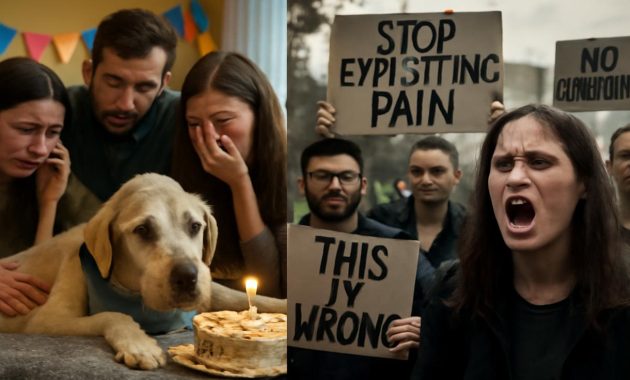
The balloons were the first thing people argued about. Blue and gold, bobbing gently in the late afternoon light, tied to a fence in the backyard where an old golden retriever named Daisy lay on a plaid blanket. She was wearing a paper crown that wouldn’t stay straight on her greying head. Her family had ordered a special dog-friendly cake. There were neighbors and children and phones held high, recording. On the screen, it looked like a celebration. In the comments, it became a battlefield.
The party that broke the internet, and a family’s heart
The video lasted forty-seven seconds. It opened with Daisy’s nose twitching toward a plate of carefully stacked treats. A child’s voice squealed her name. Someone off-camera sniffled. A woman, presumably Daisy’s guardian, knelt beside her, whispering into the fur around her ear. A caption floated over the scene: “Her last day. We wanted to make it perfect.”
The algorithm did the rest. Millions of views. Tens of thousands of comments. Some users sent hearts and crying-face emojis, writing how beautiful it was that Daisy was “getting the goodbye she deserved.” But mixed into the grief and tenderness was an equal and opposite reaction: outrage.
“This is animal abuse. She’s clearly suffering.”
“Why are you filming this instead of just letting her go in peace?”
“You’re doing this for likes, not for her.”
The family who had spent the previous week sleeping on the floor beside their dog now watched strangers dismantle their final attempt at kindness. Their farewell party—balloons, cake, photos, soft music, and long goodbyes—had been born from love. On the internet, it became a spectacle everyone felt entitled to judge.
Somewhere between Daisy’s last biscuit and the final tap of “Upload,” a line had been crossed—or at least, it looked that way from the scrolling side of the screen. The question is: which line, and who gets to draw it?
When love is loud and pain is quiet
If you’ve ever loved a dog—or any animal—through their final months, you know how grief turns ordinary choices into moral minefields. Is she still enjoying her walks, or just pushing herself because it’s what we do together? Is this medication prolonging her life, or her suffering? Are we choosing what’s best for her, or what’s easiest for our hearts?
To the outside eye, compassion seems simple: don’t make a being suffer more than they have to. But in the quiet rooms where these decisions are really made, compassion is messy, subjective, and often shaped by fear: fear of acting too soon, fear of waiting too long, fear of regret that will echo in empty rooms and on leftover leashes for years.
A farewell party is one of those messy decisions formed at the intersection of love and dread. Something about the idea feels deeply human: when we can’t fix what’s broken, we tidy its ending. We bake cakes, invite friends, take photos. We wrap agony in ritual.
Yet livestreamed, edited, and wrapped in music, that ritual becomes something else entirely: not just an act of love, but an act of performance. As more people host “last day” celebrations for their animals—and share them—our private grief collides with a public hunger for content. It’s that collision that makes some viewers furious, others deeply moved, and most of us quietly uneasy.
Compassion, cruelty, and the camera in your hand
On its own, a goodbye party isn’t inherently cruel. A soft blanket, a favorite meal, a sunny spot, all the people who mattered most—those are gifts. Many veterinarians will tell you that “the best last day” can ease not just the animal’s transition, but the human’s unbearable sense of helplessness. It becomes a moment to say everything we don’t know how to say.
The tension arrives the second we hit “Record.” Because then the audience multiplies. The dog is no longer just a beloved family member; she’s also content.
There’s an argument that documenting such moments helps normalize grief, busts the stigma around mourning animals, and reminds the world that animal lives matter. People write in the comments, “I feel less alone,” and you can’t easily dismiss that as vanity. Bearing witness has always been a way humans make sense of loss.
But the other side is harder to ignore: the camera changes behavior. Maybe we hold the goodbye a little longer so we can get a second take. Maybe we place the dog closer to the window for “better light,” even if they’d prefer the cooler floor. Maybe we stay in the room not because they need us, but because the audience does.
None of this automatically makes someone a villain. It does, however, complicate the story we like to tell ourselves: that love and exploitation are easy to tell apart. Our digital world has blurred them until they share the same filter.
What are we really sharing—and why?
If you peel back the outrage, a quieter question emerges: when we share these moments, are we trying to honor the animal—or are we trying to soothe ourselves, curate our grief, and prove (to others or to ourselves) that we did right by them?
Often, it’s both. We’re rarely motivated by one clean emotion. A person can genuinely ache with loss and at the same time crave acknowledgment, reassurance, and connection. Humans are layered like that. The problem is that social media, where Daisy’s party lived and died a second time, flattens those layers. It demands a storyline: tragic, inspiring, heartbreaking-but-beautiful.
In that compressed space, the dog becomes a symbol more than a self: a symbol of “good pet parents,” or of “public cruelty,” depending on who’s writing the caption in their head.
The dog at the center of the storm
There is one voice missing in all of this, of course: the dog’s. We like to imagine what they would have wanted, but we can’t ask them to sign a consent form. Instead, their welfare has to be sifted from small, sensory details: the looseness of their jaw, the softness of their breathing, the flicker—or absence—of interest in a treat. The space between every inhale and exhale becomes a kind of language.
So maybe the more honest question isn’t “Is a farewell party right or wrong?” but “What does this particular animal need, today, at this stage, in this body?” For some, that might be a quiet couch, one human hand, a darkened room. For others, it could truly be a yard full of people they’ve grown up around, the smell of roasted chicken in the air, the familiar rhythm of laughter.
We can’t know from a video whether Daisy’s pain was well managed, whether she was anxious about the crowd, whether she had been given space to rest between visitors. The camera only tells us what fits in the frame. Outrage fills in the gaps with the worst possibilities; sympathy fills them with the best.
In a world that loves quick moral verdicts, it’s uncomfortable to sit with not knowing. But that discomfort might be where real compassion begins—not in certainty, but in humility.
The blurry line we keep pretending is clear
Spend enough time around animal shelters, farms, or veterinary clinics, and you’ll see how wildly people’s ideas of cruelty and kindness differ. One person believes it’s cruel to let a dog sleep in their bed; another thinks it’s cruel not to. One insists that “letting nature take its course” is the most respectful death; another believes that delaying euthanasia by even a day, once suffering is clear, is unconscionable.
Here are a few of the contradictions we live with every day:
| Situation | Seen As Compassion | Seen As Cruelty |
|---|---|---|
| Hosting a “last day” party | Celebrating a life and giving closure | Forcing a sick animal into a performance |
| Choosing early euthanasia | Preventing prolonged suffering | “Giving up” too soon |
| Extending life with treatment | Fighting for every possible day together | Prolonging discomfort for human comfort |
| Not posting about pet loss | Keeping grief intimate and private | “Hiding” the importance of their life |
Each square of the table could be filled with real names, real arguments, real tears. The same act viewed through a different emotional lens transforms completely. Which suggests that what we’re really debating isn’t the dog at all—it’s our own reflection in the glass.
Rituals at the edge of life
Humans have always built rituals around loss. We plant trees, scatter ashes, light candles, wear jewelry containing fur or whiskers. We write letters to the dead, talk to their photos, keep their bowls in the corner longer than we need to. There’s nothing rational about it. That’s exactly what makes it deeply, stubbornly human.
A dying dog’s farewell party fits into that lineage of ritual, updated for a digital age. We have cupcakes instead of funeral casseroles, Reels instead of eulogies. The ritual is both tender and theatrical, heartfelt and highly visible.
If you strip away the cameras, it’s not so different from people gathering around a hospice bed, telling stories that make the patient smile, singing their favorite songs. There is a softness in making the end feel, if not good, then at least not entirely swallowed by fear.
Where it gets complicated is when those rituals are packaged, stylized, and replayed on demand. Culture starts to nudge us: “Is your goodbye beautiful enough? Did you do enough? Did you love enough, publicly enough?” That pressure can shape choices. It can turn a genuine impulse for closure into an obligation to produce something worthy of an audience.
The quiet question behind the outrage
Beneath the fury in Daisy’s comment section lingered another, less loud fear: Will I know what to do, when it’s my turn? Watching someone else’s last day forces us to imagine our own. We interrogate their choices because we’re terrified of our future ones.
Maybe that’s why people seize so fiercely on certainty: “This is abuse,” “This is beautiful,” “This is wrong,” “This is perfect.” If we can pin morality down in someone else’s story, maybe we won’t feel so lost in our own.
But animals don’t need our certainty. They need our presence, our willingness to adapt, our capacity to listen with more than our eyes. Outrage online may feel like a form of protection. It rarely helps the being at the center. Daisy doesn’t read the comments. Her family does.
Finding a kinder middle ground
So where does that leave us, in a world where a dying dog’s last treat can spark a global argument? Maybe not with answers, but with better questions to ask—of ourselves, and of each other.
Before planning a farewell party, sharing one, or condemning someone else’s, we might pause over questions like these:
- Is this animal comfortable right now? What does their body language tell me?
- Am I doing this primarily for them, or primarily for me—and can I adjust my plans to better honor both?
- Would this moment lose anything important if it weren’t filmed or posted?
- If I didn’t have an audience, would I still be making the same choices?
- How will this feel to look back on in five years—for me, for my family? Does it feel like respect, or like a performance?
These aren’t purity tests. They’re lanterns in a very foggy landscape. They won’t erase the sting of criticism or the ache of loss, but they might make our actions a little more aligned with the being whose life is actually ending.
And if we’re viewers, drifting past someone else’s raw goodbye on a tiny screen, maybe our questions shift too:
- Do I have enough information to fairly judge what’s happening outside this frame?
- Is my comment likely to help anyone, or am I reacting to my own fear and grief?
- If I’m truly worried about the animal’s welfare, can I respond with curiosity instead of attack?
It’s possible to be unsettled, to disagree, to feel that you would never do such a thing—and still leave room for the reality that most people standing beside a dying animal are doing their clumsy best with an impossible task.
Where compassion ends—and where it might begin again
We talk about compassion as if it’s a solid line between care and harm, but life with animals keeps proving it’s more of a shifting shore. The tide comes in—new knowledge about pain management, stress signals, quality of life. The tide goes out—old habits, old myths about “stoic pets” and “natural deaths” resurface. Our understanding changes. So should our judgments.
Maybe compassion doesn’t end where someone else’s choices differ from ours. Maybe it ends when we stop being willing to imagine complexity—when we see a balloon and assume a motive, when we see a trembling leg and assume no one cared enough to notice.
The paradox is that our outrage over Daisy’s party sprang, at least partly, from compassion too. People saw a creature in potential distress and felt something twist inside them. They wanted to protect her; they just had no way to reach her except through accusation.
But there is another option: to let that twist in our chest guide how we show up for the animals in our own circles. To learn more about their signals of stress and comfort. To talk frankly with veterinarians about end-of-life care before we’re staring down an emergency. To build our rituals around their needs first, and our desire to remember second.
Some future farewell will unfold in a backyard, or a living room, or a quiet clinic room with a fleece blanket on the floor. There might be balloons, or there might be only a hand resting steadily on a frail ribcage. There might be a camera, or just the unrecorded tremble of a final breath. The dog won’t measure our love by our decor or our captions. They’ll know it in the way we read their body, respect their limits, and let them go before the world turns to all pain and no more joy.
In the end, the question isn’t whether a dying dog’s farewell party is honoring love or exploiting pain. It’s whether, in those last shared hours, we are brave enough to center the one being who cannot speak—yet feels everything.
FAQ
Is it ethical to throw a “last day” party for a dying dog?
It can be, if the dog’s comfort is the first priority. That means managing pain, avoiding overwhelming crowds, and watching their body language closely. A gentle, low-stress celebration tailored to what the dog still enjoys can be kind; a noisy, demanding event that ignores signs of distress is not.
How can I tell if my dog is too sick or stressed for a farewell gathering?
Look for signs like heavy panting at rest, trembling, hiding, turning away from touch, refusing food they normally love, or trying to leave the situation. If they seem shut down or distressed rather than relaxed or curious, it’s better to keep things quiet and simple.
Should I film or post my pet’s final moments?
That’s a personal choice, but it’s worth asking whether recording changes how present you can be. If you choose to film, consider capturing small, calm moments rather than the actual euthanasia, and think carefully before sharing publicly. Once posted, you can’t control how others will react.
How do I balance what I need for closure with what my animal needs?
Start with their physical comfort and emotional state, then adapt your rituals around that. You might write letters, create a photo book, or hold a memorial with friends after they’re gone, instead of doing everything on their last day. Closure for you doesn’t have to happen in the same moment as their goodbye.
What’s the most important thing to focus on during a pet’s final day?
Presence. Whether the day is quiet or gently celebratory, being calmly, fully with them—touching them, talking softly, offering familiar comforts—matters more than decorations or plans. Your steady, loving attention is what they’re most likely to feel and remember, in whatever way animals remember at the end.