The first sign was not the orcas themselves, but the way the sea went still—as if someone had pressed mute on the ocean. Wind dropped. The slap of waves on hull faded to a hush. The men on the small fishing boat traded a look that said, wordlessly, something’s here. Then a dark fin carved a precise black line through the surface, just off the starboard bow.
When the Ocean Steps Closer
Fishermen are not easily rattled. They spend their lives in the in-between places, out where the coastline is a thin, distant smudge and the seabed falls away into ink. But that afternoon, a few miles off a rocky headland, even the most seasoned among them felt the sea shift from familiar to watchful.
The boat was nothing special—a hardworking, paint-scuffed 30-footer rigged for bottom fishing. The deck carried the day’s smell: old bait, diesel, salt, and fish scales ground into textured fiberglass. A cooler clacked softly as it knocked against the gunwale with each lazy swell.
They had been setting up on a productive patch of reef, dropping baits down toward snapper and grouper that rose from the deep like cautious ghosts. The anchor line stretched away from the bow, tight and humming with the underwater drag, a simple rope bridge between hull and seabed.
Then the orcas arrived.
“First, you feel it in your chest,” one of the fishermen would later say. “You don’t see them yet, but the water… it feels full.”
They came in from the outer blue—sleek, black-and-white shapes, large as trucks but moving with the soundless grace of swallowtail swallows. One surfaced off the port side, its exhale a sudden, explosive whoosh that made everyone on deck flinch. Another rolled just beneath the surface, white saddle patch flashing like a signal light.
For a few long moments, no one said anything. The engine ticked in idle; the lines hung still; the anchor rope thrummed like a nerve. Orcas are not strangers to fishermen, but they’re never ordinary. They’re a presence that rearranges the mood on the water. This pod had the deliberate, assessing air of hunters between decisions.
Black-and-White Shadows Under the Hull
“They came right under us,” remembered Dan, a skipper with thirty years of creases at the corners of his eyes from squinting into sun-glare. “You could feel the hull vibrate when they passed. They weren’t scared. They were… curious. Or deciding something.”
One orca paused just off the bow where the anchor line met the water, its vast head gliding close as if inspecting it. Another surfaced with a slow, theatrical spin, showing off that tall dorsal fin like a banner.
On the boat, adrenaline climbed like the tide. Orcas near a small craft are awe-inspiring, but they’re also power made visible. Every splash sounded louder. Every breath seemed shallow. The men’s hands tightened on railings, on phones pulled out half for video, half for talismanic security.
“Nobody wanted to say it,” another fisherman recalled. “But you’re thinking—what do they want from us? The fish? The boat? Just a look?”
Still the orcas circled. They moved in overlapping loops, cutting silvery wakes, occasionally slipping entirely from sight to become a heavy, unseen presence beneath the hull. The anchor line shivered every time one passed near it, as though the rope itself had learned fear.
That’s when the first shark arrived.
Teeth in the Quiet Water
It came in from down-swell, a dark, purposeful triangle slicing the faint chop. Then another triangle. Then three. The men on deck watched the water redraw its hierarchy in real time: apex meeting apex, black-and-white against gunmetal gray.
“We didn’t notice them right away because we were staring at the orcas,” one fisherman would later explain. “Then I see this grey torpedo shape, and it’s coming straight for the anchor rope.”
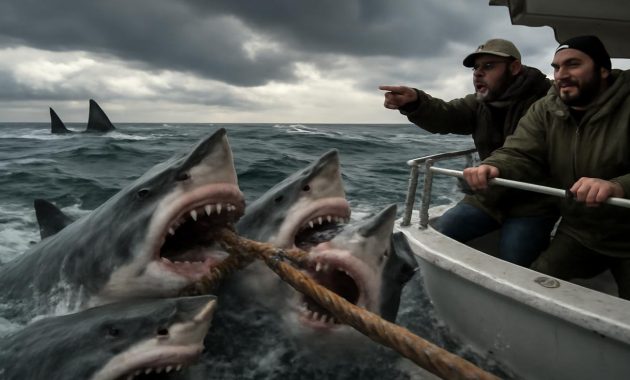
The shark, broad-shouldered and muscular, didn’t even hesitate. It swerved once at the shadow of the bow, then lunged at the taut line with a sudden, violent snap of its head. The rope jolted. The boat lurched forward a fraction of an inch.
“You hear it before you really understand it,” Dan said. “This crunch, like somebody biting into a wet branch. And your brain needs a second, then you go—that’s the boat. That’s our anchor.”
The men scrambled to the bow, boots clattering on metal hatches. The anchor rope hovered, half-submerged, vibrating like a plucked string. Just below the surface, an indistinct, pale mouth clamped around it, serrated teeth working methodically.
Then another shark joined in.
The second shark—a bit smaller but no less determined—charged the line from below and tore a fraying chunk out of it. Loose strands floated up, pale in the green water like the guts of a jellyfish. The rope sagged, tension giving way to a sickening slack.
“I’ve seen sharks bite fish, I’ve seen them go after propellers, but I’d never seen them target a rope like that,” one deckhand said. “It was like they were trying to cut us loose.”
Orcas Above, Sharks Below
The scene tilted into something close to surreal. Above, the orcas held their circling pattern, occasionally surfacing with a heavy sigh and a slab of dorsal cutting the air. Below, the sharks gnawed and wrenched at the anchor line with a focused fury that made the water boil around their heads.
The fishermen shouted over one another—“Kill the engine?” “No, keep it on!” “We’re losing the anchor!”—but no one moved to lean too far over the bow. Every instinct screamed against putting fingers or forearms anywhere near that frothing patch of water.
Another violent tug. The boat jerked sideways, nose swinging off its original point. The rope grated against the bow roller with a harsh, sawing sound. One of the sharks shook its head the way a dog worries a rope toy, white belly flashing as it rolled.
Then, as if answering some signal the humans could not perceive, all three sharks let go at once and glided back a few feet, circling. The rope hung shredded and half-severed, only a few tough strands still connecting boat to unseen anchor.
“It was like they stepped back to see what would happen,” Dan said. “And the orcas were right there, too, like they were all watching the same thing.”
When the Sea Tests the Knot
Picking up a shark-damaged anchor rope while orcas circle and sharks hover below is the kind of practical problem that arrives wrapped in raw fear. The solution is obvious—either cut free or haul fast—but executing it requires leaning into the very space your instincts scream to avoid.
“We had a second where nobody moved,” one fisherman said. “Just this thought in my head: We’re a toy right now.”
The skipper made the call fast. “We’re cutting it,” he snapped. “Forget the anchor. Grab the knife.”
But the rope, brutalized though it was, still carried weight. The anchor, somewhere below, clung to rock. The remaining strands were stretched and singing, sawing against steel. One wrong move, and it could whip back with enough force to break fingers, maybe worse.
As one deckhand reached for the forward cleat, a shark surged up again and clamped down halfway between the waterline and the bow roller. Its eye, cold and black, surfaced for a flicker of a moment, reflecting a warped image of the hull.
“I’ve never locked eyes with something that was biting my gear before,” he said later. “It felt… intentional. I know that’s not scientific, but that’s how it felt.”
The rope snapped.
There was no cinematic crack, just a low, brutal thump and a sudden freedom underfoot as the boat sprang backward an inch, then rocked gently, unmoored. Loose ends of the rope flailed and splashed, one end disappearing into the depths, the other slapping aimlessly against the hull.
For a moment, no one breathed.
Then the sharks drifted away, unhurried, as if they had accomplished something subtle and deliberate. The orcas slid a little farther off as well, their arcs widening, their interest diffusing.
“They cut us loose,” Dan said. “That’s what it felt like. Sharks took our anchor, orcas kept us busy. And we’re just standing there wondering what we were in the middle of.”
Predators, Patterns, and Theories
Stories like these have begun to stack up along coastlines where orcas, sharks, and fishing boats share water. Not every account is as dramatic, but a pattern whispers through them: orcas close in, tension spikes, sharks arrive, anchor lines or gear get bitten, and somewhere between the obvious facts and the unknown motives, anxiety sets in.
Marine biologists are careful with words like “strategy” and “coordination,” but they also know this: both orcas and many shark species are problem-solvers. Orcas are known to steal fish off longlines, to disable rudders, to teach one another new hunting techniques. Sharks, especially large coastal ones, respond quickly to the smell and sounds of feeding or stress, following opportunity like a shadow.
In water where one apex predator is hunting, another often appears. It’s not a friendship—it’s competition at the top of the food web. But to the humans in the middle, it can feel like the ocean is thinking around them.
Consider a typical moment on a boat in such an encounter:
| Moment | What the Fishermen See | What Might Be Happening Below |
|---|---|---|
| Orcas approach the boat | Circling, surfacing near hull, inspecting lines | Orcas following sound of engine, smell of catch, or investigating structure |
| Anchor line tightens | Boat held firmly; faint vibration in rope | Anchor lodged on reef where prey species shelter |
| Sharks appear | Fins approaching from different directions | Drawn by disturbance, potential feeding activity, or stress cues from other predators |
| Sharks bite rope | Anchor line thrashing, chunks torn away | Mistaking rope for prey, testing object, or reacting to vibrations and scent on fibers |
| Boat drifts free | Anchor lost, distance slowly growing from reef | Predators left with undisturbed structure and potential prey beneath |
Whether the sharks are “trying” to sever the boat from the reef—or simply treating the rope as an intriguing, bait-scented object in their hunting zone—remains a mystery best answered with careful study, not only with dockside storytelling.
But for the people on board, staring down at torn fibers and teeth marks, the theory that matters is the one written in adrenaline: something big and wild just took hold of the only line tying you to the seafloor and decided it was negotiable.
Between Awe and Unease
In port, once the boat is back against weathered timber and the deck hose has washed away the blood and bait, the story takes on edges and echoes. Words sharpen. Hands trace the width of the sharks, the stalk of the orcas’ fins. Laughter returns, but it is the kind that lives close to nerves.
“You don’t sleep the same that night,” said one fisherman. “You’re proud you saw it. You’re scared you were there. You’re replaying every second.”
What lingers is not just the sight of sharks biting rope or orcas circling like living submarines, but the sudden rearrangement of one’s own place in the pecking order. A human on land is architect, driver, builder. A human at sea, in a small boat, between orcas above and sharks below, is something else: a guest with questionable insurance.
These encounters jar loose a kind of primal humility. The boat’s fiberglass and metal—so solid at the dock—feel, in hindsight, like eggshell and foil. The thick anchor line, once a symbol of security, now wears bite marks like a reminder: down there, in the green dark, your safety is negotiable, and the negotiators have rows of serrated teeth and sonar you can’t hear.
And yet, almost all of the fishermen who tell these stories will be back out within days. They patch the rope, or buy a new anchor, but they carry the encounter with them like a quiet superstition. A new, slightly longer pause before dropping the hook. An extra glance over the rail whenever a dark shape moves below.
Reading the Water Differently
For some, the experience becomes a lens for seeing the ocean in sharper focus.
“I used to think of sharks and orcas as separate stories,” one deckhand said. “Now I see them as chapters in the same book. You realize you’re not just fishing. You’re stepping into this whole network of who’s hunting what, who’s watching who.”
The next time they set the anchor on that same reef—or one very much like it—the sounds are the same: chain rattling, rope hissing through a gloved hand, weight dropping into depths. But inside, the fishermen are tuned differently. Every tug on the line is a question. Every distant fin carries a memory.
They talk more, these days, about what it means to share water with creatures whose lives and intelligence are still only partially mapped. About whether patterns of sharks biting ropes, or orcas investigating hulls, will grow more common as fishing pressure increases and habitats shift. About what responsibility they bear to pay attention, not just to the catch, but to the quiet messages in these encounters.
Because in that moment when sharks sheared their anchor free just after orcas closed in, they were not only frightened. They were, for a brief, electric stretch of time, utterly awake—sharply aware of the thinness of fiberglass, rope, and human certainty in a world of deep, layered intentions.
Listening to the Tension
There is a sound the ocean makes when tension runs through it: a hum in a tightened rope, a bitten line, a hull pinned between surface and seafloor. On that day, with orcas circling above and sharks turning below, the fishermen stood on that tension like a stage.
They felt it in the tremor under their boots, in the bite of rope fibers in gloved hands, in the way their own heartbeats seemed to sync with the slow surface roll of a passing killer whale. And when the sharks finally bit through and the tension snapped, they felt the boat shift beneath them in a way that none of them will ever quite forget.
Stories of sharks biting anchor ropes after orcas close in will go on circulating along harbors and over beers; some will stretch, some will compress. But inside each one is the same quiet core: a human realizing, deeply and suddenly, that out there, on the open water, the script is not theirs to write.
They are characters in a story the sea tells about itself—sometimes terrifying, always bigger than any one boat—and occasionally, when sharks chew through their anchors and orcas measure their hulls with black-and-white eyes, they are granted front-row seats to the unedited version.
FAQ
Why would sharks bite an anchor rope?
Sharks rely on smell, vibration, and electrical cues more than sight. A bait-scented, tensioned rope moving in the water can trigger investigation or feeding behavior. They may mistake it for prey, respond to vibrations, or simply test an unfamiliar object. Intentional “cutting loose” of a boat is unlikely to be fully deliberate in a human sense, but the outcome can feel that way to those on board.
Are orcas and sharks working together during these encounters?
There is no strong evidence that orcas and sharks coordinate in a cooperative way. More likely, both are responding to the same cues: fishing activity, struggling prey, or disturbances on a reef. As apex predators, their paths often intersect around opportunity, which can create the impression of a joint operation from a human perspective.
How dangerous are these situations for fishermen?
Physically, most encounters end without injury. The main risks are losing gear, sudden movement of the boat when a line snaps, and the chance of someone falling overboard if they lean too far while handling damaged ropes. Psychologically, the fear factor is high, and it can change how crews perceive safety at anchor.
Can orcas intentionally damage boats?
In some regions, orcas have been documented interacting with rudders and hulls, sometimes causing significant damage. Whether this is play, learned behavior linked to past negative experiences, or exploratory behavior is still debated. Most orca-boat interactions, however, remain non-destructive and brief.
What should crews do if sharks start biting their anchor line?
Safety comes first: avoid leaning over the rail, keep hands clear of tensioned rope, and be ready to cut the line to prevent dangerous snap-back if it parts under load. Starting the engine, maintaining situational awareness, and calmly coordinating action on deck are key. Losing an anchor is better than risking serious injury.