The sky changed first. It went from an ordinary pewter gray to something heavier, denser, like a lid being lowered over the world. People remember that. They remember how the light flattened, how the cold crept under doors and into bones. The snow hadn’t started yet, but the feeling had—a quiet, electric sense that something big was coming. In living rooms and break rooms and gas stations, the same alerts pinged on screens: a sprawling winter system was gathering strength, feeding on Arctic air and Atlantic moisture, preparing to roll across a continent like a slow, grinding tide. Scientists had been warning about this kind of storm for years. Now, they said, the conditions were finally aligning for something we have never truly seen before.
The Storm the Models Didn’t Want to Believe
Long before the first flake drifts past a window, a storm exists as numbers and color fields on a scientist’s monitor. In a dim lab lit by multiple screens, meteorologist Dr. Hannah Ruiz drags her cursor across a map that looks, frankly, impossible. The blues and purples of heavy snowfall bloom over an area that spans from the Great Plains to the Eastern Seaboard, folding in major cities, mountain passes, and entire highway networks like they’re mere footpaths on a topographic map.
“We reran it three times,” she says, recalling the first model output that truly scared her. “The totals kept going up. The wind fields got stronger. Every time we tried a different initialization, it came back the same or worse.”
The system has a name that sounds almost dull: a coupled Arctic-Atlantic superstorm, a freak convergence of polar vortex disruption and a hypercharged atmospheric river. But the lived reality it suggests is anything but dull. Hannah zooms in closer. In some zones, the model paints four, five, even six feet of snow over just a few days, driven by near-blizzard or full blizzard conditions, with gusts hitting hurricane-force in coastal areas and along exposed ridges.
Most people understand a “big snow” as a sort of seasonal curiosity—kids off school, plows leaving mounded walls at the end of driveways, social media feeds filling with photos of snowmen and steaming mugs. But the system showing up on Hannah’s screen crosses a threshold. It’s not about inconvenience; it’s about infrastructure, emergency response, and what happens when the systems we count on are buried, broken, or simply unreachable.
When Every Road Becomes a Dead End
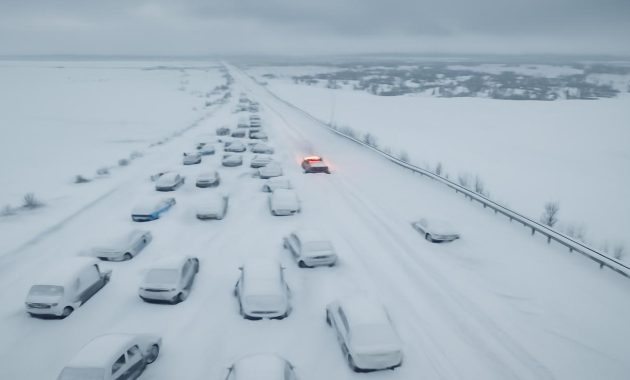
Emergency planners have a term for it: loss of access. It sounds sanitized, bureaucratic. But out on the roads, it looks like this: a line of ambulances idling at the edge of a town, lights flashing silently into a whiteout, unable to push forward because the snow has drifted into towering, shifting barricades. A snowplow, already working on its twelfth straight hour, bogs down in a drift that’s grown taller than its blade. The operator tries to back out and can’t.
“We build our response systems on the assumption that at some point, someone can get to you,” says Captain Ron McAllister, who’s spent twenty years in fire and rescue in a mountain-border town already used to tough winters. “Maybe not fast, maybe not comfortably, but we get there. With a storm like the one we’re seeing in these projections, there are just… places we won’t be able to reach. Not for a while.”
The models suggest not just heavy snowfall, but sustained snowfall, driven by a stalled jet stream pattern that locks the storm in place. That’s what unnerves people like McAllister and the scientists advising him. A standard blizzard moves through in a day or two; crews dig out, mutual aid arrives from neighboring counties, and life limps toward normal. In this scenario, the storm sits and breathes and deepens. Snow that was once knee-high becomes waist-high, and then chest-high. Secondary roads vanish first, then even the big arteries begin to choke.
Think of snow removal like triage. Plow crews prioritize major routes—interstates, hospital corridors, fire station access. Residential streets, rural lanes, and remote driveways fall to the bottom of the list. Under normal circumstances, people grumble and wait. Under this storm, waiting might mean more than cold toes and cabin fever. It might mean a diabetic watching their insulin run low, an oxygen tank reaching its final hours, a pregnant woman’s contractions growing closer with no way out.
The Fragility Beneath the White Blanket
Snow is quiet. It arrives without sirens or thunderous cracks—just a soft hiss against windows, a gentle stacking of white on railings and branches. It’s easy, especially from the warmth of a living room, to see it as merely beautiful. But beneath that soft, cosmetic layer lies a meticulous network that keeps modern life humming, and every one of those threads is vulnerable.
Power lines sag under the combined weight of ice and snow, then snap in the wind like overburdened twigs. Substations, their equipment never designed for such prolonged cold, begin to fail. Crews, who would normally fan out with bucket trucks and repair kits, find themselves cut off by drifts and abandoned cars stranded in the road. In some regions, snowfall like this also risks collapsing flat roofs—warehouses, gyms, big-box stores—where accumulated snow can weigh as much as several cars pressing down on structurally stressed beams.
Water infrastructure is no safer. Deep cold penetrates soil and old, poorly insulated pipes freeze and burst. The same trucks that would respond to a water main break are now pinned in by snow or diverted to higher-priority emergencies. Sewage systems, already taxed, can back up when pumping stations lose power and backup generators run dry.
Consider how much of our world relies on things moving: trucks carrying food and medicine, trains hauling heating fuel, technicians driving between cell towers. When a storm seals roads and rail lines, that movement stops. Shelves empty, not in a cinematic, panic-buying scene, but slowly, shelf by shelf, as resupply simply fails to arrive. In rural communities, where a single small grocery store serves hundreds of square miles, the effect compounds quickly.
Overwhelmed Before the First 911 Call
The scientists warning about this storm aren’t just meteorologists. They work in climate, hydrology, emergency management, infrastructure engineering. And increasingly, they speak the same language: compounding risk.
“We get in trouble when we think in silos,” says Dr. Malik Sorensen, a climate risk analyst who advises several regional governments. “We say, ‘Can the power grid handle this? Can our ambulance fleet handle this?’ But the real question is, what happens when the grid is strained, the ambulances can’t reach people, the hospitals lose backup power, and the roads are impassable—simultaneously?”
In tabletop exercises—those quiet, behind-the-scenes war games where agencies rehearse disaster—this storm already exists. Teams spread out maps, push colored markers representing plows, medics, and utility crews. Within hours of simulated heavy snow, the board clogs. Within a day, 911 calls are stacked, response times multiply, and resource tokens run out.
“Our emergency services are designed around peaks, but they’re still human systems,” Malik explains. “Crews get exhausted. Radios fail. Dispatchers are listening to voices shake on the other end of the line, and they have to say, ‘We can’t get to you yet.’ There’s a psychological toll that’s hard to quantify and even harder to prepare for.”
This is what keeps emergency planners awake: the mismatch between public expectation and physical reality. People assume that somewhere, there will always be a plow. Always be an ambulance. Always be a helicopter that can fly through anything. But high winds can ground air rescue. Whiteout can blind even the most experienced snow driver. And resources are finite.
Whole Regions, Briefly on Their Own
Perhaps the most unsettling phrase scientists use about this storm is “temporary isolation.” It’s the idea that, for a span of days or maybe weeks, certain towns, valleys, or stretches of countryside will function like islands, abruptly cut off from wider support.
We’re not used to thinking that way. We live inside a vast mesh of logistics and communication. A storm might delay a package or slow traffic, but it rarely severs the web. In the scenario Hannah and Malik are outlining, that web frays—and in some places, snaps.
Phone networks can falter when towers lose power or suffer damage from ice-laden branches. Internet service, already patchy in many rural areas, can drop completely. For some households, this means losing streaming shows and email. For others, it means losing access to telemedicine, banking, even the digital maps that show alternative routes.
Inside those cut-off pockets, life narrows. Neighbors knock on each other’s doors not for small talk, but to check on who has a generator, whose woodpile is big enough to share, whose pantry might stretch to cover the elderly man three houses down. The soundscape changes too: fewer passing cars, more distant rumble of overstrained generators and the crack of overloaded tree limbs splitting under snow.
Local officials have quietly begun asking themselves difficult questions: If your town becomes an island for ten days, what happens to the dialysis patients, the seniors on daily meds, the families heating with electric pumps on fragile lines? Which building could serve as a warming shelter, and does it have enough backup fuel for a week in sub-freezing temperatures? Who has snow machines, tracked vehicles, or even just strong backs and shovels?
What Preparation Looks Like When the Scale Shifts
Preparation for such a storm isn’t about panic—it’s about shifting from a mindset of “someone will come” to “we may need to bridge a gap before help arrives.” Scientists and emergency managers aren’t telling people to build bunkers. They’re asking them to imagine, with uncomfortable clarity, what three, five, or seven days of isolation in deep winter might require.
They talk about the basics: water, heat, food, light, medicine. But they also talk about relationships. In nearly every disaster after-action report, one pattern stands out: communities with strong neighbor-to-neighbor ties fare better. A single snowblower shared among four households, a teenager who checks on three homebound elders, a church that quietly stockpiles blankets and propane heaters—these become as critical as any official “resource cache.”
To put this into perspective, imagine the gap between an ordinary winter storm and the unprecedented system scientists are describing:
| Aspect | Typical Big Snowstorm | Unprecedented Snow System |
|---|---|---|
| Snow Duration | 12–36 hours | 3–7+ days with waves of heavy snow |
| Total Accumulation | 6–18 inches typical | 2–6 feet in large areas, more in drifts |
| Road Impacts | Major roads cleared within 1–2 days | Major roads blocked for days; secondary roads for longer |
| Emergency Services | Delayed but functional | Large areas unreachable; 911 overloaded |
| Infrastructure Risk | Localized outages, minor damage | Widespread power, water, and communication failures |
In meetings where these tables are printed and passed around, the mood is rarely dramatic. It’s quiet, focused, tinged with a kind of sober determination. People take notes. They circle phrases like “mutual aid exhaustion” and “extended isolation window.” They know, perhaps better than anyone, that you cannot plow your way instantly out of three or four feet of snow spread across thousands of square miles.
The Climate Thread Running Through the Snowflakes
Behind the warnings about this particular storm lies a deeper, less visible story: the way a warming climate is re-tuning winter itself. At first glance, it might seem contradictory. Warmer planet, bigger snows? But the physics is simple: warmer air holds more moisture. When that moisture-laden air meets deep cold, the result can be explosive.
“We’re seeing an amplification of extremes,” Hannah says. “Shorter average winters in many regions, but when the pattern locks in, it can be brutal. The atmosphere has more fuel now.”
Storms like this proposed super system sit at the intersection of two trends: the wobbling, disrupted polar vortex that can send frigid air pouring south, and increasingly saturated storm tracks that can wring out staggering amounts of precipitation. Add in long-term changes to sea surface temperatures and snowpack dynamics, and the stage is set for events that don’t line up neatly with our historical memory.
There’s a psychological lag, too. Many of the buildings we live and work in were designed for a past climate. Their roofs were engineered to withstand “100-year snow loads” defined by data that no longer describes the future. The backup generators at critical facilities were sized for outages measured in hours or a day or two, not an extended week-long siege of cold and darkness.
When scientists warn about an unprecedented snow system, they’re not only talking about one storm. They’re talking about a new category of risk that nudges us to update our mental maps, our building codes, and our emergency playbooks.
Telling the Story Before the Snow Falls
One of the quiet challenges in all of this is narrative. How do you get people to care about a storm that hasn’t formed yet? How do you convey urgency without collapsing into alarmism, or detail without numbing people into inaction?
“It’s a story problem as much as a science problem,” Malik admits. “If we show people a map smeared in dark blue and purple, their eyes glaze over. But if we say: imagine waking up and your town’s only road out is gone under six-foot drifts, the power has been off for eighteen hours, your phone has 12% battery, and your mother’s medication runs out tomorrow—that lands differently.”
The aim isn’t to paralyze, but to invite participation. In community halls and online town halls, planners are beginning to ask residents to imagine their own stories in such a storm and then to work backward: What would have made that story less frightening? What could you, personally, your block, your building, have done beforehand?
You can hear the shift in the questions that follow. Not “Will the government rescue us?” but “Who on my street has a generator?” Not “Will the store stay open?” but “Can we form a neighborhood supply list and share what we have?” When people stop seeing themselves as passive characters in nature’s drama and start understanding their role as co-authors, the bleakness of a storm like this becomes, if not smaller, at least more navigable.
After the Thaw, Before the Next One
All storms, no matter how fierce, eventually end. The snow tapers, the wind softens, a hesitant sun breaks through. Plows, finally, begin to nibble open corridors. Helicopters trace new routes overhead. The maps in emergency command centers slowly shift from red to amber, then to the calmer gray of “under assessment.”
In the imagined aftermath of this unprecedented snow system, what remains is not just damaged roads and bowed fences. It’s a mosaic of stories: neighbors who became lifelines, systems that failed surprisingly fast, improvisations that worked far better than expected. It’s a reckoning with which parts of our infrastructure proved brittle and which proved surprisingly resilient.
Scientists like Hannah will be there too, poring over data from satellites, weather stations, and community reports, feeding that information back into the models. Malik and his colleagues will sift through the emergency response records, looking for patterns—places where communication broke down, where resources didn’t match needs, where a simple change could save lives next time.
Because there will be a next time. Maybe not identical, maybe not in the same region, but as the climate continues to shift, the boundaries of what’s possible in a winter storm are being rewritten. The warnings about this system are not a one-off alarm; they’re part of a growing, urgent conversation about how we live in a world where the familiar seasons now carry unfamiliar teeth.
Between the flakes and the forecasts, between the quiet beauty of a snowfall and the roaring machinery of a modern city, lies a simple, fragile question: when nature presses hard on our systems, do we bend, or do we break? The scientists raising their voices about this storm are not doing it to scare us, but to buy us time—to let us shore up the places that might snap, to knit community ties a little tighter, to stock not just our pantries, but our shared sense of responsibility.
Outside, the sky is still calm. The snow may not arrive this week, or this month, or perhaps not quite in the shape these models currently sketch. But the potential is there, coiled in the changing currents of air and sea. How we use this warning—this brief, precious window before the clouds knit themselves and the first flakes fall—is up to us.
Frequently Asked Questions
Why are scientists so concerned about this particular snow system?
They’re seeing a rare combination of ingredients: disrupted polar vortex cold, unusually moist storm tracks, and a stalled jet stream pattern. Together, these can produce extremely deep, long-lasting snowfall over very large regions—enough to overwhelm plows, emergency services, and critical infrastructure all at once.
How could this storm overwhelm emergency services?
When snow accumulates by several feet and wind creates high drifts, many roads become impassable. Ambulances, fire trucks, and utility vehicles can’t reach people who call for help. At the same time, call volumes spike due to medical issues, accidents, and infrastructure failures, creating more demand than crews can handle.
What kinds of infrastructure are most at risk?
Power lines and substations, flat-roofed buildings, water and sewage pipes, cell towers, and transportation networks are all vulnerable. Heavy snow and ice can cause physical damage, while long outages and blocked access make repairs slow and difficult.
Is climate change really linked to bigger snowstorms?
Yes, indirectly. A warmer atmosphere holds more moisture, which can translate into heavier precipitation when temperatures are below freezing. At the same time, changes in the polar vortex and jet stream can allow intense cold to dip south, creating conditions for exceptionally powerful winter storms.
What can individuals do to prepare without panicking?
Focus on being self-sufficient for several days: have water, nonperishable food, ways to stay warm safely without power, a flashlight and batteries, and a week’s supply of essential medications. Get to know neighbors, especially vulnerable ones, and discuss how you might share resources or check on each other during a major storm.
How long could regions realistically be isolated?
It will vary by location, but in worst-case scenarios, some communities could be effectively cut off for several days to more than a week, especially if they’re served by only a few roads or lie in valleys prone to deep drifting.
Are governments changing their plans because of these warnings?
Many regions are quietly updating emergency plans, investing in more resilient infrastructure, revisiting snow-load standards for buildings, and running new kinds of training exercises. However, adaptation takes time and resources, so personal and community-level preparedness remains a crucial part of the picture.