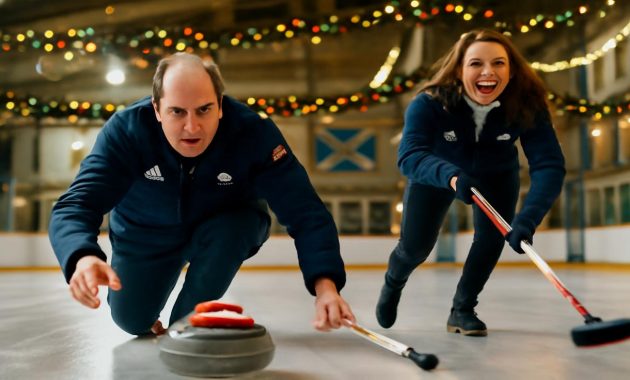
The ice doesn’t look cold from a distance. It gleams—milky, polished, a pale mirror catching the strip lights above. At one end of the rink, a black-and-gold broom rests against the barrier, like an exclamation point left waiting. There’s a hushed murmur rolling around the stands, a swirl of Scottish accents and schoolchildren’s whispers. Then a ripple of laughter runs through the air as two very familiar figures step onto the ice, hesitating for just a fraction of a second before trusting their balance.
William and Catherine, the Prince and Princess of Wales, are in Scotland, and today they’re here not to cut a ribbon or unveil a plaque, but to slide heavy granite stones across a frozen sheet and see who can come closest to a painted circle. It is, officially, a friendly visit. Unofficially, it’s something else: a lighthearted face-off, a royal curling challenge where the stakes are nothing more and nothing less than family bragging rights, a bit of pride, and a roomful of delighted spectators.
A Highlands Welcome on Ice
The chill seeps up through the soles of your boots the moment you step rink-side. It’s not the biting outdoor cold of a Highland winter, but the close, controlled cool of an indoor curling hall—the kind of clean, earthy cold that smells faintly of stone and wet wool. Outside, the Scottish sky is a shifting wash of pewter and pearl, but in here, the ice glows softly beneath fluorescent lights, the air punctuated by bursts of laughter and the occasional clack of stone on stone.
Scotland has a way of folding royalty into its landscape without much fuss. The Prince and Princess of Wales are greeted not with stiff formality, but with warm, almost familial enthusiasm—a few shy bows, more waves, plenty of phones held discreetly aloft. Somewhere, a group of teenagers tries not to look too excited and fails spectacularly.
The couple step forward, each offered a pair of curling shoes. The soles are slick, built for gliding across the ice, and the transformation from elegant royal footwear to functional sports gear is oddly intimate, the way seeing someone put on hiking boots or roll up their sleeves can be. Catherine laughs as she tests her footing, arms out just a little for balance. William jokes with one of the instructors, glancing toward his wife with mock apprehension.
“I’m not sure I should be taking her on,” he says, grinning. “She’s more competitive than I am.”
It’s an easy line, but it lands honestly. There’s a gleam in Catherine’s eye that suggests she’s already plotting her technique. Today, Scotland’s ancient winter pastime is about to become the stage for a very modern kind of royal story—one built on good-natured rivalry, shared laughter, and the kind of unguarded moments that rarely make it onto palace walls.
The Ancient Game Meets Modern Royals
Before the first stone is thrown, there’s a pause for history—because this is Scotland, and here, nothing is ever just a game. Curling is older than most of the buildings in the nearest town, its roots winding back through centuries of frost and thaw, back to when villagers carved their first stones and slid them across frozen ponds under low winter suns.
One of the local coaches, cheeks pink from the cold, runs the royal couple through the basics. The words come out in careful, patient rhythm: house, hog line, guard, hammer. It’s a vocabulary that sounds almost whimsical if you’ve never heard it before, equal parts farmyard and blacksmith’s forge, but on the ice each term carries weight and geometry.
Catherine nods, her eyes following the coach’s gloved hand as it traces invisible lines along the ice, explaining how friction and spin decide everything. William leans forward, studying the polished granite stones, each one hand-crafted and dappled with subtle patterns like galaxies trapped in rock.
The air holds a charge of anticipation now. Staff and volunteers stand just a little straighter. A few schoolchildren press closer to the barrier. In Scotland, curling is more than a sport; it’s a winter ritual, a way of making peace with long nights and short days, a reason to gather and cheer and argue about angles while your breath hangs in the air. To see future monarchs crouched over the ice, brushes in hand, feels *both* extraordinary and completely at home in this setting.
Finally, the moment: the Prince and Princess separate onto their respective lanes, each flanked by teammates—young curlers grinning as they stand shoulder to shoulder with royalty. This is not a solitary challenge. Curling, at its heart, is about trust and timing, a choreography of effort as one person slides the stone and others sweep like their lives depend on it.
A Royal Rivalry in the House
The first stone belongs to Catherine. She steps into the hack—a small foothold carved into the ice—broom tucked under one arm, a coach at her side. You can see her centering herself: shoulders relaxed, chin slightly down, gaze locked on the distant ring of the house at the far end of the rink.
The hall seems to inhale with her. Then she pushes off, gliding forward in a clean, measured motion, one leg extended gracefully behind her, fingertips releasing the stone with a gentle twist. For a heartbeat, there’s nothing but the low whisper of granite across ice.
“Sweep! Sweep!” calls her teammate, and two young curlers spring into action, brushes rasping urgently just ahead of the stone. The sound is something between a rough whisper and sand on glass, a fierce, purposeful scrubbing that leaves a narrow, shining trail.
The stone slows, then nestles into the outer edge of the house—a respectable opener. Catherine’s shoulders drop with relief, and she laughs, glancing back at William with the gleeful look of someone who has just discovered they’re not terrible at something new.
William’s first throw is less graceful but no less determined. He pushes off with a slightly awkward wobble, correcting his balance mid-slide. The stone leaves his hand with a confident spin, gliding straight and true… until, at the last moment, it drifts wide, skirting the house entirely.
The crowd responds with indulgent laughter and applause. William shakes his head, mock-aghast, and gives a theatrical bow. Catherine grins, eyebrows raised in an expression that, in any family on any given weekend, would clearly mean: One–nil to me.
From there, the rhythm of the match picks up. Stone after stone glides down the ice, some too short, some too strong, some colliding with a resounding clack that draws sharp “Oohs!” from the audience. William finds his footing, quite literally, adjusting his slide, listening closely to the quick murmur of his young teammates’ advice. Catherine experiments with different weights, pressing for that elusive balance between power and precision.
Their rivalry never tips into sharpness. It’s playful, threaded with the kind of teasing that only comes from years of lived-in partnership.
“I’ll be hearing about this on the drive home,” William jokes after Catherine lands a particularly satisfying shot, her stone knocking his gently aside and settling closer to the center.
“Only if you remember the score,” she counters, smiling.
Sound, Stone, and Sweep: The Sensory Dance of Curling
It’s one thing to watch curling on television—stones gliding in slow motion, overhead cameras turning the house into an abstract target. It’s another thing entirely to stand rink-side and feel the game in your bones.
The air is a patchwork of textures: the crisp, dry cold biting at cheeks; the faint chemical tang of ice maintenance; the woolly warmth of scarves and hats gathered along the barrier. Every shout echoes: short, sharp commands—“Hard!” “No!” “Whoa!”—bouncing off the walls like small thunderclaps.
Underfoot, the ice isn’t perfectly smooth; it’s pebbled, a faint roughness created by spraying droplets of water that freeze into tiny bumps. It’s this texture that lets the stones curl, that subtle, almost invisible topography determining whether a stone will take the line a player begged for or betray them at the last moment.
William and Catherine are learning this the only way anyone truly does: by feeling it. They lean into each throw a little more, begin to read the ice instead of fighting it. Their laughter rings warmer now, their movements looser, more instinctive.
There’s something deeply grounding about watching them like this—not as distant figures in carefully curated photographs, but as two people trying, failing, laughing, trying again. Their titles haven’t changed, but for this hour they’re teammates, opponents, novice curlers with slightly cold fingers and misted breath, standing at the edge of a sport that has shaped winters in this country for generations.
Community at the Heart of the Rink
Beyond the royal spotlight, this curling hall hums with quieter stories. The volunteers in club jackets who arrived before dawn to prep the ice. The junior curlers who somehow manage to be both utterly thrilled and impressively cool about sweeping for a future king. The grandparents in the back row remembering their own days on outdoor rinks, when the wind cut sharper and the stones didn’t glide quite so predictably.
For the club, today is more than a novelty; it’s a chance to showcase a sport that often lives in the shadow of flashier games. Curling asks for something unusual in our rush-hungry world: attention to detail, patience, an appreciation for inches rather than miles. It rewards strategy as much as strength. It allows room for conversation in between ends, for jokes and gentle ribbing, for comparing notes over hot chocolate or tea.
The Prince and Princess move among these stories with practiced ease but also something gentler—a willingness to listen, to lean close when a young curler explains how they train, to marvel at the weight of a stone, to admit when they misread the ice. When a coach offers a tip, Catherine nods thoughtfully, then immediately applies it to her next throw, eyes narrowing in concentration. William asks questions about local leagues, about how the club brings newcomers into the fold.
In these exchanges, the game takes on a different resonance. It becomes not just a charming photo-op, but a bridge—between royal and local, between tradition and today, between the polished image of monarchy and the rough, pebbled realness of a community rink on an ordinary Scottish day.
| Moment | Prince William | Princess Catherine |
|---|---|---|
| First Stone | Slides wide of the house, greeted with good-natured laughter. | Reaches the outer ring of the house, a solid opening shot. |
| Best Shot | A later stone that finally curls into scoring range after listening to coaching tips. | A precise take-out, gently nudging William’s stone aside. |
| On-Ice Style | Playful, self-deprecating, quick to joke about his aim. | Focused, quietly competitive, eager to refine each try. |
| Interaction with Team | Chats constantly, asking strategy questions between shots. | Listens closely, immediately tries out suggestions on the ice. |
| Overall Vibe | Good sport, happy to be outscored if everyone’s having fun. | Quietly delighted to edge ahead in the friendly rivalry. |
When the Stones Settle
Every game must end, even one that feels more like a shared secret than a contest. The final stones are thrown with the kind of attention you give to last pages in a good book—lingering just a little longer, hoping they slide slowly enough to stretch out the moment.
In the closing end, Catherine lines up her shot with a now-familiar poise, breath visible in the cold. She’s aiming for a narrow gap, a slice of possibility between two clustered stones. Her slide is smooth; the release clean. The stone glides, curves, kisses one rival stone just enough to change its angle, and curls into scoring position. It’s not a perfect shot, but it’s clever and effective—exactly the kind of tactical success curlers chase.
William’s response is valiant. He delivers with more power than finesse, his stone rumbling down the sheet like a promise. For a moment, the line looks promising; then, at the last second, the slightest overcurl sends it nudging his own guard, deflecting just wide. There’s an almost comical groan from the watching schoolchildren, as if a fairy-tale twist has just been narrowly averted.
The scores, when finally tallied, tip gently in Catherine’s favor. She doesn’t crow, doesn’t need to. The small, satisfied smile that touches her face says enough, as does the mock bow William gives her, broom swept dramatically to one side in playful surrender.
“I’ll demand a rematch,” he says to the nearest microphone, though he’s smiling too broadly for anyone to mistake it for real challenge.
The mood softens into that peculiar blend of adrenaline and nostalgia that follows any friendly game. Gloves come off. Stones are pushed carefully back into their racks. In the stands, conversations unfurl: about who played which shot best, about the royal couple’s ease on the ice, about how magical it is to see something so ancient and so ordinary become, even briefly, the center of the nation’s gaze.
Lingering Echoes in a Scottish Afternoon
Outside, the day has shifted. Clouds have thinned a little, letting through a shy wash of winter light. The cold feels different now—less of a barrier, more of a reminder of what just happened under the curling hall’s roof.
For the Prince and Princess, this visit will fold into a long tapestry of official engagements: hospitals and schools, regiments and charities, solemn ceremonies and quiet listening tours. In the grand narrative of monarchy, an afternoon spent sliding stones across ice might seem like a small, almost whimsical footnote.
But small things matter. They accumulate. They echo.
Somewhere in a nearby town, a teenager who watched from the stands will remember the way Catherine crouched to listen when she described her first club tournament. A volunteer will think back to the moment William asked how long it takes to learn to sweep properly, and actually listened to the answer. A young curler will tuck away the memory of seeing a future king and queen wobble, regain balance, laugh at themselves, and try again.
The rink itself will hold traces too. In the faint scuffs on the ice where royal shoes slid awkwardly at first. In the photographs pinned to the club noticeboard, showing the prince and princess mid-throw, backs curved in concentration, stones frozen in motion. In the stories that will be told whenever newcomers arrive: You see that lane? That’s where they played. Yes, those two. They were pretty good, you know. And she won.
In the end, the true victory of the day isn’t held in points or ends or who came closest to the button. It’s in the simple, resonant image of two people stepping onto unfamiliar ground—or rather, unfamiliar ice—willing to look a little foolish, willing to learn, willing to let a very old Scottish game pull them down to earth for a while.
As the cars pull away and the hall slowly empties, the rink returns to its own quiet. The ice waits patiently for the next practice, the next league night, the next burst of late-night sweeping and shouted instructions. Life goes on, as it always does. Yet for those who were there, the memory of royals in borrowed curling shoes will sit like a warm stone in the pocket of winter, something to touch and turn over again on the coldest days.
FAQs: The Royal Curling Challenge in Scotland
Did the Prince and Princess of Wales really compete against each other?
Yes. During their visit to a Scottish curling club, the Prince and Princess of Wales took part in a lighthearted on-ice challenge. They joined mixed teams with local players, but the friendly rivalry between them—who could get closer to the house, who could pull off the cleverer shot—became the informal focus of the afternoon.
Who performed better in the curling challenge?
In the spirit of good sportsmanship, both embraced being beginners, but by the end of the session, Catherine appeared to edge ahead. Her shots found the scoring rings more consistently, and she even managed a tidy take-out that nudged one of William’s stones aside, winning her some playful bragging rights.
Have William and Catherine played curling before?
They are not regular curlers, and their time on the ice was very much that of enthusiastic newcomers. Coaches walked them through the basics—sliding from the hack, releasing the stone with a gentle curl, and coordinating with sweepers. Their willingness to learn, ask questions, and laugh at their own mistakes was part of the visit’s charm.
Why was the curling session held in Scotland?
Curling is deeply rooted in Scottish history and culture, with records dating back to frozen lochs and makeshift stones. Holding the challenge in Scotland celebrated both the sport’s heritage and the strong ties between the royal family and the country, highlighting local clubs and grassroots sport in a place where curling truly belongs.
What was the purpose of the visit beyond the friendly match?
Beyond the lighthearted competition, the visit showcased how community sports like curling bring people together across generations. It highlighted the work of local clubs, encouraged young people to try the sport, and reflected the Prince and Princess of Wales’s broader focus on wellbeing, community, and the simple, connective power of shared activities.