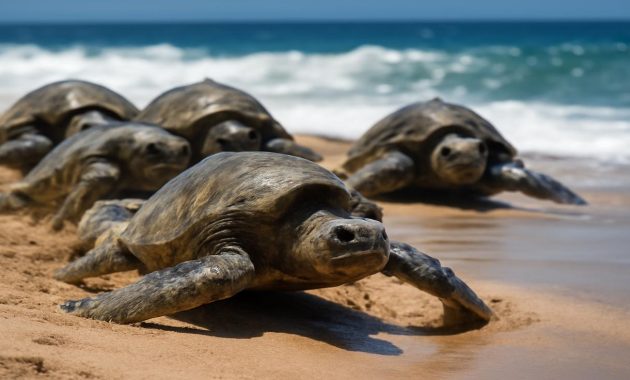
By mid-morning the island looks like a mirage: a pale scimitar of sand drifting in an ocean so blue it seems made of melted glass. The air tastes of salt and sunburn. Waves fold and unfold with a slow, hypnotic rhythm, and just beyond the break, a dark shape rises, gasps the world’s thinnest breath, and sinks again. Another follows. Then another. From shore, they look like rocks surfacing, but each one is a turtle—an ancient, heavy-bodied reptile waging a quiet war beneath the waves.
The island where survival means swimming to the edge
If you came here without context, you’d think this was a postcard paradise. Let’s call it what biologists sometimes do: a “turtle island,” one of those rare places where sea turtles congregate by the thousands. They come for one reason—this is a breeding arena, a hotspot in the ocean where males wait and females arrive loaded with eggs and destiny.
From the boat, the scene looks calm, even lazy. Green turtles—or sometimes loggerheads, depending on the region—glide just under the surface, dark ovals in orchestrated chaos. But watch a little longer and you start to see something unsettling. A single female breaks the surface, her shell scarred and pitted from a lifetime at sea. Seconds later, two, three, sometimes four males converge on her like magnets finding north.
Their flippers thrash, claws scraping her carapace. They climb over her, pushing her down. The sea that seemed so gentle moments before turns into a wrestling mat of foam and tangled bodies. You can hear the slap of shell against shell, the ragged hiss of her breath every time she manages to reach the air. Then, abruptly, she disappears under the crashing surface, buried beneath the weight of determined suitors.
This is where the romantic story of sea turtles—tragic migrations, moonlit beaches, emerging hatchlings—cracks open and shows its harsher core. Biologists have a phrase for this scene: male harassment. And in waters like these, it’s not a side note in the turtles’ lives; it’s a force that shapes their behavior, and sometimes, their deaths.
When mating turns into a gauntlet
We like to imagine wild animals finding partners through courtship, maybe a little competition, and then a clean, tidy pairing. Sea turtles shatter that illusion. For females, the breeding season can be a months-long onslaught. They don’t just mate once; they may be approached over and over, grabbed, bitten, mounted in churning, frantic encounters that leave deep gouges on their shells and torn skin at the edges of their flippers.
Males, smaller and lighter on average, are built for persistence. They have long, curved claws on their front flippers and a tail that anchors them in place during mating. Once a male manages to climb onto a female’s back, he hooks in and hangs on, sometimes for hours. In a calm sea, with only one male, this is risky but survivable. In a place like this island—where males vastly outnumber available females—it can be catastrophic.
Other males don’t politely wait their turn. They ram the pair, snap at the mounted male’s head and flippers, try to wedge themselves between bodies. In the chaos, the female is forced down, down, down. She’s strong, but she is also air-breathing, lugging a massive body that must eventually surface. Every second spent trapped beneath a writhing pile of shells is a second her oxygen debt grows, her muscles burn, her brain calculates risk the way evolution has taught it to.
From shore, this looks like brutality. And in a sense it is. But under the violence is a simple, indifferent logic: males compete; females bear the cost. Here, those costs don’t end with exhaustion and scars. Sometimes, they end with a choice no one expected to discover—females swimming to a suicidal edge to escape the attention that could drown them.
The cliff at the edge of the world
At one side of this island, the reef falls away like the lip of a continent. One moment the water is a clear, shimmering turquoise; a few strokes farther and the color plunges to an impossible cobalt, then near-black. The seafloor here drops so abruptly it feels vertical—an underwater cliff face falling hundreds of meters into open ocean.
Turtles know this edge. You can watch them move along it like travelers walking the border of a country that offers both sanctuary and danger. In the shallows, males patrol, waiting for females to approach the breeding ground. Farther out, the deep blue is quieter, emptier, almost eerily so. A few sharks may cruise along the ledge, but otherwise the water is open, endless.
When researchers followed female turtles tagged with small, non-invasive trackers, they noticed a strange pattern. During the most intense weeks of the breeding season, when males were most aggressive, certain females didn’t stay near the safe, shallow reef. Instead, they swam straight out to the ledge and then beyond it, dropping into deeper water where the males were far less common.
On paper, it looked almost like desertion. Biologically, it looked like desperation. In those deeper waters, the currents can be strong, the energy cost of swimming is high, and the visibility shrinks. Predators are rarer, but so are refuges. Stay out there too long and a turtle can starve, run out of energy, or simply fail to make it back to nest.
A few never did come back. Biologists began to realize that from a cold evolutionary perspective, some females were taking a gamble so extreme it bordered on what humans would call self-destructive: swimming to places where the chance of dying alone in the blue was still better than the immediate, suffocating risk of being pinned and drowned close to shore.
“Killing themselves” isn’t quite right—but it’s not entirely wrong
No turtle is consciously deciding, “I’d rather die than be harassed.” That’s our language, our projection. What’s happening instead is an evolutionary tightrope act. Each female is carrying a finite store of energy, a season’s worth of eggs, and an ancient set of instincts: avoid injury, breathe, reproduce, then survive to do it again.
When the males become too many, the cost of staying near the island skyrockets. Every encounter means more energy burned fighting off suitors, more time spent underwater during violent mating attempts, more risk of injury or outright drowning. In that moment, swimming away—outward, deeper, riskier—can be the better bet. It’s not suicide; it’s a high-risk escape strategy.
The tragedy is that the gamble sometimes fails. A female that flees far from the island may not find enough food. She may burn through her stored energy before she can return to lay her eggs. She may drift into cooler or less suitable waters that interrupt her reproductive cycle. From an outsider’s perspective, the outcome can look like females “killing themselves” to dodge male attention. In reality, they’re enacting a survival script that worked often enough, for long enough, to become encoded in their species’ behavior—even if it occasionally leads to an early death.
Biology’s ledger: costs, benefits, and brutal math
Biologists often talk about sexual conflict—the push and pull between male strategies to secure matings and female strategies to limit the damage of those matings. In sea turtles, the conflict is written in scars and oxygen debt. Females don’t need multiple matings to fertilize their clutches of eggs. A single successful mating can provide enough stored sperm to fertilize multiple nests over a season. Yet males keep trying, and each attempt drags her back into the arena.
From a male’s point of view, more matings mean a higher chance that his sperm, not another’s, will fertilize the eggs. From a female’s point of view, extra matings bring more cost than benefit: more harassment, more time pinned underwater, less time feeding or resting between nesting events. Her strategy leans toward avoiding redundancy. His leans toward overwhelming it.
The island amplifies that conflict. Here, the sex ratio can be skewed—more males than females in the water at once. Climate change is twisting that ratio further; because sea turtle sex is determined by sand temperature during incubation, warming beaches are producing more females in many populations worldwide. Yet locally, in some breeding areas and specific years, you can still see intense male-biased clusters, especially as adults funnel into the same limited breeding ground.
That imbalance makes harassment worse. It also forces females into sharper decisions. Do they remain close to shore, nesting repeatedly but paying the cost in constant battles and risky matings? Or do they seek short-term refuge in deeper, harsher water, hoping that a temporary exile will buy them a quieter window to come back and nest later?
When biologists map their movements through satellite data, you can almost see the logic: small loops near the island when male pressure is low; larger, bolder forays offshore when it spikes. A turtle’s track becomes a tangled signature of compromise between danger and necessity.
| Behavior | Short-Term Benefit | Long-Term Risk |
|---|---|---|
| Staying near island reef | Easy access to nesting beach; less energy spent commuting | Intense male harassment; higher risk of drowning or injury |
| Retreating to deeper open water | Fewer males; temporary relief from harassment | Greater energy expenditure; less feeding; risk of failing to return to nest |
| Accepting multiple matings | Avoids prolonged struggle during each male encounter | Cumulative stress; more time underwater; potential reduced lifespan |
The science behind the scars
For years, stories about “suicidal” turtles floated around among field biologists and conservation staff like rumors passed on a dock at dusk. The evidence was anecdotal: a female found exhausted far offshore during peak breeding season; tracker data showing animals dropping into deep water and vanishing from the study. But as technologies improved, those stories gained sharper edges.
Researchers began documenting the physical aftermath of breeding seasons—photographing females as they crawled ashore to nest, counting claw marks, bite wounds, broken or chipped scutes on their shells. Some carried injuries so severe you could trace the history of male encounters like rings in a tree. Others bore deep, healed grooves, signs of previous seasons survived—proof that for many, this gauntlet is not a one-time ordeal but a recurring tax.
In the water, direct observation sealed the picture: one female, two, three, sometimes five males at once. Prolonged mounting bouts. Failed escapes. Females surfacing, gasping, only to be dragged back down. It’s difficult to watch. It’s also difficult to ignore.
Biologists, cautious by nature, are careful with words like “harassment” and “escape.” These imply intent, emotion, a mental landscape we can’t truly access in turtles. But they’re also the most accurate shorthand we have for describing what’s happening: repeated, aggressive mating attempts that impose high physiological costs on females, and female movement patterns that strongly suggest attempts to minimize those costs—even when the alternative is swimming into danger.
Why evolution allows something so extreme
It’s tempting to ask: if this system is so dangerous for females, why hasn’t evolution “fixed” it? The answer lies in context. For most of turtle evolutionary history, the balance probably leaned toward survivable. Fewer boats cutting across breeding grounds, fewer nets, fewer injuries from human interference. Natural mortality was high, but so was resilience. Females that made it to adulthood tended to be massive, well-fed, built to withstand rough mating seasons.
Now, every extra stressor stacks up. Habitat loss, pollution, entanglement in fishing gear—these don’t erase the old problem of male harassment; they sharpen it. A female already weakened by a plastic obstruction in her gut or a healed propeller wound has less margin for error during a chaotic mating attempt. Her capacity to dive, hold her breath, and fight free is already compromised. The decision to flee into deeper water isn’t happening in a vacuum; it’s layered over a life already burdened by human-made challenges.
Evolution doesn’t work like a conscious problem-solver. It tweaks, nudges, filters. A system can be “good enough” for millions of years, then collide with a rapidly changing world and start to look catastrophically flawed. The turtles’ strategy—endure harassment, escape when necessary, risk the deep when the shallows become deadly—still produces enough hatchlings, in enough places, for the species to persist. But at the scale of individual lives, the cost can look unbearably high.
What this island tells us about ourselves
Watching a female crawl from the surf at dusk, dragging half a lifetime of scars up the beach, it’s hard not to project. Her movements are slow, labored. She stops often, panting, grains of sand stuck to her wet face. There’s a tenderness in her struggle that feels, to us, like courage. Biologically, she is a carrier of calcium and genes, hauling a cargo of eggs to the only incubator her kind has ever trusted: warm sand.
She digs with relentless precision: scooping, shoveling, testing the depth. The clutch she lays may have been fertilized by multiple males; within those shells, tiny embryos already hold a mix of lineages. Some of the very harassment that nearly drowned her may also drive genetic diversity in this population—another uncomfortable truth.
When she covers the nest and turns back toward the sea, she hesitates at the tideline. Out there, the males are waiting. The breeding season is not over. She may have to repeat this climb three, four, five times before her body’s store of yolk is exhausted. Each trip to the beach is bookended by battles in the surf.
On the island, the story plays out again and again, mostly unseen. Our role, standing on the sand with a red-filtered flashlight or looking down from a research boat, is awkward. We are intruders and witnesses, caretakers and threats. We reshape their world with our coastal development, pollution, and lighting, and then we return to tag, measure, and sometimes rescue them, as if stitching at the very wounds we helped inflict.
The phrase “female turtles killing themselves to escape male harassment” is jarring, maybe even sensational. It risks making them sound like tragic heroes in some human drama. Yet beneath the headline is a subtler, more sobering message: nature’s solutions to the problem of survival are not gentle. They are efficient, often cruel, always indifferent. And when our changing world pushes those solutions to their breaking point, we’re forced to stare at that indifference more closely than is comfortable.
Stand on that island long enough and the scene shifts in your mind. The males, desperate and unyielding, are no villains. The females, scarred and exhausted, are no martyrs. They are players in an old, rough game whose rules were written before our species learned to walk upright. The fact that we can see their plight, name it, and feel something about it—that part is on us. What we do with that feeling, in policy and protection and how we treat the coasts they depend on, will decide how long islands like this remain crowded with heavy, ancient bodies rising for breath.
FAQ
Do female turtles really “kill themselves” to escape males?
Not in the conscious, intentional sense humans mean by suicide. What happens is that some females flee intense male harassment by swimming into deeper, riskier waters. In doing so, they sometimes die from exhaustion, starvation, or failing to return to nest. It’s an extreme escape strategy driven by instinct, not deliberate self-destruction.
Why is male harassment so intense in sea turtles?
Sea turtles gather seasonally in specific breeding areas, often with many males competing for fewer receptive females. Males have evolved to be persistent and aggressive in securing matings, while females pay the physical costs. In some places and years, skewed local sex ratios make competition especially severe.
Does multiple mating benefit female turtles?
Biologically, a single mating can provide enough stored sperm to fertilize several clutches of eggs. Extra matings don’t add much benefit for females but do increase stress, risk of injury, and energy expenditure. Most of the advantage of multiple mating lies on the male side, increasing his chances of siring offspring.
How do scientists study this behavior?
Researchers combine satellite tracking, direct underwater observation, photographic records of injuries, and long-term monitoring of nesting females. Tracking data reveal where turtles go during breeding season, while field observation documents how many males engage each female and how violent the interactions become.
Is human activity making the problem worse?
Indirectly, yes. Human impacts such as pollution, bycatch in fisheries, boat strikes, and habitat loss weaken turtle populations and individual health. Females already stressed or injured by human activities are more vulnerable during intense mating encounters and may have less ability to escape or recover.
Can anything be done to help these turtles?
Protecting nesting beaches, reducing bycatch, regulating boat traffic near breeding areas, and controlling coastal lighting all help. Some projects also protect key mating and resting areas, giving females safe spaces between nesting events. Conservation can’t remove natural sexual conflict, but it can lower the added pressures that push turtles beyond their limits.
Why do turtles keep using the same risky islands to breed?
Sea turtles are strongly tied to natal beaches; many females return to nest near the place where they hatched. These sites historically offered the right sand, temperature, and access. Even as conditions change and risks rise, those deep evolutionary ties keep drawing turtles back to the same islands generation after generation.