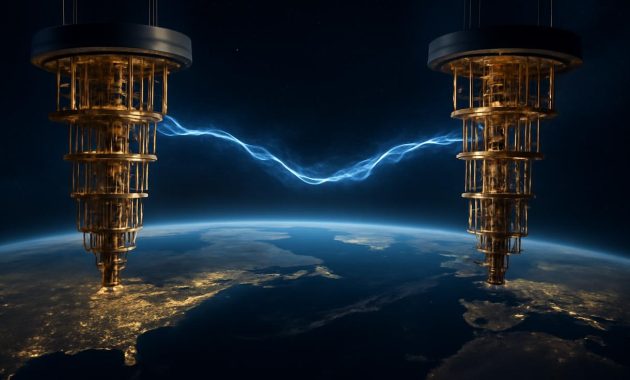
The night the message arrived, the air over Vienna was clear and sharp, the kind of cold that makes every sound feel etched in glass. In a quiet laboratory, a handful of scientists watched their screens, barely breathing. On another continent, thousands of kilometers away, a second team did the same. Somewhere between them, nothing visible moved—no cables, no beams of light bright enough to see with the naked eye. And yet, in a way that still feels more like myth than mechanism, a connection flickered into existence. A quantum link, stretched not across a bench or a building, but across continents.
This wasn’t science fiction, or a staged demo for a sci‑fi movie. It was the latest in a series of experiments showing that quantum particles—tiny packets of reality that do not behave the way our intuition says they should—can become linked so deeply that what happens to one seems to echo in the other, even when they’re separated by half the planet.
Most of us grew up with a simple map of how the world works: things move through space, signals travel from A to B, and nothing outruns light. So there’s something strikingly unsettling, and eerily beautiful, about the idea that two particles can share a single story, no matter how far apart they are. For a long time, this was a philosophical curiosity, an argument played out in chalk equations and late‑night debates. Now it’s edging into the practical world of undersea cables and fiber networks, of satellites and ground stations. The planet is, slowly and experimentally, being wired with quantum connections—not of copper or glass, but of probability itself.
When Einstein Called It “Spooky Action”
To understand why this new achievement matters, you have to roll back nearly a century, to a time when the quantum world was still young and badly behaved. In the 1930s, physicists were increasingly confident that the mathematics of quantum mechanics worked—they could predict what atoms would do with astonishing precision. But buried inside those equations was something that bothered Albert Einstein deeply.
According to quantum theory, two particles can become entangled, a word that sounds more poetic than technical, but fits perfectly. Once entangled, they behave like two halves of the same coin flip: measure one, and you instantly know the outcome of the other. The trouble is, that “instantly” seems to ignore distance. Separate the particles by a laboratory table, a city, an ocean—it makes no difference. Their outcomes are woven together.
Einstein, who preferred his universe neat, continuous, and local, didn’t buy it. He called it spooky action at a distance and suspected the theory was incomplete. There must be hidden instructions inside the particles, he argued—some underlying script that both particles carried with them from the start. Only later did experiments show that, no, there are no hidden scripts that preserve our commonsense idea of locality. Nature really does allow these strange, nonlocal links.
If that sounds philosophical and remote, consider this: those very “spooky” connections are now being stitched into the infrastructure of tomorrow’s internet. What once bothered Einstein is becoming the foundation of quantum communication across continents.
From Tabletop Tricks to Planet‑Scale Links
For decades, entanglement lived on tiny stages—vacuum chambers on lab benches, crystals cooled to near absolute zero, photons flung down short stretches of fiber. Getting quantum states to survive the messy, noisy real world is like trying to carry a soap bubble through a sandstorm. Any interaction with the environment—heat, vibration, stray light—can destroy the delicate quantum correlations in a process called decoherence.
Yet step by step, experiment by experiment, distances grew. First meters, then kilometers. Photons were entangled and sent through optical fibers that threaded under city streets. Satellites traded entangled particles with ground stations separated by hundreds, then thousands of kilometers. Each success was like bungee‑cording a soap bubble to a jet and watching it survive takeoff.
Now, scientists are beginning to demonstrate something more audacious: quantum connections that don’t just leap across cities or single ocean crossings, but span real continental scales, stitching together far‑flung laboratories in Europe, Asia, and beyond. This is not just about sending a few exotic photons from one point to another. It’s about testing whether robust, repeatable, secure quantum links can form the backbone of a new kind of global network.
Imagine a future map of the world in which, beneath the familiar web of sea cables and satellite footprints, a second, ghostly network glows: quantum channels, where entangled particles flow between nodes in Beijing and Vienna, between Toronto and Tokyo, between desert telescopes and polar research stations. That map is still mostly hypothetical—but not for much longer.
What It Feels Like to Watch Entanglement Cross an Ocean
Picture standing in a ground station on a clear, dry night. Above you, a small satellite sweeps in its orbit, a silent bright fleck against the velvet sky. Inside the satellite, a device smaller than a shoebox is performing an almost ritual act: creating pairs of entangled photons. One photon is sent down toward your station, like a messenger falling at the speed of light. Its partner is beamed to another station far away, on another continent under a different sky, where someone else is waiting in the glow of computer screens and indicator lights.
Neither you nor your distant counterpart can predict what measurement outcome you’ll record when you examine your photon. Each photon, on its own, looks like random noise. But later, when you compare notes—carefully, statistically—you find a pattern that defies classical explanation. Your random outcomes are correlated with theirs in exactly the way quantum theory predicts and local realism forbids. Across oceans and political borders, the universe has whispered in perfect unison.
What’s new today is not only that this whisper has been heard at intercontinental distances, but that the process is becoming controlled, repeatable, and increasingly efficient. Scientists are no longer content with one‑off demonstrations. They are testing protocols, pushing rates higher, refining how photons are generated, routed, and detected, exploring how to hook these fragile links into existing fiber networks on the ground.
Inside these labs and control rooms, the atmosphere is oddly mixed: calm rows of instruments and cabinets beside tense bursts of human energy. A researcher tweaks an alignment mirror by a fraction of a millimeter, breathes out, and waits for counts to rise on a screen. Another runs verification algorithms to confirm that what they’re seeing is genuine entanglement, not some classical imposter sneaking in through noise. The success doesn’t look like a glowing beam or a science‑fiction portal. It looks like numbers—levels and peaks and statistical violations of Bell inequalities that tell a quiet but profound story.
The Numbers Behind the Wonder
To help ground this in something more concrete, here is a compact comparison of how far quantum communication experiments have come, and where they’re heading:
| Milestone | Approx. Distance | Medium | Key Challenge |
|---|---|---|---|
| Early lab entanglement | Centimeters–meters | Free space in lab | Basic control, stability |
| City‑scale fiber tests | 10–100 km | Urban fiber networks | Signal loss in fiber |
| Ground‑to‑satellite links | 500–2,000 km | Atmosphere + space | Turbulence, pointing accuracy |
| Intercontinental experiments | 3,000–10,000+ km | Satellite + global fiber | Synchronization, scaling networks |
| Future quantum internet | Global | Integrated satellite + terrestrial nodes | Quantum repeaters, error correction |
Every new rung on this ladder demands a fresh round of innovations: brighter entangled photon sources, more sensitive detectors, rugged systems that can survive the thermal tantrums of space and the rumbling chaos of real‑world infrastructure. When you hear that “scientists just unlocked quantum connections across continents,” you’re hearing a compressed story of thousands of incremental steps, each one a small war against fragility.
The Subtle Art of Talking Without Eavesdroppers
One of the most tangible reasons to chase entanglement across continents is security. In our classical world, secure communication is based on complicated math problems—factor this enormous number, or guess this key, and you can break the code. As computers grow faster, and as quantum computers inch closer to reality, those math‑based locks begin to look more like sandcastles facing a slow, rising tide.
Quantum communication offers something different: security rooted not in mathematics, but in the laws of physics themselves. In a typical quantum key distribution (QKD) scheme, two parties—often nicknamed Alice and Bob—use quantum states to generate a shared, secret random key. If anyone tries to intercept the quantum states in flight, their meddling leaves fingerprints, disturbing the fragile quantum correlations and announcing their presence.
Entanglement supercharges this idea. Instead of sending a predefined sequence of bits, Alice and Bob can each receive halves of entangled pairs and perform measurements. Their results, when compared and filtered, yield shared random keys. An eavesdropper cannot copy or intercept these entangled states without breaking the correlations in ways that Alice and Bob can detect. There’s no such thing as a silent wiretap in properly implemented quantum communication.
Until recently, this promise lived mostly on modest scales: short links between buildings or within metropolitan areas. The leap to continental distances hints at a future in which governments, research institutions, and perhaps even commercial networks could rely on quantum keys shared across the globe. Imagine a secure diplomatic channel whose secrecy is guaranteed not by human agreements or corporate certificates, but by the universe’s refusal to let anyone peek at entanglement unpunished.
Of course, classical signals still matter. The actual messages—your emails, images, documents—would likely still travel over traditional networks, encrypted with keys created or refreshed via quantum links. Think of quantum connections as ultra‑secure lock‑forging workshops hovering in the background, constantly producing fresh, unguessable keys that no spy, however well funded, can steal undetected.
The Invisible Threads and Their Very Visible Obstacles
For all its poetry, quantum communication is brutally practical behind the scenes. You can’t simply declare that entangled photons will cross continents and expect the universe to cooperate. Loss is the arch‑nemesis: photons get absorbed in fiber, scattered in the atmosphere, and lost in imperfect mirrors and lenses. Detectors miss some that do arrive. Time adds another layer of difficulty: you have to synchronize distant receivers precisely, so that the signals you think are paired, truly are.
Classical networks face loss too, but they have a simple response: amplification. Boost the signal. Repeat it along the way. Quantum mechanics doesn’t allow that shortcut. You can’t copy an unknown quantum state perfectly; it’s forbidden by the no‑cloning theorem. Try to “amplify” in a naïve way and you end up destroying the very quantum features you were trying to preserve.
This is where the idea of quantum repeaters comes in—devices that don’t clone signals, but instead use chains of entanglement and a process called entanglement swapping to effectively extend quantum links over long distances. Experimental repeaters are still in their infancy, akin to the early vacuum‑tube relays of the telegraph era. But in the labs exploring continent‑spanning links, repeaters and their cousins—quantum memories that can store entangled states for brief moments—are central characters.
Then there’s the human challenge: building international collaborations that share data, trust results, and coordinate schedules across time zones. Experiments that test entanglement over continents often involve teams speaking different languages, working under different funding systems, and contending with very different weather. A cloudy night in one country can delay a satellite pass that perfectly aligns with clear skies in another. Politics and export controls add yet another layer of complexity.
And still, progress ticks forward. Every new record distance, every newly closed experimental loophole, every demonstration that quantum protocols remain robust outside the sheltered environment of a single university campus, feeds into a growing confidence: this can scale. It will not be easy, but neither was building the first undersea telegraph cable, or the global GPS network, or the internet itself.
What a Quantum‑Connected World Might Feel Like
It’s one thing to know, abstractly, that entanglement exists across continents. It’s another to imagine how it might seep into ordinary life. You won’t wake up one morning to a buzzing notification that says “Quantum internet installed.” The transition will be gradual, layered, invisible to most of us. Yet behind the scenes, reality itself would be carrying part of our conversations, our agreements, our financial systems in a new way.
In a quantum‑connected world, sensitive transactions between banks or research institutions might rely on keys distributed by entangled photons sent via satellites arcing overhead. Voting systems could, in principle, be secured by quantum protocols that guarantee both privacy and verifiability to a degree we can’t match today. Cloud computing providers might use quantum links to coordinate distributed quantum computers—machines that themselves exploit entanglement internally to perform calculations beyond classical reach.
There’s also a subtler shift in how we relate to our technology. The current internet runs on principles that, at their core, are classical and intuitive: voltages, pulses of light, error‑correcting codes. The quantum internet, in contrast, would be built from irreducible strangeness: superpositions that are neither here nor there, entanglements that reveal correlations only when compared across distance. We’d be, in some sense, embedding the weirdness of the microscopic world directly into our macroscopic social fabric.
For many people, that weirdness can feel alienating, like a private language spoken only by physicists. But there’s another way to see it. The same universe that grows trees and tides, that lets birds navigate by starlight and humans feel awe at a sunset, also allows separated particles to act like two verses of the same poem. When we harness entanglement, we’re not importing magic from somewhere else. We’re learning to listen to a different register of the same cosmic song.
FAQ: Quantum Connections Across Continents
What does it really mean that quantum connections reach across continents?
It means scientists have created and verified entanglement, or used quantum communication protocols, between locations separated by thousands of kilometers—often using a combination of satellites and ground‑based fiber networks. The quantum correlations observed cannot be explained by classical signals traveling between the sites at or below the speed of light.
Does this allow faster‑than‑light communication?
No. Even though entangled particles show correlations instantly, they can’t be used to send usable information faster than light. To turn those correlations into a meaningful message, you still need classical communication channels, which are limited by the speed of light.
Is this the same as quantum teleportation?
Related, but not identical. Quantum teleportation is a protocol where the state of a quantum system is transferred from one place to another using entanglement plus classical communication. Many long‑distance experiments do use teleportation as a building block, but “quantum connections across continents” also includes other methods like quantum key distribution.
Will ordinary people ever directly use a quantum internet?
Most likely you’ll benefit from it without noticing. Your data might be secured with keys distributed through quantum channels, or services you rely on might coordinate via quantum networks behind the scenes. The user experience may not look dramatically different; the main changes will be in security, reliability, and the kinds of computations possible in the background.
How soon could a global quantum network become reality?
Pieces of it already exist in the form of experimental testbeds, regional quantum networks, and satellite links. A fully functional, large‑scale quantum internet is still years to decades away, depending on advances in hardware like quantum repeaters, quantum memories, and low‑loss infrastructure. But each new intercontinental demonstration pushes that vision closer to everyday reality.