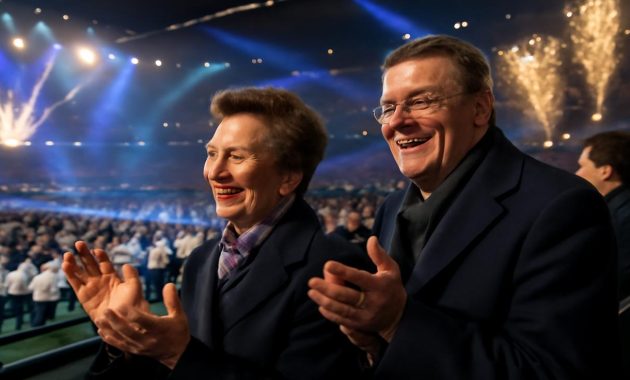
The first sound is not the roar of the crowd, but a low, rolling murmur—hundreds of conversations layered over the thud of drums and the distant crackle of fireworks tests. High above the legendary curves of San Siro Stadium, the sky over Milan is the deep, velvety blue that only winter nights seem to own. Breath ghosts in the cold, floodlights slice through the darkness, and somewhere beneath the hum of anticipation, the athletes of Team GB are fastening zips, tightening laces, and steadying their hands on small flags. In a quiet corner behind the scenes, Princess Anne and her husband, Vice Admiral Sir Tim Laurence, are preparing too—not for competition, but for something just as human: the simple, steady work of showing up.
A Royal Arrival in a City of Winter Light
They slip into the stadium with the understated efficiency that defines modern royal engagements—no fanfare, no trumpets, just a ripple of attention that follows them like the wake of a boat. Princess Anne is in a dark wool coat, practical and sharp, the sort of garment that suggests she is prepared to stand in the cold as long as needed. Sir Tim moves beside her with that quietly nautical bearing, shoulders squared, eyes taking everything in rather than searching for cameras.
The San Siro, more often a cathedral of football, has been reimagined for winter. Giant LED panels flicker with snowstorms and ice-blue graphics; speakers test the opening beats of anthems; in the stands, flags are already unfurling like bright, restless wings. British supporters, scattered among Italian, Canadian, Norwegian, and Japanese fans, are easy to spot—Union Jacks wrapped around shoulders, knitted hats in red, white, and blue, cheeks painted with quick, hopeful stripes.
Princess Anne pauses as she emerges into the open bowl of the arena. For a moment, the scene holds: her face turned upward to the tiers of seats, the arch of the sky beyond, the intricate ballet of volunteers and technicians building the final pieces of the ceremony. It’s not reverence so much as recognition. She has been here before—if not in this exact stadium, then in this precise kind of moment, on the lip between preparation and history.
The Princess Who Speaks the Language of Sport
For the athletes of Great Britain, there is something uniquely grounding about her presence. Princess Anne isn’t simply a royal in an honorary jacket; she is, in many ways, one of them. She rode at the 1976 Montreal Olympics in equestrian eventing, long before royal Instagram feeds and slick digital campaigns. Her sporting career unfolded in mud, sweat, and the delicate understanding between rider and horse. She knows what it means to hear a national anthem from the inside of an arena, pulse racing, mouth dry, mind bargaining with nerves.
Back in the Team GB holding area, a shared lounge just off the corridor that will funnel them toward the stadium floor, the air is a cocktail of anticipation and adrenaline. Parkas brushed past bobsleigh helmets; speed skates glint in overhead light; snowboards lean in clusters like resting animals. British athletes in their Milano Cortina 2026 uniforms—deep navy broken by flashes of bold colour—begin to notice the movement at the doorway.
Princess Anne steps into the room with no script in her hands. She doesn’t need one. This is familiar terrain: the anxious jokes, the careful stretching, the performers’ shuffle between “I’ve waited years for this” and “let’s just get this bit over with.” Sir Tim is beside her, hands clasped lightly behind his back, his presence less formal than it might appear. There is warmth in his expression, an I-know-you’re-nervous-but-you’ve-got-this ease that athletes pick up as quickly as they would a change in wind direction.
They move through the space unhurriedly. She asks about training conditions in the Alps, whether the snowpack held up on the downhill course. She wants to know how the ice is in Cortina, if the short-track turns feel honest or treacherous. To a young skeleton slider, she leans in and murmurs something that makes them laugh—a quick, crackling release of tension. Sir Tim, a man who spent decades reading the weather at sea, chats with a curling skip about strategy like they’re sketching plays on the back of an envelope.
Quiet Moments Before the Roar
What rarely translates through broadcast cameras is how small the world of an athlete feels right before a ceremony. Yes, the stadium is enormous, the crowds deafening, the broadcast global—but their reality, in this moment, is narrow. It’s the feel of the accreditation lanyard against the collarbone. The pinch of a new shoe. The weight of a flagpole in a teammate’s hand. The knowledge that family is watching from thousands of miles away.
Princess Anne understands that scale of feeling. She doesn’t try to inflate it with big, sweeping speeches. Instead, she offers something more intimate: perspective. “The ceremony will fly by,” she says to one cluster of athletes, voice even, eyes bright. “Try to remember the sound of it. The faces. You only get this walk once each Games.” Coming from anyone else, the words might sound like a line; from her, they land as lived experience.
Sir Tim, for his part, works the edges of the room, asking the sorts of practical questions that suggest both curiosity and respect. How early do you have to start on the mountain to catch perfect snow? How do you keep focus when your event is a week into the Games? It is a small, subtle validation: your craft is serious, and I recognise it as such.
San Siro Transformed: A Stage for Stories
Outside, San Siro has become a kaleidoscope. The stadium’s famed red girders are lit in icy white, as if glazed in frost. From the highest rafters, drones rise into the night, testing positions for the luminous choreography that will soon etch shapes in the sky—snowflakes, perhaps, or the five circles everyone has come to see.
When the announcement hums through the athletes’ area—It’s time—a collective breath is drawn. The British contingent forms into lines, the flag bearer chosen weeks ago now gripping their pole as though it were a lifeline and a torch at once. The music from inside the stadium deepens, bass notes vibrating faintly underfoot.
Princess Anne and Sir Tim step out onto their own path, guided toward the dignitaries’ box. The route takes them through a short tunnel, where the sounds from the arena are compressed and amplified at the same time—a distant roar and a close echo. She has walked corridors like this before, in cities that have become shorthand for entire eras of sport: Montreal, London, Sochi, Rio, Beijing. But tonight it is Milan, and the air smells faintly of cold metal, fireworks primer, and the wool and nylon of thousands of winter coats.
Up in the stands, British fans tighten their grips on flags as the couple takes their seats. Television cameras sweep past, capturing a brief, composed image—Princess Anne, expression attentive; Sir Tim, posture straight, hands resting on his knees. The simplicity of the picture belies the many threads of meaning woven into their presence: tradition, continuity, and the clear message that the efforts of these athletes matter enough to merit the journey, the schedule, the winter night.
Team GB Steps into the Light
When Great Britain is called, the stadium’s sound rises like a breaking wave. Union Jacks burst into motion around the stands, and somewhere in the rafters, a lone voice starts a chant that catches, then fades, then catches again. The athletes pour out from the tunnel—first in a small trickle, then a confident stream—jackets zipped, eyes wide, phones half-lifted to grab shaky, imperfect, once-in-a-lifetime videos.
From the dignitaries’ box, the view is a moving tapestry of colour and nerves and pride. Princess Anne leans forward slightly, hands together, gaze fixed on the athletes below. She finds faces she recognises from past Games, from training camps, from quiet Award ceremonies and debrief meetings back in the UK. A freestyle skier flashes a grin and looks up into the lights. A veteran curler, beard speckled with frost from the night air, raises his arm to acknowledge a bank of red-white-blue flags.
Sir Tim claps, not in the polite, metered way of ceremonial obligation, but in the genuine rhythm of someone willing the team onward. There is a small exchange—just a few words—between the couple as the athletes pass, something about the size of the squad, or perhaps the new names added since the last Winter Games. They are visibly invested, not just in the abstraction of “Team GB” but in these individuals, each carrying a private universe of sacrifice and early mornings and almost-quit-but-didn’t decisions.
| Moment | What Princess Anne & Sir Tim Are Doing | Impact on Team GB Athletes |
|---|---|---|
| Pre-ceremony lounge visit | Chatting informally, asking about training, conditions, and events | Eases nerves, makes athletes feel seen beyond statistics and medals |
| Tunnel call to line up | Offering quiet, focused encouragement before they step out | Adds a sense of calm and continuity amid the rising adrenaline |
| Entry into San Siro | Watching intently from the stands, applauding their arrival | Reinforces national support at the exact moment they meet the world’s gaze |
| During national anthem | Standing respectfully, fully present in the ceremony | Connects the athletes’ effort to a deeper sense of heritage and identity |
| Post-ceremony mingling | Reflecting on the evening, speaking with officials and coaches | Helps secure long-term support, resources, and understanding at decision-making levels |
A Conversation Between Eras
The ceremony unfolds with the carefully orchestrated wonder that modern Olympics demand. Dancers in iridescent costumes skate across a synthetic “ice” stage; a giant projection of the Dolomites wraps the field in peaks and valleys; the air occasionally blooms with cold-fire pyrotechnics that spill light but little heat. National delegations wash across the arena like tides of colour—Norway in deep red, Japan in crisp white, Italy itself arriving to a roar that seems to shake the old concrete bones of San Siro.
Through it all, Princess Anne and Sir Tim remain locked in that measured attention that comes from years of public life, but there are flashes of private reaction too. A particularly daring aerial performance draws a murmured comment. A segment honouring past Winter Olympians prompts a visible stillness from the Princess, as archival footage flickers across the stadium screens—grainy images of athletes competing in black-and-white blizzards, the early days of a movement she has watched evolve from within.
In some ways, she is a bridge between these eras: from the analog, hand-timed, newspaper-headline Olympics of the 1970s to the high-definition, globally streamed spectacle that Milano Cortina 2026 represents. Around her, smartphone screens glitter like a second constellation as spectators record their favourite moments. Down on the field, some athletes do the same, arms outstretched, capturing proof that yes, we were really here.
Support that Lingers Beyond the Spotlight
What endures after the final fireworks fall as ash, however, is rarely the perfect video clip. It’s the smaller, quieter things: the way an athlete remembers a brief conversation about icy crosswinds. The feeling of scanning the stands and seeing a familiar, resolute profile among the dignitaries. The knowledge that when results are tallied and post-Games reviews begin, someone in the room will have a vivid memory of what it felt like to stand in that stadium, with expectation pressing in from all sides.
When the flame is finally lit and the cauldron blooms in a white-gold halo above the stands, the sound is less roar than rumble—a global exhale released in one shared moment. Athletes tilt their faces towards the warmth; spectators raise phones and flags; commentators across a hundred nations search for words as old as the movement itself. “The Games have begun,” someone will say, as if the world hadn’t felt them building for years already.
Princess Anne and Sir Tim join in the standing ovation, hands coming together in unison with tens of thousands of others. It is not their names that will appear on leaderboards in the days ahead, but their presence threads through the experience all the same. For Team GB, the memory of this night will be braided with their silhouettes in the stands, their footsteps in the corridor, their voices anchoring the chaos with something steady, almost nautical in its reliability.
After the Lights: The Long Echo of a Single Night
When the ceremony finally breaks, the stadium begins its slow, intricate transformation back into a structure of exits and transport routes. Confetti clings to scarves. Voices are hoarse from cheering and singing. The cold works its way methodically back into gloves and boots as the artificial warmth of fireworks and stage lights fades.
Team GB’s athletes are shepherded back through tunnels and onto buses that will slide through the city toward villages tucked deeper into the winter landscape. Some are buoyant, energised, talking fast; others are quiet, pulling their experiences inward like a cloak, processing in private. Almost all of them, though, carry a flicker of something less tangible than excitement: a feeling of being backed, of belonging to a story that is both fiercely present and centuries long.
In another part of the stadium, Princess Anne and Sir Tim move toward their own exit. There will be meetings, debriefs, early starts, venue visits. They will see some of these athletes again—on the edge of an alpine course, by the rink where blades carve patterns into mirror-hard ice, in the hush of a curling arena where stones glide like slow, deliberate comets. Their support is not confined to the bright blaze of opening night; it stretches across the full topography of the Games, from first heats to final medals.
Yet, for many of the athletes, when they look back in years to come, it is this night at San Siro that will rise up first in memory: the unsteady rhythm of their footsteps on the stadium floor, the sudden, engulfing noise, the feeling of flags brushing their shoulders, and, high above the field, the calm, watchful figures of a Princess and a Vice Admiral who chose to stand in the cold with them as their stories began.
Frequently Asked Questions
Why is Princess Anne involved with Team GB at the Winter Olympics?
Princess Anne has a long-standing relationship with the Olympic Movement. She is a former Olympian herself, having competed in equestrian eventing at the Montreal 1976 Games, and she has served in key roles within the British Olympic Association and the International Olympic Committee. Her presence with Team GB reflects both her official positions and her genuine personal commitment to sport.
What role does Sir Tim Laurence play during the Games?
Sir Tim Laurence does not hold a formal sporting title, but he frequently accompanies Princess Anne on Olympic visits. His role is one of quiet, steady support—engaging with athletes, coaches, and officials, and helping represent the broader backing of the Royal Family and the United Kingdom for Team GB.
How does the presence of royal supporters affect the athletes?
Athletes often describe royal visits as a source of motivation and validation. Having senior figures make the journey to attend ceremonies and events signals that their years of training matter on a national level. It can ease nerves, boost morale, and create a sense of continuity with past generations of British Olympians.
Do Princess Anne and Sir Tim interact directly with the athletes?
Yes. Before and after events, they typically spend time in athlete lounges and team areas, speaking one-on-one or in small groups. These conversations are usually informal—asking about training conditions, upcoming events, or personal experiences of the Games—creating a human connection beneath the formality of the occasion.
Why is the opening ceremony at San Siro Stadium so significant?
San Siro is one of Europe’s most storied stadiums, usually associated with football. Transforming it into the stage for the Milano Cortina 2026 Winter Olympics opening ceremony carries symbolic weight: it represents Italy’s blending of sporting traditions, the meeting of past and present, and the moment when athletes from around the world step together into the shared spotlight of the Games.