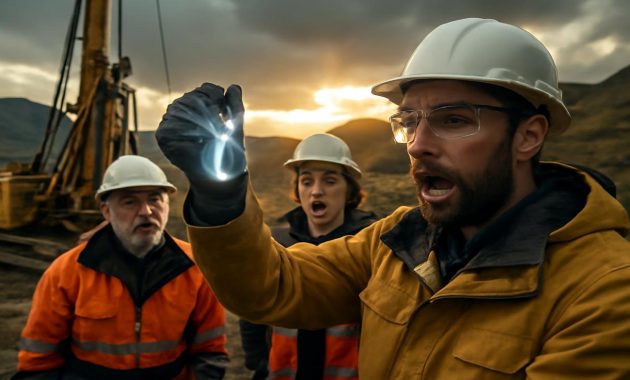
On a gray morning in eastern France, a small team of geologists stood in a muddy field, listening to a faint hum from deep below the soil. There was nothing remarkable to see—no mountains, no roaring rivers, no steaming vents—just a gently rolling landscape, the kind that tucks itself discreetly into the countryside and hopes no one makes a fuss. Yet, beneath those quiet fields, the earth was holding a secret that could redraw the map of energy on this planet.
It began with a simple question: what exactly was hiding in the bedrock below the old mining town of Folschviller, in the Lorraine region? Local scientists suspected they might find traces of gas, maybe a lingering ghost of the coal era, but what they discovered instead felt like something out of speculative fiction—a vast, naturally occurring reserve of hydrogen, the elusive “white hydrogen” that many in the energy world had long hoped for but few truly expected to find in such abundance.
Some early estimates now whisper a staggering number: potentially millions of tonnes of this invisible, odorless gas. People are calling it “the world’s largest deposit.” In a world scrambling to decarbonize, that phrase carries a weight that’s almost dizzying.
The Mist That Wasn’t: A Strange Reading Underground
The story of France’s white hydrogen discovery doesn’t start with fanfare; it starts with puzzling data. A research team investigating methane in old coal seams noticed something strange: exceptionally high levels of hydrogen in the gas mix. At first, it was easy to shrug it off—instrument error, contamination, some lab mishap. Hydrogen is notoriously elusive, after all, forever escaping, leaking, disappearing into the air.
But the hydrogen reading refused to go away. Each new test nudged skepticism into curiosity, and curiosity into a kind of quiet excitement. Drill cores from deep underground showed not just hints, but signatures of an active natural process: the Earth itself, slowly and constantly making hydrogen, molecule by molecule, in the dark pressure-cooker of rock and water below Lorraine.
What they were seeing wasn’t a trapped fossil resource laid down millions of years ago and now sitting there, finite and doomed to depletion. This was something closer to a living system—hydrogen being generated as ultrabasic rocks reacted with water, as iron minerals oxidized and split H2 from the bonds that once held it. In other words, not just a reservoir. A factory.
For decades, the idea of naturally occurring, commercially viable hydrogen deposits was treated almost like a scientific curiosity. Yes, there were springs in Mali that seemed to vent hydrogen. Yes, Soviet-era logs hinted at inexplicable gas shows that didn’t quite match methane’s signature. But these were anecdotes on the margins. This French field, in contrast, arrived with modern instruments, calibrated models, and a growing pile of data pointing in one direction: there was a lot more hydrogen down there than anyone had guessed.
The Color No One Can See: What Makes “White Hydrogen” Different?
To understand why this matters, it helps to step into the strange rainbow of hydrogen “colors” that energy analysts love to use:
- Gray hydrogen – made from natural gas, emitting CO2 into the atmosphere;
- Blue hydrogen – also from fossil fuels, but with carbon capture attached;
- Green hydrogen – produced by splitting water with renewable electricity.
And then there is white hydrogen, sometimes called natural hydrogen: hydrogen that the Earth itself generates and stores underground, without human intervention, without smokestacks, and without the energy-hungry electrolysers that define green hydrogen projects today.
Think of it as hydrogen that pre-exists your need for it. You don’t have to use precious renewable electricity to create it. You just have to find it, drill it, and bring it up safely. That doesn’t make it automatically perfect—nothing in energy is—but it makes it radically different from most hydrogen currently on the market.
In the Lorraine field, preliminary models suggest that natural processes could be producing thousands of tonnes of hydrogen each year. That implies something game-changing: a resource that might be, on human timescales, renewing itself. If proven and managed carefully, this begins to resemble a geothermal-like system—an energy source that isn’t just a reservoir to be drained, but a flow to be tapped.
Hydrogen’s Unseen Landscape
Hydrogen is a ghostly presence in the subsurface. Unlike oil, it doesn’t leave dark stains on rocks or form thick, viscous pools. Unlike gas fields rich in methane, hydrogen can be more diffuse, more reactive, quicker to disappear through leaks. It’s the Houdini of the periodic table. Which is why, for so long, geologists looked for hydrocarbons and mostly overlooked hydrogen—even when it was right there, in their datasets.
Now, that old habit is shifting. The French discovery is part of a quiet awakening in geoscience: a reassessment of old wells, forgotten logs, unexplained gas shows. Around the world, teams are opening dusty archives and reinterpreting them with one new question in mind: What if we were staring at white hydrogen for decades and never really understood what we were seeing?
France’s Quiet Giant: How Big Could This Really Be?
The Lorraine deposit is still in the cautious, methodical phase of evaluation. No one is ready to chisel definitive numbers in stone, and the word “potential” gets used a lot. Still, even conservative voices are starting to acknowledge the scale. Several early estimates suggest that the field could hold millions of tonnes of hydrogen, accumulated over deep time.
To put that into perspective, here is a simple comparison that fits in the palm of a phone screen:
| Item | Approximate Scale |
|---|---|
| Potential hydrogen in Lorraine (early estimates) | Up to several million tonnes |
| Annual hydrogen production in the EU (current, all colors) | Around 8–10 million tonnes |
| Hydrogen required to fuel 1 million fuel-cell cars for a year | Roughly 50,000–70,000 tonnes |
Even if only part of the projected resource proves extractable, that’s enough hydrogen to power transport fleets, feed industrial processes, or anchor a new regional energy economy for years to come.
Numbers aside, the shock of the discovery lies in its location. France is not a country people usually group with the classic hydrocarbon giants. It’s better known for nuclear power, robust climate rhetoric, and careful hedging in energy policy. Yet now, in a former coal basin that once fueled furnaces and steelworks, a new energy chapter is threatening to write itself.
From Black Dust to Invisible Gas
Lorraine has a long memory of extraction. Coal shaped its towns, blackened its walls, hardened and broke its bodies. When the mines closed, they left behind unemployment, hollowed-out economies, and a kind of quiet ache. Entire generations learned to reorient their lives around something other than the shift whistle and the conveyor belt.
To return now, not for coal, but for a gas that burns without smoke and, at the point of use, without CO2, is more than a technological twist. It is symbolic. Energy transitions are rarely gentle; they are strewn with ghosts of past industries. Yet here is a site where the transition might be layered directly on top of its own history—old shafts, new wells; old scars, new skills.
The Science Beneath Our Feet: How Does the Earth Make Hydrogen?
If you could travel down through Lorraine’s subsurface like a diver descends through water, you’d pass through strata that remember ancient oceans, tectonic collisions, and long-vanished forests. Somewhere far below, amid iron-rich rocks and trapped pockets of water, a quiet alchemy is unfolding.
One of the primary processes suspected here is serpentinization: when certain minerals in ultrabasic rocks react with water, they rust—very roughly speaking—freeing up hydrogen as a byproduct. It’s a slow-motion reaction, powered by the planet’s own heat, pressure, and chemistry, and it can keep producing hydrogen for as long as those ingredients remain in play.
Other mechanisms might be contributing too: radiolysis (where natural radioactivity splits water molecules), or the decomposition of hydrogen-bearing minerals. What matters for energy planners is less the precise reaction list and more the emergent pattern: there are places on Earth where hydrogen seems to be flowing like a hidden underground river.
Exploration, Not Extraction—At Least For Now
Geologists and engineers in France are now in the delicate phase of piecing together this hidden system. They are reprocessing seismic data, running new models, and drilling test wells that must balance curiosity with caution. The key questions read like a checklist for a new frontier:
- How fast is hydrogen actually being generated?
- How well is it trapped—are there good seals, or does it tend to leak upward over time?
- Can wells tap this gas without causing subsidence, contamination, or other ecological damage?
- How stable is production likely to be over decades, not just years?
Every answer will shape the future of policy. If natural hydrogen behaves like a giant, slow-recharging battery beneath our feet, then entirely new forms of resource management will have to emerge—part geology, part hydrology, part ethics.
Promise and Peril: Can White Hydrogen Really Be “Clean”?
In the rush of excitement, it’s tempting to treat white hydrogen as a silver bullet—an energy resource dropped into our laps, clean and abundant, like a last-minute twist in a climate thriller. But any time humans tap the subsurface, reality arrives with a list of caveats.
Hydrogen itself doesn’t emit CO2 when burned or used in fuel cells, but the infrastructure used to produce, transport, and store it can have significant environmental footprints. Drilling can disturb ecosystems, risk groundwater, and trigger local seismic changes—concerns that communities in other extractive regions know all too well.
There’s also a subtle climate issue: hydrogen is indirectly a greenhouse gas. When it leaks into the atmosphere, it interferes with chemical cycles that help break down methane, effectively amplifying warming if leakage is high. So while hydrogen is often labeled “clean,” it’s only as clean as the system that handles it.
Learning from Old Mistakes
The opportunity here is that the world has, painfully, learned from a century of fossil fuel extraction. Communities are more vocal, regulators more watchful, and scientists more attuned to long-term impacts. The challenge is to apply that learning with discipline.
France, like other European countries, has embedded climate targets into law. Any white hydrogen boom will be judged against those commitments. Will tapping this resource accelerate decarbonization, displacing coal and gas in hard-to-abate sectors? Or will it become just another tempting energy source that delays necessary changes in consumption and efficiency?
Done thoughtfully, natural hydrogen could be used to clean up industries that are notoriously difficult to electrify: high-temperature processes in steel, cement, or chemicals, for instance. It could bolster energy security in a continent wary of overreliance on imported gas. But if handled carelessly, it could simply become one more excuse to maintain bloated energy demand.
Ripples Across Europe: A New Energy Story Taking Shape
News of the Lorraine discovery didn’t stay local for long. Energy ministries, research institutes, and investors across Europe quickly took notice. A continent that has spent the last two years navigating gas shortages, price spikes, and geopolitical shocks suddenly had a new wildcard to consider.
Alongside France, countries like Spain, Germany, and the Nordics are now quietly reassessing their own geological records for hints of white hydrogen. There is a dawning recognition that this might not be a French anomaly but the beginning of a wider pattern: that natural hydrogen, once ignored, might be sprinkled across old shields, basins, and fault zones around the world.
Yet even as eyes turn outward, some of the most important questions remain hyper-local. For the communities of Lorraine, this is not just an energy story—it is a story about identity and future. Will hydrogen bring stable, skilled jobs? Will it come with better protections than coal once did? Will it be something they participate in, or something that happens to them?
The Human Face of a Subsurface Boom
Imagine a town hall meeting in a faded mining village: pensioners who once descended into shafts listening to younger engineers talk about sensors, control rooms, and compressed gas pipelines. There’s pride in the possibility that their region could again be central to national energy security; there’s unease too, a memory of promises made and broken in other eras.
Energy transitions rarely look like the smooth curves of policy charts. They look like such rooms: folding chairs, coffee in styrofoam cups, bitter jokes, cautious hope. How France handles this discovery—how it listens, shares benefits, and mitigates risks—will shape not just the geology of extraction, but the social geology of trust.
Between Miracle and Method: Where Does White Hydrogen Leave Us?
Standing in that quiet Lorraine field today, it is tempting to narrate this as a turning point, the moment when the Earth revealed another hidden card in our shared game against climate breakdown. But perhaps it’s more honest to describe it as an invitation: a reminder that we still don’t fully understand the energetic undercurrents of our own planet, and that some solutions may be buried not in technology, but in the crust itself.
White hydrogen won’t replace the need for renewables, for efficiency, for rethinking how much energy we truly need. No single discovery can do that. But it might, if handled wisely, soften some of the hardest edges of decarbonization—helping steelmakers shift away from coal, offering backup to fragile grids, giving old mining regions a new story to tell.
Somewhere a few kilometers below the surface of France, hydrogen is forming right now, silently, out of rocks and water and time. It has been doing so long before we learned to spell the word “energy.” The question now is not whether that process will continue—it will—but whether we can find a way to join it without repeating the excesses that brought us to the brink in the first place.
In the end, the world’s largest deposit may not be measured only in tonnes of gas, but in something harder to quantify: the chance to prove that we can learn from our past extractions, and that the next chapter of energy can be written with more humility, more listening, and a little more wonder for what the Earth has been quietly doing all along.
Frequently Asked Questions
What exactly is “white hydrogen”?
White hydrogen is naturally occurring hydrogen found in the Earth’s crust. Unlike green hydrogen, which is produced using renewable electricity and electrolysers, white hydrogen forms through geological processes such as rock–water reactions and radiolysis, and accumulates in underground reservoirs much like natural gas or oil.
How is white hydrogen different from green or blue hydrogen?
Green hydrogen is made by splitting water using renewable electricity, and blue hydrogen comes from fossil fuels with carbon capture. White hydrogen requires no primary industrial production step—it already exists underground. Its climate footprint depends largely on how it is extracted and transported, rather than how it is created.
Is the French deposit really the largest in the world?
Current estimates suggest the Lorraine deposit may be one of the largest known potential accumulations of natural hydrogen, possibly in the millions of tonnes. However, exploration is ongoing, and the term “largest” is still provisional until more data and comparable global discoveries are fully evaluated.
How soon could this hydrogen be used commercially?
Commercial use depends on confirming the size of the resource, understanding how fast it replenishes, proving safe extraction methods, and building suitable infrastructure. That process can take several years to a decade, especially under strict European environmental and safety regulations.
Is white hydrogen completely clean for the climate?
White hydrogen itself produces no CO2 at the point of use, but its overall climate impact depends on the extraction process, energy used in operations, and leakage rates. Hydrogen can indirectly contribute to warming if large amounts escape into the atmosphere, so minimizing leaks and ensuring responsible project design is crucial.
Could this discovery change Europe’s energy strategy?
It could become an important new pillar in Europe’s energy mix, particularly for decarbonizing heavy industry and long-distance transport. However, policymakers emphasize that it should complement, not replace, aggressive expansion of renewables, electrification, and energy efficiency.
What does this mean for local communities in Lorraine?
For local communities, the discovery could bring new jobs, investment, and a renewed sense of purpose in a region historically tied to coal. At the same time, residents are demanding strong safeguards, transparent decision-making, and a fair share of the benefits to avoid repeating the social and environmental harms of past mining eras.