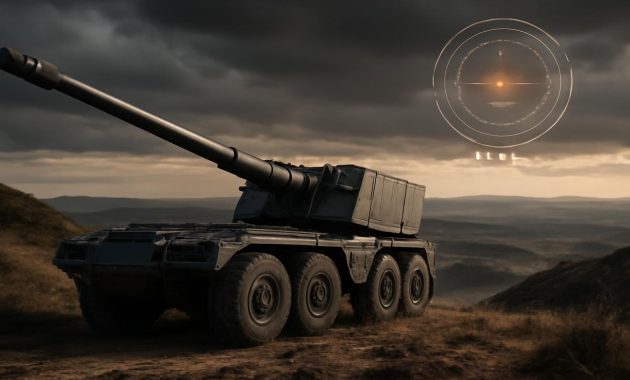
The desert was not silent. It pulsed—heat shimmering in slow waves above the sand, engines growling somewhere beyond the horizon, the metallic clank of tracks grinding over baked earth. Dust hung in the air like a curtain as a dark shape emerged, hulking and angular, moving with a slow, deliberate confidence. To someone watching from a distance, it might have looked like a creature from some other age of war. But this was something very new: China’s latest self-propelled gun, rumored to strike with devastating precision at targets 100 kilometers away—so far, and so fast, that by the time its shell arrives, there’s barely time to even realize it’s coming.
The Day the Horizon Got Closer
Imagine standing on a ridge and knowing that anything you can see—every antenna, every radar dome, every road bend—is within reach of a weapon you cannot see, cannot hear, and cannot stop once it’s fired. That’s the unsettling idea behind the reports whispering out of Chinese testing grounds: a long-range, self-propelled gun system with the kind of reach that used to belong only to missiles.
For decades, artillery was thought of as the roaring backbone of old wars—howitzers pounding trenches, guns hurling shells just over the horizon. But 100 kilometers? That used to sit comfortably in the realm of ballistic missiles and rockets, not gun barrels. A distance like that redraws battlefield geometry. It blurs the line between the “front” and “rear,” and it makes map scales feel almost irrelevant. A radar station, an air defense battery, a logistics hub—once safely tucked tens of kilometers behind the front—can suddenly be touched by steel launched from a vehicle that can fire, move, and vanish.
Somewhere out in the scrublands of western China, observers say, such a vehicle is already making tracks: a self-propelled gun that looks, at first glance, like a tank crossed with a railway cannon—long-barreled, low-slung, and bristling with boxes that almost certainly hide sensors and electronics. It’s not just a gun on a chassis; it’s a message rolling on steel: the horizon is no longer far enough.
The Quiet Evolution of a Loud Weapon
Artillery, by its nature, is not subtle. When it fires, the earth shakes, air rips, and the sound punches through your chest. Yet the way this new Chinese system came into being is the opposite: quiet, methodical, incremental. No grand unveiling with parades and banners—only a drip of satellite photos, blurred field test images, and fragments of state media commentary.
China has spent years modernizing its land forces, replacing old, towed guns with sleek, tracked and wheeled self-propelled systems. Each generation went a little farther, fired a little faster, talked more fluently with drones and radar. But this new system, hinted to be capable of 100-kilometer strikes, marks a new threshold. To achieve that range with a gun, you don’t just add more explosive behind a shell and hope the barrel survives. You redesign everything: the barrel, the breech, the ammunition, the propellant, the guidance, the cooling, the recoil system, even the vehicle’s bones.
It’s not simply brute force. Range at this scale is part engineering, part alchemy. The shell must be aerodynamic enough to ride the thin air at high altitude, tough enough not to shred itself under massive acceleration, and smart enough—through guidance fins or GPS or other secrets—to correct its flight path as it falls back to earth. What you get at the end is not just artillery. It starts to behave like a hybrid: part gun, part rocket, part guided missile, all launched from a single mobile platform.
Inside the Beast: What We Can Guess
China has not revealed a detailed spec sheet, but the silhouette speaks its own language. A long barrel—far longer than traditional 155 mm howitzers—suggests a high muzzle velocity designed to hurl shells much farther than conventional systems. The chassis appears hefty, tracked, and armored enough to survive in hostile terrain but not as thickly plated as a main battle tank; this is a weapon meant to kill at distance, not trade blows face to face.
What we do know from modern trends and glimpses of related Chinese systems is that this self-propelled gun likely lives inside a web of information: drones that scout far beyond the line of sight, radar that tracks enemy positions, satellites that feed coordinates down in near real time. Its crew, tucked deep inside the hull under composite armor, might never see their targets with their own eyes. Instead, they stare at screens—colored icons, grids, and coordinates—then confirm a fire mission. A shudder, a flash, an echo that rolls away over the desert, and somewhere dozens of kilometers away, a radar dish or mobile launcher vanishes in a bloom of fire.
Artillery once depended on spotting scopes and shouted corrections. Now, it is closer to a data service—taking target inputs from invisible partners, returning impact on demand. The new Chinese gun is expected to slot directly into this networked style of combat. It is less an isolated cannon and more a node in a chain of sensors, relays, and decision tools.
| Feature | Modern Standard SPG | China’s New Long-Range Gun (Estimated) |
|---|---|---|
| Maximum Range | 30–40 km (standard), up to ~70 km with advanced rounds | Up to ~100 km with specialized guided shells |
| Mobility | Tracked or wheeled, tactical mobility | Highly mobile tracked chassis for rapid “shoot-and-scoot” |
| Targeting | Digital fire control, some network integration | Deep integration with drones, satellites, and ground sensors |
| Munition Type | Standard HE, smoke, illumination, some guided rounds | Long-range guided shells, possibly rocket-assisted and precision-fused |
| Primary Role | Support frontline units, counter-battery fire | Deep strike, counter-battery, suppression of high-value rear-area targets |
“No Time to Strike Back”: The Psychology of Distance
Military analysts love numbers: meters per second, kilometers of range, minutes of reload time. But behind the statistic—“100 km with no time to strike back”—there’s a psychological dimension that may be even more important than the physics.
At very long ranges, the counter-battery game becomes brutally uneven. Normally, when an artillery piece fires, the enemy can approximate its position using radar that tracks the shell backward, then launch their own return fire. It’s a deadly conversation of steel and math. But when a gun fires from far beyond the typical reach of its opponents, when it’s paired with fast relocation tactics and a surrounding screen of decoys, that conversation can become one-sided.
“No time to strike back” doesn’t literally mean zero seconds. It means this: by the time an enemy detects the incoming shell, calculates its trajectory, and finds the origin point, the Chinese gun may already be rolling away, its crew hunched inside, listening to the faint ping of new coordinates arriving. The counter-battery rounds, if they come at all, may land in an empty patch of dust and old track marks.
That sense of helplessness spreads. For radar crews and logistics officers far behind the frontline, a new fear enters the equation—the idea that they are never truly “in the rear” anymore. You can be 80 kilometers from the hot edge of the battle and still be in the crosshairs. Every radio transmission feels like a risk; every radar pulse may draw the gaze of a glassy sensor half a continent away.
The Desert, the Island, and the City
If you zoom out from that dusty test range, you can begin to see where such a weapon fits in the larger picture. China is a continental power with sweeping deserts and long mountain frontiers, but it is also a maritime power pressing its claims over seas, islands, and archipelagos. A self-propelled gun that can strike at 100 km doesn’t just rewrite land war; it reaches across straits, bays, and islands.
Placed on a coastline, such a system could threaten naval targets approaching within that wide circle of fire—amphibious ships assembling for an assault, radar picket vessels, or temporary logistics points on small islands. On an island itself, it could serve as a long arm that denies enemy forces the comfort of parking just over the horizon.
And then there are cities. Not as targets—that would be catastrophic escalation—but as hubs. Long-range artillery systems tend to live near rail junctions, factories, depots. They depend on efficient supply chains and heavy industry capable of forging barrels, mixing propellants, manufacturing precision shells. In that sense, every strike the gun makes is partly the work of distant steel mills, chemical plants, and coding labs where guidance systems quietly pass their final tests. Modern artillery is not only about the front line; it’s an expression of the state’s entire industrial nervous system.
Where Nature Meets Steel
A modern battlefield isn’t just human and machine; it’s earth, air, and weather as active participants. The rumored Chinese self-propelled gun doesn’t fire into a vacuum. It fires into crosswinds that scrape down from barren mountains, through hot updrafts over farmland, into dense, wet air above coastal plains. To push a shell 100 kilometers, you have to court these forces rather than fight them outright.
Ballistic calculators now swallow wind profiles, humidity, air pressure, temperature gradients. Drones loft tiny sensors to sample the sky. A shot is not just “aim and fire”—it is a negotiation with the invisible layers of the atmosphere. The longer the distance, the more those layers can nudge, twist, and seduce a shell away from its path.
Ironically, this makes long-range artillery something almost poetic: an act of violence that relies on an intimate understanding of the environment. You can almost imagine a crew in that armored hull, lining up a mission, while outside cicadas rasp in the heat, clouds drift lazily, and dust devils scrawl in the distance. Above them, at heights they will never see, thin winds are already waiting, ready to tug on the shell the moment it leaves the barrel.
Escalation in Slow Motion
Weapons like this don’t spark global crises on their own. They don’t cause headlines like a missile test over a disputed sea might. Instead, they quietly tilt the balance. A self-propelled gun that can hit at 100 kilometers nudges neighbors to sharpen their own tools—better counter-battery radars, longer-legged artillery, more drones to hunt hidden guns, more hardened shelters to protect the critical nodes it might target.
Over time, this can feel like watching a slow storm gather. Each side responds, then responds again. Armor grows thicker, sensors grow more sensitive, ranges creep outward. The sky fills with more watchful eyes—satellites, high-altitude balloons, unmanned aircraft—peering down to catch a glimpse of a barrel lengthened just a little more than last year.
If there’s a paradox here, it’s this: weapons that can kill from very far away often coexist with far fewer human encounters on the battlefield. A crew can fight an entire war, in theory, without ever seeing their enemy in person—only icons, dots, flashes on a monitor. Yet the consequences out on the ground, where shells land, remain deeply personal and immediate. Distance numbs the trigger, but not the impact.
Frequently Asked Questions
What is a self-propelled gun?
A self-propelled gun is an artillery weapon mounted on a mobile vehicle, usually tracked or wheeled, so it can move quickly, fire, and relocate without needing to be towed. It combines heavy firepower with mobility and some degree of armor protection.
How far can traditional artillery shoot compared to this new system?
Most modern self-propelled howitzers can fire standard shells to about 30–40 km, and specialized rocket-assisted or guided rounds to perhaps 60–70 km. The Chinese system being discussed is believed to reach around 100 km, which is a significant leap in range for a gun-based system.
How can a gun hit targets 100 km away?
To reach 100 km, the system likely uses a very long barrel, high-pressure propellants, and advanced shells—possibly rocket-assisted and guided during flight. Careful design of aerodynamics, materials, and guidance allows the projectile to travel farther and still hit accurately.
What does “no time to strike back” really mean?
It refers to the difficulty of countering such long-range artillery. By the time the enemy detects incoming fire and calculates where it came from, the self-propelled gun can already be moving to a new location, making counter-battery strikes slow, inaccurate, or useless.
Why is this development important for regional security?
A long-range, mobile system like this can threaten high-value targets far behind the front lines—radars, air defenses, command posts, and logistics hubs. That changes how neighboring states plan defense, forcing investment in better protection, detection, and their own long-range strike options, and potentially intensifying regional arms competition.